MIER1 (mesoderm induction early response 1 homolog (Xenopus laevis))
2011-09-01 Laura L Gillespie , Gary D Paterno AffiliationTerry Fox Cancer Research Labs, Division of Biomedical Sciences, Faculty of Medicine, Memorial University, St Johns, NL, Canada
DNA/RNA
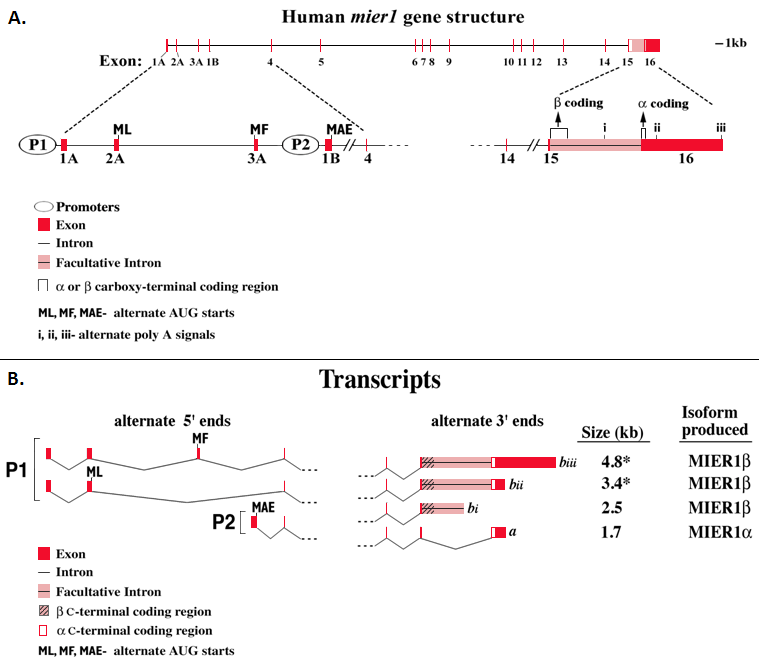
A. Schematic illustrating the exon-intron organization of the human MIER1 gene. Exons are shown as red bars/vertical lines and introns as horizontal lines; exon numbers are indicated below each schematic. The light red bar indicates the facultative intron 16 and the position of the alpha and beta carboxy-terminal coding regions are indicated. Note that the beta coding region is located within the facultative intron. The three alternate starts of translation, ML-, MF- and MAE- are indicated as are the three polyadenylation signals (PAS): i, ii and iii. B. Schematic illustrating the variant 5 and 3 ends of human MIER1 transcripts. Alternate 5 ends are generated from differential promoter usage (P1 or P2) or alternate inclusion of exon 3A. This leads to three alternate starts of translation, indicated as ML-, MF- and MAE-, and produces three distinct amino termini. The four variant 3 ends, a, bi, bii and biii, produced by alternative splicing or alternate PAS usage, result in transcripts readily distinguished by size (1.7 kb, 2.5 kb, 3.4 kb and 4.8 kb, respectively) on a Northern blot. It should be noted that three of the variant 3 ends, bi, bii and biii encode the same protein sequence and differ only in their untranslated region. * indicates beta encoding transcript that contains the alpha exon in its 3UTR. The locations of the alpha and beta carboxy-terminal coding regions and PAS i, ii and iii are indicated. The combination of three possible 5 ends with four possible 3 ends gives rise to 12 distinct transcripts, but only 6 distinct protein isoforms. In most adult tissues, the most abundant transcript is 4.8 kb. Additional transcripts have been reported in Ensembl.
Description
63 kb gene; 2 promoters controlling 2 distinct transcriptional start sites; 17 exons; intron 16 is facultative; 3 polyadenylation sites.
Proteins
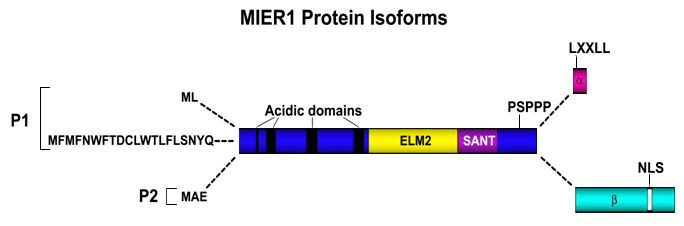
Schematic illustrating the common internal domains of the MIER1 isoforms and the variant amino- (N-) and carboxy- (C-) termini. Transcription from the P1 promoter produces proteins that either begin with M-L- or with the sequence encoded by exon 3A (MFMFNWFTDCLWTLFLSNYQ). Transcription from the P2 promoter produces a protein that begins with M-A-E-. The variant N-termini of the MIER1 isoforms are followed by common internal sequence containing several distinct domains: acidic, which function in transcriptional activation (Paterno et al., 1997); ELM2, responsible for recruitment of HDAC1 (Ding et al., 2003); SANT, which interacts with Sp1 (Ding et al., 2004) and PSPPP, which is required for MIER1 activity in the Xenopus embryo (Teplitsky et al., 2003). The two alternate C-termini, alpha and beta, result from removal or inclusion and read-through of intron 16, respectively. The alpha C-terminus contains a classic LXXLL motif for interaction with nuclear receptors; the beta C-terminus contains a nuclear localization signal (NLS).
Description
The six human MIER1 isoforms: M-3A-alpha (457 aa), M-3A-beta (536 aa), ML-alpha (432 aa), ML-beta (511 aa), MAE-alpha (433 aa), and MAE-beta (512 aa), range in predicted molecular size from 47.5 kDa-59 kDa; however all isoforms migrate slower than predicted on SDS-PAGE, with calculated molecular sizes ranging 78 kDa-90 kDa.
Expression
MIER1beta protein is expressed ubiquitously, while MIER1alpha protein is expressed mainly in a subset of endocrine organs and endocrine responsive tissues, including the pancreatic islets, adrenal glands, testis, ovary, hypothalamus, pituitary, parafollicular cells of the thyroid and mammary ductal epithelium.
Localisation
MIER1beta is nuclear in all adult cell types but is retained in the cytoplasm of the pre-gastrula Xenopus embryo. MIER1alpha is cytoplasmic in most cell types, but localized in the nucleus in normal mammary ductal epithelium. During progression to invasive breast carcinoma, its subcellular localization shifts from nuclear to exclusively cytoplasmic.
Function
MIER1alpha and beta function in transcriptional repression by at least two distinct mechanisms: recruitment and regulation of chromatin modifying enzymes, including HDAC1, HDAC2, CBP and G9a; interaction with transcription factors, such as Sp1 and ERalpha, to repress transcription of their respective target genes. MIER1alpha inhibits estrogen-stimulated anchorage-independent growth of breast carcinoma cells.
Homology
The MIER1 gene family contains two other members, MIER2 and MIER3. The MIER1 gene is conserved in chimpanzee, dog, cow, mouse, rat, chicken, frog, zebrafish, fruit fly, and C. elegans.
Implicated in
Entity name
Breast cancer
Note
Initial studies showed that total MIER1 mRNA levels were increased in breast carcinoma cell lines and tumour samples (Paterno et al., 1998); in a more recent study, no consistent difference in MIER1alpha protein expression levels between normal breast and tumour samples was detected (McCarthy et al., 2008). Immunohistochemical analysis of patient biopsies revealed that MIER1alpha protein is expressed primarily in ductal epithelial cells in normal breast tissue, with little or no expression in the surrounding stroma; in breast carcinoma samples, its expression is restricted to tumour cells. While there is no difference in expression levels, the subcellular localization of MIER1alpha changes dramatically during tumour progression: MIER1alpha is nuclear in 75% of normal breast samples and in 77% of hyperplasia, but in breast carcinoma, only 51% of ductal carcinoma in situ, 25% of invasive lobular carcinoma and 4% of invasive ductal carcinoma contained nuclear MIER1alpha (McCarthy et al., 2008). This shift from nuclear to cytoplasmic localization of MIER1alpha during breast cancer progression suggests that loss of nuclear MIER1alpha contributes to the development of invasive breast carcinoma. MIER1alpha inhibits ERalpha transcriptional activity and overexpression of MIER1alpha in breast carcinoma cells inhibits estrogen-stimulated anchorage-independent growth (McCarthy et al., 2008).
Article Bibliography
| Pubmed ID | Last Year | Title | Authors |
|---|---|---|---|
| 15302935 | 2004 | Large-scale characterization of HeLa cell nuclear phosphoproteins. | Beausoleil SA et al |
| 18721470 | 2008 | The transcriptional cofactor MIER1-beta negatively regulates histone acetyltransferase activity of the CREB-binding protein. | Blackmore TM et al |
| 15117948 | 2004 | The SANT domain of human MI-ER1 interacts with Sp1 to interfere with GC box recognition and repress transcription from its own promoter. | Ding Z et al |
| 10096069 | 1999 | Differential nuclear localization of ER1 protein during embryonic development in Xenopus laevis. | Luchman HA et al |
| 18665173 | 2008 | Changes in subcellular localisation of MI-ER1 alpha, a novel oestrogen receptor-alpha interacting protein, is associated with breast cancer progression. | McCarthy PL et al |
| 16565220 | 2006 | Phosphoproteome analysis of the human mitotic spindle. | Nousiainen M et al |
| 12242014 | 2002 | Genomic organization of the human mi-er1 gene and characterization of alternatively spliced isoforms: regulated use of a facultative intron determines subcellular localization. | Paterno GD et al |
| 11478945 | 2001 | Nuclear localization signals in the Xenopus FGF embryonic early response 1 protein. | Post JN et al |
| 15474990 | 2005 | Developmentally regulated cytoplasmic retention of the transcription factor XMI-ER1 requires sequence in the acidic activation domain. | Post JN et al |
| 12927772 | 2003 | Proline365 is a critical residue for the activity of XMI-ER1 in Xenopus embryonic development. | Teplitsky Y et al |
| 16147882 | 2005 | Cloning and characterization of the mouse ortholog of mi-er1. | Thorne LB et al |
| 17622490 | 2008 | Protein expression of the transcriptional regulator MI-ER1 alpha in adult mouse tissues. | Thorne LB et al |
| 18451879 | 2008 | Atrophin recruits HDAC1/2 and G9a to modify histone H3K9 and to determine cell fates. | Wang L et al |
Other Information
Locus ID:
NCBI: 57708
MIM: 616848
HGNC: 29657
Ensembl: ENSG00000198160
Variants:
dbSNP: 57708
ClinVar: 57708
TCGA: ENSG00000198160
COSMIC: MIER1
RNA/Proteins
Expression (GTEx)
Protein levels (Protein atlas)
References
| Pubmed ID | Year | Title | Citations |
|---|---|---|---|
| 37099381 | 2023 | A potential histone-chaperone activity for the MIER1 histone deacetylase complex. | 1 |
| 37099381 | 2023 | A potential histone-chaperone activity for the MIER1 histone deacetylase complex. | 1 |
| 28046085 | 2017 | Differential HDAC1 and 2 Recruitment by Members of the MIER Family. | 17 |
| 28046085 | 2017 | Differential HDAC1 and 2 Recruitment by Members of the MIER Family. | 17 |
| 26938916 | 2016 | Role of the BAHD1 Chromatin-Repressive Complex in Placental Development and Regulation of Steroid Metabolism. | 17 |
| 26938916 | 2016 | Role of the BAHD1 Chromatin-Repressive Complex in Placental Development and Regulation of Steroid Metabolism. | 17 |
| 26281834 | 2015 | Insulin and IGF-1, but not 17β-estradiol, alter the subcellular localization of MIER1α in MCF7 breast carcinoma cells. | 3 |
| 26281834 | 2015 | Insulin and IGF-1, but not 17β-estradiol, alter the subcellular localization of MIER1α in MCF7 breast carcinoma cells. | 3 |
| 23277184 | 2013 | Protein expression pattern of human MIER1 alpha, a novel estrogen receptor binding protein. | 2 |
| 24376786 | 2013 | Nuclear localization of the transcriptional regulator MIER1α requires interaction with HDAC1/2 in breast cancer cells. | 8 |
| 23277184 | 2013 | Protein expression pattern of human MIER1 alpha, a novel estrogen receptor binding protein. | 2 |
| 24376786 | 2013 | Nuclear localization of the transcriptional regulator MIER1α requires interaction with HDAC1/2 in breast cancer cells. | 8 |
| 22384264 | 2012 | Differential splicing alters subcellular localization of the alpha but not beta isoform of the MIER1 transcriptional regulator in breast cancer cells. | 9 |
| 22384264 | 2012 | Differential splicing alters subcellular localization of the alpha but not beta isoform of the MIER1 transcriptional regulator in breast cancer cells. | 9 |
| 18665173 | 2008 | Changes in subcellular localisation of MI-ER1 alpha, a novel oestrogen receptor-alpha interacting protein, is associated with breast cancer progression. | 13 |
Citation
Laura L Gillespie ; Gary D Paterno
MIER1 (mesoderm induction early response 1 homolog (Xenopus laevis))
Atlas Genet Cytogenet Oncol Haematol. 2011-09-01
Online version: http://atlasgeneticsoncology.org/gene/50389/mier1-(mesoderm-induction-early-response-1-homolog-(xenopus-laevis))
Historical Card
2009-12-01 MIER1 (mesoderm induction early response 1 homolog (Xenopus laevis)) by Laura L Gillespie,Gary D Paterno Affiliation
Terry Fox Cancer Research Labs, Division of Biomedical Sciences, Faculty of Medicine, Memorial University, St Johns, NL, Canada
