CHST11 (carbohydrate (chondroitin 4) sulfotransferase 11)
2014-04-01 Michael Klüppel AffiliationAnn, Robert H. Lurie Childrens Hospital of Chicago Research Center, Chicago, IL, USA, Department of Pediatrics, Robert H. Lurie Comprehensive Cancer Center, Feinberg School of Medicine, Northwestern University, Chicago, IL, USA
Identity
DNA/RNA
Description
Transcription
Proteins
Description
Expression
Localisation
Function
CHST11 catalyzes the transfer of sulfate from the universal intracellular sulfate donor PAPS (3-Phosphoadenosine 5-phosphosulfate) to the C4 position of the glycosaminoglycan chondroitin, generating chondroitin-4-sulfate (C4S) and adenosine 3,5-bisphosphate (Habuchi, 2000; Klüppel, 2010). Through a subsequent CHST11-independent enzymatic sulfation reaction, C4S can be transformed into the double-sulfated chondroitin sulfate-E (CS-E) (Habuchi, 2000; Klüppel, 2010). Different chondroitin sulfation forms have been shown to have distinct biological functions. CHST11 has also been shown to positively regulate chondroitin sulfate chain elongation (Anggraeni et al., 2011). N-glycosylation of CHST11 is required for its enzymatic function and heat stability (Yusa et al., 2005).
Role in cartilage development and osteoarthritis (OA):
Mouse CHST11 has been shown to be required for cartilage growth plate morphogenesis (Klüppel et al., 2005). Loss of CHST11 caused chondrodysplasia with severely shortened long bones, caused by shortened and thickened cartilage growth plates with disorganized and hypo-cellular cartilage growth plates with fibrillated ECM and an overall loss of chondroitin sulfate. Increased apoptosis of mutant chondrocytes was observed, and TGFbeta and BMP signaling was disturbed in mutant growth plates (Klüppel et al., 2005). Many of these cartilage deficiencies are characteristic of the degenerative alterations observed in OA, a degenerative disease characterized by loss of matrix GAGs and cartilage integrity. Increased CHST11 expression has been observed in OA (Zeggini et al., 2012). Combined, these data suggest a requirement for tightly controlled regulation of CHST11 expression in the development and maintenance of healthy cartilage.
Role in HSV infection:
Herpes simplex virus (HSV) envelope glycoproteins utilize cell-surface GAGs to efficiently bind to and infect host cells. The gC HSV envelope protein has been suggested to bind cell-surface CS-E-proteoglycans with high affinity, and treatment with exogenous CS-E could potently inhibit HSV infectivity, thus identifying CS-E chains of cell-surface proteoglycans as key receptors for HSV entry into a host cell. Deficiency in CHST11 expression leads to drastically reduced susceptibility to HSV infection in L-cell fibroblasts, presumably through the absence of CHST11-mediated CS-E synthesis (Uyama et al., 2006).
Role in malaria:
Malaria is caused by the parasites of the species Plasmodium, and is transmitted through infected mosquitos. High affinity adherence of P. falciparum-infected erythrocytes to endothelial cells is mediated by the CHST11 product C4S on endothelial cell-surface proteoglycans (Rogerson et al., 1995; Cooke et al., 1996; Pouvelle et al., 1997; Beeson et al., 1998).
Role in Costello syndrome:
Costello syndrome is a pediatric genetic disorder linked to oncogenic germline mutations in the HRAS gene (Gripp, 2005; Quezada and Gripp, 2007; Rauen, 2007; Gripp and Lin, 2012). The disease is characterized by multiple developmental abnormalities as well as predisposition to malignancies (White et al., 2005; Quezada and Gripp, 2007; Rauen et al., 2008). Reduction in CHST11 mRNA and protein expression, as well as loss of C4S has been identified in primary fibroblasts derived from Costello syndrome patients (Hinek et al., 2005; Klüppel et al., 2012). Oncogenic HRAS in normal fibroblasts can repress CHST11 expression, while interference with oncogenic HRAS signaling in these cells elevated CHST11 expression, thus identifying CHST11 as a negatively regulated target gene of HRAS signaling (Klüppel et al., 2012). Forced expression of CHST11 in Costello fibroblasts rescued the proliferation and elastogenesis defects associated with oncogenic HRAS signaling in these cells (Klüppel et al., 2012). These results indicate that reduced CHST11 expression and a subsequent chondroitin sulfation imbalance mediate the effects of oncogenic HRAS signaling in the pathogenesis of Costello syndrome.
Role in cancer:
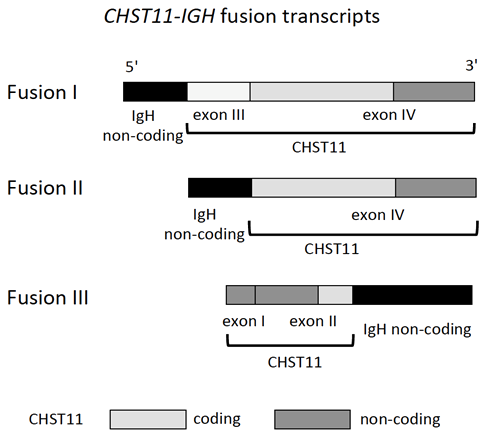
Changes in CS levels and chondroitin sulfation balance have been described during tumor progression (Ricciardelli et al., 1997; Suwiwat et al., 2004; Theocharis et al., 2006; Sakko et al., 2008; Teng et al., 2008; Svensson et al., 2011; Vallen et al., 2012). Experimental elimination of chondroitin sulfate in orthotopic breast cancer mouse models lead to increased metastasis, demonstrating a critical role of chondroitin epitopes in tumor progression in vivo (Prinz et al., 2011). The CHST11 gene was highly expressed in aggressive breast cancer cells, but significantly less so in less aggressive breast cancer cell lines (Cooney et al., 2011). Moreover, a positive correlation was observed between the expression levels of CHST11 and P-selectin-mediated adherence of breast cancer cells to endothelial cells (Cooney et al., 2011). Increased expression of the CHST11 gene has been observed in multiple myeloma (Bret et al., 2009). One case report of a patient with B-cell chronic lymphocytic leukemia (B-CLL), a chromosomal translocation with breakpoints in the IGH locus on chromosome 14, and the CHST11 locus on chromosome 12 [t(12;14)(q23;q32)] was identified. The translocation breakpoint mapped to intron 2 of the CHST11 locus, and resulted in the expression of two truncated forms of CHST11 (Schmidt et al., 2004).
Role in Wnt-β-catenin signaling:
Studies were performed in mutant sog9 L-cell fibroblasts, which lack the expression of both EXT1 (Extosis-1, required for heparan sulfate biosynthesis) and CHST11 genes (Nadanaka et al., 2008). Mutant cells had a significant decrease in Wnt3a-stimulated β-catenin accumulation, which could be rescued by stably expressing CHST11, but not EXT-1 (Nadanaka et al., 2008). In addition, this study showed that the specific chondroitin sulfate form CS-E, but not the other chondroitin sulfate forms, was able to bind Wnt3a ligand with high affinity. Addition of CS-E to normal L-cells reduced β-catenin levels, much like what was seen in the sog9 mutant L-cells lacking CHST11 expression (Nadanaka et al., 2008). Together, this data suggested that the CHST11, through its ability to produce CS-E containing proteoglycans, might play a role in the Wnt/β-catenin signaling pathway. The investigators of this study suggested a model in which CHST11 expression increases the level of CS-E containing proteoglycans, which can then bind Wnt3a, and facilitate the binding of Wnt ligands to its receptor complex, thus increasing the efficiency of ligand-receptor interactions. In a follow-up study, Nadanaka et al. (2011) show that L-cells stably expressing the Wnt3a ligand had a reduction in CHST11 gene expression, and subsequently a change in sulfation balance with a higher concentration of chondroitin sulfate products with low affinity for Wnt3a ligand binding (Nadanaka et al., 2011). This allows the Wnt3a ligand to freely diffuse across L-cell fibroblast cultures. Forced expression of CHST11 was suggested to inhibit the diffusion of Wnt3a ligand in L-cell fibroblast cultures, because of the increase in production of CS-E containing proteoglycans (Nadanaka et al., 2011). These and previous studies suggested that CHST11 expression is able to inhibit Wnt3a diffusion and sustained signaling, but CHST11 gene expression is negatively regulated by active Wnt/β-catenin signaling (Nadanaka et al., 2011). We reported the identification of the CHST11 product CS-E as an inhibitor of specific molecular and biological outcomes of Wnt3a signaling in NIH3T3 fibroblasts (Willis and Klüppel, 2012). CS-E could decrease Wnt3a signaling through negative regulation of LRP6 receptor activation. However, this inhibitory effect of CS-E only affected Wnt3a-mediated induction, but not repression, of target gene expression (Willis and Klüppel, 2012). We went on to identify a critical Wnt3a signaling threshold that differentially affects target gene induction versus repression. This Wnt3a signaling threshold also differentially controlled the effects on proliferation and serum starvation-induced apoptosis (Willis and Klüppel, 2012). These data established the feasibility to manipulate the chondroitin sulfate biosynthesis machinery, in particular CHST11, to selectively inhibit Wnt/β-catenin transcriptional programs and biological outcomes through the exploitation of intrinsic signaling thresholds (Willis and Klüppel, 2012).
Homology
Mutations
Note
Somatic
Implicated in
Article Bibliography
| Pubmed ID | Last Year | Title | Authors |
|---|---|---|---|
| 21284936 | 2011 | Correlation of C4ST-1 and ChGn-2 expression with chondroitin sulfate chain elongation in atherosclerosis. | Anggraeni VY et al |
| 9632611 | 1998 | Inhibition of binding of malaria-infected erythrocytes by a tetradecasaccharide fraction from chondroitin sulfate A. | Beeson JG et al |
| 19298595 | 2009 | Expression of genes encoding for proteins involved in heparan sulphate and chondroitin sulphate chain synthesis and modification in normal and malignant plasma cells. | Bret C et al |
| 8916971 | 1996 | Adhesion of malaria-infected red blood cells to chondroitin sulfate A under flow conditions. | Cooke BM et al |
| 21658254 | 2011 | Chondroitin sulfates play a major role in breast cancer metastasis: a role for CSPG4 and CHST11 gene expression in forming surface P-selectin ligands in aggressive breast cancer cells. | Cooney CA et al |
| 22261753 | 2012 | Costello syndrome: a Ras/mitogen activated protein kinase pathway syndrome (rasopathy) resulting from HRAS germline mutations. | Gripp KW et al |
| 16010679 | 2005 | Tumor predisposition in Costello syndrome. | Gripp KW et al |
| 6957247 | 1982 | Separation and characterization of chondroitin 6-sulfotransferase and chondroitin 4-sulfotransferase from chick embryo cartilage. | Habuchi O et al |
| 1751554 | 1991 | Secretion of chondroitin 6-sulfotransferase and chondroitin 4-sulfotransferase from cultured chick embryo chondrocytes. | Habuchi O et al |
| 10918817 | 2000 | [Biological function of chondroitin sulfate and sulfotransferases]. | Habuchi O et al |
| 15637729 | 2005 | Myocardial storage of chondroitin sulfate-containing moieties in Costello syndrome patients with severe hypertrophic cardiomyopathy. | Hinek A et al |
| 10781601 | 2000 | Molecular cloning and expression of two distinct human chondroitin 4-O-sulfotransferases that belong to the HNK-1 sulfotransferase gene family. | Hiraoka N et al |
| 22317973 | 2012 | C4ST-1/CHST11-controlled chondroitin sulfation interferes with oncogenic HRAS signaling in Costello syndrome. | Klüppel M et al |
| 12351172 | 2002 | A high-throughput induction gene trap approach defines C4ST as a target of BMP signaling. | Klüppel M et al |
| 16079159 | 2005 | Maintenance of chondroitin sulfation balance by chondroitin-4-sulfotransferase 1 is required for chondrocyte development and growth factor signaling during cartilage morphogenesis. | Klüppel M et al |
| 20807643 | 2010 | The roles of chondroitin-4-sulfotransferase-1 in development and disease. | Klüppel M et al |
| 21123170 | 2011 | Down-regulation of chondroitin 4-O-sulfotransferase-1 by Wnt signaling triggers diffusion of Wnt-3a. | Nadanaka S et al |
| 11056388 | 2000 | Molecular cloning, expression, and chromosomal mapping of human chondroitin 4-sulfotransferase, whose expression pattern in human tissues is different from that of chondroitin 6-sulfotransferase. | Okuda T et al |
| 9307979 | 1997 | Chondroitin-4-sulfate impairs in vitro and in vivo cytoadherence of Plasmodium falciparum infected erythrocytes. | Pouvelle B et al |
| 22183949 | 2011 | Elimination of breast tumor-associated chondroitin sulfate promotes metastasis. | Prinz RD et al |
| 18025929 | 2007 | Costello syndrome and related disorders. | Quezada E et al |
| 18412122 | 2008 | Molecular aspects, clinical aspects and possible treatment modalities for Costello syndrome: Proceedings from the 1st International Costello Syndrome Research Symposium 2007. | Rauen KA et al |
| 17250658 | 2007 | HRAS and the Costello syndrome. | Rauen KA et al |
| 9815775 | 1997 | Elevated stromal chondroitin sulfate glycosaminoglycan predicts progression in early-stage prostate cancer. | Ricciardelli C et al |
| 7790815 | 1995 | Chondroitin sulfate A is a cell surface receptor for Plasmodium falciparum-infected erythrocytes. | Rogerson SJ et al |
| 18768520 | 2008 | Immunohistochemical level of unsulfated chondroitin disaccharides in the cancer stroma is an independent predictor of prostate cancer relapse. | Sakko AJ et al |
| 15273723 | 2004 | Deregulation of the carbohydrate (chondroitin 4) sulfotransferase 11 (CHST11) gene in a B-cell chronic lymphocytic leukemia with a t(12;14)(q23;q32). | Schmidt HH et al |
| 15073129 | 2004 | Expression of extracellular matrix components versican, chondroitin sulfate, tenascin, and hyaluronan, and their association with disease outcome in node-negative breast cancer. | Suwiwat S et al |
| 21850370 | 2011 | Chondroitin sulfate expression predicts poor outcome in breast cancer. | Svensson KJ et al |
| 18487997 | 2008 | Increased expression of non-sulfated chondroitin correlates with adverse clinicopathological parameters in prostate cancer. | Teng YH et al |
| 17239771 | 2006 | Chondroitin sulfate as a key molecule in the development of atherosclerosis and cancer progression. | Theocharis AD et al |
| 17040900 | 2006 | Chondroitin 4-O-sulfotransferase-1 regulates E disaccharide expression of chondroitin sulfate required for herpes simplex virus infectivity. | Uyama T et al |
| 22733095 | 2012 | Highly sulfated chondroitin sulfates, a novel class of prognostic biomarkers in ovarian cancer tissue. | Vallen MJ et al |
| 15940703 | 2005 | The adult phenotype in Costello syndrome. | White SM et al |
| 22915582 | 2012 | Inhibition by chondroitin sulfate E can specify functional Wnt/β-catenin signaling thresholds in NIH3T3 fibroblasts. | Willis CM et al |
| 19937589 | 2009 | Identification and characterization of TGFbeta-dependent and -independent cis-regulatory modules in the C4ST-1/CHST11 locus. | Willis CM et al |
| 10722746 | 2000 | Molecular cloning and expression of chondroitin 4-sulfotransferase. | Yamauchi S et al |
| 15628971 | 2005 | N-linked oligosaccharides are required to produce and stabilize the active form of chondroitin 4-sulphotransferase-1. | Yusa A et al |
| 22763110 | 2012 | Identification of new susceptibility loci for osteoarthritis (arcOGEN): a genome-wide association study. | Zeggini E et al |
Other Information
Locus ID:
NCBI: 50515
MIM: 610128
HGNC: 17422
Ensembl: ENSG00000171310
Variants:
dbSNP: 50515
ClinVar: 50515
TCGA: ENSG00000171310
COSMIC: CHST11
RNA/Proteins
Expression (GTEx)
Pathways
Protein levels (Protein atlas)
References
| Pubmed ID | Year | Title | Citations |
|---|---|---|---|
| 38565604 | 2024 | Effect of CHST11, a novel biomarker, on the biological functionalities of clear cell renal cell carcinoma. | 0 |
| 38565604 | 2024 | Effect of CHST11, a novel biomarker, on the biological functionalities of clear cell renal cell carcinoma. | 0 |
| 37076815 | 2023 | KIAA1429-mediated m6A modification of CHST11 promotes progression of diffuse large B-cell lymphoma by regulating Hippo-YAP pathway. | 7 |
| 37076815 | 2023 | KIAA1429-mediated m6A modification of CHST11 promotes progression of diffuse large B-cell lymphoma by regulating Hippo-YAP pathway. | 7 |
| 36181245 | 2022 | The CHST11 gene is linked to lung cancer and pulmonary fibrosis. | 1 |
| 36546737 | 2022 | High Expression of CHST11 Correlates with Poor Prognosis and Tumor Immune Infiltration of Pancreatic Cancer. | 2 |
| 36181245 | 2022 | The CHST11 gene is linked to lung cancer and pulmonary fibrosis. | 1 |
| 36546737 | 2022 | High Expression of CHST11 Correlates with Poor Prognosis and Tumor Immune Infiltration of Pancreatic Cancer. | 2 |
| 32171335 | 2020 | An epigenome-wide association study of posttraumatic stress disorder in US veterans implicates several new DNA methylation loci. | 45 |
| 32344408 | 2020 | Carbohydrate (Chondroitin 4) Sulfotransferase-11-Mediated Induction of Epithelial-Mesenchymal Transition and Generation of Cancer Stem Cells. | 6 |
| 32707405 | 2020 | Chondroitin-4-sulfate transferase-1 depletion inhibits formation of a proteoglycan-rich layer and alters immunotolerance of bone marrow mesenchymal stem cells on titanium oxide surfaces. | 1 |
| 32171335 | 2020 | An epigenome-wide association study of posttraumatic stress disorder in US veterans implicates several new DNA methylation loci. | 45 |
| 32344408 | 2020 | Carbohydrate (Chondroitin 4) Sulfotransferase-11-Mediated Induction of Epithelial-Mesenchymal Transition and Generation of Cancer Stem Cells. | 6 |
| 32707405 | 2020 | Chondroitin-4-sulfate transferase-1 depletion inhibits formation of a proteoglycan-rich layer and alters immunotolerance of bone marrow mesenchymal stem cells on titanium oxide surfaces. | 1 |
| 29514872 | 2018 | Homozygous CHST11 mutation in chondrodysplasia, brachydactyly, overriding digits, clino-symphalangism and synpolydactyly. | 12 |
Citation
Michael Klüppel
CHST11 (carbohydrate (chondroitin 4) sulfotransferase 11)
Atlas Genet Cytogenet Oncol Haematol. 2014-04-01
Online version: http://atlasgeneticsoncology.org/gene/50474/chst11-(carbohydrate-(chondroitin-4)-sulfotransferase-11)
