SLIT3 (slit homolog 3 (Drosophila))
2012-09-01 Kim Brussen AffiliationSanquin Research, Landsteiner Laboratory, Department of Hematopoiesis, Academic Medical Center, University of Amsterdam, Amsterdam, The Netherlands
Identity
HGNC
LOCATION
5q34
IMAGE

LEGEND
Genomic localization of SLIT3. The SLIT3 gene is shown in red, the surrounding genes in grey. The arrows indicate the direction of transcription (NCBI, version 27 nov 11). Adapted from NCBI map viewer.
LOCUSID
ALIAS
MEGF5,SLIL2,SLIT1,Slit-3,slit2
FUSION GENES
DNA/RNA
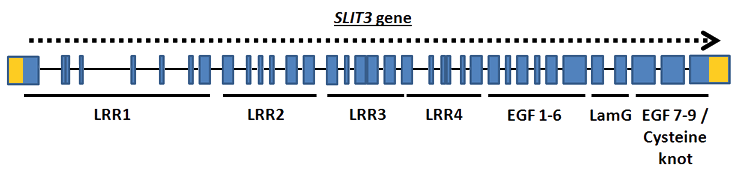
Map of the SLIT3 gene, direction from 5UTR till 3UTR. The direction of transcription is indicated by the arrow. Exons are depicted as blue boxes. Within the first and the last exon, the 5UTR and 3UTR are depicted in yellow. The length of the exons and introns is roughly indicated, but is not up to scale. The size of the exons ranges from 72 base pairs up to 4950 base pairs, the size of the introns ranges from 605 base pairs up to 310141 base pairs. For clarity, the exons are depicted larger than the introns. Below is indicated which protein domains are encoded by particular exons. Based on ENSEMBL version 68 Juli 2012 transcript ENST00000519560. Information on protein domains encoded by particular exons was obtained from Little et al., 2002.
Description
36 coding exons spanning 600 kb of the genome. All SLIT genes contain CpG islands in their promoter regions and intron length and exon-intron boundaries are highly similar (Little et al., 2002; Dallol et al., 2005).
Transcription
The leucine rich repeat regions of the three human SLIT genes contain a large number of very small exons, mostly encoding for one individual leucine rich repeat. This allows alternative splicing of the exons, without altering the frame (Little et al., 2002). 8 mRNA transcript variants were reported in ENSEMBL, of which 3 transcript variants encode for a protein. The relevance of the differently spliced variants is unclear. Only one variant of SLIT3 was identified after screening of a human fetal brain cDNA library or by nucleotide database searching (Little et al., 2002).
Pseudogene
None known.
Proteins
Note
The extracellular matrix protein SLIT was first identified in a genetic screen for mutations that affected the dorsal-ventral patterning or the development of the central nervous system in Drosophila (Anderson et al., 1984; Seeger et al., 1993). SLIT homologues have since been found in C. elegans and in vertebrates, including mammals (Holmes et al., 1998; Itoh et al., 1998; Brose et al., 1999; Holmes et al., 2001; Vargesson et al., 2001; Gilthorpe et al., 2002). The cognate receptor of the SLIT proteins is Roundabout or ROBO (Kidd et al., 1999; Huminiecki et al., 2002).
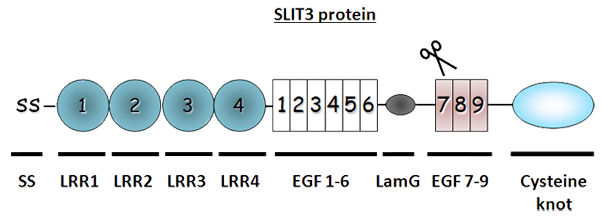
Domain organization of the SLIT protein from N-terminus to C-terminus. SS: N-terminal signal peptide; LRR: leucin-rich repeat; EGF-like: epidermal growth factor-like domain; Lam-G like: Agrin, Laminin, Perlecan and SLIT (ALPS) or laminin G-like module; Cystein knot: C-terminal cystein knot. The sciccors represent a proteolytic cleavage site. Adapted from figure created by dr. S.B. Geutskens (Leiden University Medical Center; Department of Immunohematology and Blood Transfusion & Einthoven laboratory for Experimental Vascular Medicine; Leiden; The Netherlands).
Description
In mammals there are three SLIT genes which encode large ECM glycoproteins of about 200 kDa, comprising a stretch of four leucine rich repeats (LRR) connected by disulphide bonds, seven to nine epidermal growth factor (EGF)-like domains, a domain named Agrin, Laminin, Perlecan and SLIT (ALPS) or laminin G-like module, and a C-terminal cystein knot (Rothberg and Artavanis-Tsakonas, 1992; Hohenester et al., 1999; Nguyen-Ba-Charvet and Chedotal, 2002). SLIT proteins can be proteolytically cleaved within the EGF-like region, this has been shown to occur for SLIT2 and for SLIT3 (Brose et al., 1999; Patel et al., 2001; Condac et al., 2012). Three different transcripts of SLIT3, all containing 36 exons, encode for a protein. These proteins are 1530, 1523, and 1472 amino acids long (ENSEMBL ENSP00000430333, ENSP00000332164, ENSP00000384890 respectively). The protein of 1472 amino acids lacks the cysteine knot, while the other two proteins contain all protein domains, although some domains differ slightly in amino acid position and length. The SLIT3 protein of 1523 amino acids is the major expressed protein (NCBI accession AAQ89243).
Expression
In humans, SLIT3 is expressed both during embryonic development and during adult life. During embryogenesis, it is expressed in the fetal kidney, the fetal lung (Itoh et al., 1998) and to a lower extent in the fetal brain and the fetal liver (Dickinson et al., 2004). Thereafter, it is expressed in the kidney, the lung (Itoh et al., 1998), the female reproductive tract (endometrium, fallopian tube, ovaries, mammary gland, placenta) ( Dickinson et al., 2004; Dickinson et al., 2008; Duncan et al., 2010; Dickinson et al., 2011), the prostate (Dickinson et al., 2004), the heart, the lymph nodes, the thyroid, the adrenal gland, the digestive tract (stomach, small intestine, colon), the brain, the spinal cord (Itoh et al., 1998; Dickinson et al., 2004), the spleen, the thymus, the skin and in bone marrow stromal and endothelial cells (Dickinson et al., 2004; Geutskens et al., 2012).
Localisation
SLIT is a secreted extra-cellular matrix protein that is bound to the surface of the cell by the extracellular matrix, mainly by heparan sulfates (Liang et al., 1999; Ronca et al., 2001). It has been reported that both the N-terminal part of SLIT2 (Hussain et al., 2006) and the C-terminal part of SLIT2 and SLIT3 bind to heparin and heparan sulfates (Ronca et al., 2001; Condac et al., 2012). The interaction between SLIT proteins and heparan-sulfates is not only important for the binding of SLIT proteins to the extracellular matrix, but can also increase the affinity of SLIT for ROBO (Hu et al., 2001). Removal of heparan sulfates from the cell surface abolishes the response to SLIT2 (Hu et al., 2001; Hussain et al., 2006). Therefore, heparan-sulfates are considered as important co-receptors in SLIT-ROBO signalling (Inatani et al., 2003; Steigemann et al., 2004; Hussain et al., 2006). The SLIT2 and the SLIT3 protein can be proteolytically cleaved. Following proteolytic cleavage of SLIT2, the 140kDa N-terminal fragment remains tightly associated to the cell surface, while the 50-60kDa C-terminal fragment is more loosely attached and can also be detected in conditioned medium (Brose et al., 1999; Wang et al., 1999).
Function
The extra-cellular matrix protein SLIT binds to the transmembrane receptor Roundabout or ROBO and has a conserved role in axon guidance in the central nervous system (CNS), where SLIT functions as a repellent for ROBO-expressing axons (Brose et al., 1999; Kidd et al., 1999; Long et al., 2004). Outside the CNS, SLIT plays an important role during embryonic development and in human pathology.
Neuronal guidance: Several types of axons and neurons with different origins form a complex neuronal circuitry that allows proper functioning of the brain. Vertebrate commissural neurons first arise in the dorsal spinal cord. Their axons are directed to the midline/ floorplate by the chemoattractants netrin and sonic hedgehog. When these axons have reached the midline, they cross it and turn longitudinally on the opposite side, growing right alongside the midline/ floor plate (reviewed by Dickson and Gilestro, 2006). SLIT proteins function as chemorepellents throughout the central nervous system, thereby restricting the positioning of axons to their proper sites. Commisural axons defects have been reported in several studies. In Slit3 knockout mice, commisural axons stalled at the midline or projected aberrantly, although to a lesser extent as for the other Slit proteins (Unni et al., 2012). In Slit1,2,3 triple knockout mice embryos, the phenotype was more severe. 72% of the axons failed to leave the midline and 20% recrossed the midline (Long et al., 2004).
Angiogenesis: In the early developing diaphragm, SLIT3 promotes vascular development. Slit3 homozygous knockout mice had reduced vascular density and branching points. These data are subtantiated by research on endothelial cell lines. In HUVECs, SLIT3 functioned as a chemoattractant that induced endothelial cell chemotaxis and tube formation, RhoGTPase activation and modulation of the actin cytoskeleton. The vascular defects in Slit3 homozygous knockout mice occured before the onset of congenital diaphragmatic hernia (Zhang et al., 2009).
Migration: SLIT is required for proper directional migration and for the regulation of proliferation and differentiation of various cell types during embryogenesis. SLITs not only regulate migration during embryogenesis, but also during adult life. SLIT3 increases the migration of monocytes, macrophages and endothelial cells both in vitro and in vivo (Tanno et al., 2007; Zhang et al., 2009; Geutskens et al., 2010), while it inhibits the migration of hematopoietic stem and progenitor cells (HSPC) in vitro (Geutskens et al., 2012). The differential response of cells to SLIT3 may be explained by the level of ROBO1 expression; the level of ROBO1 is lower in monocytes than in HSPC (Geutskens et al., 2012). Cell-specific downstream signaling cues may also play a role. SLIT3 treatment of monocytes activates the GTPase RhoA to enhance migration (Geutskens et al., 2010). In contrast, SLIT3 inactivates RhoA in HSPC and inhibits their migration (Geutskens et al., 2012). HSPC that were pretreated with SLIT3 and transplanted into NOD-SCID mice showed increased homing to the bone marrow, which could be explained by modulation of SLIT/ ROBO signaling in the bone marrow environment. This is supported by the fact that SLIT3 does not inhibit transendothelial migration of HSPC in vitro (Geutskens et al., 2012). Thus, the response to SLIT3 proteins may be dependent on the level of ROBO expression, downstream cell-specific signaling cues and on the environment.
Neuronal guidance: Several types of axons and neurons with different origins form a complex neuronal circuitry that allows proper functioning of the brain. Vertebrate commissural neurons first arise in the dorsal spinal cord. Their axons are directed to the midline/ floorplate by the chemoattractants netrin and sonic hedgehog. When these axons have reached the midline, they cross it and turn longitudinally on the opposite side, growing right alongside the midline/ floor plate (reviewed by Dickson and Gilestro, 2006). SLIT proteins function as chemorepellents throughout the central nervous system, thereby restricting the positioning of axons to their proper sites. Commisural axons defects have been reported in several studies. In Slit3 knockout mice, commisural axons stalled at the midline or projected aberrantly, although to a lesser extent as for the other Slit proteins (Unni et al., 2012). In Slit1,2,3 triple knockout mice embryos, the phenotype was more severe. 72% of the axons failed to leave the midline and 20% recrossed the midline (Long et al., 2004).
Angiogenesis: In the early developing diaphragm, SLIT3 promotes vascular development. Slit3 homozygous knockout mice had reduced vascular density and branching points. These data are subtantiated by research on endothelial cell lines. In HUVECs, SLIT3 functioned as a chemoattractant that induced endothelial cell chemotaxis and tube formation, RhoGTPase activation and modulation of the actin cytoskeleton. The vascular defects in Slit3 homozygous knockout mice occured before the onset of congenital diaphragmatic hernia (Zhang et al., 2009).
Migration: SLIT is required for proper directional migration and for the regulation of proliferation and differentiation of various cell types during embryogenesis. SLITs not only regulate migration during embryogenesis, but also during adult life. SLIT3 increases the migration of monocytes, macrophages and endothelial cells both in vitro and in vivo (Tanno et al., 2007; Zhang et al., 2009; Geutskens et al., 2010), while it inhibits the migration of hematopoietic stem and progenitor cells (HSPC) in vitro (Geutskens et al., 2012). The differential response of cells to SLIT3 may be explained by the level of ROBO1 expression; the level of ROBO1 is lower in monocytes than in HSPC (Geutskens et al., 2012). Cell-specific downstream signaling cues may also play a role. SLIT3 treatment of monocytes activates the GTPase RhoA to enhance migration (Geutskens et al., 2010). In contrast, SLIT3 inactivates RhoA in HSPC and inhibits their migration (Geutskens et al., 2012). HSPC that were pretreated with SLIT3 and transplanted into NOD-SCID mice showed increased homing to the bone marrow, which could be explained by modulation of SLIT/ ROBO signaling in the bone marrow environment. This is supported by the fact that SLIT3 does not inhibit transendothelial migration of HSPC in vitro (Geutskens et al., 2012). Thus, the response to SLIT3 proteins may be dependent on the level of ROBO expression, downstream cell-specific signaling cues and on the environment.
Homology
A single slit gene was isolated in invertebrates, whereas there are three SLIT genes in mammals. The human SLIT3 protein shows 41,1% sequence homology with Drosophila slit (Itoh et al., 1998; Brose et al., 1999), 66% homology to human SLIT2 (NCBI accession AAD25539.1, NCBI protein blast) and 60% homology to human SLIT1 (NCBI accession BAA35184.1, NCBI protein blast).
Implicated in
Entity name
Invasive ductal breast carcinoma
Note
Methylation of the 5CpG islands in the SLIT3 gene was detected in 41% of breast tumor cell lines and in 16% of primary human breast tumors. The methylation resulted in reduced SLIT3 expression. The methylation frequency was significantly lower than for SLIT2 (Dickinson et al., 2004). Marlow et al. reported that loss of SLIT2 and SLIT3 expression correlated with the upregulation of CXCR4 in human breast tumors. In mouse mammary gland and in human MCF7 breast cancer cells, this resulted in hyperplastic lesions and in desmoplastic stroma. Overexpression of SLIT2 or SLIT3 in human breast carcinoma MDA-MB-231 cells resulted in a down-regulation of CXCR4 expression, reduced colony formation in vitro and in inhibition of tumor growth in a xenograft model in vivo. Inhibition of tumor growth and down-regulation of CXCR4 expression in SLIT-expressing tumor cells was the most prominent with overexpression of SLIT3 (Marlow et al., 2008).
Entity name
Glioma
Note
Methylation of the 5CpG islands in the SLIT3 gene was detected in 29% of glioma tumor cell lines and in 35% of gliomas. 66,7% of the gliomas were classified as gliomblastoma multiforme, the rest was randomly collected. No methylation was found in normal tissue from glioma patients (Dickinson et al., 2004).
Entity name
Neurological diseases
Hybrid gene
It is not known whether the neuronal guidance defects cause neurological diseases in mice. However, it was reported that SLIT3 may be associated with neurological diseases in humans. Single nucleotide polymorphisms and duplications of the chromosomal region harboring the SLIT3 gene were identified. Locus 5q35.1, encompassing the genes coding for SLIT3, CCDC99 and DOCK2, had significant copy number variation in patients with major depressive disorder. In 0,7% of these cases, there was a duplication of 5q35.1 (Glessner et al., 2010). Furthermore, some of the SNPs located in introns and exons of the SLIT3 gene showed significant association with Schizophrenia in the Chinese Han population (Shi et al., 2004).
Entity name
Congenital diaphragmatic hernia
Note
Slit3 homozygous knockout mice suffered from diaphragmatic hernia. This was caused by a central tendon that remained fused to the liver. In the defective tendon, the collagen fibers did not form tight bundles. Due to the herniation, the orientation of the heart was twisted. The right ventricle faced ventrally and was enlarged (Liu et al., 2003).
Disease
Congenital diaphragmatic hernia is a rare anatomical defect in the diaphragm. As a result, abdominal organs can be herniated inside the thoracic cavity, which results in severe respiratory complications. Malformations in the heart and the vascular system are also commonly reported, resulting in cardiovascular defects (reviewed in Tovar, 2012).
Prognosis
Congenital diaphragmatic hernia is associated with a high morbidity and a mortality rate of around 50% (reviewed in Tovar, 2012).
Entity name
Renal agenesis
Note
In approximately 20% of Slit3 homozygous knockout mice that were born and in 40% of homozygous mice that died before birth, unilateral or bilateral kidney and ureter agenesis was found (Liu et al., 2003). In addition, in one mouse one kidney was smaller than normal while the other kidney appeared normal in size. In another mouse, the kidneys were abnormally shaped and the left kidney extended to the right side and appeared to be connected with the right kidney (Liu et al., 2003).
Disease
During renal agenesis one (unilateral) or two (bilateral) kidneys do not develop. Unilateral agenesis occurs more frequently than bilateral agenesis. Unilateral renal agenesis is usually accompanied by an enlargement of cells in the developed kidney. When the kidney fails to develop, the ureter often also fails to develop. Alternatively, the ureter may be dilated (Mishra, 2007).
Article Bibliography
| Pubmed ID | Last Year | Title | Authors |
|---|---|---|---|
| 6434989 | 1984 | Information for the dorsal--ventral pattern of the Drosophila embryo is stored as maternal mRNA. | Anderson KV et al |
| 18054781 | 2008 | The role of Slit-Robo signaling in the generation, migration and morphological differentiation of cortical interneurons. | Andrews W et al |
| 14735202 | 2004 | SLIT2 promoter methylation analysis in neuroblastoma, Wilms' tumour and renal cell carcinoma. | Astuti D et al |
| 10102268 | 1999 | Slit proteins bind Robo receptors and have an evolutionarily conserved role in repulsive axon guidance. | Brose K et al |
| 22641771 | 2012 | The C-terminal fragment of axon guidance molecule Slit3 binds heparin and neutralizes heparin's anticoagulant activity. | Condac E et al |
| 12384551 | 2002 | SLIT2, a human homologue of the Drosophila Slit2 gene, has tumor suppressor activity and is frequently inactivated in lung and breast cancers. | Dallol A et al |
| 12881718 | 2003 | Frequent epigenetic inactivation of the SLIT2 gene in gliomas. | Dallol A et al |
| 12615722 | 2003 | SLIT2 axon guidance molecule is frequently inactivated in colorectal cancer and suppresses growth of colorectal carcinoma cells. | Dallol A et al |
| 22132142 | 2011 | Glucocorticoid regulation of SLIT/ROBO tumour suppressor genes in the ovarian surface epithelium and ovarian cancer cells. | Dickinson RE et al |
| 17029581 | 2006 | Regulation of commissural axon pathfinding by slit and its Robo receptors. | Dickson BJ et al |
| 20651036 | 2010 | Expression of the repulsive SLIT/ROBO pathway in the human endometrium and Fallopian tube. | Duncan WC et al |
| 19550140 | 2009 | Frequent epigenetic inactivation of the SLIT2 gene in chronic and acute lymphocytic leukemia. | Dunwell TL et al |
| 22614124 | 2012 | Control of human hematopoietic stem/progenitor cell migration by the extracellular matrix protein Slit3. | Geutskens SB et al |
| 12361964 | 2002 | The migration of cerebellar rhombic lip derivatives. | Gilthorpe JD et al |
| 21152026 | 2010 | Duplication of the SLIT3 locus on 5q35.1 predisposes to major depressive disorder. | Glessner JT et al |
| 15130495 | 2004 | SLIT2-mediated ROBO2 signaling restricts kidney induction to a single site. | Grieshammer U et al |
| 10619025 | 1999 | The crystal structure of a laminin G-like module reveals the molecular basis of alpha-dystroglycan binding to laminins, perlecan, and agrin. | Hohenester E et al |
| 11668607 | 2001 | Expression of slit-2 and slit-3 during chick development. | Holmes G et al |
| 10349621 | 1998 | Distinct but overlapping expression patterns of two vertebrate slit homologs implies functional roles in CNS development and organogenesis. | Holmes GP et al |
| 11426225 | 2001 | Cell-surface heparan sulfate is involved in the repulsive guidance activities of Slit2 protein. | Hu H et al |
| 17062560 | 2006 | A molecular mechanism for the heparan sulfate dependence of slit-robo signaling. | Hussain SA et al |
| 14605369 | 2003 | Mammalian brain morphogenesis and midline axon guidance require heparan sulfate. | Inatani M et al |
| 9813312 | 1998 | Cloning and expressions of three mammalian homologues of Drosophila slit suggest possible roles for Slit in the formation and maintenance of the nervous system. | Itoh A et al |
| 10102267 | 1999 | Slit is the midline repellent for the robo receptor in Drosophila. | Kidd T et al |
| 10364234 | 1999 | Mammalian homologues of the Drosophila slit protein are ligands of the heparan sulfate proteoglycan glypican-1 in brain. | Liang Y et al |
| 12141424 | 2002 | Conserved modularity and potential for alternate splicing in mouse and human Slit genes. | Little M et al |
| 14550534 | 2003 | Congenital diaphragmatic hernia, kidney agenesis and cardiac defects associated with Slit3-deficiency in mice. | Liu J et al |
| 15091338 | 2004 | Conserved roles for Slit and Robo proteins in midline commissural axon guidance. | Long H et al |
| 18829537 | 2008 | SLITs suppress tumor growth in vivo by silencing Sdf1/Cxcr4 within breast epithelium. | Marlow R et al |
| 17762048 | 2007 | Renal agenesis: report of an interesting case. | Mishra A et al |
| 11755787 | 2002 | Role of Slit proteins in the vertebrate brain. | Nguyen-Ba-Charvet KT et al |
| 11748139 | 2001 | Slit proteins are not dominant chemorepellents for olfactory tract and spinal motor axons. | Patel K et al |
| 11804570 | 2002 | Slit1 and Slit2 cooperate to prevent premature midline crossing of retinal axons in the mouse visual system. | Plump AS et al |
| 14645233 | 2004 | Slit protein-mediated inhibition of CXCR4-induced chemotactic and chemoinvasive signaling pathways in breast cancer cells. | Prasad A et al |
| 18611862 | 2008 | Slit-2 induces a tumor-suppressive effect by regulating beta-catenin in breast cancer cells. | Prasad A et al |
| 11375980 | 2001 | Characterization of Slit protein interactions with glypican-1. | Ronca F et al |
| 1404356 | 1992 | Modularity of the slit protein. Characterization of a conserved carboxy-terminal sequence in secreted proteins and a motif implicated in extracellular protein interactions. | Rothberg JM et al |
| 8461134 | 1993 | Mutations affecting growth cone guidance in Drosophila: genes necessary for guidance toward or away from the midline. | Seeger M et al |
| 15231749 | 2004 | Genetic structure adds power to detect schizophrenia susceptibility at SLIT3 in the Chinese Han population. | Shi Y et al |
| 14761655 | 2004 | Heparan sulfate proteoglycan syndecan promotes axonal and myotube guidance by slit/robo signaling. | Steigemann P et al |
| 17306799 | 2007 | Slit3 regulates cell motility through Rac/Cdc42 activation in lipopolysaccharide-stimulated macrophages. | Tanno T et al |
| 22214468 | 2012 | Congenital diaphragmatic hernia. | Tovar JA et al |
| 20068157 | 2010 | SLIT2 attenuation during lung cancer progression deregulates beta-catenin and E-cadherin and associates with poor prognosis. | Tseng RC et al |
| 22349628 | 2012 | Multiple Slits regulate the development of midline glial populations and the corpus callosum. | Unni DK et al |
| 11472852 | 2001 | Expression patterns of Slit and Robo family members during vertebrate limb development. | Vargesson N et al |
| 12892710 | 2003 | Induction of tumor angiogenesis by Slit-Robo signaling and inhibition of cancer growth by blocking Robo activity. | Wang B et al |
| 10102266 | 1999 | Biochemical purification of a mammalian slit protein as a positive regulator of sensory axon elongation and branching. | Wang KH et al |
| 16636676 | 2006 | Inhibition of medulloblastoma cell invasion by Slit. | Werbowetski-Ogilvie TE et al |
| 12702769 | 2003 | A genetic model for a central (septum transversum) congenital diaphragmatic hernia in mice lacking Slit3. | Yuan W et al |
| 19741192 | 2009 | Repulsive axon guidance molecule Slit3 is a novel angiogenic factor. | Zhang B et al |
Other Information
Locus ID:
NCBI: 6586
MIM: 603745
HGNC: 11087
Ensembl: ENSG00000184347
Variants:
dbSNP: 6586
ClinVar: 6586
TCGA: ENSG00000184347
COSMIC: SLIT3
RNA/Proteins
| Gene ID | Transcript ID | Uniprot |
|---|---|---|
| ENSG00000184347 | ENST00000332966 | O75094 |
| ENSG00000184347 | ENST00000404867 | A0A0A0MSC8 |
| ENSG00000184347 | ENST00000519560 | O75094 |
Expression (GTEx)
Pathways
| Pathway | Source | External ID |
|---|---|---|
| Axon guidance | KEGG | ko04360 |
| Axon guidance | KEGG | hsa04360 |
| Developmental Biology | REACTOME | R-HSA-1266738 |
| Axon guidance | REACTOME | R-HSA-422475 |
| Netrin-1 signaling | REACTOME | R-HSA-373752 |
Protein levels (Protein atlas)
References
| Pubmed ID | Year | Title | Citations |
|---|---|---|---|
| 38414132 | 2024 | Stromal Cell-SLIT3/Cardiomyocyte-ROBO1 Axis Regulates Pressure Overload-Induced Cardiac Hypertrophy. | 0 |
| 38700874 | 2024 | The Role of SLIT3-ROBO4 Signaling in Endoplasmic Reticulum Stress-Induced Delayed Corneal Epithelial and Nerve Regeneration. | 0 |
| 38414132 | 2024 | Stromal Cell-SLIT3/Cardiomyocyte-ROBO1 Axis Regulates Pressure Overload-Induced Cardiac Hypertrophy. | 0 |
| 38700874 | 2024 | The Role of SLIT3-ROBO4 Signaling in Endoplasmic Reticulum Stress-Induced Delayed Corneal Epithelial and Nerve Regeneration. | 0 |
| 36793891 | 2023 | Abnormal expression of SLIT3 induces intravillous vascularization dysplasia in ectopic pregnancy. | 0 |
| 36793891 | 2023 | Abnormal expression of SLIT3 induces intravillous vascularization dysplasia in ectopic pregnancy. | 0 |
| 35034539 | 2022 | LncRNA ubiquitin-binding protein domain protein 10 antisense RNA 1 inhibits colon adenocarcinoma progression via the miR-515-5p/slit guidance ligand 3 axis. | 3 |
| 36017912 | 2022 | LncRNA PGM5-AS1 Inhibits the Progression of Bladder Cancer by Regulating miR-587/SLIT3 Axis. | 1 |
| 35034539 | 2022 | LncRNA ubiquitin-binding protein domain protein 10 antisense RNA 1 inhibits colon adenocarcinoma progression via the miR-515-5p/slit guidance ligand 3 axis. | 3 |
| 36017912 | 2022 | LncRNA PGM5-AS1 Inhibits the Progression of Bladder Cancer by Regulating miR-587/SLIT3 Axis. | 1 |
| 33933663 | 2021 | Isolated congenital diaphragm hernia associated with homozygous SLIT3 gene variant in dizygous twins. | 2 |
| 33933663 | 2021 | Isolated congenital diaphragm hernia associated with homozygous SLIT3 gene variant in dizygous twins. | 2 |
| 31696592 | 2020 | Gingival crevicular fluid levels of SLIT3 are increased in periodontal disease. | 3 |
| 32209227 | 2020 | Identification of slit3 as a locus affecting nicotine preference in zebrafish and human smoking behaviour. | 11 |
| 32762475 | 2020 | Single-nucleotide polymorphism rs10036727 in the SLIT3 gene is associated with osteoporosis at the femoral neck in older Mexican postmenopausal women. | 3 |
Citation
Kim Brussen
SLIT3 (slit homolog 3 (Drosophila))
Atlas Genet Cytogenet Oncol Haematol. 2012-09-01
Online version: http://atlasgeneticsoncology.org/gene/50515/slit3-(slit-homolog-3-(drosophila
