GALNT6 (UDP-N-acetyl-alpha-D-galactosamine:polypeptide N-acetylgalactosaminyltransferase 6 (GalNAc-T6))
2013-07-01 Jae-Hyun Park , Yusuke Nakamura AffiliationSection of Hematology\\\/Oncology, Department of Medicine, The University of Chicago, Chicago, USA
Identity
HGNC
LOCATION
12q13.13
LOCUSID
ALIAS
GALNAC-T6,GalNAcT6
FUSION GENES
DNA/RNA
Note
GALNT6 is highly expressed in many types of cancer, but expression of GALNT6 is hardly detectable in human normal tissues (Park et al., 2010).
Description
Human GALNT6 gene is located on 12 chromosome at q13.13 location. The GALNT6 gene is composed of 12 exons and ORF (open reading frame) is 1869 bp.
Proteins
Note
Human GALNT6 gene encodes 622 amino acids of 71159 Da. The protein is involved in the first step of O-type glycosylation by transferring UDP-GalNAc to Ser/Thr site of substrate protein. GALNT6 was firstly identified as a glycosyltransferase with high sequence similarity to GALNT3 (Bennett et al., 1999). GALNT6 has similar kinetic properties with other GALNTs but preferentially glycosylated fibronectin peptide in vitro. Because of expression in WI38 fibroblast cells, GALNT6 was regarded as a candidate for synthesis of the oncofetal fibronectin (Bennett et al., 1999). GALNT6 has two possible N-type glycosylation sites at N476 and N611.
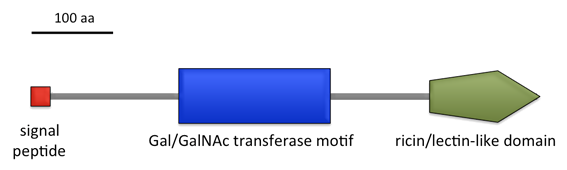
Functional domain of GALNT6. The protein contains signal peptide (1-34 aa), Gal/GalNAc transferase motif (180-370 aa), and ricin/lectin-like domain (496-622 aa).
Description
The mucin-type O-glycosylation is initiated by GALNT family members that transfer N-acetyl-alpha-D-galactosamine (GalNAc) to serine or threonine residues on the target protein (Ten Hagen et al., 2003). This modification occurs in the Golgi complex and is presumably controlled by the expressions and distributions of GALNT proteins (Brooks et al., 2007). Interestingly, structural alterations of these glycan chains are often detected in cancer cells, especially in breast cancer. For instances, the O-glycans were often truncated (core 1-based type) in breast carcinoma cells, whereas they were extended its chain (core 2-based type) in normal breast cells (Burchell et al., 2001). O-type glycosylation is one of common modifications that have multiple functions related to the folding, stability, and targeting of various glycoproteins (Carraway et al., 2007). Accumulating evidences have suggested that the GALNT family members are involved in several cellular functions by catalyzing substrates specific to each member. For instances, glycosylation by GALNT3 prevents proteolytic processing of FGF23 (fibroblast growth factor 23) and that by GALNT14 promotes ligand-stimulated clustering of death receptors (Wagner et al., 2007; Ichikawa et al., 2009).
Expression
GALNT6 is highly expressed in many types of cancer including breast, gastric, kidney, oral, and pancreatic cancer (Berois et al., 2006; Gomes et al., 2009; Kitada et al., 2013; Wandall et al., 2007; Li et al., 2011). However, in human normal tissues, GALNT6 is merely expressed in normal tissues and vital organs including lung, heart, liver, and kidney (Park et al., 2010). A specific expression of GALNT6 was also reported in the nonkeratinized epithelium of ocular cicatricial pemphigoid (OCP) patients (Argüeso et al., 2003).
Localisation
Similarly to other isoforms in the GALNT family, GALNT6 is localized in the Golgi complex as shown by double immunofluorescence staining with anti-GALNT6 mAb and anti-Golgi-58k mAb (Park et al., 2010).
Function
GALNT6 is involved in the first step of O-type glycosylation, and thereby may influence on folding, stability, and subcellular localization of target proteins. GALNT6 was reported to stabilize MUC1 protein throughout O-glycosylation and subsequently the accumulated MUC1 protein promoted breast cancer cell proliferation and induced anti-adhesive effects (Park et al., 2010). By O-glycosylation of fibronectin protein, GALNT6 showed transformational potentials through disruptive acinar morphogenesis and cellular changes similar to EMT (epithelial-to-mesenchymal transition) in normal mammary epithelial cell (Park et al., 2011). The GALNT6-mediated O-glycosylation of fibronectin was also reported in the TGF-β-induced EMT process in human prostate cells (Freire-de-Lima et al., 2011).
Homology
GALNT6 has 30~63% of amino acid homology with other family members, with the highest homology to GALNT3 (63%). In crystal structure analysis of murine GALNT isoforms, GALNT1 was reported to be more similar to GALNT6 according to the electrostatic surface potential models (Fritz et al., 2004).
Implicated in
Entity name
Breast cancer
Note
High expression of GALNT6 was frequently observed in human breast cancers (Berois et al., 2006; Freire et al., 2006; Patani et al., 2008; Park et al., 2010). In particular, strong expression of GALNT6 was reported in most of DCIS (ductal carcinoma in situ) indicating that GALNT6 should play important roles in early human breast carcinogenesis (Berois et al., 2006). On the other hand, a study of metastatic breast cancer showed that GALNT6 expression was frequently detected in bone marrow biopsy samples and therefore suggested that GALNT6 would be a good target for detection of disseminated breast cancer cells (Freire et al., 2006).
Prognosis
Disease free survival was elongated in breast cancer patients who showed negative expression of GALNT6 from bone marrow biopsy (Freire et al., 2006).
Entity name
Gastric cancer
Note
High expression of GALNT6 was reported in human gastric cancers. A heterogeneous expression and staining pattern of GALNT6 was observed in 79% of gastric carcinomas, and its expression level was associated with the presence of venous invasion (Gomes et al., 2009).
Entity name
Oral cancer
Note
GALNT6 was expressed in the oral squamous carcinoma cells, but not expressed in normal stromal fibroblasts (Wandall et al., 2007).
Entity name
Pancreatic cancer
Note
GALNT6 was highly expressed in pancreatic cancer, but not expressed in normal ductal epithelium. A close relationship was noted between GALNT6-positive expression and pathological well/moderate differentiated type, small tumor size, and absence of vascular invasion (Li et al., 2011).
Prognosis
In contrast to other reports, the outcome of the patients who had GALNT6-positive expression was significantly better than that with GALNT6-negative expression, especially in the early period after surgery (Li et al., 2011).
Entity name
Renal cell carcinoma
Note
GALNT6 was weakly expressed in 64 out of 254 renal cell carcinomas (Kitada et al., 2013).
Prognosis
GALNT6-positive patients showed poor prognosis with lower disease-specific survival rate (Kitada et al., 2013).
Entity name
Ocular cicatricial pemphigoid (OCP)
Note
OCP is one of the subsets of mucous membrane pemphigoid, which may be caused by aberrant synthesis of mucin O-glycans and thus by alteration of the physicochemical properties of mucins. GALNT6 was expressed in the apical stratified epithelia, but specific expression of GALNT6 was detected in nonkeratinized epithelium of OCP patients, without expression in keratinized epithelium nor normal subjects (Argüeso et al., 2003).
Article Bibliography
| Pubmed ID | Last Year | Title | Authors |
|---|---|---|---|
| 12506059 | 2003 | The cell-layer- and cell-type-specific distribution of GalNAc-transferases in the ocular surface epithelia is altered during keratinization. | Argüeso P et al |
| 10464263 | 1999 | Cloning and characterization of a close homologue of human UDP-N-acetyl-alpha-D-galactosamine:Polypeptide N-acetylgalactosaminyltransferase-T3, designated GalNAc-T6. Evidence for genetic but not functional redundancy. | Bennett EP et al |
| 16260590 | 2006 | UDP-N-acetyl-D-galactosamine: polypeptide N-acetylgalactosaminyltransferase-6 as a new immunohistochemical breast cancer marker. | Berois N et al |
| 17448526 | 2007 | Immunolocalisation of members of the polypeptide N-acetylgalactosaminyl transferase (ppGalNAc-T) family is consistent with biologically relevant altered cell surface glycosylation in breast cancer. | Brooks SA et al |
| 11547903 | 2001 | O-linked glycosylation in the mammary gland: changes that occur during malignancy. | Burchell JM et al |
| 17338913 | 2007 | Contribution of membrane mucins to tumor progression through modulation of cellular growth signaling pathways. | Carraway KL 3rd et al |
| 16596643 | 2006 | UDP-N-acetyl-D-galactosamine:polypeptide N-acetylgalactosaminyltransferase 6 (ppGalNAc-T6) mRNA as a potential new marker for detection of bone marrow-disseminated breast cancer cells. | Freire T et al |
| 22006308 | 2011 | Involvement of O-glycosylation defining oncofetal fibronectin in epithelial-mesenchymal transition process. | Freire-de-Lima L et al |
| 15486088 | 2004 | The beginnings of mucin biosynthesis: the crystal structure of UDP-GalNAc:polypeptide alpha-N-acetylgalactosaminyltransferase-T1. | Fritz TA et al |
| 18854599 | 2009 | Expression of UDP-N-acetyl-D-galactosamine: polypeptide N-acetylgalactosaminyltransferase-6 in gastric mucosa, intestinal metaplasia, and gastric carcinoma. | Gomes J et al |
| 19213845 | 2009 | Ablation of the Galnt3 gene leads to low-circulating intact fibroblast growth factor 23 (Fgf23) concentrations and hyperphosphatemia despite increased Fgf23 expression. | Ichikawa S et al |
| 23799843 | 2013 | Polypeptide N-acetylgalactosaminyl transferase 3 independently predicts high-grade tumours and poor prognosis in patients with renal cell carcinomas. | Kitada S et al |
| 21587259 | 2011 | Polypeptide N-acetylgalactosaminyltransferase 6 expression in pancreatic cancer is an independent prognostic factor indicating better overall survival. | Li Z et al |
| 21472136 | 2011 | Polypeptide N-acetylgalactosaminyltransferase 6 disrupts mammary acinar morphogenesis through O-glycosylation of fibronectin. | Park JH et al |
| 20215525 | 2010 | Critical roles of mucin 1 glycosylation by transactivated polypeptide N-acetylgalactosaminyltransferase 6 in mammary carcinogenesis. | Park JH et al |
| 19287074 | 2008 | Prognostic utility of glycosyltransferase expression in breast cancer. | Patani N et al |
| 12634319 | 2003 | All in the family: the UDP-GalNAc:polypeptide N-acetylgalactosaminyltransferases. | Ten Hagen KG et al |
| 17767167 | 2007 | Death-receptor O-glycosylation controls tumor-cell sensitivity to the proapoptotic ligand Apo2L/TRAIL. | Wagner KW et al |
| 16857413 | 2007 | Molecular basis for the presence of glycosylated onco-foetal fibronectin in oral carcinomas: the production of glycosylated onco-foetal fibronectin by carcinoma cells. | Wandall HH et al |
Other Information
Locus ID:
NCBI: 11226
MIM: 605148
HGNC: 4128
Ensembl: ENSG00000139629
Variants:
dbSNP: 11226
ClinVar: 11226
TCGA: ENSG00000139629
COSMIC: GALNT6
RNA/Proteins
Expression (GTEx)
Pathways
Protein levels (Protein atlas)
References
| Pubmed ID | Year | Title | Citations |
|---|---|---|---|
| 31894262 | 2020 | The GALNT6‑LGALS3BP axis promotes breast cancer cell growth. | 10 |
| 32393740 | 2020 | GALNT6 promotes invasion and metastasis of human lung adenocarcinoma cells through O-glycosylating chaperone protein GRP78. | 12 |
| 32559179 | 2020 | GALNT6 promotes breast cancer metastasis by increasing mucin-type O-glycosylation of α2M. | 17 |
| 31894262 | 2020 | The GALNT6‑LGALS3BP axis promotes breast cancer cell growth. | 10 |
| 32393740 | 2020 | GALNT6 promotes invasion and metastasis of human lung adenocarcinoma cells through O-glycosylating chaperone protein GRP78. | 12 |
| 32559179 | 2020 | GALNT6 promotes breast cancer metastasis by increasing mucin-type O-glycosylation of α2M. | 17 |
| 31071912 | 2019 | The polypeptide GALNT6 Displays Redundant Functions upon Suppression of its Closest Homolog GALNT3 in Mediating Aberrant O-Glycosylation, Associated with Ovarian Cancer Progression. | 12 |
| 31071912 | 2019 | The polypeptide GALNT6 Displays Redundant Functions upon Suppression of its Closest Homolog GALNT3 in Mediating Aberrant O-Glycosylation, Associated with Ovarian Cancer Progression. | 12 |
| 29187600 | 2018 | De novo expression of human polypeptide N-acetylgalactosaminyltransferase 6 (GalNAc-T6) in colon adenocarcinoma inhibits the differentiation of colonic epithelium. | 40 |
| 29844132 | 2018 | Glycosyltransferase Gene Expression Identifies a Poor Prognostic Colorectal Cancer Subtype Associated with Mismatch Repair Deficiency and Incomplete Glycan Synthesis. | 23 |
| 30208353 | 2018 | Critical Role of Estrogen Receptor Alpha O-Glycosylation by N-Acetylgalactosaminyltransferase 6 (GALNT6) in Its Nuclear Localization in Breast Cancer Cells. | 9 |
| 29187600 | 2018 | De novo expression of human polypeptide N-acetylgalactosaminyltransferase 6 (GalNAc-T6) in colon adenocarcinoma inhibits the differentiation of colonic epithelium. | 40 |
| 29844132 | 2018 | Glycosyltransferase Gene Expression Identifies a Poor Prognostic Colorectal Cancer Subtype Associated with Mismatch Repair Deficiency and Incomplete Glycan Synthesis. | 23 |
| 30208353 | 2018 | Critical Role of Estrogen Receptor Alpha O-Glycosylation by N-Acetylgalactosaminyltransferase 6 (GALNT6) in Its Nuclear Localization in Breast Cancer Cells. | 9 |
| 27659430 | 2017 | UDP-N-acetyl-D-galactosamine:polypeptide N-acetylgalactosaminyltransferase- 6 (pp-GalNAc-T6): Role in Cancer and Prospects as a Drug Target. | 3 |
Citation
Jae-Hyun Park ; Yusuke Nakamura
GALNT6 (UDP-N-acetyl-alpha-D-galactosamine:polypeptide N-acetylgalactosaminyltransferase 6 (GalNAc-T6))
Atlas Genet Cytogenet Oncol Haematol. 2013-07-01
