GZMA (granzyme A (granzyme 1, cytotoxic T-lymphocyte-associated serine esterase 3))
2011-09-01 Elena Catalan , Diego Sanchez-Martinez , Julián Pardo AffiliationDpto Bioquimica y Biologia Molecular y Celular, Fac Ciencias, Univ Zaragoza, Spain (EC, DSM, JP); Fundacion Aragon I+D (ARAID), Zaragoza, Spain (JP)
DNA/RNA
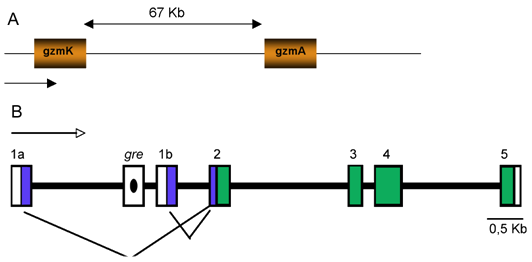
Figure 1. Genomic organization of human GZMA. A, human GZMA cluster. Arrow indicate the direction of transcription. B, representation of the GZMA genetic locus. White: untranslated regions; Blue: leader sequence; Green: mature enzyme. Solid lanes: splicing between the first and second exons. gre: glucocorticoid response element (adapted from Ruike et al., 2007).
Description
The GZMA gene, with 7607 bases in length, consists of 5 exons and 4 introns. GZMA gene is located in a gene cluster together with granzyme K (figure 1) (Grossman et al., 2003).
Transcription
There are at least two transcripts of human GZMA whose expression is differentially regulated by glucocorticoid (Ruike et al., 2007). These transcripts generate two isoforms, GZMAα and GZMAβ, which have respective first exons: exon 1a and exon 1b (figure 1):
GZMAα (exon 1a): canonical sequence,
GZMAβ (exon 1b): lack aa 1-17; aa 18-23 LLLIPE --> MTKGLR.
GZMAα (exon 1a): canonical sequence,
GZMAβ (exon 1b): lack aa 1-17; aa 18-23 LLLIPE --> MTKGLR.
Proteins
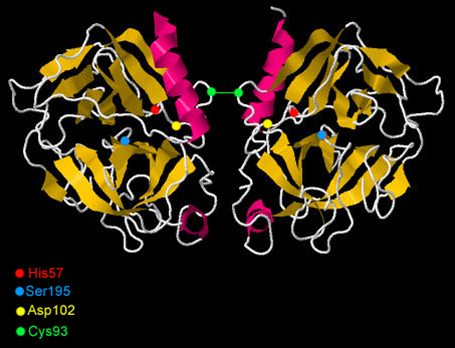
Figure 2. Diagram of the crystal structure of human granzyme A dimer (Bell et al., 2003; Hink-Schauer et al., 2003). The cystein groups involved in disulphide bond-mediated dimer (green) and the three aminoacids forming the catalytic triad (red, blue and yellow) are shown. Representation from PDB (accession code 1OP8) deposited by Hink-Schauer C, Estébanez-Perpiñá E, Kurschus FC, Bode W, Jenne DE. Nat Struct Biol. 2003 Jul;10(7):535-40.
Description
Granzyme A is a tryptase (cleave proteins after Lys or Arg residues) expressed mainly in cytotoxic cells (cytotoxic T and Natural Killer cells) (Masson et al., 1986; Simon et al., 1986; Young et al., 1986). Protein is expressed as a preproenzyme (Jenne et al., 1988) containing a signal sequence that mediates targeting of the nascent enzyme to the ER. Cleavage of the signal peptide produces an inactive proenzyme that contains an N-terminal dipeptide that needs to be cleaved to produce an active protease. In the Golgi, a mannose-6-phosphate tag is added for transporting the proenzyme to cytotoxic granules. Within the cytotoxic granule, the N-terminal dipeptide is removed by cathepsin C (dipeptidyl peptidase I) (Pham et al., 1999), producing the active enzyme that is kept inactive at low pH. Native granzyme A is expressed as a dimer (Bell et al., 2003; Hink-Schauer et al., 2003).
Expression
Cytotoxic CD8+ T cells, Natural Killer cells, CD4+ T cells, gamma-delta T cells, type II pneumocytes, alveolar macrophages, bronchiolar epithelial cells.
Localisation
Cytotoxic granules.
Function
Granzyme A is delivered from CTL or NK cytotoxic granules to the cytoplasm of target cell by a mechanism dependent on perforin (Baran et al., 2009; Praper et al., 2011; Thiery et al., 2011).
There are some controversial findings about the physiological function of gzmA.
It has been reported that human GzmA induces perforin-mediated caspase-independent cell death in some tumors cell lines (Hayes et al., 1989; Shi et al., 1992; Beresford et al., 1999; Shresta et al., 1999; Pardo et al., 2004). GzmA translocates to the nucleus and mitochondria where key substrates such as mitochondrial complex I protein, NADH dehydrogenase Fe-S protein 3 (NDUFS3) is cleaved, inducing the production of Radical Oxygen Species (ROS). ROS production induces the activation of the SET complex that translocates into the nucleus in order to repair DNA damage induced by ROS. Once there, granzyme A cleaves components of the endoplasmic reticulum-associated SET complex, releasing the endonuclease NM23H1 that induces single strand nicks in the DNA and ultimately cell death (Lieberman, 2011).
Other authors have reported that the cytotoxic potential of granzyme A is low, but induce expression of pro-inflammatory cytokines in monocytes-like cells by a caspase-1 dependent mechanism (Metkar et al., 2008).
Granzyme A is able to cleave several extracellular substrates like thrombin receptor, fibronectin, collagen IV, proteinase-activated receptor-2, Pro-urokinase plasminogen activator and myelin basic protein (Kramer et al., 1987; Buzza et al., 2006; Hendel et al., 2011).
Granzyme and granzyme B double deficient mice are more susceptible than granzyme B deficient mice to transplanted tumors suggesting a contribution of granzyme A to tumor control in vivo (Pardo et al., 2002; Cao et al., 2007).
There are some controversial findings about the physiological function of gzmA.
It has been reported that human GzmA induces perforin-mediated caspase-independent cell death in some tumors cell lines (Hayes et al., 1989; Shi et al., 1992; Beresford et al., 1999; Shresta et al., 1999; Pardo et al., 2004). GzmA translocates to the nucleus and mitochondria where key substrates such as mitochondrial complex I protein, NADH dehydrogenase Fe-S protein 3 (NDUFS3) is cleaved, inducing the production of Radical Oxygen Species (ROS). ROS production induces the activation of the SET complex that translocates into the nucleus in order to repair DNA damage induced by ROS. Once there, granzyme A cleaves components of the endoplasmic reticulum-associated SET complex, releasing the endonuclease NM23H1 that induces single strand nicks in the DNA and ultimately cell death (Lieberman, 2011).
Other authors have reported that the cytotoxic potential of granzyme A is low, but induce expression of pro-inflammatory cytokines in monocytes-like cells by a caspase-1 dependent mechanism (Metkar et al., 2008).
Granzyme A is able to cleave several extracellular substrates like thrombin receptor, fibronectin, collagen IV, proteinase-activated receptor-2, Pro-urokinase plasminogen activator and myelin basic protein (Kramer et al., 1987; Buzza et al., 2006; Hendel et al., 2011).
Granzyme and granzyme B double deficient mice are more susceptible than granzyme B deficient mice to transplanted tumors suggesting a contribution of granzyme A to tumor control in vivo (Pardo et al., 2002; Cao et al., 2007).
Homology
Mouse granzyme A;
Rat granzyme A;
Chicken granzyme A;
Fish granzyme A (Common Carp, Atlantic cod, Channel catfish) (Praveen et al., 2006; Praveen et al., 2006; Wernersson et al., 2006).
Rat granzyme A;
Chicken granzyme A;
Fish granzyme A (Common Carp, Atlantic cod, Channel catfish) (Praveen et al., 2006; Praveen et al., 2006; Wernersson et al., 2006).
Mutations
Note
Not known.
Implicated in
Entity name
Sepsis (Froelich et al., 2009; Hendel et al., 2011)
Disease
Several findings suggest that gzmA contributes to septic shock. Native and recombinant human granzyme A as well as a human NK cell line expressing gzmA induces human adherent peripheral blood mononuclear cells to express proinflammatory cytokines including interleukin-beta interleukin-6, inteleukin-8 and TNF-alpha (Sower et al., 1996; Metkar et al., 2008). Granzyme A deficient mice are more resistant than wild type mice to septic shock induced by LPS (Metkar et al., 2008).
Entity name
Rheumatoid arthritis
Prognosis
Granzyme A levels are higher in serum and synovial fluid of patients with rheumatoid arthritis (Griffiths et al., 1992; Nordstrom et al., 1992; Kummer et al., 1994; Tak et al., 1994; Muller-Ladner et al., 1995; Spaeny-Dekking et al., 1998; Tak et al., 1999).
Entity name
Chronic obstructive pulmonary disease
Prognosis
Granzyme A is expressed in type II pneumocytes of patients with severe chronic obstructive pulmonary disease (Vernooy et al., 2007).
Entity name
Hypersensitivity pneumonitis
Prognosis
Granzyme A is elevated in bronchoalveolar lavage fluid from patients with hypersensitivity pneumonitis (Tremblay et al., 2000).
Entity name
Sjögrens syndrome
Prognosis
Granzyme A is expressed in salivary glands from patients with Sjögrens syndrome (Alpert et al., 1994).
Entity name
Poxvirus infection
Disease
Granzyme A deficient mice are more susceptible than wild type mice to mousepox virus (ectromelia) (Mullbacher et al., 1996).
Entity name
Herpes virus infection
Disease
Granzyme A deficient mice are more susceptible than wild type mice to herpes simplex virus type 1 (HSV-1) (Pereira et al., 2000) and mouse cytomegalovirus (CMV) infection (Riera et al., 2000).
Article Bibliography
| Pubmed ID | Last Year | Title | Authors |
|---|---|---|---|
| 8024614 | 1994 | Expression of granzyme A in salivary gland biopsies from patients with primary Sjögren's syndrome. | Alpert S et al |
| 19446473 | 2009 | The molecular basis for perforin oligomerization and transmembrane pore assembly. | Baran K et al |
| 12819769 | 2003 | The oligomeric structure of human granzyme A is a determinant of its extended substrate specificity. | Bell JK et al |
| 10367904 | 1999 | Granzyme A loading induces rapid cytolysis and a novel form of DNA damage independently of caspase activation. | Beresford PJ et al |
| 16913832 | 2006 | Extracellular granzymes: current perspectives. | Buzza MS et al |
| 17919943 | 2007 | Granzyme B and perforin are important for regulatory T cell-mediated suppression of tumor clearance. | Cao X et al |
| 1731326 | 1992 | Perforin and granzyme A expression identifying cytolytic lymphocytes in rheumatoid arthritis. | Griffiths GM et al |
| 14499263 | 2003 | The orphan granzymes of humans and mice. | Grossman WJ et al |
| 2788710 | 1989 | Induction of target cell DNA release by the cytotoxic T lymphocyte granule protease granzyme A. | Hayes MP et al |
| 20139894 | 2010 | Granzymes in age-related cardiovascular and pulmonary diseases. | Hendel A et al |
| 12819770 | 2003 | Crystal structure of the apoptosis-inducing human granzyme A dimer. | Hink-Schauer C et al |
| 3292396 | 1988 | Granzymes, a family of serine proteases released from granules of cytolytic T lymphocytes upon T cell receptor stimulation. | Jenne DE et al |
| 7923921 | 1994 | Expression of granzymes A and B in synovial tissue from patients with rheumatoid arthritis and osteoarthritis. | Kummer JA et al |
| 20536557 | 2010 | Granzyme A activates another way to die. | Lieberman J et al |
| 3533635 | 1986 | Identification of granzyme A isolated from cytotoxic T-lymphocyte-granules as one of the proteases encoded by CTL-specific genes. | Masson D et al |
| 18951048 | 2008 | Human and mouse granzyme A induce a proinflammatory cytokine response. | Metkar SS et al |
| 8650169 | 1996 | Granzyme A is critical for recovery of mice from infection with the natural cytopathic viral pathogen, ectromelia. | Müllbacher A et al |
| 7536415 | 1995 | Demonstration of granzyme A and perforin messenger RNA in the synovium of patients with rheumatoid arthritis. | Müller-Ladner U et al |
| 1283120 | 1992 | Granzyme A-immunoreactive cells in synovial fluid in reactive and rheumatoid arthritis. | Nordström DC et al |
| 12355441 | 2002 | Granzymes are essential for natural killer cell-mediated and perf-facilitated tumor control. | Pardo J et al |
| 15534000 | 2004 | Apoptotic pathways are selectively activated by granzyme A and/or granzyme B in CTL-mediated target cell lysis. | Pardo J et al |
| 10623769 | 2000 | Granzyme A, a noncytolytic component of CD8(+) cell granules, restricts the spread of herpes simplex virus in the peripheral nervous systems of experimentally infected mice. | Pereira RA et al |
| 10411926 | 1999 | Dipeptidyl peptidase I is required for the processing and activation of granzymes A and B in vivo. | Pham CT et al |
| 20889983 | 2011 | Human perforin employs different avenues to damage membranes. | Praper T et al |
| 16137766 | 2006 | Nonspecific cytotoxic cells of teleosts are armed with multiple granzymes and other components of the granule exocytosis pathway. | Praveen K et al |
| 10820381 | 2000 | Murine cytomegalovirus replication in salivary glands is controlled by both perforin and granzymes during acute infection. | Riera L et al |
| 17180578 | 2007 | Glucocorticoid-induced alternative promoter usage for a novel 5' variant of granzyme A. | Ruike Y et al |
| 1732416 | 1992 | A natural killer cell granule protein that induces DNA fragmentation and apoptosis. | Shi L et al |
| 10367905 | 1999 | Granzyme A initiates an alternative pathway for granule-mediated apoptosis. | Shresta S et al |
| 3545816 | 1986 | Purification and characterization of a T cell specific serine proteinase (TSP-1) from cloned cytolytic T lymphocytes. | Simon MM et al |
| 8754861 | 1996 | Extracellular activities of human granzymes. I. Granzyme A induces IL6 and IL8 production in fibroblast and epithelial cell lines. | Sower LE et al |
| 9531325 | 1998 | Extracellular granzymes A and B in humans: detection of native species during CTL responses in vitro and in vivo. | Spaeny-Dekking EH et al |
| 7986219 | 1994 | Granzyme-positive cytotoxic cells are specifically increased in early rheumatoid synovial tissue. | Tak PP et al |
| 10337032 | 1999 | The levels of soluble granzyme A and B are elevated in plasma and synovial fluid of patients with rheumatoid arthritis (RA). | Tak PP et al |
| 21685908 | 2011 | Perforin pores in the endosomal membrane trigger the release of endocytosed granzyme B into the cytosol of target cells. | Thiery J et al |
| 11034405 | 2000 | Granzyme activity in the inflamed lung is not controlled by endogenous serine proteinase inhibitors. | Tremblay GM et al |
| 17138956 | 2007 | Increased granzyme A expression in type II pneumocytes of patients with severe chronic obstructive pulmonary disease. | Vernooy JH et al |
| 16413608 | 2006 | Granzyme-like sequences in bony fish shed light on the emergence of hematopoietic serine proteases during vertebrate evolution. | Wernersson S et al |
| 2420467 | 1986 | Purification and characterization of a cytolytic pore-forming protein from granules of cloned lymphocytes with natural killer activity. | Young JD et al |
Other Information
Locus ID:
NCBI: 3001
MIM: 140050
HGNC: 4708
Ensembl: ENSG00000145649
Variants:
dbSNP: 3001
ClinVar: 3001
TCGA: ENSG00000145649
COSMIC: GZMA
RNA/Proteins
| Gene ID | Transcript ID | Uniprot |
|---|---|---|
| ENSG00000145649 | ENST00000274306 | P12544 |
Expression (GTEx)
Pathways
| Pathway | Source | External ID |
|---|---|---|
| Neuroactive ligand-receptor interaction | KEGG | ko04080 |
| Neuroactive ligand-receptor interaction | KEGG | hsa04080 |
Protein levels (Protein atlas)
References
| Pubmed ID | Year | Title | Citations |
|---|---|---|---|
| 37671668 | 2024 | Homodimeric Granzyme A Opsonizes Mycobacterium tuberculosis and Inhibits Its Intracellular Growth in Human Monocytes via Toll-Like Receptor 4 and CD14. | 1 |
| 37671668 | 2024 | Homodimeric Granzyme A Opsonizes Mycobacterium tuberculosis and Inhibits Its Intracellular Growth in Human Monocytes via Toll-Like Receptor 4 and CD14. | 1 |
| 35256589 | 2022 | Heterogeneity induced GZMA-F2R communication inefficient impairs antitumor immunotherapy of PD-1 mAb through JAK2/STAT1 signal suppression in hepatocellular carcinoma. | 11 |
| 35256589 | 2022 | Heterogeneity induced GZMA-F2R communication inefficient impairs antitumor immunotherapy of PD-1 mAb through JAK2/STAT1 signal suppression in hepatocellular carcinoma. | 11 |
| 33397791 | 2021 | Lighting a Fire: Can We Harness Pyroptosis to Ignite Antitumor Immunity? | 45 |
| 34413857 | 2021 | Granzyme A Produced by γ(9)δ(2) T Cells Activates ER Stress Responses and ATP Production, and Protects Against Intracellular Mycobacterial Replication Independent of Enzymatic Activity. | 6 |
| 34634775 | 2021 | Elevated Extracellular Levels of Granzymes in Patients with Scrub Typhus. | 3 |
| 33397791 | 2021 | Lighting a Fire: Can We Harness Pyroptosis to Ignite Antitumor Immunity? | 45 |
| 34413857 | 2021 | Granzyme A Produced by γ(9)δ(2) T Cells Activates ER Stress Responses and ATP Production, and Protects Against Intracellular Mycobacterial Replication Independent of Enzymatic Activity. | 6 |
| 34634775 | 2021 | Elevated Extracellular Levels of Granzymes in Patients with Scrub Typhus. | 3 |
| 32299851 | 2020 | Granzyme A from cytotoxic lymphocytes cleaves GSDMB to trigger pyroptosis in target cells. | 531 |
| 32574709 | 2020 | COVID-19 pneumonia: CD8(+) T and NK cells are decreased in number but compensatory increased in cytotoxic potential. | 90 |
| 32640217 | 2020 | Extracellular Granzyme A Promotes Colorectal Cancer Development by Enhancing Gut Inflammation. | 25 |
| 32830401 | 2020 | Novel tumour suppressor roles for GZMA and RASGRP1 in Theileria annulata-transformed macrophages and human B lymphoma cells. | 10 |
| 32299851 | 2020 | Granzyme A from cytotoxic lymphocytes cleaves GSDMB to trigger pyroptosis in target cells. | 531 |
Citation
Elena Catalan ; Diego Sanchez-Martinez ; Julián Pardo
GZMA (granzyme A (granzyme 1, cytotoxic T-lymphocyte-associated serine esterase 3))
Atlas Genet Cytogenet Oncol Haematol. 2011-09-01
Online version: http://atlasgeneticsoncology.org/gene/51130/gzma
