AUTS2 (autism susceptibility candidate 2)
2013-10-01 Jean-Loup Huret AffiliationGenetics, Dept Medical Information, University of Poitiers, CHU Poitiers Hospital, F-86021 Poitiers, France
Identity
HGNC
LOCATION
7q11.22
LOCUSID
ALIAS
FBRSL2,MRD26
FUSION GENES
DNA/RNA
Description
The gene spans 1.19 Mb. 19 coding exons.
Transcription
There are 16 transcripts (splice variants). Six transcripts contains an open reading frame.
Proteins
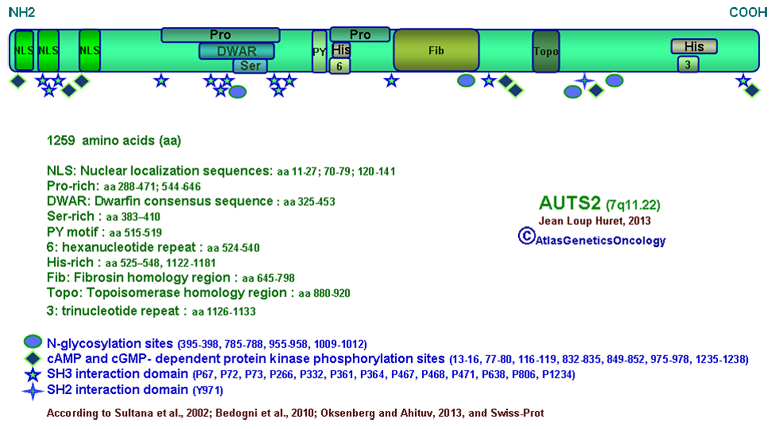
AUTS2 protein and domains.
Description
1259 amino acids (aa); from N-term to C-term, AUTS2 contains: nuclear localization sequences (aa: 11-27; 70-79; 120-141); Pro-rich regions (aa: 288-471; 544-646); a Dwarfin consensus sequence (aa: 325-453); a Ser-rich region (aa: 383-410); a PY motif (aa: 515-519); a hexanucleotide repeat (aa: 524-540; (cagcac/cagcac/cagcac/cagcac/acc/cac/cagcac/cagcac/cagcac) at nucleotide 1901-1949 (exon 9)); His-rich regions (aa: 525-548, 1122-1181); a Fibrosin homology region (aa: 645-798); a topoisomerase homology region (aa: 880-920); a trinucleotide repeat (aa: 1126-1133 (cac)8, at nucleotide 3701-3732 (exon 19)), and also N-glycosylation sites (aa 395-398, 785-788, 955-958, 1009-1012), cAMP and cGMP- dependent protein kinase phosphorylation sites (aa: 13-16, 77-80, 116-119, 832-835, 849-852, 975-978, 1235-1238), SH3 interaction domains (P67, P72, P73, P266, P332, P361, P364, P467, P468, P471, P638, P806, P1234), and a SH2 interaction domain (Y971) (Sultana et al., 2002; Bedogni et al., 2010b; Oksenberg and Ahituv, 2013).
Expression
AUTS2 is primarily expressed in the central nervous system, and also in skeletal muscle and kidney, and with lower expression in other tissues (placenta, lung, and leukocytes) (Sultana et al., 2002). AUTS2 is highly expressed in the embryo, and in more restricted areas in the adult (Oksenberg and Ahituv, 2013).
Auts2 in the mouse embryo is expressed in the cortical preplate, in frontal cortex, hippocampus and cerebellum, including Purkinje cells and deep nuclei, in developing dorsal thalamus, olfactory bulb, inferior colliculus and substantia nigra (Bedogni et al., 2010a).
Auts2 in the mouse embryo is expressed in the cortical preplate, in frontal cortex, hippocampus and cerebellum, including Purkinje cells and deep nuclei, in developing dorsal thalamus, olfactory bulb, inferior colliculus and substantia nigra (Bedogni et al., 2010a).
Localisation
AUTS2 is a nuclear protein.
Function
TBR1, a postmitotic projection-neuron specific transcription factor, binds the AUTS2 promoter and activates AUTS2 in developing neocortex in vivo (Bedogni et al., 2010b; Srinivasan et al., 2012). Suppression of auts2 in zebrafish embryos caused microcephaly, and a reduction in developing midbrain neurons and also in sensory and motor neurons (Beunders et al., 2013; Oksenberg et al., 2013). ZMAT3 (a target gene of TP53) downregulation produced significant reductions in AUTS2 mRNA levels (Sedaghat et al., 2012).
Enhancers that were mutated in patients with dyslexia or with autism spectrum disorder were described; AUTS2 has been found as a rapidly evolving gene in homo sapiens sapiens, compared to Neanderthals, and non-human primates. It is suggested that AUTS2 has an important role in the evolution of human cognitive traits (Oksenberg et al., 2013).
Enhancers that were mutated in patients with dyslexia or with autism spectrum disorder were described; AUTS2 has been found as a rapidly evolving gene in homo sapiens sapiens, compared to Neanderthals, and non-human primates. It is suggested that AUTS2 has an important role in the evolution of human cognitive traits (Oksenberg et al., 2013).
Implicated in
Entity name
t(7;9)(q11;p13) PAX5/AUTS2
Note
PAX5 is involved in B-cell differentiation. Entry of common lymphoid progenitors into the B cell lineage depends on E2A, EBF1, and PAX5. Genes repressed by PAX5 expression in early B cells are restored in their function in mature B cells and plasma cells, and PAX5 repressed (Medvedovic et al., 2011).
Disease
Pediatric B-cell precursor acute lymphoblastic leukemia (BCP-ALL).
Prognosis
Three cases to date, two boys and one girl, aged 0.6, 2.8, and 3.1 years (Kawamata 2008; Coyaud et al., 2010; Denk et al., 2012). Two patients presented with a high WBC, and also had a central nervous system involvement at a time during course of the disease. Patients were assigned to different risk arms of the respective clinical trials, as noted by Denk et al., 2012. The three patients achieved complete remission (CR), but two (those with high risk features) relapsed and died at 1.7 and 3.4 years after diagnosis, indicating a rather poor outcome (Denk et al., 2012). Only one patient is still in CR and well 2.2 years after diagnosis.
Cytogenetics
The t(7;9)(q11;p13) was the sole abnormality in one case. Unbalanced translocation in two cases, due to the loss of the der(7)t(7;9).
Hybrid gene
5 PAX5-3 AUTS2. Fusion of PAX5 exon 6 to AUTS2 exon 4 or 6.
Fusion protein
1289 or 1311 amino acids depending on whether exon 6 or 4 of AUTS2 is fused to PAX5. The predicted fusion protein contains the paired domain, the octapeptide, and the homeodomain of PAX5 and the proline rich, the Dwarfin consensus sequence, the serine rich, the PY motif, the hexanucleotide repeat, the histidine rich, the fibrosin homology region, the topoisomerase homology region, and the trinucleotide repeat of AUTS2.
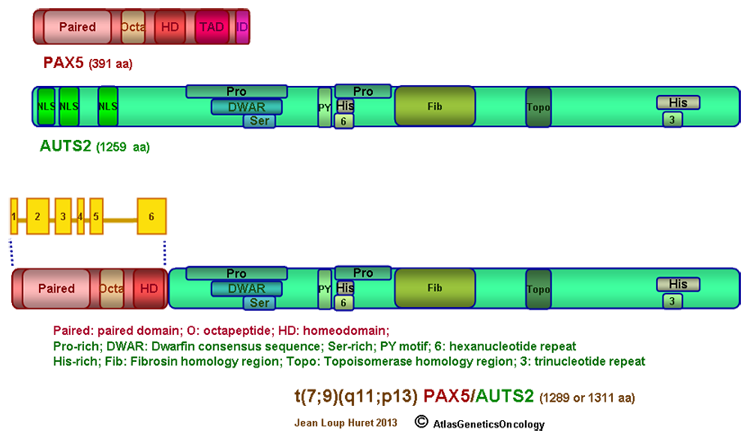
Fusion protein PAX5/AUTS2.
Entity name
Other cancers
Disease
Loss of heterozygocity was found in an adenocarcinoma of the lung, but more data is needed (Weir et al., 2007). Copy number variation was found in a single case of mixed germ cell tumor containing yolk sac tumor and teratoma (Stadler et al., 2012).
Entity name
Syndromic phenotype, mental retardation, neurodevelopmental and psychiatric disorders, including autism spectrum disorder
Note
A review in Oksenberg and Ahituv, 2013 shows a map of the gene with the structural variants and abnormalities in relation to the various phenotypes described.
Disease
Syndromic phenotype: A study on 24 patients with deletions of part of AUTS2 allowed the identification of a variable syndromic phenotype including intellectual disability, autism, short stature, microcephaly, cerebral palsy, and facial dysmorphisms. The authors delineated an "AUTS2 syndrome severity score" of the phenotypic diversity, that correlated with genotypic data: individuals with deletions in the 5 part of the gene showed a milder phenotype than those with a deletion in the 3 part of the gene (Beunders et al., 2013).
Mental retardation: A patient with developmental delay had an intragenic deletion within AUTS2 (Jolley et al., 2013). Three unrelated mentally disabled patients were found to carry a balanced translocation that truncates AUTS2. Patients were borderline or severely mentally retarded and carried different deletions in AUTS2 (Kalscheuer et al., 2007). AUTS2 has been found disrupted in balanced chromosomal abnormality in patients with abnormal neurodevelopment (Huang et al., 2010; Talkowski et al., 2012).
Autism spectrum disorder (ASD): Small copy-number variations (CNVs) that disrupt AUTS2 (duplications or deletions of exons) were found in two patients with developmental delay, and two with autism spectrum disorder (Nagamani et al., 2013). AUTS2 has been found disrupted in a monozygotic twin pair concordant for autism (Sultana et al., 2002). Duplication in the AUTS2 gene was identified in a family with ASD (Ben-David et al., 2011).
Pathological behaviour: A variant in AUTS2 was associated with excessive alcohol consumption (Edenberg and Foroud, 2013; Kapoor et al., 2013). AUTS2 variants (rs6943 allele A) are correlated with heroin dependence, and reduced AUTS2 gene expression might confer increased susceptibility (Chen et al., 2013). rs6943555 A allele was also found associated with alcohol consumption (Schumann et al., 2011), and with suicide committed after drinking (Chojnicka et al., 2013). Amino acids sequence variant in AUTS2 were found in a large family with high risk for suicide, but also with a significant co-morbidity for affective disorders, alcohol disorders, psychotic disorders, and drug abuse disorders (Coon et al., 2013).
Epilepsy: AUTS2 deletions were identified in one patient with juvenile myoclonic epilepsy and in another patient with an unclassified non-lesional epilepsy with features of atypical benign partial epilepsy (Mefford et al., 2010).
Mental retardation: A patient with developmental delay had an intragenic deletion within AUTS2 (Jolley et al., 2013). Three unrelated mentally disabled patients were found to carry a balanced translocation that truncates AUTS2. Patients were borderline or severely mentally retarded and carried different deletions in AUTS2 (Kalscheuer et al., 2007). AUTS2 has been found disrupted in balanced chromosomal abnormality in patients with abnormal neurodevelopment (Huang et al., 2010; Talkowski et al., 2012).
Autism spectrum disorder (ASD): Small copy-number variations (CNVs) that disrupt AUTS2 (duplications or deletions of exons) were found in two patients with developmental delay, and two with autism spectrum disorder (Nagamani et al., 2013). AUTS2 has been found disrupted in a monozygotic twin pair concordant for autism (Sultana et al., 2002). Duplication in the AUTS2 gene was identified in a family with ASD (Ben-David et al., 2011).
Pathological behaviour: A variant in AUTS2 was associated with excessive alcohol consumption (Edenberg and Foroud, 2013; Kapoor et al., 2013). AUTS2 variants (rs6943 allele A) are correlated with heroin dependence, and reduced AUTS2 gene expression might confer increased susceptibility (Chen et al., 2013). rs6943555 A allele was also found associated with alcohol consumption (Schumann et al., 2011), and with suicide committed after drinking (Chojnicka et al., 2013). Amino acids sequence variant in AUTS2 were found in a large family with high risk for suicide, but also with a significant co-morbidity for affective disorders, alcohol disorders, psychotic disorders, and drug abuse disorders (Coon et al., 2013).
Epilepsy: AUTS2 deletions were identified in one patient with juvenile myoclonic epilepsy and in another patient with an unclassified non-lesional epilepsy with features of atypical benign partial epilepsy (Mefford et al., 2010).
Article Bibliography
| Pubmed ID | Last Year | Title | Authors |
|---|---|---|---|
| 20615956 | 2010 | Tbr1 regulates regional and laminar identity of postmitotic neurons in developing neocortex. | Bedogni F et al |
| 21680558 | 2011 | Identification of a functional rare variant in autism using genome-wide screen for monoallelic expression. | Ben-David E et al |
| 23332918 | 2013 | Exonic deletions in AUTS2 cause a syndromic form of intellectual disability and suggest a critical role for the C terminus. | Beunders G et al |
| 22995765 | 2013 | Genetic analysis of AUTS2 as a susceptibility gene of heroin dependence. | Chen YH et al |
| 23437340 | 2013 | Possible association between suicide committed under influence of ethanol and a variant in the AUTS2 gene. | Chojnicka I et al |
| 24252905 | 2013 | Genetic risk factors in two Utah pedigrees at high risk for suicide. | Coon H et al |
| 20723977 | 2010 | PAX5-AUTS2 fusion resulting from t(7;9)(q11.2;p13.2) can now be classified as recurrent in B cell acute lymphoblastic leukemia. | Coyaud E et al |
| 22578776 | 2012 | PAX5-AUTS2: a recurrent fusion gene in childhood B-cell precursor acute lymphoblastic leukemia. | Denk D et al |
| 23712313 | 2013 | Genetics and alcoholism. | Edenberg HJ et al |
| 20635338 | 2010 | A de novo balanced translocation breakpoint truncating the autism susceptibility candidate 2 (AUTS2) gene in a patient with autism. | Huang XL et al |
| 23650183 | 2013 | De novo intragenic deletion of the autism susceptibility candidate 2 (AUTS2) gene in a patient with developmental delay: a case report and literature review. | Jolley A et al |
| 17211639 | 2007 | Mutations in autism susceptibility candidate 2 (AUTS2) in patients with mental retardation. | Kalscheuer VM et al |
| 23743675 | 2013 | A meta-analysis of two genome-wide association studies to identify novel loci for maximum number of alcoholic drinks. | Kapoor M et al |
| 18697940 | 2008 | Cloning of genes involved in chromosomal translocations by high-resolution single nucleotide polymorphism genomic microarray. | Kawamata N et al |
| 21970955 | 2011 | Pax5: a master regulator of B cell development and leukemogenesis. | Medvedovic J et al |
| 20502679 | 2010 | Genome-wide copy number variation in epilepsy: novel susceptibility loci in idiopathic generalized and focal epilepsies. | Mefford HC et al |
| 22872102 | 2013 | Detection of copy-number variation in AUTS2 gene by targeted exonic array CGH in patients with developmental delay and autistic spectrum disorders. | Nagamani SC et al |
| 23349641 | 2013 | Function and regulation of AUTS2, a gene implicated in autism and human evolution. | Oksenberg N et al |
| 21471458 | 2011 | Genome-wide association and genetic functional studies identify autism susceptibility candidate 2 gene (AUTS2) in the regulation of alcohol consumption. | Schumann G et al |
| 22347364 | 2012 | Genomic analysis of wig-1 pathways. | Sedaghat Y et al |
| 23144223 | 2012 | A network of genetic repression and derepression specifies projection fates in the developing neocortex. | Srinivasan K et al |
| 22863192 | 2012 | Rare de novo germline copy-number variation in testicular cancer. | Stadler ZK et al |
| 12160723 | 2002 | Identification of a novel gene on chromosome 7q11.2 interrupted by a translocation breakpoint in a pair of autistic twins. | Sultana R et al |
| 22521361 | 2012 | Sequencing chromosomal abnormalities reveals neurodevelopmental loci that confer risk across diagnostic boundaries. | Talkowski ME et al |
| 17982442 | 2007 | Characterizing the cancer genome in lung adenocarcinoma. | Weir BA et al |
Other Information
Locus ID:
NCBI: 26053
MIM: 607270
HGNC: 14262
Ensembl: ENSG00000158321
Variants:
dbSNP: 26053
ClinVar: 26053
TCGA: ENSG00000158321
COSMIC: AUTS2
RNA/Proteins
Expression (GTEx)
Protein levels (Protein atlas)
References
| Pubmed ID | Year | Title | Citations |
|---|---|---|---|
| 37816306 | 2024 | Isolated loss of the AUTS2 long isoform, brain-wide or targeted to Calbindin-lineage cells, generates a specific suite of brain, behavioral, and molecular pathologies. | 0 |
| 37816306 | 2024 | Isolated loss of the AUTS2 long isoform, brain-wide or targeted to Calbindin-lineage cells, generates a specific suite of brain, behavioral, and molecular pathologies. | 0 |
| 35802027 | 2023 | Cerebral organoids containing an AUTS2 missense variant model microcephaly. | 10 |
| 36864756 | 2023 | Structural polymorphism driven by a register shift in a CGAG-rich region found in the promoter of the neurodevelopmental regulator AUTS2 gene. | 1 |
| 35802027 | 2023 | Cerebral organoids containing an AUTS2 missense variant model microcephaly. | 10 |
| 36864756 | 2023 | Structural polymorphism driven by a register shift in a CGAG-rich region found in the promoter of the neurodevelopmental regulator AUTS2 gene. | 1 |
| 35525889 | 2022 | Highly diverse phenotypes of mucopolysaccharidosis type IIIB sibling patients: effects of an additional mutation in the AUTS2 gene. | 2 |
| 35525889 | 2022 | Highly diverse phenotypes of mucopolysaccharidosis type IIIB sibling patients: effects of an additional mutation in the AUTS2 gene. | 2 |
| 33562463 | 2021 | Whole Exome Sequencing Reveals a Novel AUTS2 In-Frame Deletion in a Boy with Global Developmental Delay, Absent Speech, Dysmorphic Features, and Cerebral Anomalies. | 7 |
| 33577136 | 2021 | Germ cell mosaicism for AUTS2 exon 6 deletion. | 2 |
| 34573342 | 2021 | Attention Deficit Hyperactivity and Autism Spectrum Disorders as the Core Symptoms of AUTS2 Syndrome: Description of Five New Patients and Update of the Frequency of Manifestations and Genotype-Phenotype Correlation. | 10 |
| 34637754 | 2021 | NRF1 association with AUTS2-Polycomb mediates specific gene activation in the brain. | 17 |
| 33562463 | 2021 | Whole Exome Sequencing Reveals a Novel AUTS2 In-Frame Deletion in a Boy with Global Developmental Delay, Absent Speech, Dysmorphic Features, and Cerebral Anomalies. | 7 |
| 33577136 | 2021 | Germ cell mosaicism for AUTS2 exon 6 deletion. | 2 |
| 34573342 | 2021 | Attention Deficit Hyperactivity and Autism Spectrum Disorders as the Core Symptoms of AUTS2 Syndrome: Description of Five New Patients and Update of the Frequency of Manifestations and Genotype-Phenotype Correlation. | 10 |
Citation
Jean-Loup Huret
AUTS2 (autism susceptibility candidate 2)
Atlas Genet Cytogenet Oncol Haematol. 2013-10-01
Online version: http://atlasgeneticsoncology.org/gene/51794/auts2-(autism-susceptibility-candidate-2)
