ERG (v-ets erythroblastosis virus E26 oncogene like (avian))
2010-11-01 Roopika Menon , Martin Braun , Sven Perner AffiliationIdentity
HGNC
LOCATION
21q22.2
IMAGE

LEGEND
Probe(s) - Courtesy Mariano Rocchi, Resources for Molecular Cytogenetics.
LOCUSID
ALIAS
erg-3,p55
FUSION GENES
DNA/RNA
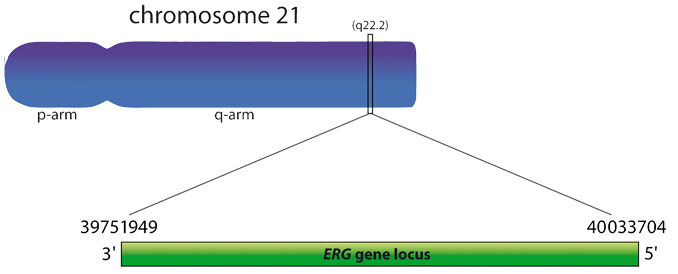
ERG gene locus on the q-arm of chromosome 21 (21q22.2) spanning from 39751949 to 40033704 (according to UCSC genome browser, Feb. 2009 GRCh37/hg19, and Ensemble, Aug. 2010).
Description
The ERG gene belongs to the erythroblast transformation-specific (ETS) family of transcriptions factors. The ERG gene (ETS related gene 1) is located on chromosome 21, and consists of 17 exons, approximately 300 kb DNA in length.
Transcription
The ERG gene forms 20 known transcripts (ranging from 560 to 5034 bp in length), amongst which 15 are coding for proteins, and 5 are non-coding. 8 alternative splice variants are known.
Pseudogene
No observed pseudogenes.
Proteins
Description
Amongst the 20 known transcripts of the ERG gene, 15 are protein coding. The 15 proteins range from 171 to 486 amino acids in length, and up to 55 kDa in weight.
Expression
On the protein level, ERG is mainly expressed in the nucleus and is rarely seen in the cytoplasm. Basically, in the GNF SymAtlas database, major ERG expression was found to be in CD34+ cells (that include both hematopoietic stem cells and endothelial cells). In detail, ERG is reported to be expressed during early T and B cell development, and down-regulated in later stages of B and T cell differentiation. Also, ERG is expressed in platelets, megakaryoblastic cell lines, primary megakaryoblastic leukemia (AMKL or M7-AML) in Down syndrome patients. Furthermore, ERG is strongly expressed in ERG gene rearranged prostate tissue (both in prostatic cancer tissue and adjacent prostatic intraepithelial neoplasia lesions). Of note, using immunohistochemistry, ERG expression is regularly observed in lymphocytes and small blood vessels.
Localisation
Predominantely nuclear and rarely cytoplasmic.
Function
The ERG protein is a member of the ETS-family and is known to bind to purine-rich sequences. ERG and other members of the same family are downstream regulators of mitogenic signal transduction pathways. They are key regulators of embryonic development, cell proliferation, differentiation, angiogenesis, inflammation, and apoptosis. At the DNA level, isoforms of ERG are known to regulate methylation. Further, ERG is required for platelet adhesion to the subendothelium, inducing vascular cell remodeling. Moreover, hematopoesis, as well as the differentiation and maturation of megakaryocytic cells are regulated by ERG. Overexpression of the ERG protein is suggested to aid in forming solid tumors. However, the exact molecular mechanisms of ERG as a transcription factor are still unknown.
Homology
A member of the ETS transcription factors, most homologous to FLI1.
Mutations
Note
No known mutations.
Implicated in
Entity name
Ewings sarcoma
Prognosis
The prognostic relevance of an ERG gene fusion or an ERG overexpression in Ewings sarcoma (EWS-ETS fusion type) is yet to be determined. So far, no prognostic relevance could be shown.
Hybrid gene
If a gene fusion occurs in Ewings sarcoma, most frequently it is a fusion of EWS to FLI-1 (in app. 85% of cases) or ERG (in app. 10% of cases). Other ETS genes rarely serve as EWS gene fusion partners (in app. 5% of cases).
Fusion protein
The EWS gene fuses with the carboxyl terminal of ERG containing the ETS DNA binding domain of ERG. Therefore, the resulting fusion protein deregulates a large number of genes by so far poorly defined mechanisms.
Oncogenesis
In a transgenic mouse model expression of the EWS-ERG in lymphoid progenitors induced T-cell leukemia.
Entity name
Acute myeloid leukemia (AML)
Prognosis
Several studies suggest a poorer prognosis for FUS-ERG gene fusion positive AML as compared to non-fused AML. Moreover, an ERG overexpression, not necessarily due to the FUS-ERG gene fusion, predicts an increased relapse risk and shorter survival in AML patients. However, the exact contribution of ERG overexpression to myeloid leukemiogenesis and progression is still unknown.
Hybrid gene
In the FUS-ERG gene fusion, the FUS gene fuses with the carboxyl terminal of ERG containing the ETS DNA binding domain of ERG. Of note, in a single case, a gene fusion of ERG with the myeloid ELF-like factor 1 (ELF4) was detected.
Oncogenesis
The FUS-ERG fusion protein helps in activating the oncogenic activity of transcription factors.
Entity name
Prostate cancer
Prognosis
The body of literature is controversial about the prognostic relevance of ERG rearrangements in prostate cancer. Some studies reported an association of the ERG rearrangement with adverse clinical parameters (i.e. time to prostate cancer specific death and the development of hormone-refractory metastasis). On the other hand, some studies demonstrated an association of ERG rearrangement with parameters of more favourable outcome, such as lower Gleason score, stage, volume, better overall survival, or late biochemical recurrence. Interestingly, a subset of studies without any such association was reported as well.
Hybrid gene
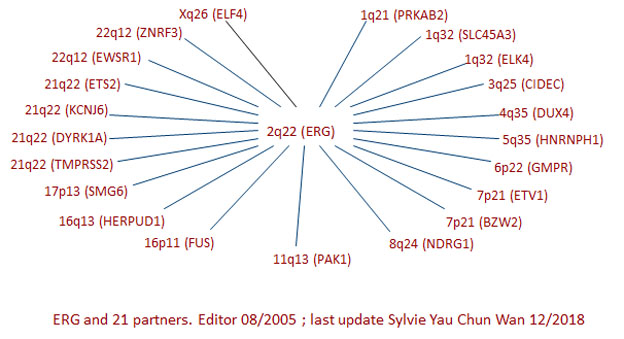
In approximately 50% of prostate cancers, the ERG gene is rearranged, i.e. fused to another gene. In case of a rearrangement, TMPRSS2 is the ERG 5 fusion partner in the vast majority of cases (app. 85%). Other known, but rarely occurring ERG fusion partners include NDRG1, SLC45A3, and HERPUD1. The ERG gene rearrangement either occurs due to a deletion, or an insertion.
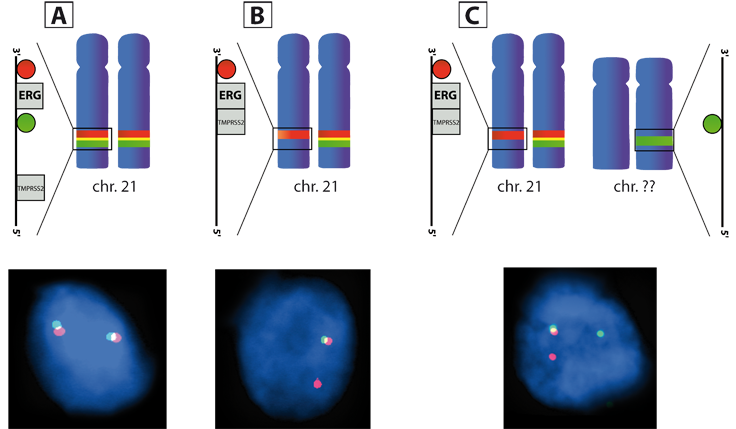
Schematic displaying ERG rearrangement status (via FISH) in prostate cancer. The red-labelled centromeric and the green-labelled telomeric probes span the ERG locus on chromosomes 21. If a break-apart occurs, the green signal is either lost (ERG rearrangement through deletion) or translocated (ERG rearrangement through insertion). An ERG break-apart as determined by FISH accounts for a fusion of ERG mainly with TMPRSS2 but also with other 5 fusion partners such as SLC45A3, HERPUD1, or NDRG1. A: Both alleles with wild type (wt) ERG. B: One allele with ERG rearrangement through deletion (single red signal) and the other allele with wt ERG (yellow signal). C: One allele with ERG rearrangement through insertion (separated red and green signal) and the other allele with wt ERG (yellow signal).
Fusion protein
An ERG gene rearrangement in prostate cancer mainly results in an androgen dependant ERG overexpression.
Oncogenesis
In-vitro models complement that over expression of truncated ERG and various TMPRSS2-ERG isoforms increase cell migration and invasion. In-vivo recapitulation of ETS fusions by prostate specific expression of truncated ERG in mice resulted in the development of PIN but not carcinoma. Subsequent work on transgenic TMPRSS2-ERG mice develop PIN progressing to invasive cancer, but only in the context of PI3-kinase pathway activation. TMPRSS2-ERG-positive human tumors are also enriched for PTEN loss, suggesting cooperation in prostate tumorigenesis.
Entity name
Acute lymphoblastic leukemia (ALL)
Prognosis
Overexpression of ERG was shown to be a risk factor in adult T-ALL. ALL patients with ERG overexpression were four times more likely to fail long-term recurrence free survival, indicating inferior survival.
Oncogenesis
Studies assessing ERG overexpression in ALL have shown that due to the involvement of ERG in T-cell development, it may have an oncogenic potential.
Entity name
Prognosis
Even though ERG is highly considered to be oncogenic in AMKL, no prognostic relevance has been determined.
Oncogenesis
ERG was found to be expressed megakaryoblastic leukemic cell lines and in primary leukemic cells from DS patients. Moreover, in mouse models, expression of ERG drove megakaryopoiesis and lead to a rapid development of aggressive leukemia.
Entity name
Alzheimers disease (AD)
Note
ERG has been linked to AD, due to an ERG protein overexpression as compared to control patients. This is further supported by experiments conducted on patients suffering from Down syndrome, who gradually develop AD-like symptoms, linked to ERG overexpression.
Entity name
Down syndrome (DS)
Note
DS is associated with trisomy of the chromosome 21, where the ERG gene is located. The trisomy is considered to be responsible for an ERG overexpression. In a DS mouse model, an induced functional disomy of the ERG allele corrects some pathologic features of the disease, including myeloproliferation and progenitor cell expansion, suggesting a pathogenic effect of trisomy driven ERG overexpression.
Entity name
ERG involvement in endothelial development
Note
ERG has been reported to regulate genes involved in chondrogenesis and angiogenesis and functions as a modulator of endothelial cell differentiation. In an in-vitro study, the decrease of the ERG protein follows a reduction in endothelial cell proliferation and vascular tube formation. In human umbilical vein endothelial cell lines, vascular endothelial growth factor (VEGF) was seen to significantly up-regulate ERG expression. Controversially, on the other hand, ERG expression was shown to inhibit responsiveness to the VEGF receptor in a Down Syndrome mouse model.
Entity name
ERG involvement in lymphoid development
Note
ERG was reported to be expressed in during early T and B cell development, and to be down-regulated in later stages of B and T cell differentiation. In detail, the ERG protein modulates the maturation of lymphoid cells. Interestingly, ERG overexpression is associated with T-ALL.
Breakpoints
Article Bibliography
| Pubmed ID | Last Year | Title | Authors |
|---|---|---|---|
| 16448544 | 2006 | At the crossroads: diverse roles of early thymocyte transcriptional regulators. | Anderson MK et al |
| 16954520 | 2006 | High expression of the ETS transcription factor ERG predicts adverse outcome in acute T-lymphoblastic leukemia in adults. | Baldus CD et al |
| 15007164 | 2004 | Acute myeloid leukemia with complex karyotypes and abnormal chromosome 21: Amplification discloses overexpression of APP, ETS2, and ERG genes. | Baldus CD et al |
| 20068566 | 2010 | Prostate cancer genes associated with TMPRSS2-ERG gene fusion and prognostic of biochemical recurrence in multiple cohorts. | Barwick BG et al |
| 19716227 | 2010 | Expression of the androgen-regulated fusion gene TMPRSS2-ERG does not predict response to endocrine treatment in hormone-naïve, node-positive prostate cancer. | Boormans JL et al |
| 19396168 | 2009 | Aberrant ERG expression cooperates with loss of PTEN to promote cancer progression in the prostate. | Carver BS et al |
| 20570349 | 2011 | The role of microRNA-196a and microRNA-196b as ERG regulators in acute myeloid leukemia and acute T-lymphoblastic leukemia. | Coskun E et al |
| 20697343 | 2010 | Trisomic dose of several chromosome 21 genes perturbs haematopoietic stem and progenitor cell differentiation in Down's syndrome. | De Vita S et al |
| 8510931 | 1993 | New human erg isoforms generated by alternative splicing are transcriptional activators. | Duterque-Coquillaud M et al |
| 19555438 | 2010 | BAALC and ERG expression in acute myeloid leukemia with normal karyotype: impact on prognosis. | Eid MA et al |
| 20693982 | 2010 | ERG rearrangement is present in a subset of transition zone prostatic tumors. | Falzarano SM et al |
| 8040301 | 1994 | EWS-erg and EWS-Fli1 fusion transcripts in Ewing's sarcoma and primitive neuroectodermal tumors with variant translocations. | Giovannini M et al |
| 20671189 | 2010 | Identification of a cell of origin for human prostate cancer. | Goldstein AS et al |
| 20713528 | 2010 | FZD4 as a mediator of ERG oncogene-induced WNT signaling and epithelial-to-mesenchymal transition in human prostate cancer cells. | Gupta S et al |
| 20601956 | 2010 | Androgen-induced TOP2B-mediated double-strand breaks and prostate cancer gene rearrangements. | Haffner MC et al |
| 20546020 | 2010 | ETS-related gene ERG expression in AML patients is significantly associated with NPM1 mutation status. | Hämäläinen M et al |
| 20220513 | 2010 | ETS gene aberrations in atypical cribriform lesions of the prostate: Implications for the distinction between intraductal carcinoma of the prostate and cribriform high-grade prostatic intraepithelial neoplasia. | Han B et al |
| 20432469 | 2010 | Expression profiling of ETS and MMP factors in VEGF-activated endothelial cells: role of MMP-10 in VEGF-induced angiogenesis. | Heo SH et al |
| 11312105 | 2001 | Selective expression of erg isoforms in human endothelial cells. | Hewett PW et al |
| 11680687 | 2001 | The role of ERG (ets related gene) in cartilage development. | Iwamoto M et al |
| 20633768 | 2010 | Complex rearrangement of chromosomes 1, 7, 21, 22 in Ewing sarcoma. | Jinawath N et al |
| 19396167 | 2009 | Cooperativity of TMPRSS2-ERG with PI3-kinase pathway activation in prostate oncogenesis. | King JC et al |
| 9242552 | 1997 | Consistent detection of TLS/FUS-ERG chimeric transcripts in acute myeloid leukemia with t(16;21)(p11;q22) and identification of a novel transcript. | Kong XT et al |
| 20479932 | 2010 | ETS transcription factors control transcription of EZH2 and epigenetic silencing of the tumor suppressor gene Nkx3.1 in prostate cancer. | Kunderfranco P et al |
| 20808444 | 2010 | VE-statin/egfl7 expression in endothelial cells is regulated by a distal enhancer and a proximal promoter under the direct control of Erg and GATA-2. | Le Bras A et al |
| 20308673 | 2010 | Impact of EWS-ETS fusion type on disease progression in Ewing's sarcoma/peripheral primitive neuroectodermal tumor: prospective results from the cooperative Euro-E.W.I.N.G. 99 trial. | Le Deley MC et al |
| 20800881 | 2010 | TMPRSS2-ERG gene fusion and clinicopathologic characteristics of Korean prostate cancer patients. | Lee K et al |
| 20442300 | 2010 | Association of SPINK1 expression and TMPRSS2:ERG fusion with prognosis in endocrine-treated prostate cancer. | Leinonen KA et al |
| 18500345 | 2008 | The transcription factor Erg is essential for definitive hematopoiesis and the function of adult hematopoietic stem cells. | Loughran SJ et al |
| 20878952 | 2011 | TMPRSS2-ERG gene fusion prevalence and class are significantly different in prostate cancer of Caucasian, African-American and Japanese patients. | Magi-Galluzzi C et al |
| 20617339 | 2010 | CD99-positive large cell neuroendocrine carcinoma with rearranged EWSR1 gene in an infant: a case of prognostically favorable tumor. | Malone VS et al |
| 20516122 | 2010 | Distinct genomic alterations in prostate cancers in Chinese and Western populations suggest alternative pathways of prostate carcinogenesis. | Mao X et al |
| 16275934 | 2005 | Overexpression of the ETS-related gene, ERG, predicts a worse outcome in acute myeloid leukemia with normal karyotype: a Cancer and Leukemia Group B study. | Marcucci G et al |
| 11719371 | 2001 | Combined genomic and antisense analysis reveals that the transcription factor Erg is implicated in endothelial cell differentiation. | McLaughlin F et al |
| 16303180 | 2006 | ELF4 is fused to ERG in a case of acute myeloid leukemia with a t(X;21)(q25-26;q22). | Moore SD et al |
| 20007548 | 2010 | Trisomy of Erg is required for myeloproliferation in a mouse model of Down syndrome. | Ng AP et al |
| 20620604 | 2010 | Two childhood cases of acute leukemia with t(16;21)(p11.2;q22): second case report of infantile acute lymphoblastic leukemia with unusual type of FUS-ERG chimeric transcript. | Oh SH et al |
| 12559563 | 2003 | Molecular biology of the Ets family of transcription factors. | Oikawa T et al |
| 15298723 | 2004 | ETS transcription factors: possible targets for cancer therapy. | Oikawa T et al |
| 20676125 | 2010 | A previously unrecognized promoter of LMO2 forms part of a transcriptional regulatory circuit mediating LMO2 expression in a subset of T-acute lymphoblastic leukaemia patients. | Oram SH et al |
| 14693372 | 2004 | Detailed mapping of the ERG-ETS2 interval of human chromosome 21 and comparison with the region of conserved synteny on mouse chromosome 16. | Owczarek CM et al |
| 20651988 | 2010 | Antibody-based detection of ERG rearrangement-positive prostate cancer. | Park K et al |
| 20018353 | 2010 | ERG rearrangement metastasis patterns in locally advanced prostate cancer. | Perner S et al |
| 20687225 | 2010 | An in vitro model for preclinical testing of endocrine therapy combinations for prostate cancer. | Pfeiffer MJ et al |
| 16140924 | 2005 | The proto-oncogene ERG in megakaryoblastic leukemias. | Rainis L et al |
| 20535211 | 2010 | Tumour angiogenesis is reduced in the Tc1 mouse model of Down's syndrome. | Reynolds LE et al |
| 20160063 | 2010 | Evaluation of the ETS-related gene mRNA in urine for the detection of prostate cancer. | Rice KR et al |
| 20303538 | 2010 | Clinical implications of TMPRSS2-ERG gene fusion expression in patients with prostate cancer treated with radical prostatectomy. | Rubio-Briones J et al |
| 19487285 | 2009 | ERG is a megakaryocytic oncogene. | Salek-Ardakani S et al |
| 20636794 | 2010 | ERG rearrangement in small cell prostatic and lung cancer. | Scheble VJ et al |
| 20860828 | 2010 | Changes in cortical cytoskeletal and extracellular matrix gene expression in prostate cancer are related to oncogenic ERG deregulation. | Schulz WA et al |
| 20424012 | 2010 | Isolation and characterization of circulating tumor cells from patients with localized and metastatic prostate cancer. | Stott SL et al |
| 20579941 | 2010 | Integrative genomic profiling of human prostate cancer. | Taylor BS et al |
| 19409690 | 2009 | ETS gene fusions in prostate cancer: from discovery to daily clinical practice. | Tomlins SA et al |
| 20147525 | 2010 | 1{alpha},25-Dihydroxyvitamin D3 inhibits growth of VCaP prostate cancer cells despite inducing the growth-promoting TMPRSS2:ERG gene fusion. | Washington MN et al |
| 20517297 | 2010 | Genome-wide analysis of ETS-family DNA-binding in vitro and in vivo. | Wei GH et al |
| 20887958 | 2010 | Combinatorial transcriptional control in blood stem/progenitor cells: genome-wide analysis of ten major transcriptional regulators. | Wilson NK et al |
| 12086872 | 2002 | Classification, subtype discovery, and prediction of outcome in pediatric acute lymphoblastic leukemia by gene expression profiling. | Yeoh EJ et al |
| 20478527 | 2010 | An integrated network of androgen receptor, polycomb, and TMPRSS2-ERG gene fusions in prostate cancer progression. | Yu J et al |
| 20308669 | 2010 | Current treatment protocols have eliminated the prognostic advantage of type 1 fusions in Ewing sarcoma: a report from the Children's Oncology Group. | van Doorninck JA et al |
| 16237084 | 2005 | Ig gene rearrangement steps are initiated in early human precursor B cell subsets and correlate with specific transcription factor expression. | van Zelm MC et al |
Other Information
Locus ID:
NCBI: 2078
MIM: 165080
HGNC: 3446
Ensembl: ENSG00000157554
Variants:
dbSNP: 2078
ClinVar: 2078
TCGA: ENSG00000157554
COSMIC: ERG
RNA/Proteins
Expression (GTEx)
Pathways
| Pathway | Source | External ID |
|---|---|---|
| Transcriptional misregulation in cancer | KEGG | ko05202 |
| Transcriptional misregulation in cancer | KEGG | hsa05202 |
Protein levels (Protein atlas)
References
| Pubmed ID | Year | Title | Citations |
|---|---|---|---|
| 38091230 | 2024 | ERG mediates the inhibition of NK cell cytotoxicity through the HLX/STAT4/Perforin signaling pathway, thereby promoting the progression of myocardial infarction. | 0 |
| 38309204 | 2024 | NKX2-1-AS1 promotes the lymphangiogenesis of lung adenocarcinoma through regulation of ERG-mediated FABP4. | 0 |
| 38457494 | 2024 | ERG and c-MYC regulate a critical gene network in BCR::ABL1-driven B cell acute lymphoblastic leukemia. | 0 |
| 38695236 | 2024 | An intricate regulatory circuit between FLI1 and GATA1/GATA2/LDB1/ERG dictates erythroid vs. megakaryocytic differentiation. | 0 |
| 38091230 | 2024 | ERG mediates the inhibition of NK cell cytotoxicity through the HLX/STAT4/Perforin signaling pathway, thereby promoting the progression of myocardial infarction. | 0 |
| 38309204 | 2024 | NKX2-1-AS1 promotes the lymphangiogenesis of lung adenocarcinoma through regulation of ERG-mediated FABP4. | 0 |
| 38457494 | 2024 | ERG and c-MYC regulate a critical gene network in BCR::ABL1-driven B cell acute lymphoblastic leukemia. | 0 |
| 38695236 | 2024 | An intricate regulatory circuit between FLI1 and GATA1/GATA2/LDB1/ERG dictates erythroid vs. megakaryocytic differentiation. | 0 |
| 35435050 | 2023 | ERG Expression is Helpful in Differentiating T-Lymphoblastic Lymphoma from Thymoma. | 0 |
| 36269819 | 2023 | EVI1 exerts distinct roles in AML via ERG and cyclin D1 promoting a chemoresistant and immune-suppressive environment. | 1 |
| 36637217 | 2023 | ERG Functionally Overlaps with Other Ets Proteins in Promoting TH9 Cell Expression of Il9 during Allergic Lung Inflammation. | 3 |
| 36657266 | 2023 | Novel high-risk acute myeloid leukemia subgroup with ERG amplification and Biallelic loss of TP53. | 1 |
| 36828362 | 2023 | ERG Status at the Margin Is Associated With Biochemical Recurrence After Radical Prostatectomy With Positive Surgical Margins. | 0 |
| 37317853 | 2023 | Cytokine-Mediated Degradation of the Transcription Factor ERG Impacts the Pulmonary Vascular Response to Systemic Inflammatory Challenge. | 1 |
| 37537199 | 2023 | Gain-of-function mutant p53 together with ERG proto-oncogene drive prostate cancer by beta-catenin activation and pyrimidine synthesis. | 3 |
Citation
Roopika Menon ; Martin Braun ; Sven Perner
ERG (v-ets erythroblastosis virus E26 oncogene like (avian))
Atlas Genet Cytogenet Oncol Haematol. 2010-11-01
Online version: http://atlasgeneticsoncology.org/gene/53/erg
Historical Card
2006-08-01 ERG (v-ets erythroblastosis virus E26 oncogene like (avian)) by Liat Rainis-Ganon,Shai Izraeli Affiliation
Head, Research section, Pediatric Hemato-Oncology, Cancer Research Center, Sheba Medical Center, Tel-Hashomer, Ramat Gan, Israel 52621
