EEF1E1-BLOC1S5
2020-03-01 Luigi Cristiano, MSc AffiliationAesthetic and medical biotechnologies research unit, Prestige, Terranuova Bracciolini, Italy; [email protected] - [email protected]
Identity
HGNC
LOCATION
6p24.3
LOCUSID
ALIAS
EEF1E1-BLOC1S5 readthrough,EEF1E1-MUTED,lnc-EEF1E1-2
FUSION GENES
Abstract
EEF1E1-BLOC1S5 is a long non-coding RNA that derives from the read-through transcription between the neighboring EEF1E1 and BLOC1S5 genes. This review collects the data on DNA\/RNA and the diseases where it is involved.
DNA/RNA
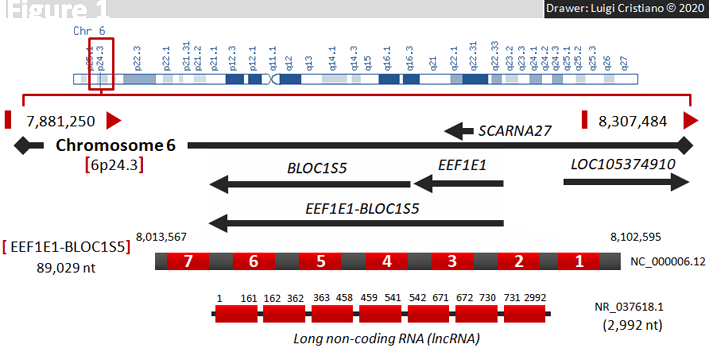
Figure. 1. EEF1E1-BLOC1S5 lncRNA. The figure shows the locus on chromosome 6 for EEF1E1-BLOC1S5 (reworked from https://www.ncbi.nlm.nih.gov/gene; http://grch37.ensembl.org; www.genecards.org)
Description
EEF1E1-BLOC1S5 was identified for the first time by Prakash and colleagues in 2010 (Prakash et al, 2010). It starts at 8,013,567 nt and ends at 8,102,595 nt from pter with a length of 89,029 bp. It counts 7 exons and the current reference sequence is NC_000006.12. Near to the genomic sequence of EEF1E1-BLOC1S5 there is a strong promoter transcriptional element that is located at +1.0 kb. Enhancer transcriptional elements are located at +38.2 Kb and at +18.1 Kb respectively.
Transcription
EEF1E1-BLOC1S5 counts 2,992 bp and it is a long non-coding RNA with reference sequence NR_037618.1. It derives from the read-through transcription between the neighboring EEF1E1 (eukaryotic translation elongation factor 1 epsilon 1) and MUTED (muted homolog) genes on chromosome 6. MUTED gene, alias BLOC1S5 (biogenesis of lysosomal organelles complex 1 subunit 5), is a component of BLOC-1 (biogenesis of lysosome-related organelles complex 1) complex that is involved in the biogenesis of organelles like melanosomes and platelet-dense granules.
It is a chimeric RNA, i.e. an RNA with a sequence derived from two genes and its transcriptional and post-transcriptional regulations could be the same as those of the other known-genes (He et al, 2018).
It was not possible to find experimentally a protein product for this chimeric RNA (Fagerberg et al, 2014), although in some databases is reported a theoretical protein product of 151 amino acids, with a predicted weight of 17,02 kDa and isoelectric point of 7.39 (https://www.uniprot.org/uniprot/C9J1V9; http://www.ensembl.org/Homo_sapiens/Transcript/ProteinSummary?g=ENSG00000265818;r=6:8015726-8102530;t=ENST00000397456). Therefore EEF1E1-BLOC1S5 is a candidate for nonsense-mediated mRNA decay (NMD) because it is unlikely to produce a protein product.
It is a chimeric RNA, i.e. an RNA with a sequence derived from two genes and its transcriptional and post-transcriptional regulations could be the same as those of the other known-genes (He et al, 2018).
It was not possible to find experimentally a protein product for this chimeric RNA (Fagerberg et al, 2014), although in some databases is reported a theoretical protein product of 151 amino acids, with a predicted weight of 17,02 kDa and isoelectric point of 7.39 (https://www.uniprot.org/uniprot/C9J1V9; http://www.ensembl.org/Homo_sapiens/Transcript/ProteinSummary?g=ENSG00000265818;r=6:8015726-8102530;t=ENST00000397456). Therefore EEF1E1-BLOC1S5 is a candidate for nonsense-mediated mRNA decay (NMD) because it is unlikely to produce a protein product.
Proteins
Expression
EEF1E1-BLOC1S5 ncRNA is transcribed (but not translated) widely in human tissues and normal cells. In memory B cells, it was found that the EEF1E1-BLOC1S5 is downregulated in the early gene expression (Day3-Day 0) following seasonal trivalent influenza vaccination in older individuals (Haralambieva et al, 2016)
Implicated in
Top note
LncRNAs are nowadays considered as emerging key regulators of cellular processes and they are often aberrantly expressed in various diseases (Kumar et al, 2019). EEF1E1-BLOC1S5 is not been still well-characterized, i.e. it is still unclear its physiologic role in the cell and its involvement in diseases when its expression is altered, however it is involved in some genomic translocations with the creation of several fusion genes (Table.1).
Table.1 EEF1E1-BLOC1S5 rearrangements: translocations and fusion genes (reworked from: http://www.tumorfusions.org; https://mitelmandatabase.isb-cgc.org/; http://quiver.archerdx.com; http://atlasgeneticsoncology.org//Bands/6p24.html#REFERENCES; https://fusionhub.persistent.co.in/home.html). [ (?) ] unknown; [ 1 ] Campbell et al, 2020; [ 2 ] Robinson et al, 2015; [ - ] no reference
| Name | 5 end | 3 end | Loc1 | Loc2 | Description | Type | Disease | Organ | Code | Ref. |
| EEF1E1-BLOC1S5/NCOR1 | EEF1E1-BLOC1S5 | NCOR1 | 6p24.3 | 17p12 | t(6;17)(p24;p12) | Translocation | Cancer | Prostate | - | 2 |
| EEF1E1-BLOC1S5 | EEF1E1 | BLOC1S5 | 6p24.3 | 6p24.3 | Readthrough transcription | Fusion gene | (?) | (?) | - | - |
| EEF1E1-BLOC1S5/ZNF384 | EEF1E1-BLOC1S5 | ZNF384 | 6p24.3 | 12p13.31 | t(6;12)(p24;p13) | Translocation | Cancer | Prostate | - | 2 |
Table.1 EEF1E1-BLOC1S5 rearrangements: translocations and fusion genes (reworked from: http://www.tumorfusions.org; https://mitelmandatabase.isb-cgc.org/; http://quiver.archerdx.com; http://atlasgeneticsoncology.org//Bands/6p24.html#REFERENCES; https://fusionhub.persistent.co.in/home.html). [ (?) ] unknown; [ 1 ] Campbell et al, 2020; [ 2 ] Robinson et al, 2015; [ - ] no reference
Entity name
Prostate cancer
Note
Two genomic translocations were found in prostate cancer samples derived from patients, i.e. the t(6;17)(p24;p12) EEF1E1-BLOC1S5/NCOR1 and the t(6;12)(p24;p13) EEF1E1-BLOC1S5/ZNF384 (Robinson et al., 2015).
The t(6;17)(p24;p12) EEF1E1-BLOC1S5/NCOR1 is originated by the fusion of EEF1E1-BLOC1S5 gene at 5-end with "nuclear receptor corepressor 1" (NCOR1) gene at 3 end while the t(6;12)(p24;p13) EEF1E1-BLOC1S5/ZNF384 NCOR1 is originated by the fusion of EEF1E1-BLOC1S5 gene at 5-end with "zinc finger protein 384" ( ZNF384) gene at 3. There are no data about the respective chimeric transcripts or proteins and the role of these genomic alterations is still unknown.
The t(6;17)(p24;p12) EEF1E1-BLOC1S5/NCOR1 is originated by the fusion of EEF1E1-BLOC1S5 gene at 5-end with "nuclear receptor corepressor 1" (NCOR1) gene at 3 end while the t(6;12)(p24;p13) EEF1E1-BLOC1S5/ZNF384 NCOR1 is originated by the fusion of EEF1E1-BLOC1S5 gene at 5-end with "zinc finger protein 384" ( ZNF384) gene at 3. There are no data about the respective chimeric transcripts or proteins and the role of these genomic alterations is still unknown.
Entity name
Cystic fibrosis
Note
EEF1E1-BLOC1S5 is found to be over-expressed in cystic fibrosis (CF) airway tissues respect control tissues and it may play an important role in the pathophysiology of CF lung disease. However, further studies are needed to understanding its exact role in this disease (Kumar et al, 2019).
Article Bibliography
| Pubmed ID | Last Year | Title | Authors |
|---|---|---|---|
| 24309898 | 2014 | Analysis of the human tissue-specific expression by genome-wide integration of transcriptomics and antibody-based proteomics. | Fagerberg L et al |
| 27317456 | 2016 | Transcriptional signatures of influenza A/H1N1-specific IgG memory-like B cell response in older individuals. | Haralambieva IH et al |
| 29337901 | 2018 | Transcriptional-Readthrough RNAs Reflect the Phenomenon of "A Gene Contains Gene(s)" or "Gene(s) within a Gene" in the Human Genome, and Thus Are Not Chimeric RNAs. | He Y et al |
| 32025007 | 2020 | Pan-cancer analysis of whole genomes. | |
| 31842871 | 2019 | Comparative analyses of long non-coding RNA profiles in vivo in cystic fibrosis lung airway and parenchyma tissues. | Kumar P et al |
| 28843286 | 2015 | Integrative Clinical Genomics of Advanced Prostate Cancer. | Robinson D et al |
Citation
Luigi Cristiano, MSc
EEF1E1-BLOC1S5
Atlas Genet Cytogenet Oncol Haematol. 2020-03-01
Online version: http://atlasgeneticsoncology.org/gene/62733/eef1e1-bloc1s5
