EEF1E1 (eukaryotic translation elongation factor 1 epsilon 1)
2020-03-01 Luigi Cristiano, MSc AffiliationAesthetic and medical biotechnologies research unit, Prestige, Terranuova Bracciolini, Italy; [email protected] - [email protected]
Abstract
Eukaryotic translation elongation factor 1 epsilon 1, alias EEF1E1, is a protein-coding gene that plays a role in the elongation step of translation. In particular, it is an auxiliary component of the macromolecular aminoacyl-tRNA synthase complex (MARS). Its expression is found frequently altered in human cancer cells and it is considered a putative tumor suppressor gene. This review collects the data on DNA\/RNA, the protein encoded and the diseases where EEF1E1 is involved.
DNA/RNA
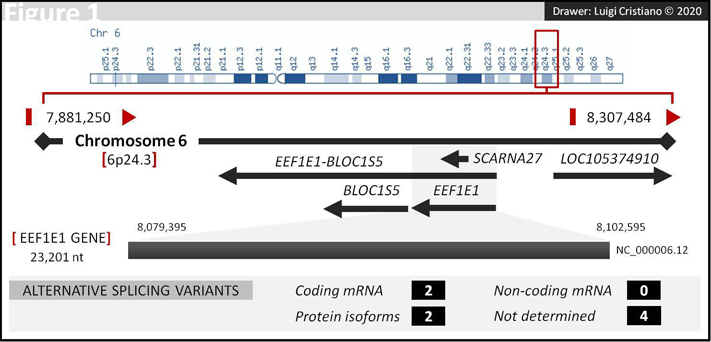
Description
Near to the genomic sequence of EEF1E1 there is a strong promoter transcriptional element that is located at +1.0 kb. Enhancer transcriptional elements are located at +22.0 Kb and at +18.1 Kb respectively.
Transcription
The main characteristics of the alternative splicing transcript variants are reported in Table.1.
The transcript variant 1 mRNA has reference sequence NM_004280.5 and it is 1047 bp long. The 5UTR counts 27 nt, the CDS is extended from 28 to 552 nt, while the 3UTR covers the last 495 nt.
The transcript variant 2 mRNA has reference sequence NM_001135650.2 and it is 562 bp long. The 5UTR counts 27 nt, the CDS is extended from 28 to 447 nt, while the 3UTR covers the last 115 nt.
| Name | Variant | RefSeq (1) | Transcript ID | Exons | Type | Lenght (bp) | Isoform | Alias | RefSeq (2) | Lenght (aa) | MW (kDa) | pI |
| EEF1E1-001 | - | - | ENST00000488226.2 | 2 | protein coding | 443 | - | - | - | 94 | (?) | (?) |
| EEF1E1-002 | Var.1 | NM_004280.5 | ENST00000379715.5 | 4 | protein coding | 1077 | isoform 1 | O43324-1 | NP_004271.1 | 174 | 19.81 | 8.55 |
| EEF1E1-003 | - | - | ENST00000507463.1 | 3 | protein coding | 654 | - | - | - | 150 | 16.69 | (?) |
| EEF1E1-004 | Var.2 | NM_001135650.2 | ENST00000429723.2 | 4 | protein coding | 562 | isoform 2 | O43324-2 | NP_001129122.1 | 139 | 15.55 | 7.95 |
| EEF1E1-005 | - | - | ENST00000502429.1 | 4 | protein coding | 591 | - | - | - | 136 | (?) | (?) |
| EEF1E1-006 | - | - | ENST00000515633.1 | 3 | protein coding | 460 | - | - | - | 56 | 5.89 | (?) |
Table.1 Alterative splicing variants and isoforms of EEF1E1. (reworked from http://grch37.ensembl.org; https://www.ncbi.nlm.nih.gov; https://web.expasy.org/protparam/; https://www.uniprot.org). ncRNA = non-coding RNA; nonsense md = nonsense mediated decay; (?) = undetermined; MW = molecular weight; pI = theoretical pI.
Pseudogene
If EEF1E1P1 has any regulatory role in the expression of the respective gene as described for others (Hirotsune et al., 2003), is only speculation in the absence of experimental evidence. Currently, there is no evidence about the involvement of this pseudogene in human cancers or in other diseases.
Proteins
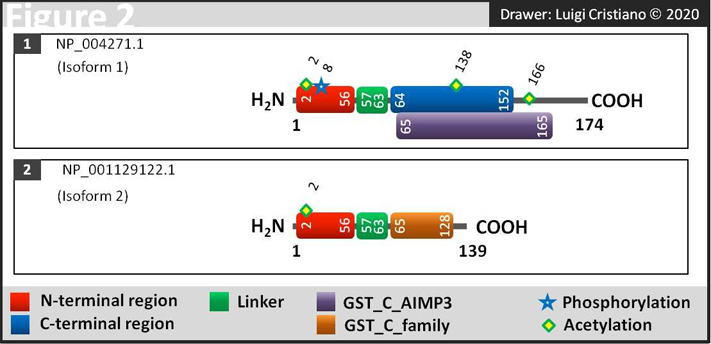
Description
EEF1E1 is a small globular protein with a length of 174 amino acids and a molecular weight of 19,8 kDa.
eEF1E1 shows strong sequence similarity with eukaryotic translation elongation factor 1 beta 2 ( EEF1B2) and eukaryotic translation elongation factor 1 gamma ( EEF1G) (Quevillon and Mirande, 1996) and with the N-terminal sequence of valyl-tRNA synthetase (Deineko V.V., 2008).
eEF1E1 shows many domains in both isoforms: the amino half terminal is unique for both isoforms and shows an N-terminal-like domain not well characterized followed by a linker domain, while the major differences between the two isoforms are in the carboxyl half terminal. In fact, in the carboxyl half terminal of isoform 1 there are reported two domain overlapping, i.e. a Glutathione S-transferase C-terminal-like domain (GST_C_AIMP3), folded in alpha-helical, and a more general and not well characterized C-terminal domain. In isoform 2, there is a unique region called C-terminal domain of the Glutathione S-transferase family (GST_C_family). The fold of this domain is alpha-helical (see figure.2).
EEF1E1 interacts with other members of the MARS complex and one interactional model was proposed (Mirande, 2017) although its exact interactions need to be still clarified.
Post-translational modifications. Some post-translational modifications are observed, such as phosphorylation and acetylation (https://www.ncbi.nlm.nih.gov).
Expression
Cells that show overexpression of eEF1E1 show an acceleration of senescence and also defects in nuclear morphology (Oh et al, 2010).
Localisation
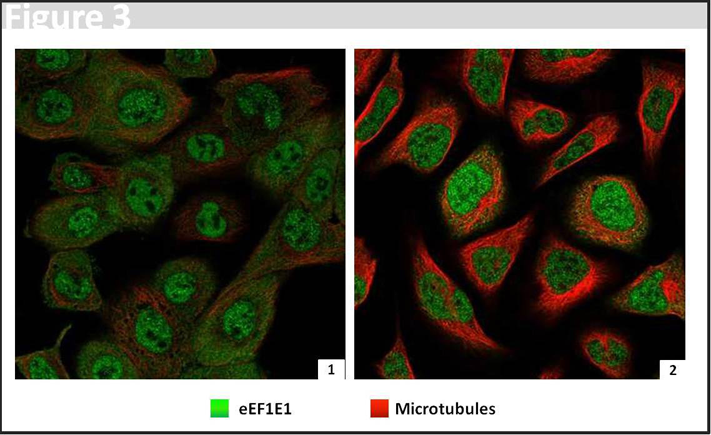
Function
It is well known that in eukaryotic cells the various components of translation machinery Therefore, the main canonical function of eEF1E1 is to play a role as an auxiliary component of the macromolecular aminoacyl-tRNA synthetases complex in the elongation step of translation, in particular, it interacts with several aminoacyl-tRNA synthetases (Tao et al, 2017) and it could contribute to the anchorage of MARS complex to EF1H complex (Quevillon and Mirande, 1996).
Other functions (non-canonical roles): in addition to what has already been said, it seems to play a role in embryonic development of the mammalian face and other structures (Fowles et al, 2003).
eEF1E1 has the ability to translocate into the nucleus in response to DNA damage where it has a role in the DNA damage response in association with serine/threonine kinases ATM / ATR and TP53. In fact, it was found a positive relationship between expression levels of eEF1E1 and TP53, i.e. high expression levels of eEF1E1 are correlated with elevated TP53 levels, while eEF1E1 depletion leads to the block of TP53 induction (Park et al, 2005). The eEF1E1 loss-of-function phenotype leads to various kinds of abnormalities: in particular, one allele inactivation increases the susceptibility to spontaneous tumors while the inactivation of both EEF1E1 alleles caused embryonic lethality (Park et al, 2005). The importance of eEF1E1 in embryogenesis is previously reported (Fowles et al, 2003) while in the context of the tumors, eEF1E1 could be a haploinsufficient tumor suppressor (Park et al, 2005) that can accelerate cellular senescence (Kang et al, 2012).
eEF1E1 in involved in the degradation of mature Lamin A ( LMNA) which is a major component of the nuclear envelope matrix (Tao et al, 2017).
Homology
| Organism | Species | Symbol | DNA Identity (%) | PROT Identity (%) |
| Human | H.sapiens | EEF1E1 | 100 | 100 |
| Chimpanzee | P.troglodytes | EEF1E1 | 99.2 | 100 |
| Macaco | M.mulatta | EEF1E1 | 97.5 | 99.4 |
| Wolf | C.lupus | EEF1E1 | 92.5 | 96.0 |
| Cattle | B.taurus | EEF1E1 | 89.8 | 96.5 |
| Mouse | M.musculus | Eef1e1 | 86.6 | 88.5 |
| Rat | R.norvegicus | Eef1e1 | 83.7 | 87.9 |
| Chicken | G.gallus | EEF1E1 | 75.9 | 77.6 |
| Xenopus tropicalis | X.tropicalis | Eef1e1 | 67.6 | 69.6 |
| Zebrafish | D.rerio | Eef1e1 | 63.0 | 63.7 |
Table.2 EEF1E1 homology (reworked from ps://www.ncbi.nlm.nih.gov/homologene)
Mutations
Note
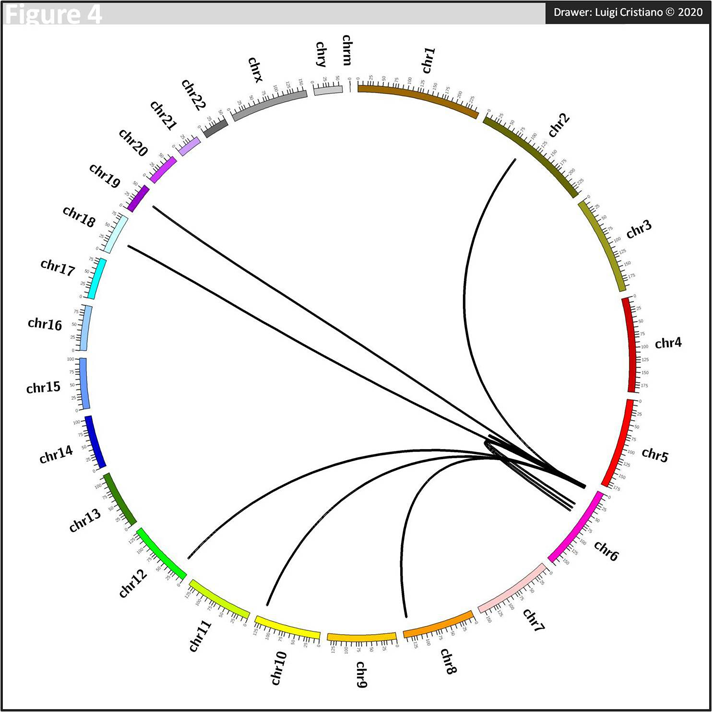
The genomic alterations observed include also the formation of novel fusion genes. However, there are no sufficient experimental data yet to understand the repercussions on cellular behavior and so the implications in cancer of these alterations.
Implicated in
However, Hassan et colleagues reported that EEF1E1 is overexpressed in many other cancer types such as breast, lung, gastric, prostate, colorectal and liver tumors and this fact could predict poor survival (breast, lung, liver)(Hassan et al, 2018).
Interesting is the role of inorganic arsenic (iAs) in the epigenetic alteration of DNA methylation in arsenic-induced diseases such as cancer of the bladder, kidney, lung, liver, and prostate. It was revealed that EEF1E1 is one of many genes silenced and involved in iAs related-hypermethylation in an arsenic-methylated tumor suppressorome (Smeester et al, 2011).
In addition, eEF1E1 is involved in some genomic translocations with the creation of numerous fusion genes (Table.3).
| Name | 5 end | 3 end | Loc1 | Loc2 | Description | Type |
| Pubmed ID | Last Year | Title | Authors |
|---|---|---|---|
| 22480366 | 2012 | Deletions in chromosome 6p22.3-p24.3, including ATXN1, are associated with developmental delay and autism spectrum disorders. | Celestino-Soper PB et al |
| 29736267 | 2018 | Long non-coding RNAs: crucial regulators of gastrointestinal cancer cell proliferation. | Chen J et al |
| 14519448 | 2003 | Direct and biochemical interaction between dopamine D3 receptor and elongation factor-1Bbetagamma. | Cho DI et al |
| 26472928 | 2015 | Assembly of Multi-tRNA Synthetase Complex via Heterotetrameric Glutathione Transferase-homology Domains. | Cho HY et al |
| 22685290 | 2012 | Elevation of highly up-regulated in liver cancer (HULC) by hepatitis B virus X protein promotes hepatoma cell proliferation via down-regulating p18. | Du Y et al |
| 31059041 | 2019 | Screening of underlying genetic biomarkers for ankylosing spondylitis. | Fan X et al |
| 12533789 | 2003 | Genomic screen for genes involved in mammalian craniofacial development. | Fowles LF et al |
| 29617662 | 2018 | Driver Fusions and Their Implications in the Development and Treatment of Human Cancers. | Gao Q et al |
| 24917520 | 2015 | Loss of expression of the tumour suppressor gene AIMP3 predicts survival following radiotherapy in muscle-invasive bladder cancer. | Gurung PM et al |
| 29342219 | 2018 | The expression profile and prognostic significance of eukaryotic translation elongation factors in different cancers. | Hassan MK et al |
| 29337901 | 2018 | Transcriptional-Readthrough RNAs Reflect the Phenomenon of "A Gene Contains Gene(s)" or "Gene(s) within a Gene" in the Human Genome, and Thus Are Not Chimeric RNAs. | He Y et al |
| 30071685 | 2018 | Role of Pseudogenes in Tumorigenesis. | Hu X et al |
| 22944692 | 2012 | A catalogue of putative HIV-1 protease host cell substrates. | Impens F et al |
| 22646717 | 2012 | Effects on human transcriptome of mutated BRCA1 BRCT domain: a microarray study. | Iofrida C et al |
| 22190034 | 2011 | Global landscape of HIV-human protein complexes. | Jäger S et al |
| 22867704 | 2012 | AIMP3/p18 controls translational initiation by mediating the delivery of charged initiator tRNA to initiation complex. | Kang T et al |
| 30250065 | 2018 | AIMP3 depletion causes genome instability and loss of stemness in mouse embryonic stem cells. | Kim SM et al |
| 21789020 | 2011 | Expression of AIMP1, 2 and 3, the scaffolds for the multi-tRNA synthetase complex, is downregulated in gastric and colorectal cancer. | Kim SS et al |
| 9653160 | 1998 | Identification of genes expressed in human CD34(+) hematopoietic stem/progenitor cells by expressed sequence tags and efficient full-length cDNA cloning. | Mao M et al |
| 28271488 | 2017 | The Aminoacyl-tRNA Synthetase Complex. | Mirande M et al |
| 15504251 | 2004 | Distinct pattern of gene expression in pyothorax-associated lymphoma (PAL), a lymphoma developing in long-standing inflammation. | Nishiu M et al |
| 20726853 | 2010 | Downregulation of lamin A by tumor suppressor AIMP3/p18 leads to a progeroid phenotype in mice. | Oh YS et al |
| 15680327 | 2005 | The haploinsufficient tumor suppressor p18 upregulates p53 via interactions with ATM/ATR. | Park BJ et al |
| 16849534 | 2006 | AIMP3 haploinsufficiency disrupts oncogene-induced p53 activation and genomic stability. | Park BJ et al |
| 19095653 | 2009 | Coordination of eukaryotic translation elongation factor 1A (eEF1A) function in actin organization and translation elongation by the guanine nucleotide exchange factor eEF1Balpha. | Pittman YR et al |
| 8849690 | 1996 | The p18 component of the multisynthetase complex shares a protein motif with the beta and gamma subunits of eukaryotic elongation factor 1. | Quevillon S et al |
| 17303557 | 2007 | Characterization of p43(ARF), a derivative of the p43 component of multiaminoacyl-tRNA synthetase complex released during apoptosis. | Shalak V et al |
| 21291286 | 2011 | Epigenetic changes in individuals with arsenicosis. | Smeester L et al |
| 28797100 | 2017 | Mapping the contact surfaces in the Lamin A:AIMP3 complex by hydrogen/deuterium exchange FT-ICR mass spectrometry. | Tao Y et al |
| 11896579 | 2002 | Involvement of intact HPV16 E6/E7 gene expression in head and neck cancers with unaltered p53 status and perturbed pRb cell cycle control. | Wiest T et al |
| 25500544 | 2015 | The landscape and therapeutic relevance of cancer-associated transcript fusions. | Yoshihara K et al |
| 27781386 | 2017 | HULC: an oncogenic long non-coding RNA in human cancer. | Yu X et al |
Other Information
Locus ID:
NCBI: 9521
MIM: 609206
HGNC: 3212
Ensembl: ENSG00000124802
Variants:
dbSNP: 9521
ClinVar: 9521
TCGA: ENSG00000124802
COSMIC: EEF1E1
RNA/Proteins
Expression (GTEx)
Pathways
Protein levels (Protein atlas)
References
| Pubmed ID | Year | Title | Citations |
|---|---|---|---|
| 33538115 | 2021 | AIMP3 inhibits cell growth and metastasis of lung adenocarcinoma through activating a miR-96-5p-AIMP3-p53 axis. | 5 |
| 33538115 | 2021 | AIMP3 inhibits cell growth and metastasis of lung adenocarcinoma through activating a miR-96-5p-AIMP3-p53 axis. | 5 |
| 30706629 | 2019 | HIF1α-mediated AIMP3 suppression delays stem cell aging via the induction of autophagy. | 24 |
| 30706629 | 2019 | HIF1α-mediated AIMP3 suppression delays stem cell aging via the induction of autophagy. | 24 |
| 28797100 | 2017 | Mapping the contact surfaces in the Lamin A:AIMP3 complex by hydrogen/deuterium exchange FT-ICR mass spectrometry. | 3 |
| 28797100 | 2017 | Mapping the contact surfaces in the Lamin A:AIMP3 complex by hydrogen/deuterium exchange FT-ICR mass spectrometry. | 3 |
| 26472928 | 2015 | Assembly of Multi-tRNA Synthetase Complex via Heterotetrameric Glutathione Transferase-homology Domains. | 32 |
| 26472928 | 2015 | Assembly of Multi-tRNA Synthetase Complex via Heterotetrameric Glutathione Transferase-homology Domains. | 32 |
| 25465621 | 2014 | miR-543 and miR-590-3p regulate human mesenchymal stem cell aging via direct targeting of AIMP3/p18. | 28 |
| 25465621 | 2014 | miR-543 and miR-590-3p regulate human mesenchymal stem cell aging via direct targeting of AIMP3/p18. | 28 |
| 23306449 | 2013 | Contributions of aminoacyl-tRNA synthetase-interacting multifunctional protein-3 to mammalian translation initiation. | 2 |
| 24104880 | 2013 | Identification of two novel BRCA1-partner genes in the DNA double-strand break repair pathway. | 3 |
| 23306449 | 2013 | Contributions of aminoacyl-tRNA synthetase-interacting multifunctional protein-3 to mammalian translation initiation. | 2 |
| 24104880 | 2013 | Identification of two novel BRCA1-partner genes in the DNA double-strand break repair pathway. | 3 |
| 22867704 | 2012 | AIMP3/p18 controls translational initiation by mediating the delivery of charged initiator tRNA to initiation complex. | 19 |
Citation
Luigi Cristiano, MSc
EEF1E1 (eukaryotic translation elongation factor 1 epsilon 1)
Atlas Genet Cytogenet Oncol Haematol. 2020-03-01
Online version: http://atlasgeneticsoncology.org/gene/40409/eef1e1-(eukaryotic-translation-elongation-factor-1-epsilon-1)
