ERVH-1 (endogenous retrovirus group H member 1)
2021-02-01 Luigi Cristiano, MSc AffiliationR&D Division, Prestige, Terranuova Bracciolini, Italy [email protected]; [email protected]
Identity
HGNC
LOCATION
4p15.2
LOCUSID
ALIAS
HERV-H4p15.2,NONHSAG037622.2,Lnc-PPARGC1A-1,HSALNG0033326,RP11-380P13.2
Abstract
Endogenous retrovirus group H member 1, alias ERVH-1, is an integrated retroviral element of the human genome. Still poorly characterized it maps on Chromosome 4.
DNA/RNA
Note
It is known that human endogenous retroviruses (ERVs) and ERV-like sequences are part of the repetitive portions of the human genome and are remnants of infections of former exogenous retroviruses. They comprise approximately 8% of the human genome (Landers et al, 2001) and include solitary long terminal repeats (LTRs), non-retroviral sequences flanked by LTRs, and LTRs-like sequences (Mayer et al, 2011). ERVs are divided into various groups.
Endogenous retrovirus group H member 1 (ERVH-1), formerly HERV-H4p15.2, is an integrated retroviral element of the human genome and maps on Chromosome 4, in particular on 4p15.2
Endogenous retrovirus group H member 1 (ERVH-1), formerly HERV-H4p15.2, is an integrated retroviral element of the human genome and maps on Chromosome 4, in particular on 4p15.2
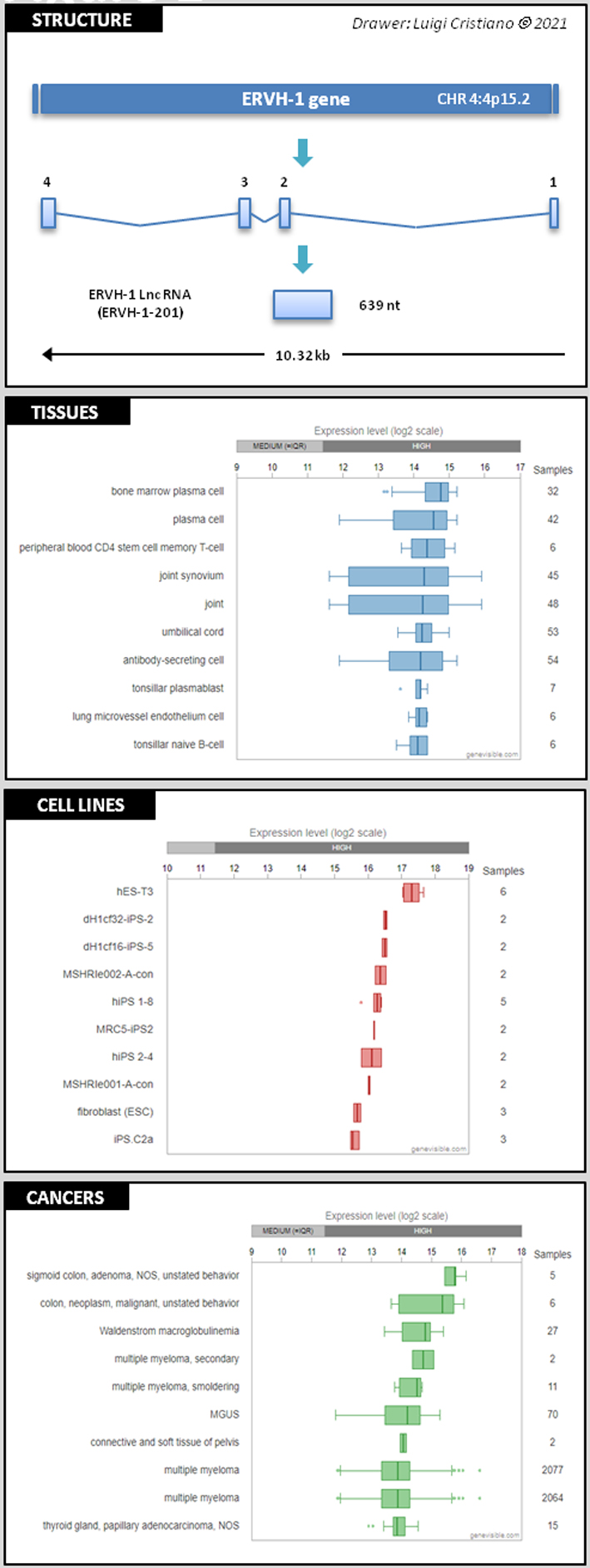
Figure 1. Expression levels for ERVH-1. The figure shows the gene expression levels for ERVH-1 in human tissues, cell lines and cancers (from https://genevisible.com/search). The structure of LncRNA for ERVH-1 is reported (reworked from https://www.ensembl.org/ )
Transcription
Usually, human ERVs are silenced epigenetically and are not transcribed (Kewitz and Staege, 2013), however, they are found to be transcribed in particular situations, such as under pathological conditions, and usually their transcription is initiated by promoter sequences within the proviral LTRs (Mayer et al, 2011).
ERVH-1 gene produces a long non-coding RNA (LncRNA), named ERVH-1-201, of 639 nt. Its sequence is registered in GenBank (BC015108 or EU669866) and in Ensembl (ENSG00000251292). The tissue of origin in which it was first identified is renal cell carcinoma (hypernephroma) (Liang et al, 2009), but it has been detected in various human tissues (see figure 1) and preferentially in human embryonic stem cells (hESCs) (Lu et al, 2014).
ERVH-1 gene produces a long non-coding RNA (LncRNA), named ERVH-1-201, of 639 nt. Its sequence is registered in GenBank (BC015108 or EU669866) and in Ensembl (ENSG00000251292). The tissue of origin in which it was first identified is renal cell carcinoma (hypernephroma) (Liang et al, 2009), but it has been detected in various human tissues (see figure 1) and preferentially in human embryonic stem cells (hESCs) (Lu et al, 2014).
Localisation
The subcellular localization of ERVH-1 is almost-exclusive to the nucleus (Lu et al, 2014).
Pseudogene
No pseudogenes were observed for the ERVH-1 sequence.
Proteins
Note
It is well-known that human ERVs and ERV-like sequences no longer encode proteins because of the accumulation of nonsense mutations as a consequence of their ancient incorporation into the genome of the host (Mayer et al, 2011). For ERVH-1 no protein has been identified so far.
Implicated in
Top note
Expression of ERVs is usually switched off (Kewitz and Staege, 2013) but the expression of ERVs and ERV-like sequences have been reported for a large number of human diseases, including cancer, however, their exact involvement and mechanism of action remain to be clarified (Mayer et al, 2011). Studies on ERVH-1 are in their infancy.
Entity name
Human diseases
Note
ERVH-1 has not yet been well characterized. However, some preliminary raw data (gene expression levels) are present in the literature on its relationship to kidney cancer (or renal cell carcinoma) (RCC)(Li et al, 2018) and a rare primary liver cancer without underlying liver disease, i.e. the fibrolamellar hepatocellular carcinoma (FLC) (Farber et al, 2017). Furthermore, its LncRNA was found in extracellular vesicles (EVs) released from mutant KRAS colorectal cancer (CRC) cells (Hinger et al,2018). ERVH-1 is also expressed in both Hodgkins lymphoma (HL) cell lines and normal blood cells (Kewitz and Staege, 2013). Its functional role in these diseases is largely unknown.
Article Bibliography
| Reference Number | Pubmed ID | Last Year | Title | Authors |
|---|---|---|---|---|
| 1 | 29535801 | 2018 | Non coding RNA analysis in fibrolamellar hepatocellular carcinoma. | Farber BA et al |
| 2 | 30332650 | 2018 | Diverse Long RNAs Are Differentially Sorted into Extracellular Vesicles Secreted by Colorectal Cancer Cells. | Hinger SA et al |
| 3 | 23847767 | 2013 | Expression and Regulation of the Endogenous Retrovirus 3 in Hodgkin's Lymphoma Cells. | Kewitz S et al |
| 4 | 11237011 | 2001 | Initial sequencing and analysis of the human genome. | Lander ES et al |
| 5 | 30082482 | 2018 | Dissecting LncRNA Roles in Renal Cell Carcinoma Metastasis and Characterizing Genomic Heterogeneity by Single-Cell RNA-seq. | Li X et al |
| 6 | 21637440 | 2009 | Identification and detection of a novel human endogenous retrovirus-related gene, and structural characterization of its related elements. | Liang Q et al |
| 7 | 24681886 | 2014 | The retrovirus HERVH is a long noncoding RNA required for human embryonic stem cell identity. | Lu X et al |
| 8 | 21542922 | 2011 | A revised nomenclature for transcribed human endogenous retroviral loci. | Mayer J et al |
Other Information
Locus ID:
Variants:
dbSNP: 100616446
ClinVar: 100616446
COSMIC: ERVH-1
Expression (GTEx)
Citation
Luigi Cristiano, MSc
ERVH-1 (endogenous retrovirus group H member 1)
Atlas Genet Cytogenet Oncol Haematol. 2021-02-01
Online version: http://atlasgeneticsoncology.org/gene/62907/ervh-1-(endogenous-retrovirus-group-h-member-1)
