BYSL (Bystin-Like)
2013-09-01 Michiko N Fukuda , Kazuhiro Sugihara AffiliationTumor Microenvironment Program, Cancer Center, Sanford-Burnham Medical Research Institute, La Jolla, CA, USA (MNF); Department of Gynecology, Obstetrics, Hamamatsu University School of Medicine, Hamamatsu City, Shizuoka, Japan (KS)
DNA/RNA
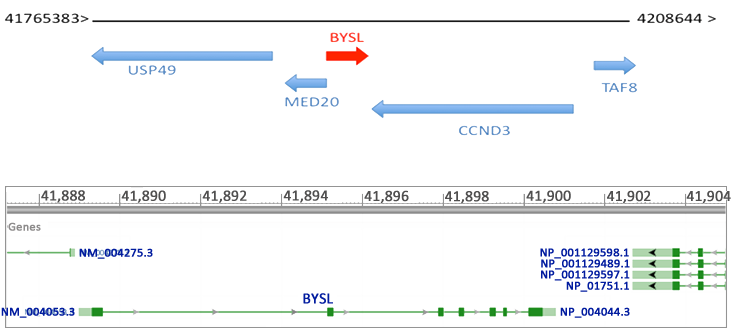
Figure 1. Genomic organization of BYSL.
Description
BYSL locates on 6 chromosome 6p21.1 (Pack et al., 1998). It contains 8 exons spanning 10.7 kb of genomic DNA.
Proteins
Expression
BYSL is expressed in trophectoderm cells and endometrial epithelial cells during embryo implantation in human (Aoki and Fukuda, 2000; Nakayama et al., 2003; Suzuki et al., 1999; Suzuki et al., 1998). The expression pattern of mouse bystin at peri-implantation (Aoki et al., 2006) is similar to that of mouse trophinin (Nadano et al., 2002).
In the mouse, bystin protein was found in the blastocyst embryo and endometrial epithelial cells during peri-implantation period (Aoki et al., 2006). Bystin is expressed in mouse endometrial luminal and glandular epithelial cells throughout hormonal cycles (Aoki et al., 2006). Bystin in the luminal epithelia showed a distinct blastocyst-dependent pattern: in the presence of blastocysts, bystin proteins localized to the apical side of the epithelia, whereas in their absence bystin protein was localized to the abluminal or basal side of the epithelia (Figure 2). This observation suggests the existence of an embryonic factor affecting in a way determining the localization of bystin in the maternal epithelia. The molecular basis underlying apical or basal localization of bystin is presently unknown.
Bysl is strongly expressed in the adult rat brain after injury (Ma et al., 2006; Sheng et al., 2004). Bystin is expressed after optic nerve injury in zebra fish (Neve et al., 2012).
Bystin protein was found in mature sperm, of which function is implicated to sperm motility (Hatakeyama et al., 2008). Bystin is overexpressed in hepatocellular carcinoma, suggesting its function in cell proliferation in liver cancer (Wang et al., 2009).
In the Drosophila embryo, bys expression is ubiquitous but relatively weak at early stages, but at later stages bys expression is strong and specifically localized to larval imaginal discs, suggesting a role of bys in cell adhesion. In particular, bys expression is strong in the region of the wing pouch giving rise to two epithelial sheets of the adult wing that adhere to one another after the disc everts (Stewart and Nordquist, 2005).
In the mouse, bystin protein was found in the blastocyst embryo and endometrial epithelial cells during peri-implantation period (Aoki et al., 2006). Bystin is expressed in mouse endometrial luminal and glandular epithelial cells throughout hormonal cycles (Aoki et al., 2006). Bystin in the luminal epithelia showed a distinct blastocyst-dependent pattern: in the presence of blastocysts, bystin proteins localized to the apical side of the epithelia, whereas in their absence bystin protein was localized to the abluminal or basal side of the epithelia (Figure 2). This observation suggests the existence of an embryonic factor affecting in a way determining the localization of bystin in the maternal epithelia. The molecular basis underlying apical or basal localization of bystin is presently unknown.
Bysl is strongly expressed in the adult rat brain after injury (Ma et al., 2006; Sheng et al., 2004). Bystin is expressed after optic nerve injury in zebra fish (Neve et al., 2012).
Bystin protein was found in mature sperm, of which function is implicated to sperm motility (Hatakeyama et al., 2008). Bystin is overexpressed in hepatocellular carcinoma, suggesting its function in cell proliferation in liver cancer (Wang et al., 2009).
In the Drosophila embryo, bys expression is ubiquitous but relatively weak at early stages, but at later stages bys expression is strong and specifically localized to larval imaginal discs, suggesting a role of bys in cell adhesion. In particular, bys expression is strong in the region of the wing pouch giving rise to two epithelial sheets of the adult wing that adhere to one another after the disc everts (Stewart and Nordquist, 2005).
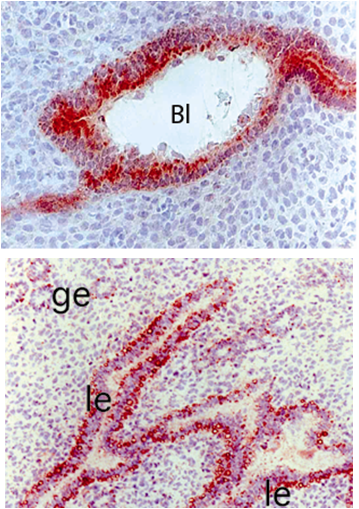
Figure 2. Blastocyst-dependent localization of bystin protein in the mouse endometrial epithelia. Above: mouse endometrium with implanting blastocyst (Bl) shows bystin protein (red) on the apical side of epithelia. below: mouse endometrium from pseudopregnant female shows bystin at abluminal side of epithelia. Glandular epithelia (ge); luminal epithelia (le).
Localisation
In 6 weeks human placenta, bystin protein was found in the cytoplasm of the syncytiotrophoblast and cytotrophoblast in the chorionic villi, and in endometrial decidual cells at the utero placental interface. In 10 weeks placenta, bystin was exclusively in the nucli of cytotrophoblast (Suzuki et al., 1999). In cultured cells, bystin localizes to both the nucleus and cytoplasm (Aoki et al., 2006; Miyoshi et al., 2007). In the nucleus, bystin was often found in the nucleoli.
Function
Bystin function in human embryo implantation: Bystin was originally identified as a cytoplasmic protein that forms a complex with trophinin and tastin in human trophoblastic embryonal carcinoma HT-H cells (Fukuda and Nozawa, 1999; Suzuki et al., 1998). While genes encoding trophinin and tastin are only found in mammals, the bystin gene is conserved across a wide range of eukaryotes, including yeast, nematodes, insects, snakes, and mammals (Roos et al., 1997; Stewart and Denell, 1993; Stewart and Nordquist, 2005; Trachtulec and Forejt, 2001). Trophinin is an intrinsic membrane protein that mediates cell adhesion by homophilic trophinin-trophinin binding (Fukuda et al., 1995). Tastin and bystin are cytoplasmic proteins required for trophinin to function efficiently as a cell adhesion molecule. In humans, trophinin, tastin and bystin are expressed at the utero-placental interface or at implantation sites (Suzuki et al., 1999). These proteins are expressed in human placenta at early stages of pregnancy but disappear from the placenta after 10 weeks of pregnancy (Aoki and Fukuda, 2000; Fukuda and Nozawa, 1999; Suzuki et al., 1999).
In trophoblastic HT-H cells, bystin protein associates with trophinin and ErbB4 in the cytoplasm (Sugihara et al., 2007). When trophinin-mediated cell adhesion takes place on the cell surface, bystin dissociates from trophinin and tyrosine phosphorylation of ErbB4 takes place, suggesting the mechanism underlying the trophectoderm cell activation upon human embryo implantation (Figure 3). Bystin functions as molecular switch in trophinin-mediated signal transduction in trophoblastic cells (Fukuda and Sugihara, 2007; Fukuda and Sugihara,2008; Fukuda and Sugihara,2012).
Bystin function in mouse embryo: Bystin null mouse embryos implanted successfully but died soon after implantation (Aoki et al., 2006), suggesting that bystin is essential for mouse embryo survival after implantation. However, as described below, Bysl gene knockdown experiments show that bystin is also required for survival of pre-implantation stage mouse embryos (Adachi et al., 2007). In the knockout mouse, it is likely that maternally derived Bysl mRNA masks loss of Bysl at pre-implantation stages.
When Bysl siRNAs were microinjected into fertilized eggs, compaction at the eight-cell stage occurred normally in vitro (Adachi et al., 2007). Bysl siRNA-injected embryos showed slightly reduced expression of cytokeratin 8 (EndoA), an early trophectoderm marker (Oshima et al., 1983). While control blastocysts showed assembled cytokeratin structures in the trophectoderm layer, no organized structures were detected in Bysl siRNA-injected embryos. Consequently, blastocyst formation was completely inhibited. These embryos failed to hatch from the zona pellucida and could not outgrow in culture, suggesting that the bystin functions in trophectoderm differentiation. Bysl knockdown also inhibited embryonic stem cell proliferation (Adachi et al., 2007).
Bystin function in stem cells: Mouse bystin gene Bysl has been identified as the stem cell marker commonly expressed in embryonal, neuronal and hematopoietic stem cells (Ramalho-Santos et al., 2002). BYSL is also identified as the major target of MYC in B-cells (Basso et al., 2005). Since MYC is one of essential genes for converting somatic cells into induced pluripotent stem cell (iPS) (Takahashi and Yamanaka, 2006), these observations suggest strongly an essential role of bystin in pluripotent stem cells. Bysl is included in a gene cluster of stem cell markers found on mouse chromosome 16 (Ramalho-Santos et al., 2002).
Bystin function in human sperm motility: Bystin regulates sperm motility (Hatakeyama et al., 2008). Trophinin plays multiple roles in each cell type under different conditions.
Bystin function in ribosomal biogenesis: The yeast bystin homologue ENP1 is essential for budding yeast to survive (Roos et al., 1997). A temperature-sensitive ENP1-null mutant showed defective processing of ribosomal RNA (rRNA) (Chen et al., 2003). Studies of ribosomal biogenesis in yeast indicate that Enp1 is required to synthesize 40S ribosomal subunits by functioning in their nuclear export (Schafer et al., 2003).
Eukaryotic ribosome formation occurs predominantly in nucleoli, but late maturation steps occur in both the nucleoplasm and cytoplasm. Location of bystin in the cytoplasm during G1 and its nuclear localization prior to mitosis suggest that bystin plays dual roles in cell growth and proliferation in mammalian cells.
Although bystin exhibits activities similar to Enp1, human bystin cannot rescue the lethal phenotype of Enp1-null yeast mutant, suggesting that ribosomal RNA processing pathways in multicellular organisms differ from those in yeast and that bystins activities may have been modified during evolution. Recent studies reveal that maturation of the 40S ribosomal subunit precursors in mammals includes an additional step during processing of the internal transcribed spacer 1 (ITS1), and that coordination between maturation and nuclear export of pre-40S particles has evolved differently in yeast and mammalian cells (Carron et al., 2011). In higher organisms, it was long believed that rRNA processing is completed within the nucleus. However, maturation of the 40S subunit, including final processing of 18S rRNA, occurs in the cytoplasm in human cells (Zemp and Kutay, 2007). Since part of cytoplasmic bystin is associated with the 40S subunit before translation in human cells (Miyoshi et al., 2007), bystin may also function in the final step of 40S subunit synthesis in the cytoplasm.
Bystin associates with undefined nuclear particles following actinomycin D treatment of HeLa cells (Miyoshi et al., 2007). Soluble proteins involved in ribosome biogenesis may shuttle between the nucleolus and nucleoplasm (Dez and Tollervey, 2004). Given the dependence of cell proliferation on ribosome biogenesis, when biogenesis is halted by nucleolar stress this system may allow rapid ribosome re-synthesis following relief from stress (Phipps et al., 2011).
In trophoblastic HT-H cells, bystin protein associates with trophinin and ErbB4 in the cytoplasm (Sugihara et al., 2007). When trophinin-mediated cell adhesion takes place on the cell surface, bystin dissociates from trophinin and tyrosine phosphorylation of ErbB4 takes place, suggesting the mechanism underlying the trophectoderm cell activation upon human embryo implantation (Figure 3). Bystin functions as molecular switch in trophinin-mediated signal transduction in trophoblastic cells (Fukuda and Sugihara, 2007; Fukuda and Sugihara,2008; Fukuda and Sugihara,2012).
Bystin function in mouse embryo: Bystin null mouse embryos implanted successfully but died soon after implantation (Aoki et al., 2006), suggesting that bystin is essential for mouse embryo survival after implantation. However, as described below, Bysl gene knockdown experiments show that bystin is also required for survival of pre-implantation stage mouse embryos (Adachi et al., 2007). In the knockout mouse, it is likely that maternally derived Bysl mRNA masks loss of Bysl at pre-implantation stages.
When Bysl siRNAs were microinjected into fertilized eggs, compaction at the eight-cell stage occurred normally in vitro (Adachi et al., 2007). Bysl siRNA-injected embryos showed slightly reduced expression of cytokeratin 8 (EndoA), an early trophectoderm marker (Oshima et al., 1983). While control blastocysts showed assembled cytokeratin structures in the trophectoderm layer, no organized structures were detected in Bysl siRNA-injected embryos. Consequently, blastocyst formation was completely inhibited. These embryos failed to hatch from the zona pellucida and could not outgrow in culture, suggesting that the bystin functions in trophectoderm differentiation. Bysl knockdown also inhibited embryonic stem cell proliferation (Adachi et al., 2007).
Bystin function in stem cells: Mouse bystin gene Bysl has been identified as the stem cell marker commonly expressed in embryonal, neuronal and hematopoietic stem cells (Ramalho-Santos et al., 2002). BYSL is also identified as the major target of MYC in B-cells (Basso et al., 2005). Since MYC is one of essential genes for converting somatic cells into induced pluripotent stem cell (iPS) (Takahashi and Yamanaka, 2006), these observations suggest strongly an essential role of bystin in pluripotent stem cells. Bysl is included in a gene cluster of stem cell markers found on mouse chromosome 16 (Ramalho-Santos et al., 2002).
Bystin function in human sperm motility: Bystin regulates sperm motility (Hatakeyama et al., 2008). Trophinin plays multiple roles in each cell type under different conditions.
Bystin function in ribosomal biogenesis: The yeast bystin homologue ENP1 is essential for budding yeast to survive (Roos et al., 1997). A temperature-sensitive ENP1-null mutant showed defective processing of ribosomal RNA (rRNA) (Chen et al., 2003). Studies of ribosomal biogenesis in yeast indicate that Enp1 is required to synthesize 40S ribosomal subunits by functioning in their nuclear export (Schafer et al., 2003).
Eukaryotic ribosome formation occurs predominantly in nucleoli, but late maturation steps occur in both the nucleoplasm and cytoplasm. Location of bystin in the cytoplasm during G1 and its nuclear localization prior to mitosis suggest that bystin plays dual roles in cell growth and proliferation in mammalian cells.
Although bystin exhibits activities similar to Enp1, human bystin cannot rescue the lethal phenotype of Enp1-null yeast mutant, suggesting that ribosomal RNA processing pathways in multicellular organisms differ from those in yeast and that bystins activities may have been modified during evolution. Recent studies reveal that maturation of the 40S ribosomal subunit precursors in mammals includes an additional step during processing of the internal transcribed spacer 1 (ITS1), and that coordination between maturation and nuclear export of pre-40S particles has evolved differently in yeast and mammalian cells (Carron et al., 2011). In higher organisms, it was long believed that rRNA processing is completed within the nucleus. However, maturation of the 40S subunit, including final processing of 18S rRNA, occurs in the cytoplasm in human cells (Zemp and Kutay, 2007). Since part of cytoplasmic bystin is associated with the 40S subunit before translation in human cells (Miyoshi et al., 2007), bystin may also function in the final step of 40S subunit synthesis in the cytoplasm.
Bystin associates with undefined nuclear particles following actinomycin D treatment of HeLa cells (Miyoshi et al., 2007). Soluble proteins involved in ribosome biogenesis may shuttle between the nucleolus and nucleoplasm (Dez and Tollervey, 2004). Given the dependence of cell proliferation on ribosome biogenesis, when biogenesis is halted by nucleolar stress this system may allow rapid ribosome re-synthesis following relief from stress (Phipps et al., 2011).
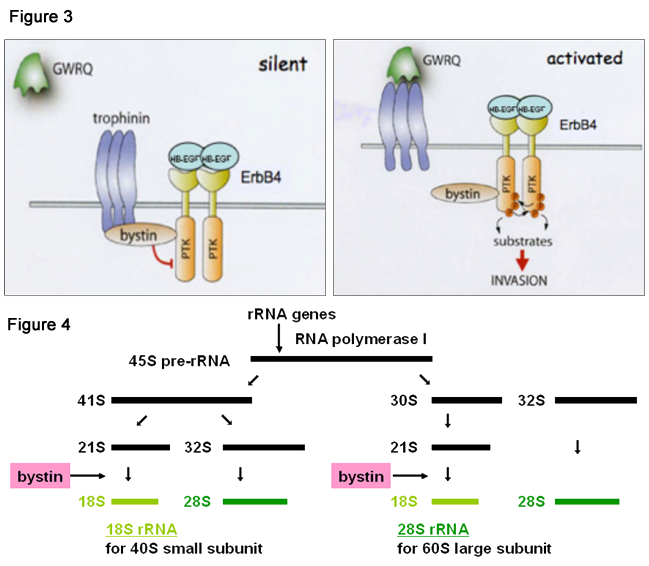
Figure 3. Role of bystin protein in signal transduction. Prior to trophinin-mediated cell adhesion or in silent trophectoderm cells, ErbB4 is arrested by trophinin-bystin complex. When trophinin-mediated cell adhesion occurs or trophinin-binding GWRQ peptide mimics trophinin-mediated cell adhesion, bystin dissociates from trophinin leading into tyrosine phosphorylation of ErbB4 (Sugihara et al., 2007). Figure 4. Ribosomal biogenesis and rRNA processing in eukaryotic cells. The initial pre-rRNA transcript is first transcribed from repetitive ribosomal DNA genes by RNA polymerase I in the nucleolus. rRNA precursors are then processed, chemically modified, and folded in the nucleolus, and ribosomal proteins, which are translated in the cytoplasm and imported into this organelle, concomitantly assemble with pre-rRNAs. There are two alternative pathways for rRNA processing in human HeLa cells. Bystin is likely involved in processing of a 21S intermediate, of which the final product, 18S rRNA, is included in the 40S small subunit. Bystin is involved in 18S rRNA processing.
Homology
None.
Implicated in
Entity name
Various cancers
Note
Cancer progression depends on cell growth and cell cycle progression. Upregulation of BYSL is implicated to following cancers.
Entity name
Gastric cancer
Note
Entity name
Hepatocellular carcinoma (HCC)
Note
Expression levels of BYSL mRNA and protein in human HCC specimens were markedly increased compared with those seen in adjacent non-cancerous tissue (Wang et al., 2009). BYSL shRNA decreased HCC cell proliferation in vitro, induced apoptosis and partially arrested the cell cycle in the G2/M phase. In vivo, HCC cells treated with BYSL siRNA failed to form tumors in nude mice after subcutaneous implantation. BYSL was found at multiple stages during nucleologenesis, including in nucleolus-derived foci (NDF), perichromosomal regions and the prenucleolar body (PNB) during mitosis. BYSL depletion remarkably suppressed NDF and PNB formation, and disrupted nucleoli assembly after mitosis, resulting in increased apoptosis and reduced tolerance of HCC cells to serum starvation.
Entity name
Prostate cancers
Note
In prostate cancer cells, which adhere to neurons, bystin protein is expressed in a manner suggesting a role in cell-cell contact and cell growth (Ayala et al., 2006).
Entity name
B cell lymphoma
Note
Indeed BYSL and CCND3 are both elevated in B cell lymphoma (Bea, 2010; Kasugai et al., 2005), which is consistent with close proximity of BYSL and CCND3 encoding cyclin D3 (Figure 1) suggesting their co-ordinated role in normal and malignant cells.
Article Bibliography
| Pubmed ID | Last Year | Title | Authors |
|---|---|---|---|
| 17242206 | 2007 | Crucial role of Bysl in mammalian preimplantation development as an integral factor for 40S ribosome biogenesis. | Adachi K et al |
| 11299965 | 2000 | Recent molecular approaches to elucidate the mechanism of embryo implantation: trophinin, bystin, and tastin as molecules involved in the initial attachment of blastocysts to the uterus in humans. | Aoki R et al |
| 17055491 | 2006 | The Bysl gene product, bystin, is essential for survival of mouse embryos. | Aoki R et al |
| 16245277 | 2006 | Bystin in perineural invasion of prostate cancer. | Ayala GE et al |
| 15778709 | 2005 | Reverse engineering of regulatory networks in human B cells. | Basso K et al |
| 20233055 | 2010 | Amplifications and target genes in diffuse large B-cell lymphoma: real targets or consequences of structural features of the genome? | Bea S et al |
| 20805244 | 2011 | Analysis of two human pre-ribosomal factors, bystin and hTsr1, highlights differences in evolution of ribosome biogenesis between yeast and mammals. | Carron C et al |
| 12527778 | 2003 | Enp1, a yeast protein associated with U3 and U14 snoRNAs, is required for pre-rRNA processing and 40S subunit synthesis. | Chen W et al |
| 15556036 | 2004 | Ribosome synthesis meets the cell cycle. | Dez C et al |
| 10797941 | 1999 | Trophinin, tastin, and bystin: a complex mediating unique attachment between trophoblastic and endometrial epithelial cells at their respective apical cell membranes. | Fukuda MN et al |
| 7758945 | 1995 | Trophinin and tastin, a novel cell adhesion molecule complex with potential involvement in embryo implantation. | Fukuda MN et al |
| 18554632 | 2008 | Enhancement of human sperm motility by trophinin binding peptide. | Hatakeyama S et al |
| 16322284 | 2005 | Identification of CCND3 and BYSL as candidate targets for the 6p21 amplification in diffuse large B-cell lymphoma. | Kasugai Y et al |
| 16706835 | 2006 | Expression of trophinin and bystin identifies distinct cell types in the germinal zones of adult rat brain. | Ma L et al |
| 17381424 | 2007 | Bystin in human cancer cells: intracellular localization and function in ribosome biogenesis. | Miyoshi M et al |
| 11804944 | 2002 | Significant differences between mouse and human trophinins are revealed by their expression patterns and targeted disruption of mouse trophinin gene. | Nadano D et al |
| 14633596 | 2003 | Implantation-dependent expression of trophinin by maternal fallopian tube epithelia during tubal pregnancies: possible role of human chorionic gonadotrophin on ectopic pregnancy. | Nakayama J et al |
| 21889613 | 2012 | Activating transcription factor 3 and reactive astrocytes following optic nerve injury in zebrafish. | Neve LD et al |
| 6352374 | 1983 | Intermediate filament protein synthesis in preimplantation murine embryos. | Oshima RG et al |
| 9925933 | 1998 | Assignment1 of the bystin gene BYSL to human chromosome band 6p21.1 by in situ hybridization. | Pack SD et al |
| 21318072 | 2011 | The small subunit processome in ribosome biogenesis—progress and prospects. | Phipps KR et al |
| 12228720 | 2002 | "Stemness": transcriptional profiling of embryonic and adult stem cells. | Ramalho-Santos M et al |
| 9034325 | 1997 | ENP1, an essential gene encoding a nuclear protein that is highly conserved from yeast to humans. | Roos J et al |
| 12628929 | 2003 | The path from nucleolar 90S to cytoplasmic 40S pre-ribosomes. | Schäfer T et al |
| 15305856 | 2004 | Bystin as a novel marker for reactive astrocytes in the adult rat brain following injury. | Sheng J et al |
| 15580530 | 2005 | Drosophila Bys is nuclear and shows dynamic tissue-specific expression during development. | Stewart MJ et al |
| 17360433 | 2007 | Trophoblast cell activation by trophinin ligation is implicated in human embryo implantation. | Sugihara K et al |
| 10026108 | 1999 | Expression of trophinin, tastin, and bystin by trophoblast and endometrial cells in human placenta. | Suzuki N et al |
| 9560222 | 1998 | A cytoplasmic protein, bystin, interacts with trophinin, tastin, and cytokeratin and may be involved in trophinin-mediated cell adhesion between trophoblast and endometrial epithelial cells. | Suzuki N et al |
| 16904174 | 2006 | Induction of pluripotent stem cells from mouse embryonic and adult fibroblast cultures by defined factors. | Takahashi K et al |
| 11252172 | 2001 | Synteny of orthologous genes conserved in mammals, snake, fly, nematode, and fission yeast. | Trachtulec Z et al |
| 18798223 | 2008 | Genome-wide analysis of DNA copy number alterations and gene expression in gastric cancer. | Tsukamoto Y et al |
| 19687802 | 2009 | Bystin-like protein is upregulated in hepatocellular carcinoma and required for nucleologenesis in cancer cell proliferation. | Wang H et al |
| 17509569 | 2007 | Nuclear export and cytoplasmic maturation of ribosomal subunits. | Zemp I et al |
Other Information
Locus ID:
NCBI: 705
MIM: 603871
HGNC: 1157
Ensembl: ENSG00000112578
Variants:
dbSNP: 705
ClinVar: 705
TCGA: ENSG00000112578
COSMIC: BYSL
RNA/Proteins
| Gene ID | Transcript ID | Uniprot |
|---|---|---|
| ENSG00000112578 | ENST00000230340 | Q13895 |
| ENSG00000112578 | ENST00000372996 | H7BY94 |
| ENSG00000112578 | ENST00000489290 | F8WBL2 |
Expression (GTEx)
Pathways
Protein levels (Protein atlas)
References
| Pubmed ID | Year | Title | Citations |
|---|---|---|---|
| 33628587 | 2021 | BYSL contributes to tumor growth by cooperating with the mTORC2 complex in gliomas. | 10 |
| 34797290 | 2021 | DDX10 and BYSL as the potential targets of chondrosarcoma and glioma. | 4 |
| 33628587 | 2021 | BYSL contributes to tumor growth by cooperating with the mTORC2 complex in gliomas. | 10 |
| 34797290 | 2021 | DDX10 and BYSL as the potential targets of chondrosarcoma and glioma. | 4 |
| 20805244 | 2011 | Analysis of two human pre-ribosomal factors, bystin and hTsr1, highlights differences in evolution of ribosome biogenesis between yeast and mammals. | 31 |
| 21048031 | 2011 | Single nucleotide polymorphisms of matrix metalloproteinase 9 (MMP9) and tumor protein 73 (TP73) interact with Epstein-Barr virus in chronic lymphocytic leukemia: results from the European case-control study EpiLymph. | 5 |
| 20805244 | 2011 | Analysis of two human pre-ribosomal factors, bystin and hTsr1, highlights differences in evolution of ribosome biogenesis between yeast and mammals. | 31 |
| 21048031 | 2011 | Single nucleotide polymorphisms of matrix metalloproteinase 9 (MMP9) and tumor protein 73 (TP73) interact with Epstein-Barr virus in chronic lymphocytic leukemia: results from the European case-control study EpiLymph. | 5 |
| 17917702 | 2008 | The role of bystin in embryo implantation and in ribosomal biogenesis. | 12 |
| 17917702 | 2008 | The role of bystin in embryo implantation and in ribosomal biogenesis. | 12 |
| 17381424 | 2007 | Bystin in human cancer cells: intracellular localization and function in ribosome biogenesis. | 16 |
| 17381424 | 2007 | Bystin in human cancer cells: intracellular localization and function in ribosome biogenesis. | 16 |
Citation
Michiko N Fukuda ; Kazuhiro Sugihara
BYSL (Bystin-Like)
Atlas Genet Cytogenet Oncol Haematol. 2013-09-01
Online version: http://atlasgeneticsoncology.org/gene/857/bysl-(bystin-like)
