PDSS2 (prenyl (decaprenyl) diphosphate synthase, subunit 2)
2014-07-01 Ping Chen , Qi Chen AffiliationDepartment of genetics, Molecular Biology, Xian Jiaotong University School of Medicine, Xian 710061, China (PC); Department of Pharmacology, Toxicology,, Therapeutics, University of Kansas Medical Center, Kansas City, KS, 66160, USA (QC)
Identity
DNA/RNA

Description
Transcription
Proteins
Note
The isoprenoid chain of ubiquinone (coenzyme Q) varies in length between species and is determined by trans-polyprenyl diphosphate synthase.
Other names: decaprenyl pyrophosphate synthetase subunit 2; prenyl diphosphate synthase, subunit 2; subunit 2 of decaprenyl diphosphate synthase.
Description
It is also a candidate tumor suppressor protein, and was found down-regulated in melanoma, gastric cancer and non-small-cell lung cancers.
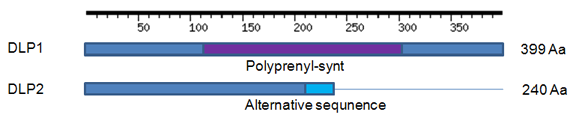
A mutated protein was identified by Saiki et al. (2005) that contains the 7 conserved domains typically found in all trans-prenyl diphosphate synthases, but it lacks DDxxD motifs which could be involved in the catalytic mechanism and/or the binding of the substrates.
Expression
Northern blot analysis shows PDSS2 expresses two transcripts: 3.5 and 1.2 kb. The 3.5-kb transcript was expressed strongly in heart, prostate, and testis; moderately in brain, kidney, liver, lung, spleen, duodenum, esophagus, pancreas, thymus, and thyroid; and weakly in colon, muscle, small intestine, salivary gland, and uterus, and was absent in stomach, peripheral blood lymphocyte, and urinary bladder. Expression of the 1.2-kb transcript was detected in heart, kidney, liver, pancreas, prostate, testis, thymus, and thyroid.
Localisation
Function
Related super-pathways: Metabolic pathways, apoptosis, geranyldiphosphate biosynthesis, trans-octaprenyl transferase activity and protein heterodimerization activity.
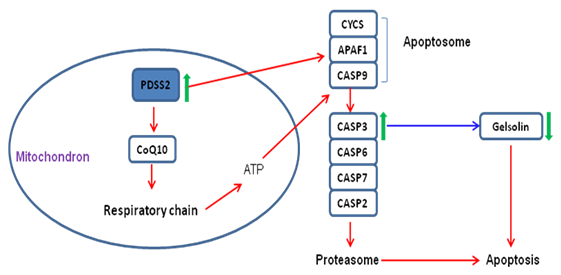
Protein interaction: PDSS2 protein can interact with apoptotic protease-activating factor 1 (APAF1, DIP27624N), which mediates the cytochrome c-dependent autocatalytic activation of pro-caspase-9 (Apaf-3), leading to the ATP required activation of caspase-3 and apoptosis. Result from in silicon pathway analysis showed that PDSS2 protein could interact with hepatocyte nuclear factor 4 alpha (HNF4a), a nuclear transcription factor which regulates the expression of many genes involved in cell growth and proliferation.
Homology
Mutations
Note
PDSS2, SER382LEU [dbSNP:rs118203956]
Disease: Primary coenzyme Q10 deficiency-3 (COQ10D3; OMIM614652).
Two compound heterozygous mutations in the PDSS2 gene were identified by López et al. (2006) in an infant with fatal encephalomyopathy and nephrotic syndrome due to coenzyme Q10 deficiency-3 (COQ10D3; 614652): 2 mutations in the PDSS2 gene: a 964C-T transition resulting in a gln322-to-ter (Q322X,610564.0001) substitution inherited from the unaffected father; and a 1145C-T transition resulting in a ser382-to-leu (S382L; 610564.0002) substitution in the seventh conserved domain inherited from the unaffected mother (López et al., 2006).
In fibroblasts derived from the patient reported by López et al. (2006). CoQ10 levels were decreased to 22.4% of normal, and the cells showed reduced ATP levels (50% of controls), but no increase in reactive oxygen species, signs of oxidative stress, increased antioxidant defense markers,or oxidative stress-induced cell death (Quinzii et al., 2008; Quinzii et al., 2010). This suggested that the pathology caused by these PDSS2 mutations was related to the marked bioenergetic defect, but not to oxidative stress. The very low mitochondrial respiratory activity may even confer some resistance to stress-induced apoptosis.
PDSS2 polymorphisms
Disease: Leigh syndrome with nephropathy
A pair of proxy SNPs of PDSS2 was significantly associated with podocyte diseases, and patients homozygous for one PDSS2 haplotype had a strongly increased risk for podocyte disease. A deficiency of coenzyme Q10 is manifested in lymphoblastoid cell lines derived from focal segmental glomerulosclerosis patients (Gasser et al., 2013).
Implicated in
Expression of PDSS2 is downregulated in human gastric cancer (84.6%, 33/39), and the degree of expression degraded with the increase of malignant degree of tumor. In poorly differentiated gastric cancer, the negative or low expression of PDSS2 was 35% (7/20) or 55% (11/20) and in moderately differentiated gastric cancer, it was 10.5% (2/19) or 68.4% (13/19), respectively (Chen et al., 2009).
The sequence of PDSS2 (AF254956) was firstly submitted to National Cancer for Biotechnology Information by the authors in 2000 and was then named as C6orf210 by Human Genome Organization. Then C6orf210 was found to be important in determining the length of the side chain of ubiquinone in mammals and was named as PDSS2 (Saiki et al., 2005).
The PDSS2 gene has low expression levels in human lung cancer cell lines. The forced PDSS2 overexpression caused massive cell death through apoptotic pathways and significantly inhibited colony formation in the NCI-H1299 lung cancer cell line. At the same time, repression of PDSS2 expression by siRNA enhanced the growth of a noncancerous lung epithelial cell line MRC-5. There was an inverse correlation between PDSS2 expression and gelsolin expression, which is known to inhibit apoptosis and enhance cell invasion and metastasis. The ability of PDSS2 to repress gelsolin might contribute to its tumor-suppressing activity. However, PDSS2 did not influence the sensitivity of the lung cancer cells to chemotherapeutic drugs. Taken together, PDSS2 has tumor-suppressing activity in human lung cancer cells by enhancing apoptosis and inhibiting tumorigenic capacity (Chen et al., 2014).
Breakpoints
Note
Overexpression of PDSS2 induced apoptosis in cancer cells. The mechanism is not clear. A possible mechanism could be that CoQs including CoQ10 can selectively inhibit DNA topoisomerase II (topo-II) activity and eukaryotic DNA polymerase-γ, which is a mitochondrial DNA polymerase, and thus inhibit DNA synthesis and mitochondrial proliferation and consequently induce cancer cell death.
An inverse correlation of PDSS2 expression and gelsolin expression was reported. Gelsolin has been shown to inhibit apoptosis by blocking mitochondrial membrane potential loss and cytochrome c release, thus stabilizing mitochondria. Repression of gelsolin by PDSS2 may counteract the mitochondrial stabilization, and thus induce apoptosis in cancer cells.
PDSS2 does not influence the chemosensitivity of lung cancer cells.
Article Bibliography
| Pubmed ID | Last Year | Title | Authors |
|---|---|---|---|
| 23312889 | 2013 | Decrease of PDSS2 expression, a novel tumor suppressor, in non-small cell lung cancer. | Chen P et al |
| 24608273 | 2014 | The tumor-suppressing activity of the prenyl diphosphate synthase subunit 2 gene in lung cancer cells. | Chen P et al |
| 19209031 | 2009 | Anticancer activity of PDSS2, prenyl diphosphate synthase, subunit 2, in gastric cancer tissue and the SGC7901 cell line. | Chen P et al |
| 17855635 | 2007 | COQ2 nephropathy: a newly described inherited mitochondriopathy with primary renal involvement. | Diomedi-Camassei F et al |
| 19188149 | 2009 | Identification and characterization of a novel melanoma tumor suppressor gene on human chromosome 6q21. | Fung JM et al |
| 23926186 | 2013 | Focal segmental glomerulosclerosis is associated with a PDSS2 haplotype and, independently, with a decreased content of coenzyme Q10. | Gasser DL et al |
| 11996799 | 2002 | Characterization of a complex chromosome rearrangement involving 6q in a melanoma cell line by chromosome microdissection. | Guan XY et al |
| 23382691 | 2013 | Loci associated with N-glycosylation of human immunoglobulin G show pleiotropy with autoimmune diseases and haematological cancers. | Lauc G et al |
| 17186472 | 2006 | Leigh syndrome with nephropathy and CoQ10 deficiency due to decaprenyl diphosphate synthase subunit 2 (PDSS2) mutations. | López LC et al |
| 21871565 | 2012 | Cerebellar defects in Pdss2 conditional knockout mice during embryonic development and in adulthood. | Lu S et al |
| 20507940 | 2010 | Genotype-phenotype correlations in non-Finnish congenital nephrotic syndrome. | Machuca E et al |
| 18437205 | 2008 | Primary coenzyme Q deficiency in Pdss2 mutant mice causes isolated renal disease. | Peng M et al |
| 20495179 | 2010 | Reactive oxygen species, oxidative stress, and cell death correlate with level of CoQ10 deficiency. | Quinzii CM et al |
| 16262699 | 2005 | Characterization of solanesyl and decaprenyl diphosphate synthases in mice and humans. | Saiki R et al |
Other Information
Locus ID:
NCBI: 57107
MIM: 610564
HGNC: 23041
Ensembl: ENSG00000164494
Variants:
dbSNP: 57107
ClinVar: 57107
TCGA: ENSG00000164494
COSMIC: PDSS2
RNA/Proteins
| Gene ID | Transcript ID | Uniprot |
|---|---|---|
| ENSG00000164494 | ENST00000369031 | Q86YH6 |
| ENSG00000164494 | ENST00000369037 | Q86YH6 |
| ENSG00000164494 | ENST00000449027 | Q5JRD6 |
Expression (GTEx)
Pathways
Protein levels (Protein atlas)
References
| Pubmed ID | Year | Title | Citations |
|---|---|---|---|
| 33929387 | 2021 | PDSS2 Inhibits the Ferroptosis of Vascular Endothelial Cells in Atherosclerosis by Activating Nrf2. | 32 |
| 33929387 | 2021 | PDSS2 Inhibits the Ferroptosis of Vascular Endothelial Cells in Atherosclerosis by Activating Nrf2. | 32 |
| 33064899 | 2020 | PDSS2-Del2, a new variant of PDSS2, promotes tumor cell metastasis and angiogenesis in hepatocellular carcinoma via activating NF-κB. | 6 |
| 33064899 | 2020 | PDSS2-Del2, a new variant of PDSS2, promotes tumor cell metastasis and angiogenesis in hepatocellular carcinoma via activating NF-κB. | 6 |
| 31783675 | 2019 | Sp1 Mediates the Constitutive Expression and Repression of the PDSS2 Gene in Lung Cancer Cells. | 14 |
| 31783675 | 2019 | Sp1 Mediates the Constitutive Expression and Repression of the PDSS2 Gene in Lung Cancer Cells. | 14 |
| 29967258 | 2018 | PDSS2 Deficiency Induces Hepatocarcinogenesis by Decreasing Mitochondrial Respiration and Reprogramming Glucose Metabolism. | 22 |
| 29967258 | 2018 | PDSS2 Deficiency Induces Hepatocarcinogenesis by Decreasing Mitochondrial Respiration and Reprogramming Glucose Metabolism. | 22 |
| 27561104 | 2016 | Non-additive genome-wide association scan reveals a new gene associated with habitual coffee consumption. | 13 |
| 27561104 | 2016 | Non-additive genome-wide association scan reveals a new gene associated with habitual coffee consumption. | 13 |
| 25780306 | 2015 | Decaprenyl diphosphate synthase subunit 2 as a prognosis factor in hepatocellular carcinoma. | 3 |
| 25780306 | 2015 | Decaprenyl diphosphate synthase subunit 2 as a prognosis factor in hepatocellular carcinoma. | 3 |
| 24608273 | 2014 | The tumor-suppressing activity of the prenyl diphosphate synthase subunit 2 gene in lung cancer cells. | 5 |
| 25189544 | 2014 | Clinical utility of PDSS2 expression to stratify patients at risk for recurrence of hepatocellular carcinoma. | 6 |
| 25330808 | 2014 | Decreased expression of prenyl diphosphate synthase subunit 2 correlates with reduced survival of patients with gastric cancer. | 14 |
Citation
Ping Chen ; Qi Chen
PDSS2 (prenyl (decaprenyl) diphosphate synthase, subunit 2)
Atlas Genet Cytogenet Oncol Haematol. 2014-07-01
Online version: http://atlasgeneticsoncology.org/gene/890/pdss2-(prenyl-(decaprenyl)-diphosphate-synthase-subunit-2)
