CARD8 (caspase recruitment domain family, member 8)
2007-05-01 Frank A. Kruyt AffiliationDepartment of Medical Oncology, VU University Medical Center, 1081 HV Amsterdam, The Netherlands [email protected]
Identity
HGNC
LOCATION
19q13.33
LOCUSID
ALIAS
CARDINAL,DACAR,DAKAR,NDPP,NDPP1,TUCAN
FUSION GENES
DNA/RNA
Description
The CARD8 gene contains 13 exons spanning over approximately 30 kb of genomic DNA
Transcription
At least 5 transcripts have been identified generated by alternative splicing that together with different start codon usage yield different CARD8 isoforms. Gene products encoded by exons 1 to 13 and 5 to 13 yield TUCAN/CARD8-54-kDa and TUCAN/CARD8-48-kDa, respectively.
Proteins
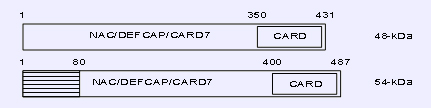
Schematic representation of two CARD8 variants. The CARD domain, the NAC/DEFCAP/CARD7 homology domain, and the amino-terminal residues that differ between the isoforms are indicated.
Description
The CARD8 gene encodes different CARD8 isoforms that contain the caspase-associated recruitment domain (CARD) in their carboxy-termini that acts as a protein-protein interaction interface. A 431 amino acids CARD8 protein of 48-kDa (TUCAN-48) has been best studied and more recently a 54-kDa isoform (TUCAN-54, 487 amino acids) was identified sharing the same CARD motif but with a different stretch of 80 amino-terminal residues. In the amino terminal part of the protein a NAC/DEFCAP/CARD7 homology domain is present.
Expression
Normal tissue: wide and differential expression at mRNA level in tissues; present in heart, brain, lung, muscle, spleen, ovary; high in kidney, testis and spinal cord; absent in liver.
Cancer: the CARD8 (48 kDa) protein is differentially expressed in cancer. High levels of CARD8 expression were found in tumor cell lines, including breast, prostate, ovarian and colon cancer cells as well as high expression in non-small cell lung cancer (NSCLC) cells and with hardly detectable expression in normal lung, in contrast to a lack of expression in small-cell lung cancer cell lines. In tumor specimens from patients CARD8 expression has been demonstrated in colon cancer and non-small cell lung cancer. The 54-kDa CARD8 isoform has a different expression profile when compared to TUCAN/CARD8-48. For example a number of breast cancer cell lines do not express TUCAN/CARD8-54, although some of them express TUCAN/CARD8-48. Expression also varies widely among different tumor cell lines with high levels in colon cancer cells.
Cancer: the CARD8 (48 kDa) protein is differentially expressed in cancer. High levels of CARD8 expression were found in tumor cell lines, including breast, prostate, ovarian and colon cancer cells as well as high expression in non-small cell lung cancer (NSCLC) cells and with hardly detectable expression in normal lung, in contrast to a lack of expression in small-cell lung cancer cell lines. In tumor specimens from patients CARD8 expression has been demonstrated in colon cancer and non-small cell lung cancer. The 54-kDa CARD8 isoform has a different expression profile when compared to TUCAN/CARD8-48. For example a number of breast cancer cell lines do not express TUCAN/CARD8-54, although some of them express TUCAN/CARD8-48. Expression also varies widely among different tumor cell lines with high levels in colon cancer cells.
Localisation
In MCF-7 cells overexpressed CARD8 localized to both the cytoplasmic and nuclear compartment. In specimens derived from colon cancer cells a predominant cytoplasmic expression was found, whereas in NSCLC tumor samples CARD8 was either exclusively nuclear or cytoplasmic or present in both compartments.
Function
CARD8 belongs to the CARD family of proteins that play a role in apoptosis regulation and NF-kB signaling associated with the innate or adaptive immune response. For example the binding of CARDs present in caspase-9 and Apaf-1 mediate the assembly of the apoptosome in which caspase-9 is activated. CARD motifs have different binding selectivity towards each other and the presence of additional structural/ functional domains in the various CARD-containing proteins may also determine the choice of interaction partner.
In literature there is some controversy on the function of CARD8. Some reports mention an apoptosis inhibitory function of CARD8 involving its CARD-dependent binding to procaspase-9, whereas others did not find an association between CARD8 and caspase-9 and instead found either pro-apoptotic activity of CARD8 and associations with the inflammatory caspase-1 or the regulatory subunit of IkB kinase (NEMO) thereby suppressing NF-kB activation. Also an interaction between the p53-responsive gene DRAL (FLH2) and CARD8 has been reported resulting in the suppression of NF-kB activation. Furthermore, TUCAN/CARD8-54 was found to inhibit chemotherapy-induced caspase-9 activation and Fas ligand-induced caspase-8 activation. Based mainly on its proposed anti-apoptotic activity CARD8 is considered as a possible therapeutic target for cancer.
In literature there is some controversy on the function of CARD8. Some reports mention an apoptosis inhibitory function of CARD8 involving its CARD-dependent binding to procaspase-9, whereas others did not find an association between CARD8 and caspase-9 and instead found either pro-apoptotic activity of CARD8 and associations with the inflammatory caspase-1 or the regulatory subunit of IkB kinase (NEMO) thereby suppressing NF-kB activation. Also an interaction between the p53-responsive gene DRAL (FLH2) and CARD8 has been reported resulting in the suppression of NF-kB activation. Furthermore, TUCAN/CARD8-54 was found to inhibit chemotherapy-induced caspase-9 activation and Fas ligand-induced caspase-8 activation. Based mainly on its proposed anti-apoptotic activity CARD8 is considered as a possible therapeutic target for cancer.
Homology
CARD family proteins.
Mutations
Somatic
Ten single nucleotide polymorphisms (SNPs) across TUCAN/CARD8 have been identified in healthy persons and patients suffering from inflammatory bowl disease.
Implicated in
Entity name
Colon cancer
Prognosis
TUCAN/CARD8 expression has been analyzed by immunohistochemistry in paraffin-embedded colon cancer specimens (N=102) derived from patients with clinical stage II that were surgically treated. TUCAN/CARD8 staining was stronger in colon cancer cells when compared to normal cells in 64% of the 102 specimens examined. Scoring staining intensity revealed a significant correlation between high TUCAN/CARD8 expression in tumor cells and shorter patient survival.
Entity name
Non-small cell lung cancer (NSCLC)
Prognosis
The expression of TUCAN/CARD8 has been determined by immunohistochemistry in tumor specimens derived from NSCLC patients (N=49, stage III and IV) that received neoadjuvant or palliative chemotherapy. TUCAN/CARD8 expression was detected in 69% of the samples, showing exclusively cytoplasmic (27%) or nuclear (11%) staining, or in both compartments (31%). No correlation between response to chemotherapy or expression/ localization was found, although, cytoplasm-only staining NSCLC samples predicted shorter survival, suggesting a possible prognostic value.
Entity name
Inflammatory bowel disease (IBD)
Disease
Crohn disease and ulcerative colitis
Prognosis
Patients with IBD (Crohns disease (CD) and ulcerative colitis) and healthy individuals were genotyped for SNP. A significant association between a TUCAN SNP and CD was found. However, in other reports this association was not confirmed, rejecting TUCAN/CARD8 as a possible susceptibility gene for IBD.
Article Bibliography
| Pubmed ID | Last Year | Title | Authors |
|---|---|---|---|
| 12101092 | 2002 | CARD games in apoptosis and immunity. | Bouchier-Hayes L et al |
| 17094407 | 2006 | The expression of TUCAN, an inhibitor of apoptosis protein, in patients with advanced non-small cell lung cancer treated with chemotherapy. | Checinska A et al |
| 15134219 | 2004 | CARD proteins as therapeutic targets in cancer. | Damiano JS et al |
| 17484911 | 2007 | Combined evidence from three large British Association studies rejects TUCAN/CARD8 as an IBD susceptibility gene. | Fisher SA et al |
| 17030188 | 2006 | TUCAN (CARD8) genetic variants and inflammatory bowel disease. | McGovern DP et al |
| 11408476 | 2001 | TUCAN, an antiapoptotic caspase-associated recruitment domain family protein overexpressed in cancer. | Pathan N et al |
| 11821383 | 2002 | CARD-8 protein, a new CARD family member that regulates caspase-1 activation and apoptosis. | Razmara M et al |
| 12067710 | 2002 | TUCAN/CARDINAL and DRAL participate in a common pathway for modulation of NF-kappaB activation. | Stilo R et al |
| 16204039 | 2005 | A novel isoform of TUCAN is overexpressed in human cancer tissues and suppresses both caspase-8- and caspase-9-mediated apoptosis. | Yamamoto M et al |
| 11956601 | 2002 | NDPP1 is a novel CARD domain containing protein which can inhibit apoptosis and suppress NF-kappaB activation. | Zhang H et al |
Other Information
Locus ID:
NCBI: 22900
MIM: 609051
HGNC: 17057
Ensembl: ENSG00000105483
Variants:
dbSNP: 22900
ClinVar: 22900
TCGA: ENSG00000105483
COSMIC: CARD8
RNA/Proteins
Expression (GTEx)
Pathways
| Pathway | Source | External ID |
|---|---|---|
| NOD-like receptor signaling pathway | KEGG | ko04621 |
| NOD-like receptor signaling pathway | KEGG | hsa04621 |
Protein levels (Protein atlas)
References
| Pubmed ID | Year | Title | Citations |
|---|---|---|---|
| 38350853 | 2024 | Association between C10X polymorphism in the CARD8 gene and inflammatory markers in young healthy individuals in the LBA study. | 1 |
| 38350853 | 2024 | Association between C10X polymorphism in the CARD8 gene and inflammatory markers in young healthy individuals in the LBA study. | 1 |
| 36649710 | 2023 | The NLRP1 and CARD8 inflammasomes detect reductive stress. | 10 |
| 36649711 | 2023 | Protein folding stress potentiates NLRP1 and CARD8 inflammasome activation. | 11 |
| 36835594 | 2023 | Association between NLRP3 rs10754558 and CARD8 rs2043211 Variants and Susceptibility to Chronic Kidney Disease. | 3 |
| 36870425 | 2023 | Inflammasome genes polymorphisms are associated with progression to mechanical ventilation and death in a cohort of hospitalized COVID-19 patients in a reference hospital in Rio de Janeiro, Brazil. | 2 |
| 37276232 | 2023 | Variants of CARD8 in Leishmania guyanensis-cutaneous leishmaniasis and influence of the variants genotypes on circulating plasma cytokines IL-1β, TNFα and IL-8. | 1 |
| 37311351 | 2023 | Tripping the wire: sensing of viral protease activity by CARD8 and NLRP1 inflammasomes. | 5 |
| 37417868 | 2023 | A human-specific motif facilitates CARD8 inflammasome activation after HIV-1 infection. | 4 |
| 37712526 | 2023 | The role of NLRP3 and CARD8 polymorphisms in the risk of rheumatoid arthritis: A meta-analysis of genetic association studies. | 2 |
| 36649710 | 2023 | The NLRP1 and CARD8 inflammasomes detect reductive stress. | 10 |
| 36649711 | 2023 | Protein folding stress potentiates NLRP1 and CARD8 inflammasome activation. | 11 |
| 36835594 | 2023 | Association between NLRP3 rs10754558 and CARD8 rs2043211 Variants and Susceptibility to Chronic Kidney Disease. | 3 |
| 36870425 | 2023 | Inflammasome genes polymorphisms are associated with progression to mechanical ventilation and death in a cohort of hospitalized COVID-19 patients in a reference hospital in Rio de Janeiro, Brazil. | 2 |
| 37276232 | 2023 | Variants of CARD8 in Leishmania guyanensis-cutaneous leishmaniasis and influence of the variants genotypes on circulating plasma cytokines IL-1β, TNFα and IL-8. | 1 |
Citation
Frank A. Kruyt
CARD8 (caspase recruitment domain family, member 8)
Atlas Genet Cytogenet Oncol Haematol. 2007-05-01
Online version: http://atlasgeneticsoncology.org/gene/913/card8-(caspase-recruitment-domain-family-member-8)
