CASP8AP2 (caspase 8 associated protein 2)
2015-03-01 Rocío Juárez-Velázquez , Patricia Pérez-Vera, PhD AffiliationLaboratorio de Cultivo de Tejidos, Departamento de Genética Humana, Instituto Nacional de Pediatria, Mexico, Mexico; [email protected]
Identity
Abstract
CASP8AP2 was initially identified as a pro-apoptotic protein that transmits an apoptosis indication through the death-inducing signaling complex. More recently, diverse functions have been described including TNF-induced NF-kappaB activation, cell-cycle progression and cell division, regulation of histone gene transcription and histone mRNA processing.
DNA/RNA
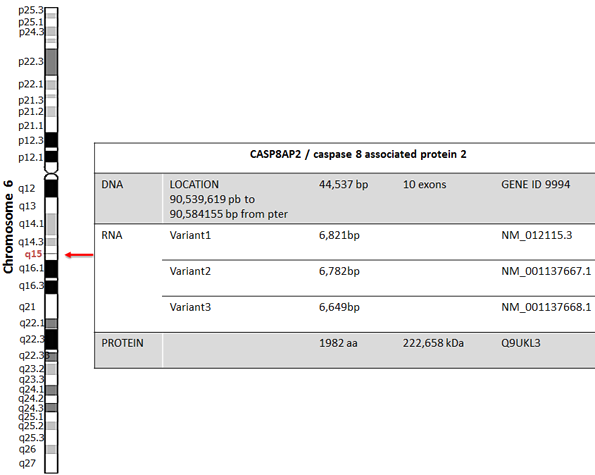
Description
Transcription
Proteins
Description
Localisation
Function
Component of the machinery required for histone precursor mRNA expression and essential for 3end maturation of histone mRNAs (Barcaroli D et al., 2006; De Cola et al., 2012; Yang XC et al., 2009).
It participates in TNF-alpha-induced blockade of glucocorticoid receptor transactivation at the nuclear receptor coactivator level, upstream and independently of NF-kappa-B (Kino and Chrousos, 2003).
It also contributes to cell cycle progression at S phase (Kiriyama et al., 2009; Barcaroli D et al., 2006).
Homology
Implicated in
The usefulness of CASP8AP2 expression as a potential marker of response to treatment has been analyzed in leukemic patients from different populations. In a cohort of 39 newly diagnosed ALL children treated with the Beijing Children`s Hospital (BCH)-ALL 2003 protocol, the bone marrow expression of CASP8AP2 at diagnosis resulted a suitable indicator of relapse. In the same study, another cohort of 106 patients enrolled in the Chinese Childrens Leukemia Group (CCLG)-ALL 2008 protocol were also analyzed, patients with low CASP8AP2 expression showed higher relapse rates, lower relapse-free survival and lower overall-survival, in comparison to the higher-expression group (Jiao Y et al., 2012). ).
In an independent study a gene signature of 14 genes, including CASP8AP2 and H2AFZ, was identified (Flotho C et al., 2007); their low expressions were associated to relapse. Based on this result, the expressions of CASP8AP2 and H2AFZ were analyzed in a cohort of 88 ALL Mexican children treated with the Popular Medical Insurance protocols (Juárez-Velázquez R et al., 2014). An increased risk for early relapse in patients with low expression of CASP8AP2 was found, confirming its usefulness as a risk marker; the H2AFZ expression did not showed the same effect. The CASP8AP2 expression was not an independent marker of relapse, but combined characteristics as the low expressions of both genes and high white blood cell count, identified more accurately patients at greater risk of relapse (Juárez-Velázquez R et al., 2014). Although the prognostic value of CASP8AP2 expression as an independent factor is controversial (Yang YL et al., 2010), combined with expressions of other genes such as H2AFZ (Juárez-Velázquez R et al., 2014) and ARS2 (Cui L et al., 2015), could more precisely predict high risk of relapse in ALL. ).
Epigenetic modifications are also related to the down-regulation of CASP8AP2. DNA hypermethylation of the gene promoter was analyzed in 86 children with ALL, treated according to the BCH-2003 and CCLG-2008 protocols. The percentage of methylation of two CpG sites at positions -1189 and -1176 were inversely correlated with mRNA expression. The patients with higher methylation presented MRD and poor treatment outcome. The results suggested that combination of methylation level and MRD might improve current risk stratification (Li ZG et al., 2013). In regard to these findings, it has been demonstrated that methylation of the CASP8AP2 promoter in somatic stem cells and cancer cells increase their resistance to drugs (Lee KD et al., 2012). These data associate this epigenetic modification with the development of drug resistance.
Article Bibliography
| Pubmed ID | Last Year | Title | Authors |
|---|---|---|---|
| 19615980 | 2009 | SUMO modification regulates the transcriptional activity of FLASH. | Alm-Kristiansen AH et al |
| 17003125 | 2006 | FLASH is required for histone transcription and S-phase progression. | Barcaroli D et al |
| 25530566 | 2015 | Low expressions of ARS2 and CASP8AP2 predict relapse and poor prognosis in pediatric acute lymphoblastic leukemia patients treated on China CCLG-ALL 2008 protocol. | Cui L et al |
| 21725362 | 2012 | FLASH is essential during early embryogenesis and cooperates with p73 to regulate histone gene transcription. | De Cola A et al |
| 17456722 | 2007 | A set of genes that regulate cell proliferation predicts treatment outcome in childhood acute lymphoblastic leukemia. | Flotho C et al |
| 10235259 | 1999 | The CED-4-homologous protein FLASH is involved in Fas-mediated activation of caspase-8 during apoptosis. | Imai Y et al |
| 21696825 | 2012 | CASP8AP2 is a promising prognostic indicator in pediatric acute lymphoblastic leukemia. | Jiao Y et al |
| 24397596 | 2014 | Significance of CASP8AP2 and H2AFZ expression in survival and risk of relapse in children with acute lymphoblastic leukemia. | Juárez-Velázquez R et al |
| 12477726 | 2003 | Tumor necrosis factor alpha receptor- and Fas-associated FLASH inhibit transcriptional activity of the glucocorticoid receptor by binding to and interfering with its interaction with p160 type nuclear receptor coactivators. | Kino T et al |
| 19546234 | 2009 | Interaction of FLASH with arsenite resistance protein 2 is involved in cell cycle progression at S phase. | Kiriyama M et al |
| 22595458 | 2012 | Targeted Casp8AP2 methylation increases drug resistance in mesenchymal stem cells and cancer cells. | Lee KD et al |
| 23953914 | 2013 | Hypermethylation of two CpG sites upstream of CASP8AP2 promoter influences gene expression and treatment outcome in childhood acute lymphoblastic leukemia. | Li ZG et al |
| 19837277 | 2009 | CASP8AP2 is a novel partner gene of MLL rearrangement with t(6;11)(q15;q23) in acute myeloid leukemia. | Park TS et al |
| 19406988 | 2009 | High-resolution genomic profiling of childhood T-ALL reveals frequent copy-number alterations affecting the TGF-beta and PI3K-AKT pathways and deletions at 6q15-16.1 as a genomic marker for unfavorable early treatment response. | Remke M et al |
| 25042405 | 2015 | Characterization of genomic imbalances in diffuse large B-cell lymphoma by detailed SNP-chip analysis. | Scholtysik R et al |
| 19854135 | 2009 | FLASH, a proapoptotic protein involved in activation of caspase-8, is essential for 3' end processing of histone pre-mRNAs. | Yang XC et al |
| 20109966 | 2010 | Expression and prognostic significance of the apoptotic genes BCL2L13, Livin, and CASP8AP2 in childhood acute lymphoblastic leukemia. | Yang YL et al |
Other Information
Locus ID:
NCBI: 9994
MIM: 606880
HGNC: 1510
Ensembl: ENSG00000118412
Variants:
dbSNP: 9994
ClinVar: 9994
TCGA: ENSG00000118412
COSMIC: CASP8AP2
RNA/Proteins
| Gene ID | Transcript ID | Uniprot |
|---|---|---|
| ENSG00000118412 | ENST00000419040 | A0A096LP21 |
| ENSG00000118412 | ENST00000551025 | A0A087WTW5 |
| ENSG00000118412 | ENST00000552401 | A0A096LP21 |
Expression (GTEx)
References
| Pubmed ID | Year | Title | Citations |
|---|---|---|---|
| 36162009 | 2023 | Interaction of E2F3a and CASP8AP2 Regulates Histone Expression and Chemosensitivity of Leukemic Cells. | 0 |
| 36252816 | 2023 | CRISPRi screening identifies CASP8AP2 as an essential viability factor in lung cancer controlling tumor cell death via the AP-1 pathway. | 3 |
| 36162009 | 2023 | Interaction of E2F3a and CASP8AP2 Regulates Histone Expression and Chemosensitivity of Leukemic Cells. | 0 |
| 36252816 | 2023 | CRISPRi screening identifies CASP8AP2 as an essential viability factor in lung cancer controlling tumor cell death via the AP-1 pathway. | 3 |
| 35139734 | 2022 | Interaction between CASP8AP2 and ZEB2-CtBP2 Regulates the Expression of LEF1. | 0 |
| 35139734 | 2022 | Interaction between CASP8AP2 and ZEB2-CtBP2 Regulates the Expression of LEF1. | 0 |
| 32910455 | 2021 | Knockout of the caspase 8-associated protein 2 gene improves recombinant protein expression in HEK293 cells through up-regulation of the cyclin-dependent kinase inhibitor 2A gene. | 3 |
| 32910455 | 2021 | Knockout of the caspase 8-associated protein 2 gene improves recombinant protein expression in HEK293 cells through up-regulation of the cyclin-dependent kinase inhibitor 2A gene. | 3 |
| 31819999 | 2020 | Composition and processing activity of a semi-recombinant holo U7 snRNP. | 10 |
| 32722282 | 2020 | Structural Analysis of the SANT/Myb Domain of FLASH and YARP Proteins and Their Complex with the C-Terminal Fragment of NPAT by NMR Spectroscopy and Computer Simulations. | 4 |
| 32804017 | 2020 | Low expression of CTBP2 and CASP8AP2 predicts risk of relapse in childhood B-cell precursor acute lymphoblastic leukemia: a retrospective cohort study. | 1 |
| 31819999 | 2020 | Composition and processing activity of a semi-recombinant holo U7 snRNP. | 10 |
| 32722282 | 2020 | Structural Analysis of the SANT/Myb Domain of FLASH and YARP Proteins and Their Complex with the C-Terminal Fragment of NPAT by NMR Spectroscopy and Computer Simulations. | 4 |
| 32804017 | 2020 | Low expression of CTBP2 and CASP8AP2 predicts risk of relapse in childhood B-cell precursor acute lymphoblastic leukemia: a retrospective cohort study. | 1 |
| 28289156 | 2017 | U7 snRNP is recruited to histone pre-mRNA in a FLASH-dependent manner by two separate regions of the stem-loop binding protein. | 21 |
Citation
Rocío Juárez-Velázquez ; Patricia Pérez-Vera, PhD
CASP8AP2 (caspase 8 associated protein 2)
Atlas Genet Cytogenet Oncol Haematol. 2015-03-01
Online version: http://atlasgeneticsoncology.org/gene/926/casp8ap2-(caspase-8-associated-protein-2)
