t(11;19)(q23;p13.1) KMT2A/ELL
1997-12-01 Jean-Loup Huret , Jean-Loup Huret Affiliation1.Genetics, Dept Medical Information, University of Poitiers, CHU Poitiers Hospital, F-86021 Poitiers, France
Clinics and Pathology
Disease
AML
Phenotype stem cell origin
M4/M5 most often; M1/M2 at times; therapyrelated AL; however, clonal rearrangements of IgH gene have been found,demonstrating a biphenotypic nature
Epidemiology
children and, most often, adults (7 days to 83 yrs);congenital cases are rare, in contrast with the t(11;19)(q23;p13.3)leukaemia; balanced sex ratio
Clinics
organomegaly in half cases; CNS involvement in some cases
Treatment
BMT is indicated
Prognosis
very poor (median: 6 mths!)
Cytogenetics
Cytogenetics morphological
can be seen with R-banding: chromosome 11appears enlarged, chromosome 19 shortened (11q+ and 19p-); will be missedwith G-banding
Cytogenetics molecular
... therefore, FISH may be needed
Additional anomalies
none at diagnosis in 2/3 cases; +8
Genes Involved and Proteins
Gene name
KMT2A (myeloid/lymphoid or mixed lineage leukemia)
Location
11q23.3
Dna rna description
21 exons, spanning over 100 kb; 13-15 kb mRNA
Protein description
431 kDa; contains two DNA binding motifs (a AT hook,and Zinc fingers), a DNA methyl transferase motif, a bromodomain;transcriptional regulatory factor; nuclear localisation
Gene name
ELL (eleven nineteen lysin rich leukemia gene)
Location
19p13.11
Protein description
contains a Lysin rich domain (basic motif); nuclear
Protein description
localisation; transcription factor (RNA polymerase elongation factor)
Result of the Chromosomal Anomaly
Description
5 MLL - 3 ELLAT hook and DNA methyltransferase from MLL fused to most of ELL
Expression localisation
nuclear localisation
Oncogenesis
potential transcription factor
Highly cited references
| Pubmed ID | Year | Title | Citations |
|---|---|---|---|
| 33608309 | 2021 | Rare KMT2A-ELL and Novel ZNF56-KMT2A Fusion Genes in Pediatric T-cell Acute Lymphoblastic Leukemia. | 83 |
| 35566503 | 2022 | Genetic Characteristics According to Subgroup of Acute Myeloid Leukemia with Myelodysplasia-Related Changes. | 39 |
| 37942413 | 2023 | A scoring system based on fusion genes to predict treatment outcomes of the non-acute promyelocytic leukemia pediatric acute myeloid leukemia. | 38 |
| 33303709 | 2020 | Changing the frequency and spectra of chromosomal aberrations in Korean patients with acute leukemia in a tertiary care hospital. | 19 |
| 30922345 | 2019 | Rare myeloid sarcoma with KMT2A (MLL)-ELL fusion presenting as a vaginal wall mass. | 18 |
| 32337199 | 2020 | Acute myeloid leukemia with t(11;19)(q23;p13.1) in a patient with a gastrointestinal stromal tumor undergoing imatinib therapy: A case report. | 17 |
| 36640593 | 2023 | Rare case of pediatric trilineal mixed-phenotype acute leukemia with t(11;19)(q23.3;p13)/KMT2A::ELL. | 0 |
| 30203571 | 2018 | KMT2A (MLL) rearrangements observed in pediatric/young adult T-lymphoblastic leukemia/lymphoma: A 10-year review from a single cytogenetic laboratory. | 0 |
| 32175599 | 2020 | Measurable residual disease assessment by qPCR in peripheral blood is an informative tool for disease surveillance in childhood acute myeloid leukaemia. | 0 |
Bibliography
No bibliography items were found for this article.
Summary
Fusion gene
KMT2A/ELL KMT2A (11q23.3) ELL (19p13.11) COF 1988 1989 1990 1991 1992 1993 1994 1995 1996 1997|KMT2A/ELL KMT2A (11q23.3) ELL (19p13.11) TIC
Note
two different translocations (and two clinical entities), bothinvolving 11q23 with a common breakpoint in MLL, and 19p13 with differentbreakpoints are now identified: the above mentioned, and thet(11;19)(q23;p13.3)
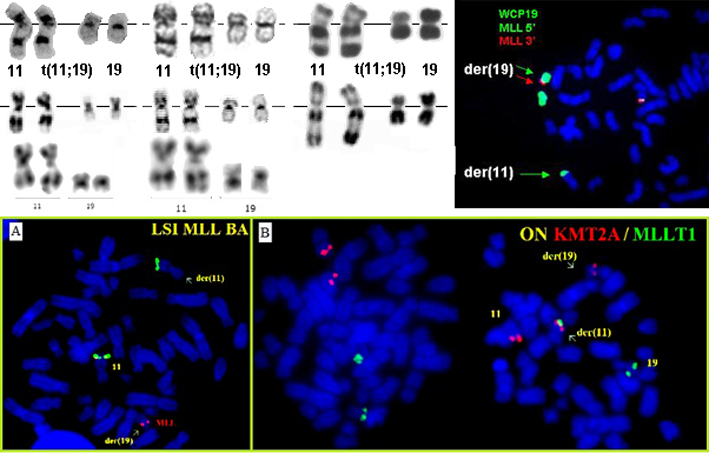
t(11;19)(q23;p13.1) KMT2A/ELL G- banding (left and center) and R- banding (right). G- banding frist and second row - Courtesy H. Norback, Eric B. Johnson, Sara Morrison-Delap UW Cytogenetic Services; third row. Courtesy Adriana Zamecnikova; and R- banding top: Jean Loup Huret; second row - Courtesy Christiane Charrin); Top right: In situ hybridization with a 19 whole chromosome paint probe (spectrum green ) and a KMT2A (MLL) dual color break apart rearrangement probe; the der(19) is WCP19-spectrum green+ and 3-MLL spectrum orange+ - Courtesy Pascaline Talmant; Bottom: Fluorescence in situ hybridization with the Vysis LSI MLL (KMT2A) break apart probe (Abbott Molecular, US) showing translocation of MLL sequences to der(19) chromosome (red signal) (A). Hybridization with Kreatech KMT2A/MLLT1 probe showing 2 green and 2 red signals on normal metaphase (left) and translocation of MLL sequences to der(19) with relocation of 19p13.3 sequences distal to residual MLL gene (right) (B). Courtesy Adriana Zamecnikova.
Citation
Jean-Loup Huret ; Jean-Loup Huret
t(11;19)(q23;p13.1) KMT2A/ELL
Atlas Genet Cytogenet Oncol Haematol. 1997-12-01
Online version: http://atlasgeneticsoncology.org/haematological/1029/t(11
