t(1;18)(q10;q10)
2013-03-01 Adriana Zamecnikova Affiliation1.Kuwait Cancer Control Center, Laboratory of Cancer Genetics, Department of Hematology, Shuwaikh, 70653, Kuwait
2.Hematology Division, Department of Pathology, The University of Hong Kong, Queen Mary Hospital, Hong Kong, P.R. China
Clinics and Pathology
Disease
Only 5 cases of hematological malignancy with der(1;18) are reported in the literature. Four cases of chronic myeloproliferative disorders (CMD) (one case with myelodysplastic syndrome, one patient with CMD, unclassifiable, one with essential thrombocythemia (ET) coexistent with the JAK2 V617F mutation, one idiopathic myelofibrosis (IMF)) and one patient was diagnosed with multiple myeloma.
Phenotype stem cell origin
Unknown, but may involve a myeloid progenitor cell as both reported cases can be grouped under myeloid malignancy.
Clinics
The first case was a 23-year old male who presented as myelodysplastic syndrome that rapidly progressed to acute myeloid leukemia, and died of neutropenic sepsis at induction phase. The second case was a 65-year old female diagnosed as chronic myeloproliferative disorder, unclassifiable, and run a chronic stable clinical course for years. She however suffered from recurrent pyogenic cutaneous infection. The patient with essential thrombocythemia was a 75-year-old woman receiving ranimustine therapy. The case with IMF was a male with a history of polycythemia vera (PV) and normal karyotype at diagnosis.
Prognosis
Owing to the small number of cases reported, the prognostic implication of der(1;18)(q10;q10) remains to be defined. The clinical outcome of the two reported cases with detailed clinica course were markedly different, with one having rapid downhill course and short survival whereas the other one having chronic disease.
Cytogenetics
Cytogenetics morphological
Found in the unbalanced form -18, + der(1;18), with trisomy for 1q and monosomy for 18p.
Additional anomalies
Sole abnormality in 3 of 4 patients with chronic myeloproliferative disorders; +22 reported as additional abnormality in a post-polycythemic myelofibrosis patient. Patient with multiple myeloma had a complex karyotype with der(8)t(8;11)(q24;q13)ins(8;22)(q24;q11q11) and numerical changes.
Genes Involved and Proteins
Note
Genes involved are unknown. Mechanistically, either trisomy 1q or monosomy 18p that results from the unbalanced translocation may potentially contribute to leukemogenesis. Whole arm chromosome translocations resulting in trisomy of the long arm of chromosome chromosome 1 have been identified with several partner chromosomes including chromosomes 7, 9, 13, 15, 16 and Y in BCR-ABL-negative myeloproliferative neoplasms (MPN). While the underlying mechanisms for these chromosomal alterations are unclear, it is likely that chromosomes with large constitutive heterochromatin bands such as chromosome 1 may be at risk of centromeric instability and be predisposed to centromeric fusion with other chromosomes.
These observations suggest that a gene dosage effect of certain chromosome 1q regions, analogous to numerical aberrations may be involved in disease pathogenesis. Additionally, deletion of 18p may also contribute to clonal proliferation through loss of putative tumor suppressor genes, analogous to numerical aberrations and deletions associated with both chronic and advanced phases of MPN. In support of this contention, deletions on chromosome 18p as a result of der(18)t(9;18)(p13;p11) and der(9;18)(p10;q10) associated with the JAK2 V617F mutation have been described with phenotypes of transitional PV and IMF, suggesting that 18p deletion may be associated with myeloproliferative disorders showing a high propensity to transformation.
While the association of derivative (1;18) with JAK2 V617F still remain elusive, it is possible that that patients having this chromosome abnormality together with the JAK2 V617F mutation may belong to the subgroup of patients with highly proliferative phenotype of MPN which potentially transforms into acute myeloid leukemia.
These observations suggest that a gene dosage effect of certain chromosome 1q regions, analogous to numerical aberrations may be involved in disease pathogenesis. Additionally, deletion of 18p may also contribute to clonal proliferation through loss of putative tumor suppressor genes, analogous to numerical aberrations and deletions associated with both chronic and advanced phases of MPN. In support of this contention, deletions on chromosome 18p as a result of der(18)t(9;18)(p13;p11) and der(9;18)(p10;q10) associated with the JAK2 V617F mutation have been described with phenotypes of transitional PV and IMF, suggesting that 18p deletion may be associated with myeloproliferative disorders showing a high propensity to transformation.
While the association of derivative (1;18) with JAK2 V617F still remain elusive, it is possible that that patients having this chromosome abnormality together with the JAK2 V617F mutation may belong to the subgroup of patients with highly proliferative phenotype of MPN which potentially transforms into acute myeloid leukemia.
Result of the Chromosomal Anomaly
Note
This abnormality yields the net result of an extra / third copy of chromosome 1q and a deletion of chromosome 18p.
Article Bibliography
| Pubmed ID | Last Year | Title | Authors |
|---|---|---|---|
| 20417872 | 2010 | Derivative (1;18)(q10;q10) in essential thrombocythemia. | Azuma T et al |
| 18381641 | 2008 | Secondary genomic rearrangements involving immunoglobulin or MYC loci show similar prevalences in hyperdiploid and nonhyperdiploid myeloma tumors. | Gabrea A et al |
| 18081705 | 2008 | Cytogenetic studies at diagnosis in polycythemia vera: clinical and JAK2V617F allele burden correlates. | Gangat N et al |
| 19141119 | 2009 | Conventional cytogenetics in myelofibrosis: literature review and discussion. | Hussein K et al |
| 17213018 | 2007 | A der(18)t(9;18)(p13;p11) and a der(9;18)(p10;q10) in polycythemia vera associated with a hyperproliferative phenotype in transformation to postpolycythemic myelofibrosis. | Larsen TS et al |
| 9233587 | 1997 | Robertsonian translocation as an acquired karyotypic abnormality in leukaemia. | Ma SK et al |
| 11454427 | 2001 | Derivative (1;18)(q10;q10): a recurrent and novel unbalanced translocation involving 1q in myeloid disorders. | Wan TS et al |
Summary
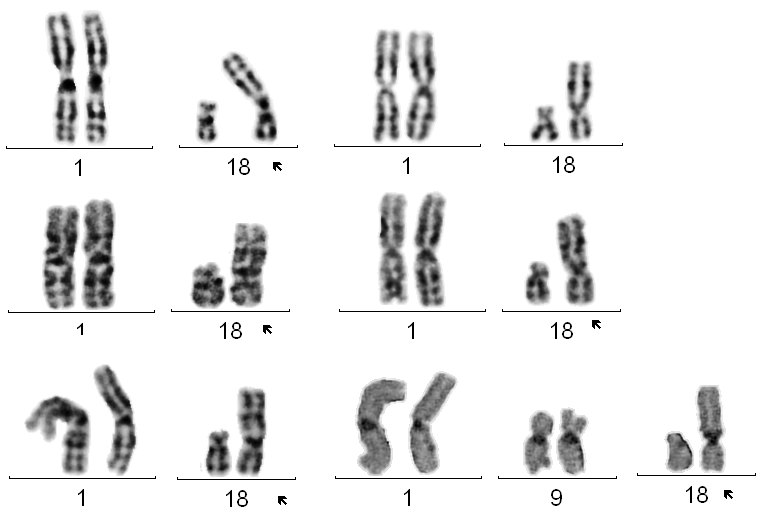
Partial G-banded karyotypes showing the whole-arm chromosome translocation der(1;18)(q10)(q10).
Citation
Adriana Zamecnikova
t(1;18)(q10;q10)
Atlas Genet Cytogenet Oncol Haematol. 2013-03-01
Online version: http://atlasgeneticsoncology.org/haematological/1254/t(1
Historical Card
2002-09-01 t(1;18)(q10;q10) by Edmond SK Ma,Thomas SK Wan Affiliation
Hematology Division, Department of Pathology, The University of Hong Kong, Queen Mary Hospital, Hong Kong, P.R. China
