t(2;5)(p23;q35) SQSTM1/ALK
2011-11-01 Jean-Loup Huret Affiliation1.Genetics, Dept Medical Information, University of Poitiers, CHU Poitiers Hospital, F-86021 Poitiers, France
Clinics and Pathology
Disease
ALK-positive large B-cell lymphoma (ALK+ LBCL)
Phenotype stem cell origin
One case to date, a 67-year-old male patient (Takeuchi et al., 2011).
Cytology
Anti-ALK immunohistochemistry showed a diffuse cytoplasmic staining pattern, in contrast with the nuclear and cytoplasmic pattern usually sen in the NPM1-ALK fusion gene/protein.
Prognosis
Complete remission was obtained, but the patient relapsed four months later.
Genes Involved and Proteins
Gene name
ALK (anaplastic lymphoma receptor tyrosine kinase)
Location
2p23.2
Protein description
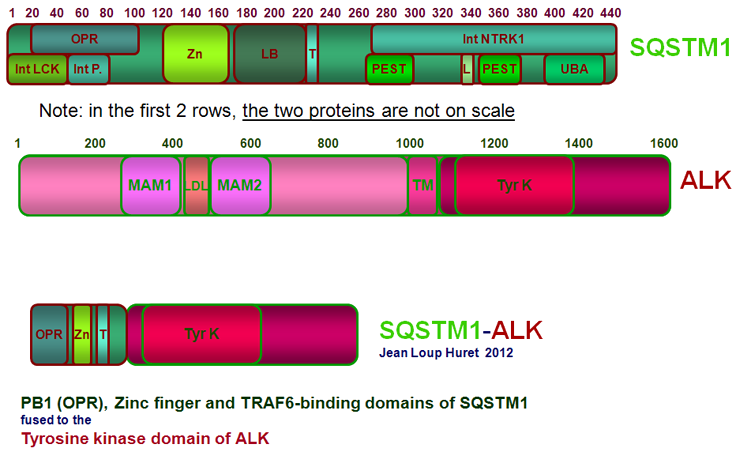
ALK is composed of an extracellular region (containing two MAM (meprin, A-5 protein, and receptor protein-tyrosine phosphatase mu) and one LDLa (low-density lipoprotein receptor) domains, and one glycin-rich region), a transmembrane domain, and an intracellular region (composed of a tyrosine kinase domain. Membrane receptor tyrosine kinase.
Germinal mutations
In familial neuroblastoma.
Somatic mutations
Fusion proteins in anaplastic large cell lymphoma, some diffuse large B-cell lymphomas, inflammatory myofibroblastic tumours, and some non-small cell lung cancers. Somatic mutations in sporadic neuroblastoma (review in Allouche, 2010).
Gene name
SQSTM1 (sequestosome 1)
Location
5q35.3
Protein description
SQSTM1 (sequestosome1), also called p62, is a scaffolding protein with several interaction domains; it is composed of an OPR domain (octicosapeptide repeat (PB1 dimerization domain)), a Zn finger, a LIM protein-binding region, a TRAF6-binding motif, a PEST sequence (proline, glutamic acid, serine, and threonine rich), a LIR motif (LC3 interaction region, SGGDDDWTHLSS), a second PEST sequence, a KIR (keap1 interacting region), and an UBA (ubiquitin-associated) domain. Interacts with Caspase-8 and the apoptosis, machinery, MAPK kinases such as MAP2K5 (15q23), LCK (1p34), NBR1 (17q21), PRKCI (3q26), PAWR (12q21), RIPK1 (6p25), TRAF6 (11p12) and NTRK1 (1q23) and the NF-kappaB pathway, KEAP1 (19p13), GABARAPL1 (12p13), MAP1LC3A/LC3 (20q11), and ubiquitin. Mediates the interaction between TRAF6 and CYLD (16q12). Implicated in the activation of the transcription factor NF-kappaB. Involved in the autophagy-lysosome pathway. Plays a role in the formation of cytoplasmic proteinaceous inclusions in various pathologic situations where autophagy is inactivated (Geetha and Wooten, 2002; Lamark et al., 2009; Moscat and Diaz-Meco, 2009; Moscat et al., 2009; Ichimura and Komatsu, 2010; Komatsu and Ichimura, 2010; Moscat and Diaz-Meco, 2011).
Germinal mutations
Mutated in Pagets disease of bone.
Result of the Chromosomal Anomaly
Description
Exon 5 of SQSTM1 fused to the ALK exon 20.
Description
Fuses the PB1 dimerization domain of SQSTM1 to the tyrosine kinase domain of ALK, resulting in a constitutive activation of the ALK kinase domain.
Highly cited references
| Pubmed ID | Year | Title | Citations |
|---|---|---|---|
| 36754839 | 2023 | Inflammatory myofibroblastic tumor of the mesentery with a SQSTM1::ALK fusion responding to alectinib. | 33 |
| 39810398 | 2025 | Assessment of Exhaled Breath Condensate for ALK, RET, ROS1, and NTRK1 Fusion Transcript Detection in NSCLC: Comparison With Tissue and Liquid Biopsy Samples. | 33 |
| 21134980 | 2011 | Identification of a novel fusion, SQSTM1-ALK, in ALK-positive large B-cell lymphoma. | 24 |
| 29747676 | 2018 | Epithelioid cell histiocytoma with SQSTM1-ALK fusion: a case report. | 19 |
| 39651381 | 2024 | Partial Response to Treatment with ALK Inhibitor in a Patient With SQSTM1-ALK Fusion Positive Lung Adenocarcinoma. | 10 |
| 39555099 | 2024 | Case report: Treatment with ensartinib shows good response to SQSTM1-ALK fusion in lung adenocarcinoma. | 7 |
| 38266918 | 2024 | Molecular Screening in Anaplastic Lymphoma Kinase-Positive Anaplastic Large Cell Lymphoma: Anaplastic Lymphoma Kinase Analysis, Next-Generation Sequencing Fusion Gene Detection, and T-Cell Receptor Immunoprofiling. | 0 |
| 30790150 | 2019 | Durable response to the ALK inhibitor alectinib in inflammatory myofibroblastic tumor of the head and neck with a novel SQSTM1-ALK fusion: a case report. | 0 |
| 29327718 | 2018 | Epithelioid fibrous histiocytoma: molecular characterization of ALK fusion partners in 23 cases. | 0 |
| 23588372 | 2013 | STAT3 pathway is activated in ALK-positive large B-cell lymphoma carrying SQSTM1-ALK rearrangement and provides a possible therapeutic target. | 0 |
| 25413595 | 2015 | Epithelioid cell histiocytoma of the skin with clonal ALK gene rearrangement resulting in VCL-ALK and SQSTM1-ALK gene fusions. | 0 |
| 29329131 | 2018 | ALK Gene Fusions in Epithelioid Fibrous Histiocytoma: A Study of 14 Cases, With New Histopathological Findings. | 0 |
Article Bibliography
| Pubmed ID | Last Year | Title | Authors |
|---|---|---|---|
| 11852044 | 2002 | Structure and functional properties of the ubiquitin binding protein p62. | Geetha T et al |
| 20814791 | 2010 | Selective degradation of p62 by autophagy. | Ichimura Y et al |
| 20153326 | 2010 | Physiological significance of selective degradation of p62 by autophagy. | Komatsu M et al |
| 19502794 | 2009 | NBR1 and p62 as cargo receptors for selective autophagy of ubiquitinated targets. | Lamark T et al |
| 22078874 | 2011 | Feedback on fat: p62-mTORC1-autophagy connections. | Moscat J et al |
| 19713972 | 2009 | Of the atypical PKCs, Par-4 and p62: recent understandings of the biology and pathology of a PB1-dominated complex. | Moscat J et al |
| 21134980 | 2011 | Identification of a novel fusion, SQSTM1-ALK, in ALK-positive large B-cell lymphoma. | Takeuchi K et al |
Summary
Fusion gene
SQSTM1/ALK SQSTM1 (5q35.3) ALK (2p23.2) COF 1051 1052|SQSTM1/ALK SQSTM1 (5q35.3) ALK (2p23.2) M t(2;5)(p23;q35)|SQSTM1/ALK SQSTM1 (5q35.3) ALK (2p23.2) TIC
Note
Not to be confused with the t(2;5)(p23;q35) with NPM1-ALK involvement.
Citation
Jean-Loup Huret
t(2;5)(p23;q35) SQSTM1/ALK
Atlas Genet Cytogenet Oncol Haematol. 2011-11-01
Online version: http://atlasgeneticsoncology.org/haematological/1584/t(2
