t(X;11)(q28;p15) NUP98/HMGB3
2017-03-01 Tatiana Gindina Affiliation1.R.M. Gorbacheva Research Institute of Pediatric Oncology Hematology and Transplantation at First Saint-Petersburg State Medical University named I.P.Pavlov, Saint-Petersburg, Russia / [email protected]
Abstract
Review on t(X;11)(q28;p15), with data on the genes involved
Clinics and Pathology
Disease
Therapy-related acute myeloid leukemia ( M4 AML)
Epidemiology
Only one case to date: a 73-year-old female patient.
Cytogenetics
Cytogenetics morphological
It is a semi-cryptic translocation, not visible with conventional cytogenetics alone and identified as a partner in the translocation after FISH technique with the NUP98 probe and the telomeric probe RP11-479B17 in the first reported case (Romana et al, 2006).
Additional anomalies
The patient showed a complex karyotype with a t(5;12)(q11;p13) as the only one chromosomal aberration observed in the stemline and a der(11) chromosome in two sidelines. (Romana et al, 2006).
Genes Involved and Proteins
Gene name
HMGB3 (high mobility group box 3)
Location
Xq28
Protein description
HMGB3 encodes a member of a family of proteins containing one or more high mobility group (HMG) DNA-binding motifs. The protein plays an important role in maintaining stem cell populations, and may be aberrantly expressed in tumor cells.
Gene name
NUP98 (nucleoporin 98 kDa)
Location
11p15.4
Protein description
NUP98 belongs to the nucleoporin gene family and encodes a 186 kDa precursor protein that undergoes autoproteolytic cleavage to produce a 98 kDa nucleoporin and 96 kDa nucleoporin. The 98 kDa nucleoporin contains a Gly-Leu-Phe-Gly (GLGF) repeat domain and participates in many cellular processes including nuclear import/export, mitotic progression, and regulation of gene expression. The 96 kDa nucleoporin is a component of the nuclear pore complex.
Result of the Chromosomal Anomaly
Note
5 NUP98 - 3 HMGB3
Description
Nucleotide sequence analyses revealed an in-frame fusion of the exon 11 of NUP98 to the exon 2 of HMGB3. No reciprocal HMGB3-NUP98 transcript could be detected (Petit et al, 2010).
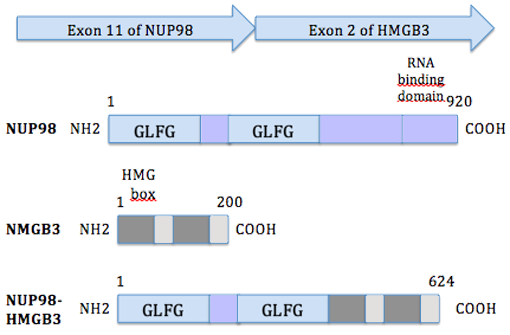
Schematic representation of the NUP98/HMGB3 chimeric transcript, the native and chimeric proteins, showing the Gly-Leu-Phe-Gly (GLFG) repeats and RNA binding domain of NUP98 and the two high mobility group (HMG) boxes of HMGB3.
Description
The NUP98-HMGB3 protein is composed of the first 422 amino acids of NUP98 fused to the entire HMGB3 coding sequence (Petit et al, 2010).
Oncogenesis
The NUP98-fusion proteins induce leukemic transformation through the upregulation of HOXA genes and the Hox cofactor MEIS1. However, in mouse model, it has been shown the NUP98/HMGB3-expressing blasts upregulate HOXA9 only weakly and retain wild-type levels of MEIS1. Evidently, the transformation mediated by the NUP98/HMGB3 fusion does not involve deregulated activity of the canonical HOXA - MEIS1 pathway. The ectopic expression of HMGB3, as a result of the fusion with NUP98, can bypass the requirement of a concomitant HOXA9 and MEIS1 misregulation in human malignancy. It seems that the several transformation pathways might be involved in the leukemogenic properties of NUP98 fusions. NUP98/HMGB3 is the first example of a NUP98 leukemogenic fusion whose expression is not associated with a strong HOXA and concomitant MEIS1 expression (Petit et al, 2010).
Highly cited references
| Pubmed ID | Year | Title | Citations |
|---|---|---|---|
| 19956199 | 2010 | NUP98-HMGB3: a novel oncogenic fusion. | 0 |
Article Bibliography
| Pubmed ID | Last Year | Title | Authors |
|---|---|---|---|
| 19956199 | 2010 | NUP98-HMGB3: a novel oncogenic fusion. | Petit A et al |
| 16467868 | 2006 | NUP98 rearrangements in hematopoietic malignancies: a study of the Groupe Francophone de Cytogénétique Hématologique. | Romana SP et al |
Summary
Fusion gene
NUP98/HMGB3
Citation
Tatiana Gindina
t(X;11)(q28;p15) NUP98/HMGB3
Atlas Genet Cytogenet Oncol Haematol. 2017-03-01
Online version: http://atlasgeneticsoncology.org/haematological/1588/t(x
