t(6;14)(p25.3;q11.2) TRA/IRF4
2013-03-01 Andrew L Feldman Affiliation1.Department of Laboratory Medicine, Pathology, College Of Medicine, Mayo Clinic, 200 First Street SW, Hilton Building, Room 11-52D, Rochester, MN 55905 USA
Clinics and Pathology
Disease
Phenotype stem cell origin
Mature (peripheral) cytotoxic alpha-beta T-cell origin.
Etiology
No etiologic factors are known.
Epidemiology
Adult males (age range, 67-82 years).
Clinics
Presentation with cytopenias in the absence of lymphadenopathy, sometimes with skin involvement.
Pathology
The bone marrow is hypercellular with the normal marrow elements replaced by an extensive infiltrate of atypical, mostly medium-sized lymphoid cells with irregular nuclear outlines. Admixed plasma cells and a background of reticulin fibrosis are present. The tumor cells display an abnormal T-cell phenotype with expression of CD3, the cytotoxic marker TIA1 (+/- granzyme B), and T-cell receptor-beta (beta-F1), but without coexpression of CD5. Most cases express CD4 and lack expression of CD25 and CD30. IRF4/MUM1 protein is expressed in tumor cell nuclei. Cases tested for EBV by in situ hybridization have been negative.
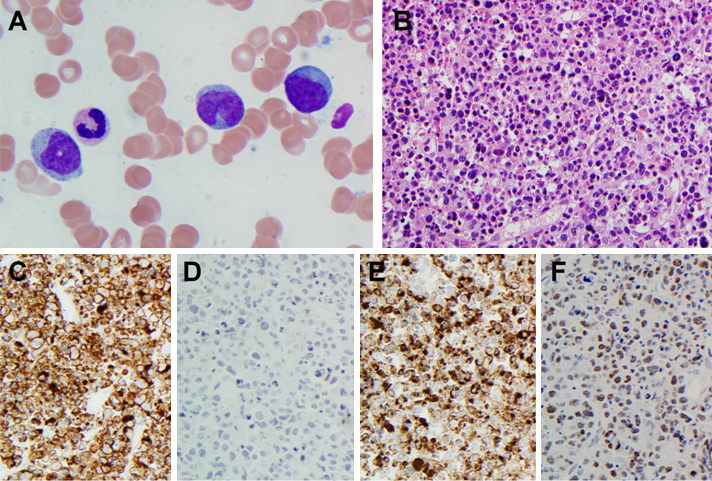
(A) Atypical lymphocytes in bone marrow smear from patient with PTCL, NOS with t(6;14)(p25.3;q11.2) (Wright-Giemsa, original magnification x1000). (B) Bone marrow trephine biopsy (H&E, x400). Tumor cells are (C) positive for CD2, (D) negative for CD5, (E) positive for granzyme B, and (F) positive for nuclear IRF4/MUM1 (x400).
Treatment
No treatment data are available.
Prognosis
The prognosis has not been established.
Cytogenetics
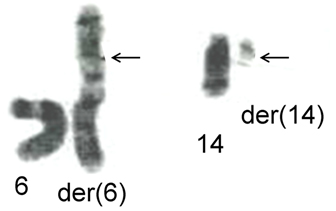
t(6;14)(p25.3;q11.2) [G-banding].
Cytogenetics morphological
The rearrangement can be detected in standard G-banded karyotype.
Cytogenetics molecular
The rearrangement can be detected using dual-fusion fluorescence in situ hybridization with probes to the IRF4 and TCR@ loci.
Genes Involved and Proteins
Note
The IRF4/MUM1 protein is expressed in cases with t(6;14)(p25.3;q11.2). This expression likely results from the translocation, but this has not been proved.
Gene name
IRF4 (interferon regulatory factor 4)
Location
6p25.3
Dna rna description
Nine-exon gene on 6p25.3.
Protein description
The gene encodes interferon regulatory factor-4 (IRF4)/multiple myeloma oncogene-1 (MUM1), a transcription factor in the IRF family. Its expression limited mainly to lymphocytes and is critical in lymphocyte activation.
Gene name
TRA (T cell Receptor Alpha)
Location
14q11.2
Note
Other name: TRA@.
Dna rna description
~ 1Mb on 14q11.2 containing TCR alpha V, J, and C regions, as well as the TCR-delta locus.
Protein description
TRA@ encodes the T-cell receptor-alpha chains, translated from transcripts resulting from rearrangement of the TRAV and TRAJ regions and from TRAC.
Result of the Chromosomal Anomaly
Note
No RNA studies have been reported on cases with t(6;14)(p25.3;q11.2). Most translocations involving TRA@ in T-cell neoplasia do not produce fusion transcripts.No studies of potential fusion proteins have been reported on cases with t(6;14)(p25.3;q11.2). Most translocations involving TRA@ in T-cell neoplasia do not produce fusion proteins.
Article Bibliography
| Pubmed ID | Last Year | Title | Authors |
|---|---|---|---|
| 18987657 | 2009 | Recurrent translocations involving the IRF4 oncogene locus in peripheral T-cell lymphomas. | Feldman AL et al |
| 19383829 | 2009 | IRF4: Immunity. Malignancy! Therapy? | Shaffer AL et al |
Summary
Fusion gene
TRA/IRF4 TRA (-) IRF4 (6p25.3) M t(6;14)(p25;q11)
Citation
Andrew L Feldman
t(6;14)(p25.3;q11.2) TRA/IRF4
Atlas Genet Cytogenet Oncol Haematol. 2013-03-01
Online version: http://atlasgeneticsoncology.org/haematological/1606/t(6
