t(5;6)(q33;q23) CEP85L/PDGFRB
2013-04-01 Juliann Chmielecki , William Pao Affiliation1.Dana-Farber Cancer Institute, Department of Medical Oncology, Boston, MA, USA (JC); The Broad Institute of Harvard, MIT, Cancer Program, Cambridge, MA, USA (JC); Vanderbilt-Ingram Cancer Center, Department of Medicine, Nashville, TN, USA (WP)
Clinics and Pathology
Disease
Precursor T-cell lymphoblastic lymphoma (T-ALL) with an association myeloproliferative neoplasm (MPN) with eosinophilia.
Epidemiology
Very rare; 1 case reported (Chmielecki et al., 2011).
Clinics
The patient was a 38 year-old male with a history of precursor T lymphoblastic lymphoma, a myeloid neoplasm associated neoplasm associated with eosinophilia, and a t(5;6)(q33-34;q23) identified by metaphase cytogenetics.
Treatment
The patient received a brief 5-day course of imatinib therapy, prior to allogenic stem cell transplantation, which resulted in resolution of his eosinophilia (white blood cell counts decreased from 27.3 to 5.4 thou/μL; normal range (3.9-10.7 thou/μL).
Prognosis
In patients with myeloid neoplasms associated with eosinophilia, imatinib is also highly active against TK fusions involving PDGFRA and PDGFRB (David et al., 2007; Vardiman et al., 2009).
Note
The c6orf204-PDGFRB fusion protein fuses exon 11 of CEP85L/C6orf204 to exon 12 of PDGFRB. The cDNA breakpoint within PDGFRB is the same as that observed in the NIN-PDGFRB fusion, previously observed in another case of an imatinib-responsive myeloproliferative neoplasm (Vizmanos et al., 2004). The break within PDGFRB occurs just downstream of the transmembrane domain, removing the five immunoglobulin-like domains found within the extracellular domain but leaving the tyrosine kinase domain intact. The 5 sequence observed in our fusion protein could have resulted from two isoforms (a and c) arising from alternative transcriptional start sites and differing only in the first 24 amino acids. RT-PCR analysis using an anchored reverse primer and forward primers specific to isoforms a or c confirmed that the 5 sequence of the fusion originated from the isoform c start site. Motif analysis of C6orf204 revealed the presence of a coiled-coil domain just N-terminal to the breakpoint observed in the C6orf204-PDGFRB fusion. The presence of a coiled-coil domain-containing 5 partner is a common occurrence in tyrosine kinase fusions involving PDGFRB and other tyrosine kianses (Vizmanos et al., 2004), as it facilitates dimerization necessary for kinase (Carroll et al., 1996; Grisolano et al., 2003; Vizmanos et al., 2004; Taylor and Keating, 2005). The fusion here removes the last 8 amino acids of the domain. In vitro, a C6orf204-PDGFRB fusion product, generated via transient transfection of 293T cells with an expression plasmid, showed increased PDGFRB phosphorylation relative to mock transfected cells; such phosphorylation was inhibited by imatinib. Combined with the clinical response data, these studies indicate that the C6orf204-PDGFRB fusion is likely the driver of the patients eosinophilia.
Cytogenetics
Cytogenetics molecular
FISH analysis of the patients lymph node suggested a rearrangement involving PDGFRB.
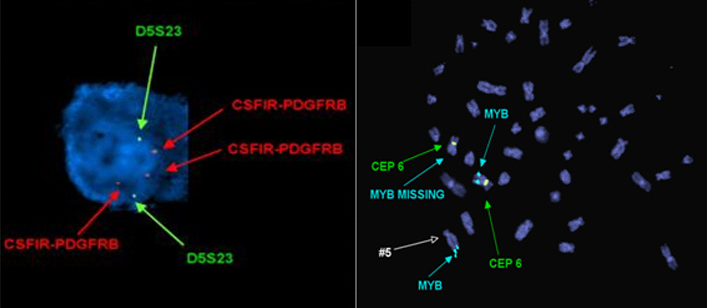
Fluorescence in situ hybridization (FISH) of a lymph node shows one split red signal (CSF1R-PDGFRB), one normal red signal, and two normal green signals (D5S23), suggesting existence of a rearrangement involving PDGFRB (LEFT). FISH analysis with a probe against MYB on chromosome 6 (marked by CEP 6 probe) shows one copy of MYB is now located on chromosome 5, suggesting involvement of MYB in the translocation (RIGHT).
Probes
Additional anomalies
FISH analysis of the patients diagnostic lymph node with T-ALL also revealed the presence of a PDGFRB rearrangement, suggesting that this event occurred in a common clonal precursor that gave rise to both the T-ALL and eosinophilia.
Genes Involved and Proteins
Gene name
PDGFRB (platelet-derived growth factor receptor, beta polypeptide)
Location
5q32
Dna rna description
23 exons.
Protein description
Platelet-derived growth factor receptor beta (PDGFRb) is a catalytic receptor with intrinsic intracellular tyrosine kinase activity. It plays a role in the regulation of many biological processes including embryonic development, angiogenesis, cell proliferation and differentiation, and contribute to the pathophysiology of some diseases, including cancer (adapted from GeneCards).
Gene name
CEP85L (centrosomal protein 85 like)
Location
6q22.31
Note
The 5 sequence observed in our fusion protein could have resulted from two isoforms (a and c) arising from alternative transcriptional start sites and differing only in the first 24 amino acids.
Dna rna description
13-14 exons (depending on isoform).
Protein description
The gene encoding CEP85L/c6orf204 was originally identified as a breast cancer antigen (Scanlan et al., 2001).
Result of the Chromosomal Anomaly
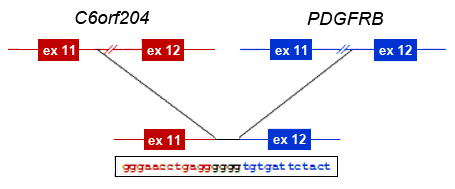
Genomic structure of the in-frame c6orf204-PDGFRB fusion.
Description
Exons 1-11 of c6orf204 fuse to exons 12-23 of PDGFRB.

cDNA structure of the in-frame c6orf204-PDGFRB fusion. The resultant protein sequence is indicated below the cDNA sequence (TOP). Schematic showing the entire structure of the c6orf204-PDGFRB fusion protein including the coiled-coil domain within c6orf204 and the tyrosine kinase domain within PDGFRB.
Description
Amino acids 1-677 of c6orf204 (isoform c) fused to amino acids 559-1106 of PDGFRB.
Oncogenesis
The patients clinical response to imatinib therapy suggests that this fusion is the "driver" oncogene behind the eosinophilia.
Highly cited references
| Pubmed ID | Year | Title | Citations |
|---|---|---|---|
| 23186533 | 2013 | Recurrent CEP85L-PDGFRB fusion in patient with t(5;6) and imatinib-responsive myeloproliferative neoplasm with eosinophilia. | 0 |
Article Bibliography
| Pubmed ID | Last Year | Title | Authors |
|---|---|---|---|
| 8962143 | 1996 | The TEL/platelet-derived growth factor beta receptor (PDGF beta R) fusion in chronic myelomonocytic leukemia is a transforming protein that self-associates and activates PDGF beta R kinase-dependent signaling pathways. | Carroll M et al |
| 21938754 | 2012 | Systematic screen for tyrosine kinase rearrangements identifies a novel C6orf204-PDGFRB fusion in a patient with recurrent T-ALL and an associated myeloproliferative neoplasm. | Chmielecki J et al |
| 16960151 | 2007 | Durable responses to imatinib in patients with PDGFRB fusion gene-positive and BCR-ABL-negative chronic myeloproliferative disorders. | David M et al |
| 12881486 | 2003 | An activated receptor tyrosine kinase, TEL/PDGFbetaR, cooperates with AML1/ETO to induce acute myeloid leukemia in mice. | Grisolano JL et al |
| 12747765 | 2001 | Humoral immunity to human breast cancer: antigen definition and quantitative analysis of mRNA expression. | Scanlan MJ et al |
| 16331985 | 2005 | Orientation and oligomerization specificity of the Bcr coiled-coil oligomerization domain. | Taylor CM et al |
| 19357394 | 2009 | The 2008 revision of the World Health Organization (WHO) classification of myeloid neoplasms and acute leukemia: rationale and important changes. | Vardiman JW et al |
| 15087377 | 2004 | NIN, a gene encoding a CEP110-like centrosomal protein, is fused to PDGFRB in a patient with a t(5;14)(q33;q24) and an imatinib-responsive myeloproliferative disorder. | Vizmanos JL et al |
Summary
Fusion gene
CEP85L/PDGFRB CEP85L (6q22.31) PDGFRB (5q32) TIC
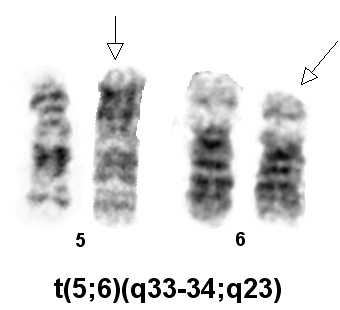
Karyotype analysis of the bone marrow showed a translocation involving chromosomes 5 and 6: t(5;6)(q33-34;q23).
Citation
Juliann Chmielecki ; William Pao
t(5;6)(q33;q23) CEP85L/PDGFRB
Atlas Genet Cytogenet Oncol Haematol. 2013-04-01
Online version: http://atlasgeneticsoncology.org/haematological/1620/t(5
