t(7;9)(q11.2;p13.2) PAX5/AUTS2
2013-11-01 Dagmar Denk Affiliation1.CCRI, Childrens Cancer Research Institute, St. Anna Kinderkrebsforschung e.V., Zimmermannplatz 10, 1090 Vienna, Austria
Clinics and Pathology
Disease
B-cell precursor acute lymphoblastic leukemia (BCP-ALL)
Epidemiology
This unbalanced chromosomal rearrangement was found in three pediatric patients with B-cell precursor acute lymphoblastic leukemia (Kawamata et al., 2008; Coyaud et al., 2010a; Denk et al., 2012).
Clinics
All three patients achieved a complete remission (CR) after completion of induction therapy; however, two of the patients experienced an early relapse and both patients died, one from an infectious complication in second CR and one from progressive leukemia after a further relapse. The third patient remains in first CR for more than two years after diagnosis (Denk et al., 2012).
Genes Involved and Proteins
Gene name
PAX5 (paired box gene 5)
Location
9p13.2
Dna rna description
10 exons, alternatively spliced transcript variants encoding different isoforms.
Protein description
PAX5 is a transcription factor harboring a conserved paired box DNA-binding domain. It is a master regulator of B-cell commitment and maintenance and within the hematopoietic system is expressed in B-cells from the pro-B cell to the mature B-cell stage and repressed upon plasma cell differentiation (Cobaleda et al., 2007; Medvedovic et al., 2011). In BCP-ALL PAX5 is a frequent target of somatic mutations, comprising deletions, point mutations, and structural rearrangements resulting in the expression of fusion transcripts (Mullighan et al., 2007). To date, 16 different in-frame PAX5 fusions genes have been reported in B-ALL (Cazzaniga et al., 2001; Bousquet et al., 2007; Mullighan et al., 2007; Nebral et al., 2007; Kawamata et al., 2008; Nebral et al., 2009; Coyaud et al., 2010b; Lee et al., 2012). The PAX5 fusion partners comprise a heterogeneous group of genes that encode transcription factors, structural proteins, kinases, as well as several genes with so far unknown functions.
Gene name
AUTS2 (autism susceptibility candidate 2)
Location
7q11.22
Dna rna description
19 exons, alternatively spliced transcript variants encoding different isoforms.
Protein description
AUTS2, is a highly conserved nuclear protein with so far unknown function, contains several putative N-terminal nuclear localization signals (NLS), two proline alternating with two histidine-rich regions, and two potential serine phosphorylation sites. It is strongly expressed in fetal and adult brain, particularly in the frontal, parietal, and temporal lobes. Mutations in the gene have been associated with autism and mental retardation (Oksenberg and Ahituv, 2013).
Result of the Chromosomal Anomaly
Transcript
In-frame fusions between PAX5 exon 6 and AUTS2 exon 4, 5 or 6 have been described (Kawamata et al., 2008; Coyaud et al., 2010; Denk et al., 2012).
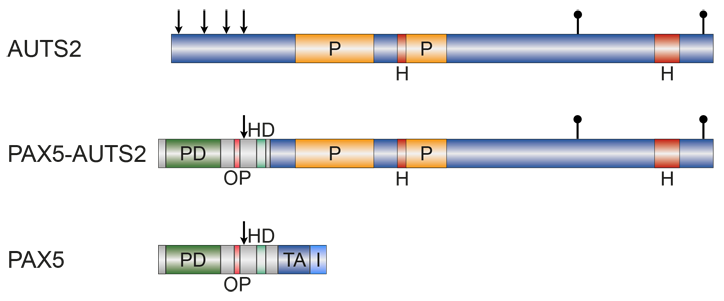
Figure 1. Schematic representation of the structure of AUTS2 (top) and PAX5 (bottom) wild-type proteins as well as the putative consensus chimeric protein (middle). PD: paired domain; OP: octapeptide; HD: partial homeodomain; TA: transactivation domain; I: inhibitory domain; H: histidine-rich regions; P: proline-rich region; arrows indicate nuclear localization signals (NLS); filled lollipops represent serine phosphorylation sites.
Description
The putative consensus chimeric protein contains the DNA-binding paired domain, the octapeptide, and the partial homeodomain of PAX5 fused to the C-terminal regions of AUTS2.
Highly cited references
| Pubmed ID | Year | Title | Citations |
|---|---|---|---|
| 39702796 | 2025 | PAX5::AUTS2 childhood B-ALL: a relapse-prone genetic subtype with frequent central nervous system involvement and a poor outcome. | 15 |
| 22578776 | 2012 | PAX5-AUTS2: a recurrent fusion gene in childhood B-cell precursor acute lymphoblastic leukemia. | 8 |
| 20723977 | 2010 | PAX5-AUTS2 fusion resulting from t(7;9)(q11.2;p13.2) can now be classified as recurrent in B cell acute lymphoblastic leukemia. | 0 |
| 29641322 | 2018 | Preclinical Efficacy and Safety of CD19CAR Cytokine-Induced Killer Cells Transfected with Sleeping Beauty Transposon for the Treatment of Acute Lymphoblastic Leukemia. | 0 |
Article Bibliography
| Pubmed ID | Last Year | Title | Authors |
|---|---|---|---|
| 17179230 | 2007 | A novel PAX5-ELN fusion protein identified in B-cell acute lymphoblastic leukemia acts as a dominant negative on wild-type PAX5. | Bousquet M et al |
| 11406533 | 2001 | The paired box domain gene PAX5 is fused to ETV6/TEL in an acute lymphoblastic leukemia case. | Cazzaniga G et al |
| 17440452 | 2007 | Pax5: the guardian of B cell identity and function. | Cobaleda C et al |
| 20160164 | 2010 | Wide diversity of PAX5 alterations in B-ALL: a Groupe Francophone de Cytogenetique Hematologique study. | Coyaud E et al |
| 22578776 | 2012 | PAX5-AUTS2: a recurrent fusion gene in childhood B-cell precursor acute lymphoblastic leukemia. | Denk D et al |
| 18697940 | 2008 | Cloning of genes involved in chromosomal translocations by high-resolution single nucleotide polymorphism genomic microarray. | Kawamata N et al |
| 22309891 | 2012 | Sequential array comparative genomic hybridization analysis identifies copy number changes during blastic transformation of chronic myeloid leukemia. | Lee ST et al |
| 21970955 | 2011 | Pax5: a master regulator of B cell development and leukemogenesis. | Medvedovic J et al |
| 17344859 | 2007 | Genome-wide analysis of genetic alterations in acute lymphoblastic leukaemia. | Mullighan CG et al |
| 19020546 | 2009 | Incidence and diversity of PAX5 fusion genes in childhood acute lymphoblastic leukemia. | Nebral K et al |
| 17897302 | 2007 | Identification of PML as novel PAX5 fusion partner in childhood acute lymphoblastic leukaemia. | Nebral K et al |
| 24008202 | 2013 | The role of AUTS2 in neurodevelopment and human evolution. | Oksenberg N et al |
Summary
Fusion gene
PAX5/AUTS2 PAX5 (9p13.2) AUTS2 (7q11.22) M t(7;9)(q11;p13)|PAX5/AUTS2 PAX5 (9p13.2) AUTS2 (7q11.22) TIC
Citation
Dagmar Denk
t(7;9)(q11.2;p13.2) PAX5/AUTS2
Atlas Genet Cytogenet Oncol Haematol. 2013-11-01
Online version: http://atlasgeneticsoncology.org/haematological/1633/t(7
