del(5q) in acute lymphoblastic leukemia (ALL)
2019-08-01 Soad Al Bahar , Adriana Zamecnikova Affiliation[email protected] (AZ); Kuwait Cancer Control Center, Kuwait (SaB).
Abstract
Myelodysplatic syndrome (MDS) with an isolated 5q deletion (5q-syndrome), that may arise de novo or may be therapy-related is recognized as a distinct entity by the WHO classification. While del(5q) thought to contribute to the pathogenesis of myeloid neoplasms, it has also been reported in lymphoblastic leukemia, suggesting a common underlying mechanism.
Clinics and Pathology
Disease
Acute lymphoblastic leukemia
Etiology
Acute leukemia evolving from an underlying MDS with del(5q) is almost always of myeloid lineage and only anecdotal case reports of MDS transforming to ALL have been reported (Agostino et al., 2011; Jain et al., 2016). Whether the presence of del(5q) in these cases reflects the underlying myelodysplastic state that later evolved into ALL remains unclear. del(5q) in ALL is mostly associated with multiple cytogenetic abnormalities that thought to be due to clonal expansion from an abnormal pluripotent stem cell.
Epidemiology
At least 160 reported patients aged 0 to 86 years (98 males, 61 females, 1 unknown); prevalence of pediatric patients (86 patients) and there were 46 adults.
B-cell acute lymphoblastic leukemia: 70 patients aged 0 to 86 years (41 males and 28 females, 1 unknown); among them there were 22 adults (14 males and 8 females, aged 22 to 86 years; median 42 years) and 39 pediatric patients (22 males and 17 females, aged 0 to 18; median 6 years). In addition, there were 9 patients with unknown age (5 males and 3 females, 1 unknown).
T-cell acute lymphoblastic leukemia: 58 patients (35 males and 23 females aged 1 to 79 years); among them there were 17 adults (9 males and 8 females aged 19 to 79 years), 35 pediatric patients (22 males 13 females aged 1 to 18 years) and 6 patients with unknown age (4 males and 2 females).
32 patients had unspecified ALL (22 males, 10 females aged 3 to 81 years; median 13 years); 7 patients were adults (5 males and 2 females) aged 34 to 81 years (median 72 years), 12 were pediatric patients (8 males and 4 females aged 3 to 16 years; median 6 years) and there were 12 patients with unknown age (8 males and 4 females).
B-cell acute lymphoblastic leukemia: 70 patients aged 0 to 86 years (41 males and 28 females, 1 unknown); among them there were 22 adults (14 males and 8 females, aged 22 to 86 years; median 42 years) and 39 pediatric patients (22 males and 17 females, aged 0 to 18; median 6 years). In addition, there were 9 patients with unknown age (5 males and 3 females, 1 unknown).
T-cell acute lymphoblastic leukemia: 58 patients (35 males and 23 females aged 1 to 79 years); among them there were 17 adults (9 males and 8 females aged 19 to 79 years), 35 pediatric patients (22 males 13 females aged 1 to 18 years) and 6 patients with unknown age (4 males and 2 females).
32 patients had unspecified ALL (22 males, 10 females aged 3 to 81 years; median 13 years); 7 patients were adults (5 males and 2 females) aged 34 to 81 years (median 72 years), 12 were pediatric patients (8 males and 4 females aged 3 to 16 years; median 6 years) and there were 12 patients with unknown age (8 males and 4 females).
Clinics
In contrast to its presence in myeloid malignancies, isolated del(5q) is rare in ALL, thus its clinical significance is unknown. del(5q) also appears to be clinically insignificant in patients following cytotoxic therapy or tyrosine kinase inhibitor (TKI) therapy, similar to other clonal cytogenetic abnormalities if detected as a minor clone (Tang et al., 2015). del(5q) in ALL mainly found as a clonal evolution event associated with disease progression.
Note
Del(5q) may be found as sole abnormality at first, as an evolutionary event in other cases, and as a transient event in patients after being treated with cytotoxic agents or TKI for the prior malignancies.
Genes Involved and Proteins
Result of the Chromosomal Anomaly
Oncogenesis
Interstitial or terminal deletions of the long arm of chromosome 5 are common findings in MDS or acute myeloid leukemia (AML), but they may also occur in patients with ALL. Deletions of genetic material from 5q result in loss of tumor suppressor genes that may potentially play a role in the pathogenesis of these diseases. The long arm of chromosome 5 contains many genes that are relevant in hematopoiesis and several candidate genes including transcription factors, cytokines and their receptors, signal mediators and cell cycle regulators have been identified. These include the RPS14 gene on 5q33.1, a critical gene for the erythroid phenotype, a microRNA cluster on 5q32-33 important for the megakaryocytic phenotype, the EGR1 gene on 5q31 that plays a role in hematopoietic stem cell proliferation. Other genes such as NPM1 and APC, the transcription factor Egr1/Krox20, the cytoskeletal remodeling protein, alpha-catenin may also contribute to the disease phenotype and progression (Tang et al., 2015). Although a critical tumor suppressor gene has not yet been identified in ALL, several putative tumor suppressors such as NR3C1 and TCF7, located within the 5q31 common deleted region and TRIM41, ZFP62, MAPK9, MGAT1, and CNOT6, mapping at 5q35 have been found to be down-regulated in T- ALL (La Starza et al.,2016). Given the large size and variable pattern of 5q deletions, it is probable that the loss of several genes that act alone or in combination contribute to pathogenesis. The absence of a clear critical gene suggests that deletion of variable combinations of genes may result in a clinical spectrum ranging from myeloid malignancies to lymphoid leukemia.
Article Bibliography
| Pubmed ID | Last Year | Title | Authors |
|---|---|---|---|
| 21487529 | 2011 | Transformation of the 5q- syndrome to acute lymphoblastic leukemia: a report of two cases and review of the literature. | Agostino NM et al |
| 16157196 | 2005 | Genetic abnormalities associated with the t(12;21) and their impact in the outcome of 56 patients with B-precursor acute lymphoblastic leukemia. | Alvarez Y et al |
| 18957548 | 2008 | Variable breakpoints target PAX5 in patients with dicentric chromosomes: a model for the basis of unbalanced translocations in cancer. | An Q et al |
| 12970786 | 2003 | t(5;14)/HOX11L2-positive T-cell acute lymphoblastic leukemia. A collaborative study of the Groupe Français de Cytogénétique Hématologique (GFCH). | Berger R et al |
| 11587205 | 2001 | A new recurrent and specific cryptic translocation, t(5;14)(q35;q32), is associated with expression of the Hox11L2 gene in T acute lymphoblastic leukemia. | Bernard OA et al |
| 3352540 | 1988 | Hematologic and clinical features of patients with chromosome 5 monosomy or deletion (5q). | Brusamolino E et al |
| 1638475 | 1992 | Non-random involvement of chromosome 5 in ALL. | Chen Z et al |
| 20332472 | 2010 | Philadelphia chromosome-positive acute lymphoblastic leukemia: a cytogenetic study of 33 patients diagnosed between 1981 and 2008. | De Braekeleer E et al |
| 11137559 | 2001 | Loss of heterozygosity on chromosome 5 in adults with acute lymphoblastic leukemia. | Faderl S et al |
| 18271061 | 2008 | Cytogenetic analysis of 298 newly diagnosed cases of acute lymphoblastic leukaemia in Tunisia. | Gmidène A et al |
| 26514535 | 2015 | Importance of FISH combined with Morphology, Immunophenotype and Cytogenetic Analysis of Childhood/ Adult Acute Lymphoblastic Leukemia in Omani Patients. | Goud TM et al |
| 23341344 | 2013 | The molecular profile of adult T-cell acute lymphoblastic leukemia: mutations in RUNX1 and DNMT3A are associated with poor prognosis in T-ALL. | Grossmann V et al |
| 9552025 | 1998 | Frequency and clinical significance of cytogenetic abnormalities in pediatric T-lineage acute lymphoblastic leukemia: a report from the Children's Cancer Group. | Heerema NA et al |
| 10477737 | 1999 | The (4;11)(q21;p15) translocation fuses the NUP98 and RAP1GDS1 genes and is recurrent in T-cell acute lymphocytic leukemia. | Hussey DJ et al |
| 26437693 | 2016 | Synchronous del5q myelodysplastic syndrome (del5qMDS) and adult B-cell acute lymphoblastic leukemia (B-ALL) with TET2 and TP53 mutations. | Jain P et al |
| 27341996 | 2016 | Chromosomal aberrations in childhood acute lymphoblastic leukemia: 15-year single center experience. | Jarosova M et al |
| 2586183 | 1989 | Chromosomal and immunophenotypic patterns in T cell acute lymphoblastic leukemia (T ALL) and lymphoblastic lymphoma (LBL). | Kaneko Y et al |
| 2900030 | 1988 | Chromosome translocations involving band 7q35 or 7p15 in childhood T-cell leukemia/lymphoma. | Kaneko Y et al |
| 16525638 | 2006 | Novel cryptic chromosomal rearrangements detected in acute lymphoblastic leukemia detected by application of new multicolor fluorescent in situ hybridization approaches. | Karst C et al |
| 6575861 | 1983 | A possible subgroup of ALL with 9p-. | Kowalczyk J et al |
| 15876250 | 2005 | Children and adults with acute lymphoblastic leukaemia have similar gene expression profiles. | Kuchinskaya E et al |
| 27151989 | 2016 | Deletions of the long arm of chromosome 5 define subgroups of T-cell acute lymphoblastic leukemia. | La Starza R et al |
| 10874883 | 2000 | Flow cytometric detection of CD79a expression in T-cell acute lymphoblastic leukemias. | Lai R et al |
| 11918540 | 2002 | Influence of karyotype on outcome of allogeneic bone marrow transplantation for adults with precursor B-lineage acute lymphoblastic leukaemia in first or second remission. | Lee S et al |
| 10451708 | 1999 | Trisomy 21 is a recurrent secondary aberration in childhood acute lymphoblastic leukemia with TEL/AML1 gene fusion. | Loncarevic IF et al |
| 12399965 | 2002 | The utility of spectral karyotyping in the cytogenetic analysis of newly diagnosed pediatric acute lymphoblastic leukemia. | Lu XY et al |
| 24726034 | 2014 | Clinical and genetic features of pediatric acute lymphoblastic leukemia in Down syndrome in the Nordic countries. | Lundin C et al |
| 15704129 | 2005 | ETV6/RUNX1 fusion at diagnosis and relapse: some prognostic indications. | Martineau M et al |
| 26952838 | 2016 | MLL rearrangements impact outcome in HOXA-deregulated T-lineage acute lymphoblastic leukemia: a Children's Oncology Group Study. | Matlawska-Wasowska K et al |
| 25727050 | 2015 | Cooperative genetic changes in pediatric B-cell precursor acute lymphoblastic leukemia with deletions or mutations of IKZF1. | Olsson L et al |
| 30203896 | 2018 | Improved cytogenetic characterization and risk stratification of pediatric acute lymphoblastic leukemia using single nucleotide polymorphism array analysis: A single center experience of 296 cases. | Olsson L et al |
| 12090419 | 2002 | Acute lymphoblastic leukemia in elderly patients the Philadelphia chromosome may not be a significant adverse prognostic factor. | Onciu M et al |
| 2021919 | 1991 | Chromosome 5 abnormalities in acute lymphoblastic leukemia. | Palau F et al |
| 3263151 | 1988 | Cytogenetics of childhood T-cell leukemia. | Raimondi SC et al |
| 8982045 | 1996 | Prognostic significance of additional chromosome abnormalities in adult patients with Philadelphia chromosome positive acute lymphoblastic leukaemia. | Rieder H et al |
| 10068677 | 1999 | Spectral karyotype analysis of T-cell acute leukemia. | Rowley JD et al |
| 17940204 | 2008 | t(6;14)(p22;q32): a new recurrent IGH@ translocation involving ID4 in B-cell precursor acute lymphoblastic leukemia (BCP-ALL). | Russell LJ et al |
| 2009511 | 1991 | Involvement of the short arm of the derivative chromosome 9 in Philadelphia-positive acute lymphoblastic leukemia. | Sessarego M et al |
| 16843112 | 2006 | Unexpected cytogenetic finding in acute lymphoblastic leukemia: a case of del(5q) with a cryptic t(12;21). | South ST et al |
| 17237825 | 2007 | Genome complexity in acute lymphoblastic leukemia is revealed by array-based comparative genomic hybridization. | Strefford JC et al |
| 2147972 | 1990 | Acute T-lymphocytic leukemia with Ph1 and 5q-chromosome abnormalities and rearrangements of bcr and TCR-delta genes. | Takechi M et al |
| 26071464 | 2015 | Isolated del(5q) in Patients Following Therapies for Various Malignancies May Not All Be Clinically Significant. | Tang G et al |
| 7564511 | 1995 | A late-appearing Philadelphia chromosome in acute lymphoblastic leukemia confirmed by expression of BCR-ABL mRNA. | Tsuchiya H et al |
| 1861547 | 1991 | Mosaic 46,XY/92,XXYY,del(5)(q13 q34) in an adult lymphoblastic leukemia. | Valtat C et al |
| 14717774 | 2004 | Additional cytogenetic abnormalities in adults with Philadelphia chromosome-positive acute lymphoblastic leukaemia: a study of the Cancer and Leukaemia Group B. | Wetzler M et al |
| 22237106 | 2012 | The genetic basis of early T-cell precursor acute lymphoblastic leukaemia. | Zhang J et al |
| 22373549 | 2012 | Detection of ETV6 gene rearrangements in adult acute lymphoblastic leukemia. | Zhou MH et al |
Summary
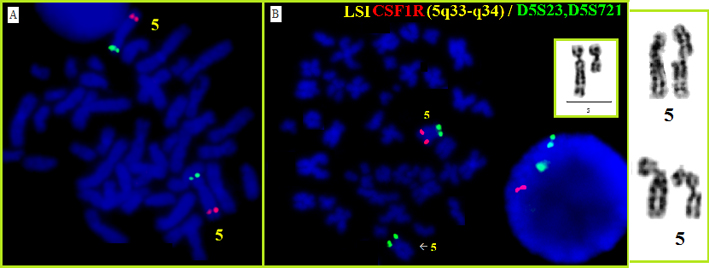
Figure 1. (A). Fluorescence in situ hybridization with Vysis LSI CSF1R (5q33-34)/5p15.2 probe (Abott Molecular/Vysis, US) showing 2 red and 2 green signals on a normal metaphase and only 1 red signal on a metaphase with 5q deletion. Inset: Partial karyotype with 5q deletion and with chromosome 5 in action (chromosome 5 breaks).
Citation
Soad Al Bahar ; Adriana Zamecnikova
del(5q) in acute lymphoblastic leukemia (ALL)
Atlas Genet Cytogenet Oncol Haematol. 2019-08-01
Online version: http://atlasgeneticsoncology.org/haematological/1768/cancer-prone-explorer/
