Florid follicular hyperplasia PTLD
2017-06-01 Ding-Bao Chen Affiliation1.Department of Pathology, Peking University Peoples Hospital, Beijing 100044, Peoples Republic of China. [email protected]
Abstract
Post-transplant lymphoproliferative disorders (PTLDs) are serious, life-threatening complications of transplantation, which represent a heterogeneous group of lymphoproliferative diseases and show a spectrum of clinical, morphologic, and molecular genetic features ranging from reactive polyclonal lesions to frank lymphomas. Florid follicular hyperplasia (FFH) PTLD is a kind of early lesions, which shows characteristic clinicopathological features and molecular involvement.
Clinics and Pathology
Disease
PTLDs are classified into early lesions, polymorphic, monomorphic and classical Hodgkins lymphoma-like PTLD.
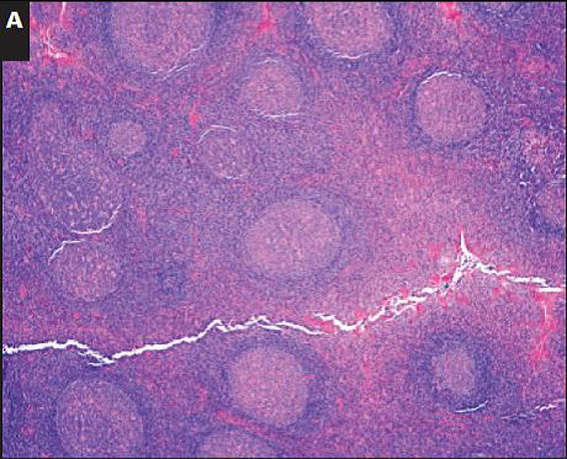
FFH PTLD is a kind of early lesions, which shows characteristic clinicopathological features and molecular involvement. The early lesions are defined as lymphoid proliferations in an allograft recipient, characterized by architectural preservation of the involved tissue, with preservation of the nodal sinuses or tonsillar crypts, and residual or sometimes floridly reactive follicles in some cases. FFH PTLD is defined as a distinct entity in 2016 WHO classification of lymphoid neoplasms. Such lesions, although reactive, may have clonal chromosomal abnormalities and may lead to uncontrolled lymphoid proliferation in solid organ transplant recipients. (Swerdlow, et al ,2008. Mucha, et al. 2010. Swerdlow, et al, 2016. Vakiani, et al, 2007).
Phenotype stem cell origin
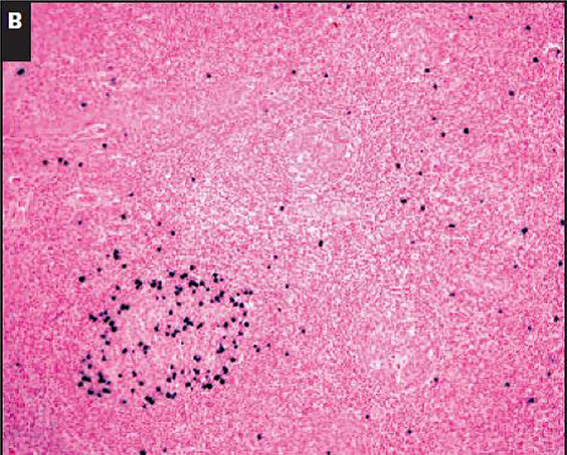
Phenotypically, FFH PTLD cases show follicular hyperplasia and the size of the follicles varied, but they all contained large, polarized, germinal centers with many mitoses and mantle zones that were often attenuated. Some cases of FFH may lack increased numbers of plasma cells. Some cells of which may express CD20, PAX5, CD3, CD5 , with markedly enlarged germinal centers (CD10+, BCL6+, BCL2-) containing numerous tingible-body macrophages and expanded follicular dendritic cell meshworks (CD21+). EBV detected by in situ hybridization is usually positive, and the number of EBV-positive cells are usually fewer, but some cases of FFH may be EBV negative (Swerdlow, et al ,2008. Vakiani,et al, 2007).
Epidemiology
In our hospital, it is 1.5 % (9/585) from August 2002 to October 2006 and about 1 % (9/857) from November 2006 to November 2009 after allo-HSCT, respectively. The incidence of PTLD was higher in mismatched or unrelated HSCT group than that of conventional one, 3.4 % (7/208), 2.3 % (1/44) versus 0/323. It was also higher in patients with conditioning regimen including ATG than those without, 3.4 % (9/262) vs. 0/323. FFH PTLD accouted for 4 of 15 cases in a study of eraly lesions of PTLD. (Swerdlow et al ,2008. Chen, 2013. Nelson et al, 2012).
Clinics
Early lesions mostly develop within 1 year after transplantation, and most patients with early lesions affected tonsils, Waldeyer ring, adenoids or lymph nodes, of which FFH PTLD often affects adenotonsillar, nodal, and extranodal lymphoid tissue.They often show spontaneous regression or regress following reduction in IS, and express EBER or EBV-LMP-1 (Opelz, 2003. Swerdlow, et al ,2008. Johnson, 2006. Vakiani,et al, 2007).
Pathology
Treatment
Prognosis
Note
Genes Involved and Proteins
Article Bibliography
| Pubmed ID | Last Year | Title | Authors |
|---|---|---|---|
| 7495309 | 1995 | Post-transplantation lymphoproliferative disorders arising in solid organ transplant recipients are usually of recipient origin. | Chadburn A et al |
| 23255160 | 2013 | Clinicopathologic spectrum and EBV status of post-transplant lymphoproliferative disorders after allogeneic hematopoietic stem cell transplantation. | Chen DB et al |
| 10498590 | 1999 | Risk of lymphoproliferative disorders after bone marrow transplantation: a multi-institutional study. | Curtis RE et al |
| 17122518 | 2006 | Impact of Epstein-Barr virus in monomorphic B-cell posttransplant lymphoproliferative disorders: a histogenetic study. | Johnson LR et al |
| 20576725 | 2010 | Post-transplant lymphoproliferative disorder in view of the new WHO classification: a more rational approach to a protean disease? | Mucha K et al |
| 23010712 | 2012 | Early posttransplant lymphoproliferative disease: clinicopathologic features and correlation with mTOR signaling pathway activation. | Nelson BP et al |
| 20110857 | 2010 | Impact of HLA mismatching on incidence of posttransplant non-hodgkin lymphoma after kidney transplantation. | Opelz G et al |
| 7902900 | 1993 | Incidence of non-Hodgkin lymphoma in kidney and heart transplant recipients. | Opelz G et al |
| 6142304 | 1984 | Reversibility of lymphomas and lymphoproliferative lesions developing under cyclosporin-steroid therapy. | Starzl TE et al |
| 17134734 | 2007 | Cytogenetic analysis of B-cell posttransplant lymphoproliferations validates the World Health Organization classification and suggests inclusion of florid follicular hyperplasia as a precursor lesion. | Vakiani E et al |
| 21211211 | 2010 | [The efficacy and safety of donor lymphocyte infusion to treat Epstein-Barr virus associated lymphoproliferative diseases after allogeneic hematopoietic stem cell transplantation]. | Xu LP et al |
Citation
Ding-Bao Chen
Florid follicular hyperplasia PTLD
Atlas Genet Cytogenet Oncol Haematol. 2017-06-01
Online version: http://atlasgeneticsoncology.org/haematological/1788/florid-follicular-hyperplasia-ptld
