t(6;8)(p21;q24) MYC/SUPT3H
2018-05-01 Hélène Bruyère , Muntadhar Al Moosawi Affiliation1.Hematopathology, Department of Pathology and Laboratory Medicine, [email protected] (MAM); Vancouver General Hospital Cytogenetics Laboratory, Department of Pathology and Laboratory Medicine, University of British Columbia, Vancouver, BC, Canada, [email protected] (HB)
Abstract
Review on t(6;8)(p21;q24), with data on clinics, and the genes involved.
Clinics and Pathology
Disease
Blastic plasmacytoid dendritic cell neoplasm (BPDCN)
Phenotype stem cell origin
Disease derives from precursors of plasmacytoid dendritic cells.
Epidemiology
The t(6;8) has been found in a limited subset of BPDCN: Less than 10 cases reported to date. Preponderance of male cases (7/8 to date). Average age 65 years, in keeping with BPDCNs mean/median age of 61-67 (WHO Classification of Tumours of Hematopoietic and Lymphoid Tissues, 2017).
Clinics
In general, BPDCN is an aggressive disease that most commonly involves the skin but can also infiltrate the bone marrow and peripheral blood as well as the lymph nodes. Seven out of eight cases of t(6;8) reported so far had bone marrow involvement based on bone marrow biopsy (Boddu et al., 2018; Momoi et al., 2002; Takiuchi et al., 2012; Nakamura et al., 2015; Fu et al., 2013; personal communication). One case reported by Leroux et al. in 2002 showed an extensive peripheral blood involvement with 95% circulating blasts. Although a bone marrow biopsy was not performed, the heavy involvement of peripheral blood, indicating bone marrow involvement, was sufficient to make the diagnosis.
Cytogenetics
Found with additional abnormalities in all cases, as the sole abnormality in the stemline in one case (Boddu et al., 2018), as a secondary abnormality in one case (Boddu et al., 2018), as part of a complex karyotype in 5/8 cases.
Table 1: Cases of BPDCN with t(6;8)(q21;q24)
BM: bone marrow, LN: lymph node, PB: peripheral blood.
Of note, cytogenetic abnormalities are present in about two-thirds of BPDCN cases, involving chromosomes 5q34, 12p13, 13q13-21, 15q, and loss of chromosome 9 (WHO Classification of Tumours of hematopoietic and lymphoid tissues, 2017).
Table 1: Cases of BPDCN with t(6;8)(q21;q24)
| Reference | Age | Sex | Site involved | Karyotype |
| Momoi et al. 2002 | 69 | M | BM, Skin | 46, XY, add(5)(q11), add(5)(q31), t(6;8)(p21,q24),del(13)(q12q14),add(15)(q13) |
| Boddu et al. 2018 | 60 | M | BM, Skin, LN | 46,XY,del(13)(q12q22)[16]/46,idem,t(6;8)(p21;q24.1),del(14)(q24q32)[2]/46,idem,t(6;8)(p21;q24.1),del(14)(q24q32)[cp2] |
| Boddu et al. 2018 | 71 | M | BM, Skin | 46,XY,t(6;8)(p21;q24.2)[5]/47,idem,+18[11]/46,XY[4] |
| Takiuchi et al. 2012 | 74 | M | BM, spleen | 47, XY, t(6;8)(p21;q24),+r |
| Nakamura et al. 2015 | 81 | M | BM, Skin, LN | 47,X,-Y t(6;8)(p21;q24),+add(7)(p11.2),+der(8)t(6;8),+20[17/20], 46,XY[3/20] among LN cells; 48,X,Y,t(6;8)(p21;q24),+add(7)(p11.2),+der(8)t(6;8),+2[5/13],49,idem,+mar1[2/13],49,idem,der(8)t(6;8),?t(9;15)(p22;q15),+mar1 2/13]/46, XY[3/13] |
| Fu et al. 2013 | 67 | F | BM, LN | 46,XX,del(5)(q13q33),t(6;8)(p21;q24) |
| Leroux et al. 2002 | 74 | M | PB (BM not performed) | 49,XY,+add(6)(q21),-8,+2mar,+r[6]/49,idem,t(15;16)(?q21;?q21)[6]/49,idem,t(3;5)(?q21;?q31)[5], ish wcp M-FISH 49,XY,+6,t(6;8)(p21;q24),+r(12),+20/49,idem,inv(15)(q1?4q2?3),t(16;16)(q?;q?)/49,idem,t(3;5)(q?21;q?31)[13] |
| Personal communication | 29 | M | BM, PB | 44-45,X,-Y,del(1)(p12p22),t(6;8)(p21.1;q24.2)[cp5]/46,XY[1].nuc ish(MYCx2)(5MYC sep 3MYCx1)[54/100] |
BM: bone marrow, LN: lymph node, PB: peripheral blood.
Of note, cytogenetic abnormalities are present in about two-thirds of BPDCN cases, involving chromosomes 5q34, 12p13, 13q13-21, 15q, and loss of chromosome 9 (WHO Classification of Tumours of hematopoietic and lymphoid tissues, 2017).
Prognosis
The prognosis of BPDCN is usually poor in adults (Bekkenk et al., 2004, Suzuki et al., 2005) and this appears to be true for cases with t(6;8). Two cases with this translocation failed to respond to treatment, the overall survival being 3 and 12 months respectively (Boddu et al., 2018). One patient relapsed three months after the initial diagnosis and treatment and received multiple lines of chemotherapy but eventually died because of septic shock nine months after the initial diagnosis (Momoi et al., 2002). The only female reported so far with t(6;8) received palliative chemotherapy and died two months after the initial diagnosis. Another patient responded to treatment and tumor cells in the peripheral blood disappeared in day 8; however, the patient died of septic shock on day 16 (Takiuchi et al., 2012). A 29-year-old male patient who was diagnosed with BPDCN with complex karyotype including t(6;8) received ALL-based chemotherapy achieved complete morphological remission by day 24 of treatment and has been on sustained remission at least until this paper was written (personal communication).
Cytogenetics
Note
The t(6;8)(p21.1;q24.2) is identified by conventional karyotyping.
Note: Other translocations involving 8q24 have been reported in BPDCN: t(8;14)(q24;q32), t(X;8)(q24;q24), t(3;8)(p25;q24) (Boddu et al., 2018; Nakamura et al., 2015)
Note: Other translocations involving 8q24 have been reported in BPDCN: t(8;14)(q24;q32), t(X;8)(q24;q24), t(3;8)(p25;q24) (Boddu et al., 2018; Nakamura et al., 2015)
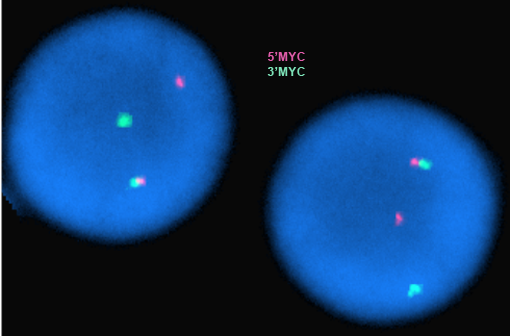
Figure 2: FISH image showing the presence of a normal (fused) MYC signal and separated 5MYC signal from 3MYC signal.
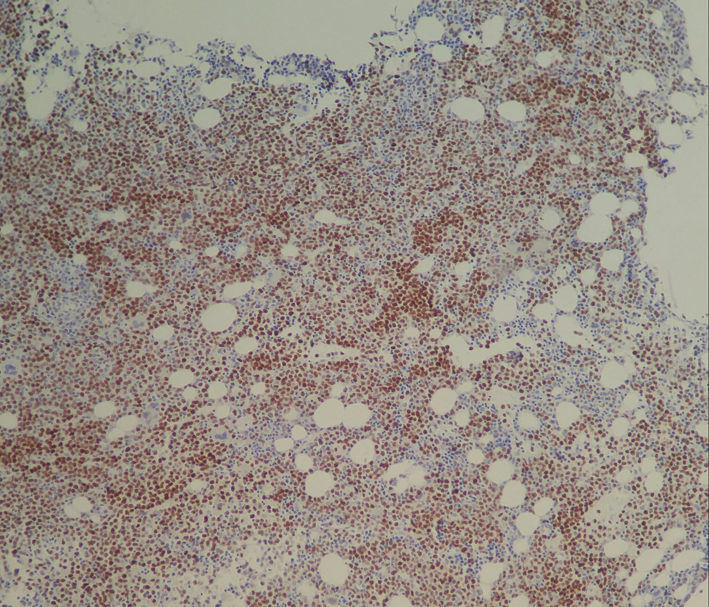
Figure 3: Image from immunohistochemistry with MYC antibody on bone marrow cells.
Genes Involved and Proteins
Gene name
Location
14q23.3
Dna rna description
DNA/RNA: CMYC is composed of three exons spanning over 4 kb with the second and third exons encoding most MYC protein.
Gene name
Location
6p21.1
Dna rna description
DNA/RNA: SUPT3H is composed of 22 exons with a size of 570 kb.
Protein description
399 amino acids and 44 kDa.
Result of the Chromosomal Anomaly
Description
The translocation has been shown to result in a split MYC signal when using a commercial MYC break-apart FISH probe (Nakamura et al., 2015, Boddu et al., 2018, Fu et al., 2013). Involvement of the MYC gene has also be inferred from the positive MYC immunochemistry observed on bone marrow slides (Nakamura et al., 2015, Boddu et al., 2018). Molecular analysis of the 8q24 breakpoint showed that it occurred in the PVT1 gene on chromosome 8 (Nakamura et al., 2015; Fu et al., 2013; Jardin et al., 2009). PVT1 is located 149 kb telomeric to MYC. It is a long non-coding RNA located within the interval between the 5 MYC probe and 3MYC commercial probes used to identify MYC rearrangements. Jardin et al. in 2009 found, in BPDCN, a 5.6-Mb interstitial deletion on 8q24 involving PVT1 bringing MYC oncogene adjacent to miR-30b/30c leading to possible up-regulation of these genes.
Article Bibliography
| Pubmed ID | Last Year | Title | Authors |
|---|---|---|---|
| 26056082 | 2015 | Classification and clinical behavior of blastic plasmacytoid dendritic cell neoplasms according to their maturation-associated immunophenotypic profile. | Martín-Martín L et al |
| 12008089 | 2002 | Cutaneous lymphoblastic lymphoma of putative plasmacytoid dendritic cell-precursor origin: two cases. | Momoi A et al |
| 25860292 | 2015 | Identification of SUPT3H as a novel 8q24/MYC partner in blastic plasmacytoid dendritic cell neoplasm with t(6;8)(p21;q24) translocation. | Nakamura Y et al |
| 23065521 | 2013 | Blastic plasmacytoid dendritic cell neoplasm with leukemic presentation: an Italian multicenter study. | Pagano L et al |
| 15999368 | 2005 | Blastic natural killer cell lymphoma/leukemia (CD56-positive blastic tumor): prognostication and categorization according to anatomic sites of involvement. | Suzuki R et al |
| 19924135 | 2010 | Alterations of the cell-cycle inhibitors p27(KIP1) and p16(INK4a) are frequent in blastic plasmacytoid dendritic cell neoplasms. | Wiesner T et al |
Summary
Fusion gene
MYC/SUPT3H
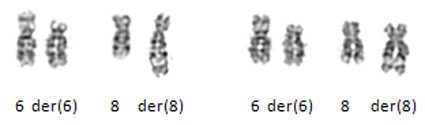
Figure 1: t(6;8)(p21.1;q24.2), G-banding. Courtesy Hélène Bruyère.
Citation
Hélène Bruyère ; Muntadhar Al Moosawi
t(6;8)(p21;q24) MYC/SUPT3H
Atlas Genet Cytogenet Oncol Haematol. 2018-05-01
Online version: http://atlasgeneticsoncology.org/haematological/2987/t(6
