Nervous system: Astrocytic tumors
2000-11-01 Anne Marie Capodano Affiliation1.Laboratoire de Cytogénétique Oncologique, Hpital de la Timone, 264 rue Saint Pierre, 13005 Marseille, France
Classification
Note
Astrocytic tumors comprise a wide range of neoplasms that differ in their location within the central nervous system (CNS), age and gender distribution, growth potential, extent of invasiveness, morphological features, tendency for progression and clinical course; there is increasing evidence that these differences reflect the type and sequence of genetic alterations acquired during the process of transformation.
Classification
The following clinicopathological entities can be distinguished :Pilocytic Astrocytomas (Grade I) Fibrillary Astrocytomas (Grade II) Anaplastic Astrocytomas (Grade III) Glioblastoma Multiforme (Grade IV)
Clinics and Pathology
Etiology
Epidemiology
diffuse astrocytomas are the most frequent intracranial neoplasm and account for more than 60% of all primary brain tumors; the incidence differs between regions, but there are 5 to 7 new cases per 100.000 population per year
Clinics
glioblastoma multiforme may develop de novo (primary glioblastoma) or though progression from low-grade or anaplastic astrocytoma (secondary glioblastoma); patients with a primary glioblastoma are usually older, present a rapid tumor progression and a poor prognosis; patient with secondary glioblastomas are younger and tumor progress more slowly, with a better prognosis; these two groups are histologically indistinguishable
Pathology
another subgroup of glioblastoma can be distinguished: the giant cell glioblastomas; histologically it is a glioblastoma with giant cells (500 mm in diameter): it develops clinically de novo ; it is associated with a favorable prognosis
Treatment
treatment differs according to grade and location of tumor
pilocytic astrocytomas can be cured by complete resection of tumor; if exeresis is not possible due to the location of the tumor, chemotherapy is indicated in young children and radiotherapy in adults
in fibrillary astrocytomas, the treatment consists of total and extent resection of tumor
in anaplastic tumors and glioblastoma multiforme, the treatment consists of total resection and radiotherapy and chemotherapy after surgery
pilocytic astrocytomas can be cured by complete resection of tumor; if exeresis is not possible due to the location of the tumor, chemotherapy is indicated in young children and radiotherapy in adults
in fibrillary astrocytomas, the treatment consists of total and extent resection of tumor
in anaplastic tumors and glioblastoma multiforme, the treatment consists of total resection and radiotherapy and chemotherapy after surgery
Prognosis
in low grade astrocytomas, a correlation of proliferation was reported (Ki67 index) with clinical outcome; the proliferative potential correlates inversely with survival and time to recurrence; the mean survival time after surgery is 6-8 years in low-grade astrocytomas; after surgery, the prognosis depends on whether the neoplasm undergoes progression to a more malignant phenotype; in pilocytic astrocytomas, total cure is possible after total resection; in fibrillary astrocytomas reccurrence is frequent
.in anaplastic astrocytomas and in glioblastomas, evaluation of the extent of resection can be a prognostic factor; prognosis is generally poor (about one year); patients below 45 yrs have a considerably better prognosis than elderly patients; primary glioblastomas have a short clinical history with a poor prognosis; survival is better in secondary glioblastomas
.in anaplastic astrocytomas and in glioblastomas, evaluation of the extent of resection can be a prognostic factor; prognosis is generally poor (about one year); patients below 45 yrs have a considerably better prognosis than elderly patients; primary glioblastomas have a short clinical history with a poor prognosis; survival is better in secondary glioblastomas
Cytogenetics
Cytogenetics morphological
loss or deletion of chromosome 13, 13q14-q31 is found in some glioblastomas
trisomy 19 was reported in glioblastomas by cytogenetic and comparative genomic hybridization (CGH) analysis; the loss of 19q in 19q13.2-qter was detected by loss of heterozigocity (LOH) studies in glioblastomas
deletion of chromosome 4q, complete or partial gains of chromosome 20 has been described; gain or amplification of 12q14-q21 has been reported
the loss of chromosome Y might be considered, when it occurs in addition to other clonal abnormalities
Genes Involved and Proteins
Note
over expression of PDGFR-a (platelet derived growth factor) is asociated with loss of heterozygosity of chromosome 17p and p53 mutations in secondary glioblastomas
the p16 gene and the p15 gene are located in 9p21, a chromosome region commonly deleted in astrocytomas; expression of p16 gene is frequently altered in these tumors: in 33-68% of primary glioblastomas and 25% of anaplastic astrocytomas
others growth factors expressed in gliomas include fibroblast growth factors (FGFs), insulin-like growth factors (IGFs), and vascular endothelial growth factor (VEGF)the p53 gene is a tumor suppressor gene located on chromosome 17p13.1; loss or mutation of p53 gene has been detected in many types of gliomas and represents an early genetic event in these tumors
overexpression of MDM2 is also seen in primary glioblastomas
others oncogenes have been found to be amplified in a few cases of astrocytomas : oncogenes Gli, MYC, MYCN, MET and N-Ras
in addition to p53 gene, others tumor suppression genes play a role in astrocytomas
loss of chromosome 10 is the most frequent abnormality associated with the progression of malignant astrocytic tumors; more than 70% of glioblastomas show LOH on chromosome 10; amplification of EGFR is always associated with loss of chromosome 10
the PTEN gene located at the 10q23 locus is implicated more frequently in glioblastomas than in anaplastic astrocytomas
another suppressor gene the MXII gene has also been located on the distal portion of chromosome 10 at the 10q24 at the 10q24-p25 locus
the LG11 novel gene located in 10p24 region is a suppressor gene rearranged in several glioblastomas tumors
allelic loss of chromosome 22q wich contains the neurofibromatosis type 2, tumor suppressor gene NF2 is observed in 20-30% of astrocytomas. But another possibility is the involvement of another gene located on chromosome 22 in the tumorogenesis of astrocytomas
most of these genes participate in the progression of astrocytomas (fig 1)
the epidermal growth factor receptor (EGFR) coded by the EGFR cellular oncogene is located on human chromosome 7 at locus 7p12-p14; EGRF is amplified in 40-60% of glioblastomas; it constitues a hallmark: primary glioblastomas rarely contain EGFR overexpression; patients with anaplastic astrocytomas or glioblastomas have a poorer prognosis when EGFR gene amplification is present; amplification could be a significant prognostic factor in these tumors
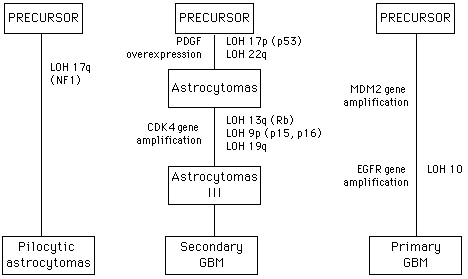
Molecular pathways in the progression of astrocytomas (from Ho-Keung and Paula Y.P. Lam)
Article Bibliography
| Pubmed ID | Last Year | Title | Authors |
|---|---|---|---|
| 8174086 | 1994 | Molecular analysis of genomic abnormalities in human gliomas. | Bello MJ et al |
| 3367154 | 1988 | Gene amplification in malignant human gliomas: clinical and histopathologic aspects. | Bigner SH et al |
| 2192793 | 1990 | Cytogenetics of human brain tumors. | Bigner SH et al |
| 9879993 | 1998 | A novel gene, LGI1, from 10q24 is rearranged and downregulated in malignant brain tumors. | Chernova OB et al |
| 8586464 | 1995 | Gene amplification in human gliomas. | Collins VP et al |
| 10671694 | 2000 | Cytogenetic and molecular abnormalities in astrocytic gliomas (Review). | Goussia AC et al |
| 1591709 | 1992 | Chromosome abnormalities in low-grade central nervous system tumors. | Griffin CA et al |
| 9072974 | 1997 | PTEN, a putative protein tyrosine phosphatase gene mutated in human brain, breast, and prostate cancer. | Li J et al |
| 7887443 | 1995 | MTS1/p16/CDKN2 lesions in primary glioblastoma multiforme. | Moulton T et al |
| 9643506 | 1998 | The molecular genetics of central nervous system tumors. | Ng HK et al |
| 9559346 | 1998 | Investigation of genetic alterations associated with the grade of astrocytic tumor by comparative genomic hybridization. | Nishizaki T et al |
| 9331072 | 1997 | PTEN gene mutations are seen in high-grade but not in low-grade gliomas. | Rasheed BK et al |
| 8957092 | 1996 | Refined deletion mapping of the chromosome 19q glioma tumor suppressor gene to the D19S412-STD interval. | Rosenberg JE et al |
| 8558174 | 1996 | Detection of complex genetic alterations in human glioblastoma multiforme using comparative genomic hybridization. | Schlegel J et al |
| 7622287 | 1995 | EGFR gene amplification--rearrangement in human glioblastomas. | Schwechheimer K et al |
| 9407626 | 1998 | Molecular changes during the genesis of human gliomas. | Sehgal A et al |
| 9090379 | 1997 | Identification of a candidate tumour suppressor gene, MMAC1, at chromosome 10q23.3 that is mutated in multiple advanced cancers. | Steck PA et al |
| 1551072 | 1992 | Karyotypes in 90 human gliomas. | Thiel G et al |
| 8806688 | 1996 | Characterization of genomic alterations associated with glioma progression by comparative genomic hybridization. | Weber RG et al |
| 9354456 | 1997 | MXI1, a putative tumor suppressor gene, suppresses growth of human glioblastoma cells. | Wechsler DS et al |
Citation
Anne Marie Capodano
Nervous system: Astrocytic tumors
Atlas Genet Cytogenet Oncol Haematol. 2000-11-01
Online version: http://atlasgeneticsoncology.org/solid-tumor/5007/nervous-system-astrocytic-tumors
