Bone and Soft Tissue: Ewing sarcoma
2019-07-01 Kelly M Bailey , Sarangarajan Ranganathan Affiliation1.University of Pittsburgh School of Medicine, Department of Pediatrics, Division of Pediatric Hematology\/Oncology, [email protected] (KMB); University of Pittsburgh School of Medicine, Department of Pathology (SR)
Summary
Note
Ewing sarcoma is defined by the presence of a fusion gene, most commonly EWSR1/FLI1.
Abstract
Ewing sarcoma is a bone or soft tissue sarcoma most commonly diagnosed in adolescents and young adults. It is one of the pediatric small, round, blue cell tumors and a fusion gene-driven cancer.
Classification
Note
Ewing sarcoma is a tumor of the bone (most commonly) or soft tissue and is defined by the presence of the fusion gene EWSR1/FLI1 or other less common FET/ETS family fusions.
Clinics and Pathology
Phenotype stem cell origin
Thought to be derived from a neural crest or mesenchymal cell of origin, although the exact cell of origin is still a source of debate.
Etiology
Ewing tumors arise most commonly from a translocation of chromosomes 11 and 22, resulting in the generation of the fusion gene EWSR1/FLI1. Recent evidence has demonstrated that ~40% of Ewing tumors FET/ETS fusions arise from chromoplexy.
Epidemiology
Ewing sarcoma is a rare subtype of sarcoma. It is the second most common primary bone sarcoma in pediatric patients and can also occur in the soft tissue. In the United States, there are 200-250 newly diagnosed cases annually. Ewing sarcoma most commonly occurs in the AYA (adolescent and young adult) patient population, with a peak incidence at 15 years of age. This tumor can also less commonly occur in older adults, with a second smaller peek in incidence in patients older than 35 years. There are no known environmental exposures known to cause Ewing sarcoma.
Clinics
Ewing sarcoma can arise in the bone or soft tissue. Bone lesions are the most common and occur most often in the pelvis or femur. Common locations for soft tissue Ewing sarcoma include the buttock, thigh and chest wall. Many other bone and soft tissue primary locations for Ewing tumors have been reported but are less common.
70-75% of Ewing tumors present as a single, localized mass. The remaining ~25% of patients present with upfront metastatic disease in the lung or bone/bone marrow, as noted on imaging (PET and CT scans) and bilateral bone marrow biopsies obtained for disease staging.
70-75% of Ewing tumors present as a single, localized mass. The remaining ~25% of patients present with upfront metastatic disease in the lung or bone/bone marrow, as noted on imaging (PET and CT scans) and bilateral bone marrow biopsies obtained for disease staging.
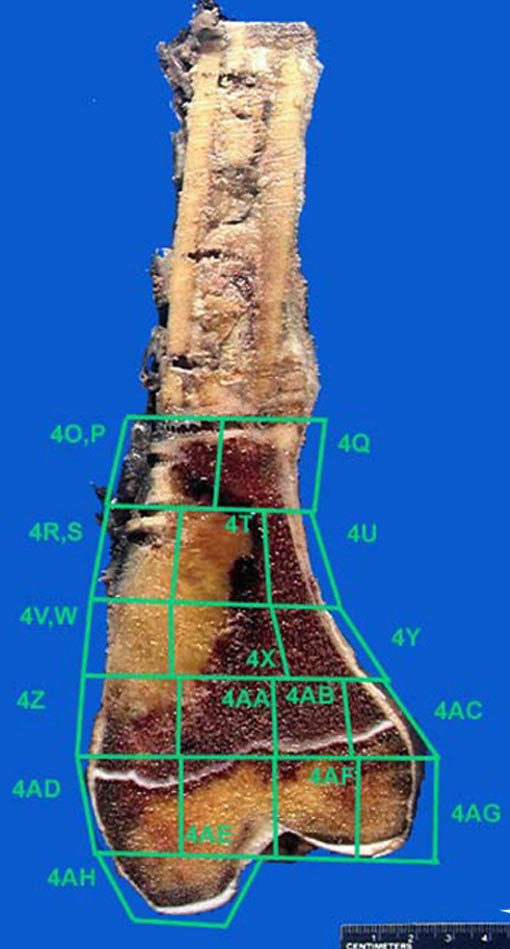
Gross dissection map of a treated, resected Ewing sarcoma of the femur. Image courtesy of Sarangarajan Ranganathan.
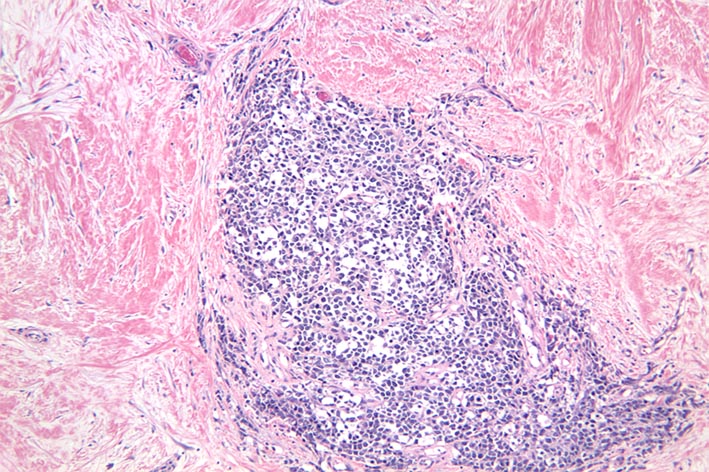
A small isolated focus of Ewing tumor cells in the bone marrow. Image courtesy of Sarangarajan Ranganathan
Pathology
Uniform sheets of small, round blue cells, often (95%) CD99+ and (100%) Tdt- by immunohistochemistry staining. EWSR1 break-apart FISH probes are commonly used diagnostically to detect the presence of the EWS-containing fusion (most commonly EWSR1/FLI1). FISH probes are not as reliable for detecting EWSR1/ERG or non-EWSR1 FET/ETS fusions. Tumor sequencing is thus also used to more precisely define the fusion present in FISH "negative" cases.
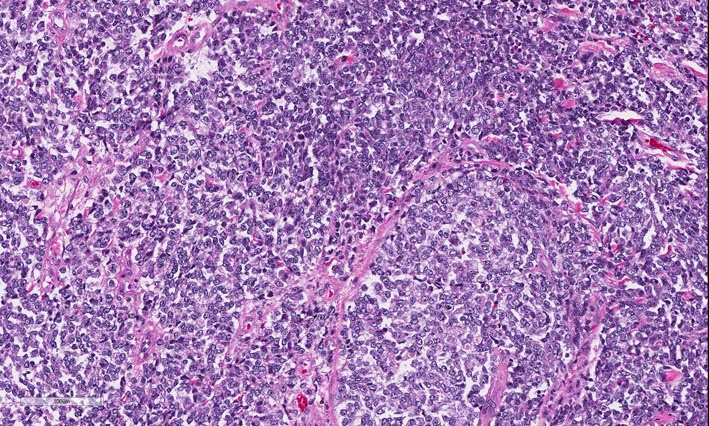
H&E section showing sheets of a small blue cell tumor with closely packed cells with indistinct cell borders and inconspicuous nucleoli. Note the cytoplasmic clearing. Thin fibrovascular septa are seen in between. (H&E x 200)
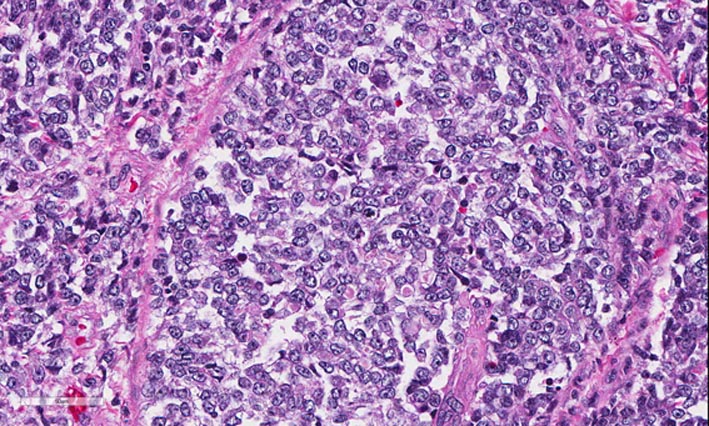
Higher magnification showing the individual tumor cells that are monomorphic and in sheets with no nucleoli and frequent mitoses. Note occasional cells with cytoplasmic eosinophilic staining. A break-apart FISH probe showed EWR1 rearrangement. (H&E x 400) Image courtesy of Sarangarajan Ranganathan
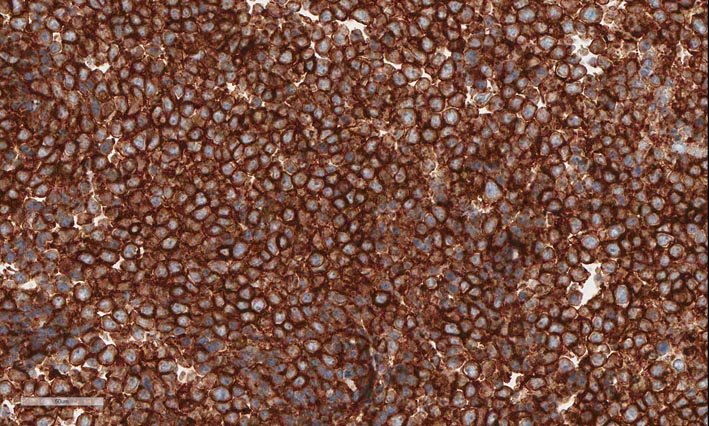
A CD99 stain showing strong and diffuse membranous staining of tumor cells (CD99 x 400). Image courtesy of Sarangarajan Ranganathan
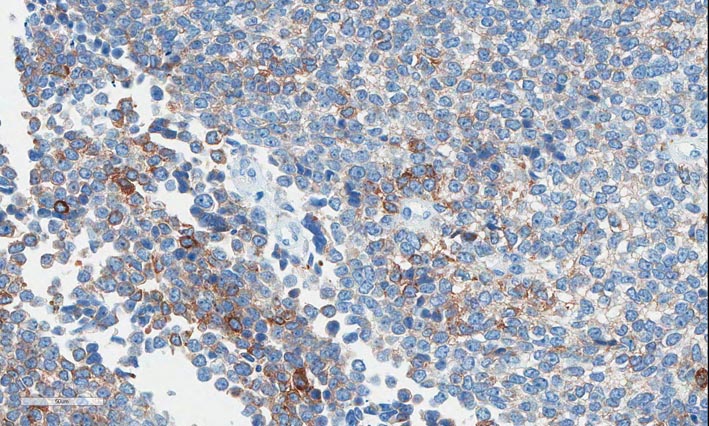
A synaptophysin stain showing scattered brown staining in cytoplasm of the tumor cells (Synaptophysin x 400). Image courtesy of Sarangarajan Ranganathan
Genes
Treatment
Localized Ewing sarcoma is currently treated with alternating, compressed cycles of multi-agent chemotherapy, such as VDC/IE (vincristine, doxorubicin, cyclophosphamide/ifosfamide, etoposide). Ewing tumors are sensitive to radiation and local control is achieved by surgery and/or radiation therapy.
Ongoing clinical trials aim to improve the outcomes for patients with upfront metastatic and relapsed Ewing sarcoma. These trials include international efforts to determine the most effective chemotherapy backbone for patients with relapsed Ewing sarcoma. Novel single agents include those attempting to target the EWSR1/FLI1 fusion itself.
Ongoing clinical trials aim to improve the outcomes for patients with upfront metastatic and relapsed Ewing sarcoma. These trials include international efforts to determine the most effective chemotherapy backbone for patients with relapsed Ewing sarcoma. Novel single agents include those attempting to target the EWSR1/FLI1 fusion itself.
Prognosis
Current survival estimates for patients with primary, localized Ewing sarcoma is ~70%. Survival for patients with upfront metastatic or relapsed Ewing sarcoma is only 10-30%.
Cytogenetics
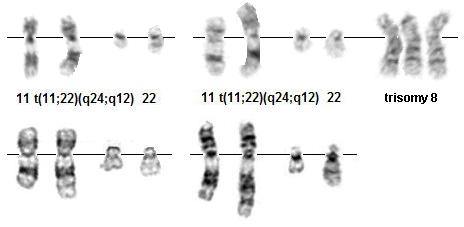
t(11;22)(q24;q12) in Ewing sarcoma, G- banding - top: courtesy Jean Luc Lai (with trisomy 8 on the right); - bottom: courtesy G. Reza Hafez, Eric B.Johnson, and Sara Morrison-Delap, UW Cytogenetic Services
Cytogenetics morphological
about 85% of Ewing tumors show a t(11;22)(q24;q12); the translocation results in the fusion of the EWSR1 gene with the transcription factor gene FLI1, leading to a hybrid transcript and an oncogenic chimeric protein. Other more rare FET-ETS family member fusions have been described, such as: t(21;22)(q12;q12) and t(7;22)(p22;q12), leading to the fusions EWSR1/ERG and EWSR1/ETV1, respectively.
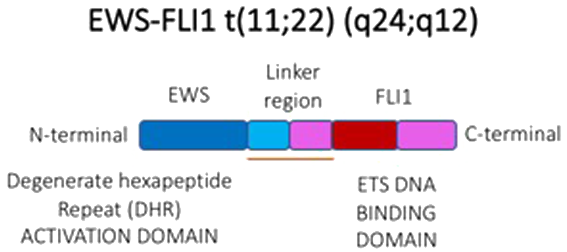
Schematic of the t(11;22)(q24;q12) EWSR1/FLI1 translocation demonstrating the 5 EWSR1 activation domain and the 3 FLI1 ETS DNA binding domain joined by a variable length linker region (denoted by the orange bar).
Additional anomalies
Additional anomalies in Ewings tumors mainly consist in chromosome gains: +8 (45% of the cases) and, with a much lower frequency, trisomies 2, 5, 7, 9, 12 (between 10 and 15% of the cases); trisomy 1q, through unbalanced t(1q;16q), is observed in about 25% of the cases
Genetics
Note
Germline Mutations
~13% of patients with Ewing sarcoma have been found to have germline mutations. These germline mutations are enriched in genes associated with DNA damage repair. The pathogenicity of such mutations remains a subject of ongoing investigation
~13% of patients with Ewing sarcoma have been found to have germline mutations. These germline mutations are enriched in genes associated with DNA damage repair. The pathogenicity of such mutations remains a subject of ongoing investigation
Genes Involved and Proteins
Note
The following genes have been identified as involved FET or ETS family members comprising various FET-ETS fusions: EWSR1, FLI1, ERG, ETV1, ETV4, FEV, FUS
Gene name
EWSR1 (Ewing sarcoma breakpoint region 1)
Location
22q12.2
Protein description
Contains both a transcriptional activation domain and an RNA-binding domain.
Gene name
FLI1 (Friend leukemia virus integration 1)
Location
11q24.3
Protein description
Member of the ETS family of transcription factors.
Gene name
ERG (v-ets erythroblastosis virus E26 oncogene like (avian))
Location
21q22.2
Protein description
Member of the ETS family of transcription factors.
Gene name
ETV1 (Ets variant 1)
Location
7p21.2
Protein description
Member of the ETS family of transcription factors.
Gene name
ETV4 (Ets variant 4)
Location
17q21.31
Protein description
ETV4 serves as a transcriptional activator.
Gene name
FEV (fifth ewing variant)
Location
2q35
Protein description
Member of the ETS family of transcription factors.
Gene name
FUS (fused in sarcoma)
Location
16p11.2
Protein description
The FUS protein binds to DNA and participates in transcription.
Result of the chromosomal anomaly
Description
The 5 portion of FET family members are fused to the 3 portion of ETS family members to generate a FET-ETS fusion oncogene, most commonly (85%) EWSR1/FLI1.
Description
FUSR1/ERG t(16;21)
Oncogenesis
TGFBR2 (TGF-beta receptor II) expression is one example of a gene/protein classically repressed by EWS-R1/FLI1.
Article Bibliography
| Pubmed ID | Last Year | Title | Authors |
|---|---|---|---|
| 31031965 | 2019 | Emerging novel agents for patients with advanced Ewing sarcoma: a report from the Children's Oncology Group (COG) New Agents for Ewing Sarcoma Task Force. | Bailey K et al |
| 28125078 | 2017 | Frequent inactivating germline mutations in DNA repair genes in patients with Ewing sarcoma. | Brohl AS et al |
| 25186949 | 2014 | The genomic landscape of pediatric Ewing sarcoma. | Crompton BD et al |
| 1522903 | 1992 | Gene fusion with an ETS DNA-binding domain caused by chromosome translocation in human tumours. | Delattre O et al |
| 29977059 | 2018 | Ewing sarcoma. | Grünewald TGP et al |
| 25223734 | 2014 | Genomic landscape of Ewing sarcoma defines an aggressive subtype with co-association of STAG2 and TP53 mutations. | Tirode F et al |
| 20543858 | 2010 | Recent advances in the molecular pathogenesis of Ewing's sarcoma. | Toomey EC et al |
| 31157509 | 2019 | A germline BARD1 mutation in a patient with Ewing Sarcoma: Implications for familial testing and counseling. | Venier RE et al |
Citation
Kelly M Bailey ; Sarangarajan Ranganathan
Bone and Soft Tissue: Ewing sarcoma
Atlas Genet Cytogenet Oncol Haematol. 2019-07-01
Online version: http://atlasgeneticsoncology.org/solid-tumor/5010/bone-and-soft-tissue-ewing-sarcoma
