Ovary: Germ cell tumors
2003-08-01 Lisa Lee-Jones Affiliation1.Tumour Molecular Genetics Group, Institute of Medical Genetics, University of Wales College of Medicine, Heath Park, Cardiff, CF14 4XN, UK
Summary
Note
Classification
Note
Clinics and Pathology
Etiology
Epidemiology
Clinics
Pathology
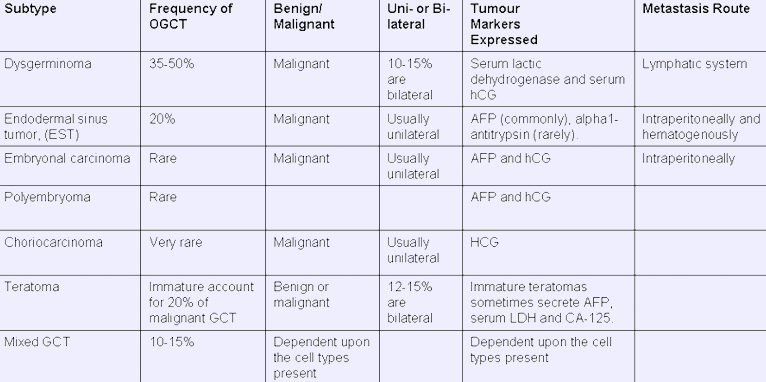
Teratomas develop from totipotential germ cells, and consequently contain all three germ cell layers: ectoderm, mesoderm and endoderm. Teratomas are classified into immature (malignant), mature (dermoid cyst) and monodermal (struma ovarii, carcinoid).
Dysgerminomas have a solid, lobulated, tan, flesh-like gross appearance with a smooth surface. Microscopically dysgerminoma cells are round and ovoid, contain abundant cytoplasm, irregularly shaped nuclei, >1 prominent nucleolus. These cells have a propensity to aggregate forming cords and sheets. Lymphocytic and granulocytic infiltration of the fibrous septa are often evident.
Gross examination of EST, also known as yolk sac tumour, demonstrate smooth, glistening, hemorrhagic and necrotic surfaces. Histology reveals a wide range of patterns (microcystic, endodermal sinus, solid, alveolar-glandular, papillary, macrocystic, hepatoid, primitive endodermal). The classic pattern contains Schiller-Duval bodies (central capillary surrounded by simple papillae) and eosinophilic globules containing AFP. Intracellular and extracellular hyaline droplets (periodic acid-Schiff positive) are also seen in EST.
Gross examination of embryonal carcinoma reveals a solid, haemorrhagic, necrotic tumour, resembling a larger form of EST. Embryonal glands, glandlike clefts (embryoid bodies), and syntrophoblastic giant cells are present microscopically.
Choriocarcinoma is a very rare solid, haemorrhagic tumour, composed of malignant cytotropohoblast and syncytiotrophoblast. Nongestational and gestational choriocarcinoma have identical histologies.
As the name suggests, mixed germ cell tumours contain >1 histological type. Dysgerminoma with EST, and immature teratomas with EST are frequent combinations.
Histological analysis of polyembryoma demonstrates embryoid bodies in different stages of presomite development.
Treatment
Evolution
Prognosis
Treatment
Treatment
Treatment
Treatment
Cytogenetics
Cytogenetics morphological
Immature teratomas frequently have chromosomal abnormalities (63%), of which gains of chromosomes 3, 8, 12 and 14, losses of chromosomes 4 and 13, and several structural rearrangements including i(12p) are common. It has been proposed that cytogenetically abnormal immature teratomas are more likely to recur than their cytogenetically normal counterparts.
Over 300 mature teratomas have undergone cytogenetic analysis and only 4% have had aberrant karyotypes, displaying numerical alterations only, none of which are recurrent. The few cases in which abnormalities have been identified were as follows: trisomy of chromosome 8 (2 cases), 13 (1 case), 15 (1 case), 20 (1 case) and double trisomy of chromosomes 7 and 12; losses of chromosomes 3, 6, 7, 11, 16, 17, 21 and 22; structural rearrangements involving +mar (2 cases), add(1)(q11) (1 case), der(6)(t1;6)(q11q22) (1 case), i(12)(p10) (1 case) and +del(20)(q11) (1 case).
Mature teratomas that have undergo malignant transformation display multiple numerical and structural chromosomal anomalies principally involving chromosomes X, 1, 3, 4, 5, 9, 10 and 11. Several similarities were found when comparing the benign cystic and malignant component of an ovarian teratoma. It is noteworthy that the benign component had multiple anomalies (13 non-random structural and numerical changes), which raises the possibility that multiple anomalies in the benign component predispose the tumour to malignant transformation.
Complex numerical and structural chromosome changes were apparent in mixed mesodermal tumors, but there is insufficient data to address whether this tumour subtype has a different composition of chromosomal abnormalities than the other subtypes. Abnormalities of chromosome 12 were found in two of six cases of ovarian choriocarcinomas. Monosomy 22 was identified as the sole anomaly in a mixed germ cell-sex cord stromal tumour in the ovary, by both karyotyping and CGH, which may suggest a common pathogenetic mechanism for both tumour types.
From the cytogenetic data available to date, it appears that similarities exist between OGCT and TGCT. Isochromosome 12p, i(12p), gains of chromosomes 1, 8, 21 and loss of chromosomes 6 and 13 have been reported in both.
Cytogenetics molecular
27 ovarian GCT were analysed by CGH, of which 12 were dysgerminomas, 6 were ESTs, 3 were mixed GCT and the remainder were immature teratomas. The data was grouped for the dysgerminomas, ESTs and mixed GCT and the most frequent finding was gain of 12p, (14/19), 8 of which showed gain of 12p only, (which may result from i(12p)), 4 showed gains of the entirety of chromosome 12 and 2 showed high level amplification of 12p11-p12. 12p gain is a frequent finding in TGCT, and amplification of 12p11-p12 has also been found in a few such cases. Other recurrent abnormalities were found in this group which have also been previously reported as recurrent findings in TGCT. These include gain of entire chromosome 21 (42 % of malignant OGCT vs. 45% TGCT), gain of chromosome 8 (42% OGCT vs. 45% TGCT), gain of 1q (32% OGCT vs. 36 TGCT) and loss of chromosome 13 (26% OGCT vs. 38% TGCT). There did not appear to be a correlation between the pattern of chromosomal imbalances and histological subtype, except for distal 1p deletion, which was exclusively found in two ESTs. Meanwhile, only 1 of the 6 immature teratomas revealed an abnormality, gain of chromosome 14.
A study summarised these findings according to histological entity. Every dysgerminoma (n=12) analysed showed chromosomal imbalances, with an average number of 10 changes per case. Gains were more common than losses. The most frequent anomalies were gains of 12p (8/12), 12q (9/12), 21q (8/12), 22q (7/12), 20q (6/12), 15q (5/12), 1p (4/12) and 6p (4/12) and the whole of chromosomes 19 (6/12), 7 (5/12), 8 (5/12) and 17 (5/12). Losses of chromosome 13 were seen in 7/12 of the cases. All 4 ESTs analysed displayed copy number changes, with an average of 6 per case. These included gain of 12p (3/4), 1q (3/4), 3p (2/4), 11q (2/4), Xp (2/4), and loss of 18q (2/4). Fewer changes were observed in the immature teratomas, with an average of 1.4 per case. 4 of the 9 immature teratomas had no copy number change. Gain of all or parts of 1p, 16p, 19 and 22 were identified in 2 of the cases with anomalies.
Thus both studies frequently found 12p gains in several subtypes of OGCT, except for immature teratomas, and suggest that immature teratomas follow a different pathway to that taken by other malignant OGCT (and TGCT).
Several interphase cytogenetic studies have been performed on paraffin sections using centromeric probes to determine the copy number of chromosomes, and probes specifically designed to identify the i(12p). A study showed over-representation of chromosomes 7 and 12, and under-representation of chromosome 18, all of which are characteristic features in the male counterpart testicular seminoma.
Genetics
Note
Genes Involved and Proteins
Note
Ovarian teratomas develop in transgenic mice lacking a functional c-mos proto-oncogene. However, analysis of twenty teratomas for mutations of c-MOS did not identify any, suggesting that mutations of c-MOS do not play a significant role in the development of human ovarian teratomas.
Amplification of MYCN was found in 3/3 immature teratomas, but in 0/5 dermoid cysts and 0/5 mature teratomas. Less than 3% of GCT have mutations of p53. A somatic novel missense mutation (G to C at nucleotide 2467) of c-KIT has been identified in one ovarian mixed dysgerminoma/EST, which resulted in constitutive activation of KIT kinase activity.
There has been a single report of a germline BRCA1 mutation in a 16 year-old woman with dysgerminoma. This mutation was present in numerous relatives with different cancers including breast and ovarian cancer. It is unclear whether the dysgerminoma was a consequence of the germline mutation, or whether germline BRCA1 mutations are responsible for a small proportion of dysgerminomas and other types of OGCT.
Article Bibliography
| Pubmed ID | Last Year | Title | Authors |
|---|---|---|---|
| 9202807 | 1997 | Germ cell tumours in a brother and sister. | Akyüz C et al |
| 7682284 | 1993 | Malignant germ cell tumours in two siblings. | Blake KI et al |
| 12414650 | 2002 | Genomic and expression analysis of the 12p11-p12 amplicon using EST arrays identifies two novel amplified and overexpressed genes. | Bourdon V et al |
| 6136438 | 1983 | Familial benign cystic teratomata. | Brenner SH et al |
| 7640186 | 1995 | Dysgerminoma in mother and daughter: use of lactate dehydrogenase as a tumor marker in the child. | Chisholm JC et al |
| 1970513 | 1990 | Benign ovarian teratomas. An analysis of their cellular origin. | Dahl N et al |
| 10785479 | 2000 | Molecular genetic analysis of malignant ovarian germ cell tumors. | Faulkner SW et al |
| 8344765 | 1993 | Cytogenetic analysis of an immature teratoma of the ovary and its metastasis after chemotherapy-induced maturation. | Gibas Z et al |
| 3376353 | 1988 | Familial ovarian dermoid cysts. | Gustavson KH et al |
| 2790757 | 1989 | Are germ cell tumors part of the Li-Fraumeni cancer family syndrome? | Hartley AL et al |
| 1521236 | 1992 | Genetics and biology of human ovarian teratomas. III. Cytogenetics and origins of malignant ovarian germ cell tumors. | Hoffner L et al |
| 8825060 | 1996 | Familial predisposition to both male and female germ cell tumours? | Huddart RA et al |
| 6498772 | 1984 | Histologic grade and karyotype of immature teratoma of the ovary. | Ihara T et al |
| 2024455 | 1991 | N-myc gene amplification and neuron specific enolase production in immature teratomas. | Ishiwata I et al |
| 5619989 | 1967 | Ovarian dysgerminoma in three generations? | Jackson SM et al |
| 3471312 | 1987 | A chromosome study of three ovarian tumors. | Jenkyn DJ et al |
| 2332272 | 1990 | Immature teratoma of the ovary grade 3, with karyotype analysis. | King ME et al |
| 8913724 | 1996 | Detection of chromosomal DNA gains and losses in testicular germ cell tumors by comparative genomic hybridization. | Korn WM et al |
| 10850452 | 2000 | DNA copy number changes in malignant ovarian germ cell tumors. | Kraggerud SM et al |
| 12752258 | 2003 | Role of gain of 12p in germ cell tumour development. | Looijenga LH et al |
| 8183736 | 1993 | Discrepancies of DNA content of various solid tumours before and after culture measured by image analysis. Comparison of cytogenetical data. | Lorenzato M et al |
| 2767876 | 1989 | Trisomy 12 and translocation (7;9) in an ovarian immature teratoma. | López Ginés C et al |
| 9524566 | 1998 | P53 tumour suppressor gene and germ cell neoplasia. | Lutzker SG et al |
| 8137225 | 1994 | Familial clustering of malignant germ cell tumors and Langerhans' histiocytosis. | Mandel M et al |
| 9530347 | 1998 | Trisomy 3 as the sole karyotypic change in a pediatric immature teratoma. | Mertens F et al |
| 8697422 | 1996 | Comparative genomic hybridization of germ cell tumors of the adult testis: confirmation of karyotypic findings and identification of a 12p-amplicon. | Mostert MM et al |
| 11297769 | 2001 | Chromosome analysis and comparison of the benign cystic and malignant squamous component of an ovarian teratoma. | Noumoff JS et al |
| 4707237 | 1973 | Familial incidence of ovarian dermoid cysts. | Plattner G et al |
| 10655070 | 2000 | Localization to Xq27 of a susceptibility gene for testicular germ-cell tumours. | Rapley EA et al |
| 9679978 | 1998 | Genetic analysis of ovarian germ cell tumors by comparative genomic hybridization. | Riopel MA et al |
| 7627937 | 1995 | Chromosome 12 abnormalities in malignant ovarian germ cell tumors. | Rodriguez E et al |
| 12660824 | 2003 | Expression profile of genes from 12p in testicular germ cell tumors of adolescents and adults associated with i(12p) and amplification at 12p11.2-p12.1. | Rodriguez S et al |
| 11850083 | 2002 | Comprehensive cytogenetic evaluation of a mature ovarian teratoma case. | Schmid-Braz AT et al |
| 11528555 | 2001 | Genetic analysis of childhood germ cell tumors with comparative genomic hybridization. | Schneider DT et al |
| 9785136 | 1998 | Ovarian mature cystic teratoma with malignant transformation. An interphase cytogenetic study. | Shen DH et al |
| 4022488 | 1985 | Familial occurrence of mature ovarian teratomas. | Simon A et al |
| 9219001 | 1997 | Monosomy 22 in a mixed germ cell-sex cord-stromal tumor of the ovary. | Speleman F et al |
| 10213045 | 1999 | Familial ovarian germ cell cancer: report and review. | Stettner AR et al |
| 1330288 | 1992 | Verification of isochromosome 12p and identification of other chromosome 12 aberrations in gonadal and extragonadal human germ cell tumors by bicolor double fluorescence in situ hybridization. | Suijkerbuijk RF et al |
| 2220805 | 1990 | Genetics and biology of human ovarian teratomas. I. Cytogenetic analysis and mechanism of origin. | Surti U et al |
| 4734177 | 1973 | Dysgerminoma. Clinocopathologic study of 22 cases. | Talerman A et al |
| 10362788 | 1999 | Activating c-kit gene mutations in human germ cell tumors. | Tian Q et al |
| 1992986 | 1991 | Squamous cell carcinoma in situ arising in an ovarian mature cystic teratoma. Report of one case with histopathologic, cytogenetic, and flow cytometric DNA content analysis. | Tobon H et al |
| 4810099 | 1974 | An unusual case of gonadic germinal tumor in a brother and sister. | Trentini GP et al |
| 1655213 | 1991 | an unusual family cancer syndrome manifested in young siblings. | Weinblatt M et al |
| 881128 | 1977 | Incidence of the histologic types of ovarian cancer: the U.S. Third National Cancer Survey, 1969-1971. | Weiss NS et al |
| 11109172 | 2000 | Primary ovarian dysgerminoma in a patient with a germline BRCA1 mutation. | Werness BA et al |
| 3180015 | 1988 | Cytogenetic analysis of ependymoma and teratoma of the ovary. | Yang-Feng TL et al |
| 8204448 | 1994 | Occurrence of seminoma and dysgerminoma in father and daughter. | Yule SM et al |
| 9635841 | 1998 | Mutation analysis of the c-mos proto-oncogene in human ovarian teratomas. | de Foy KA et al |
| 9650555 | 1998 | Cytogenetics of a malignant ovarian germ-cell tumor. | van Echten J et al |
Citation
Lisa Lee-Jones
Ovary: Germ cell tumors
Atlas Genet Cytogenet Oncol Haematol. 2003-08-01
Online version: http://atlasgeneticsoncology.org/solid-tumor/5067/ovary-germ-cell-tumors
