Breast: Secretory Ductal Carcinoma
2004-08-01 Stevan Knezevich Affiliation1.BC Cancer Research Centre (BCCRC), Vancouver, British Columbia, Canada
Summary
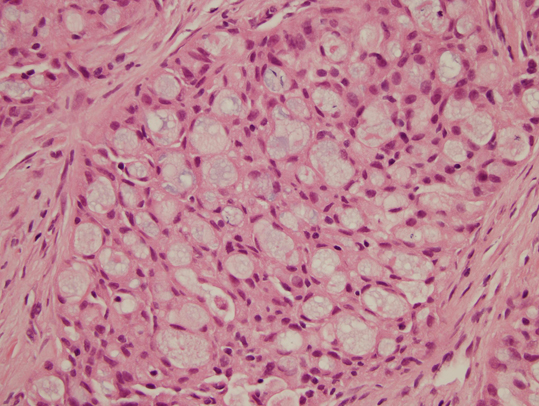
Histology of index secretory breast carcinoma (SBC) case demonstrating well-differentiated but invasive glands containing eosinophilic secretions.
Classification
Note
Considered to be a subtype of infiltrating ductal carcinoma of the breast, but associated with a better prognosis.
Clinics and Pathology
Embryonic origin
Epithelial derived tumors, such as the breast carcinomas, arise from the Ectoderm.
Etiology
Our index case only demonstrated a t(12;15)(p13;q25) by cytogenetics, as seen in congenital fibrosarcoma (CFS) and the cellular variant of congenital mesoblastic nephroma (cCMN). Unlike CFS and cCMN, however, SBC did not show evidence of trisomy 11 which is found in virtually all cases of CFS and cCMN.
Epidemiology
Quite rare, with only a few reported cases.
Treatment
Simple mastectomy and axillary dissection.
Prognosis
The prognosis seems to correlate with age. The younger population has a 100% survival rate at 5-years, whereas the adult population with SBC has a much poorer prognosis on par with infiltrating ductal carcinoma.
Cytogenetics
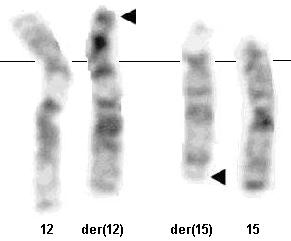
Partial karyogram demonstrating the t(12;15)(p13;q25) in secretory breast carcinoma occurring in a 6-year-old female. Arrowheads show breakpoints at derivative 12p13 and derivative 15q25.
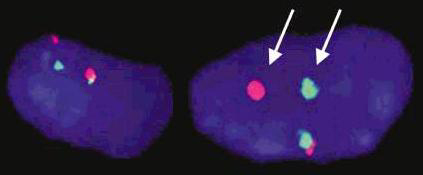
Dual color FISH using ETV6 exon 1-containing cosmid 179A6 (green) and ETV6 exon 8-containing cosmid 148B6. Arrows show separate signals indicating disruption of the ETV6 gene.
Genes Involved and Proteins
Gene name
ETV6 (ets variant 6)
Location
12p13.2
Dna rna description
9 exons; alternate splicing
Protein description
contains a Helix-Loop-Helix and ETS DNA binding domains; wide expression; nuclear localisation;. ETS-related transcription factor
Gene name
NTRK3 (neurotrophic tyrosine kinase, receptor, type 3)
Location
15q25.3
Dna rna description
20 exons, variant transcripts.
Protein description
extra-cellular ligand binding domain, a transmembrane domain, and an intracellular tyrosine kinase domain. Tyrosine kinase cell surface receptor.
Result of the chromosomal anomaly
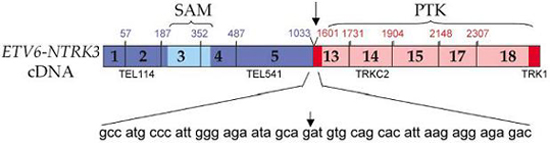
Schematic diagram showing the structure of the ETV6-NTRK3 chimeric cDNA in secretory breast carcinoma. Exons 1-5 of ETV6 (blue boxes) are fused in frame with exons 13-15 and 17-18 of NTRK3 (red boxes). The lighter shade of blue indicates the region encoding the ETV6 sterile-alpha-motif (SAM) domain, while the lighter shade of red indicates the region encoding the NTRK3 protein tyrosine kinase (PTK) domain. Numbers above the exons indicate the last nucleotide of each exon. The fusion point is between ETV6 nucleotide 1033 and NTRK3 nucleotide 1601 (indicated by the vertical arrow) which is identical to that observed in congenital fibrosarcoma. The positions of the TEL114 and TEL541 forward primers and the TRKC2 and TRK1 reverse primers used to characterize ETV6-NTRK3 fusion transcripts are shown under the exons (see text). An expanded view of the ETV6-NTRK3 breakpoint sequence in the index secretory breast carcinoma case is shown below the cDNA schematic. This was derived by sequencing of RT-PCR products using primers TEL-541 and TRKC2. Identical sequences were observed in multiple clones from three separate experiments. The vertical arrow shows the fusion point.

The amino terminus is composed of the first 5 exons from ETV6, which carries the Helix-Loop-Helix Domain (HLH) responsible for dimerization. The remainder of the protein is composed of the Protein Tyrosine Kinase domain from NTRK3. The arrow represents the point at which the ETV6 contribution ends and the NTRK3 contribution begins.
Oncogenesis
Current speculation regarding the oncogenic mechanism of the fusion protein is related to its putative activation of the MAP Kinase pathway with resultant activation of various downstream proteins such as transcription factors. Native NTRK3 requires extracellular ligand binding of Neurotrophin 3 prior to its dimerization and autophosphorylation. ETV6-NTRK3, however, bypasses this requirement as it contains the HLH domain from ETV6 which allows the molecule to dimerize in the absence of Neurotrophin 3 and thus remain in a constitutively activated (phosphorylated) state. Once again, the presence of ETV6-NTRK3 seems to make these particular neoplasms behave more indolent than their aggressive Ductal Carcinoma counterparts, which do not harbor the ETV6-NTRK3 gene fusion.
Article Bibliography
| Pubmed ID | Last Year | Title | Authors |
|---|---|---|---|
| 14691916 | 2003 | Secretory carcinoma of the breast: a distinct variant of invasive ductal carcinoma assessed by comparative genomic hybridization and immunohistochemistry. | Diallo R et al |
| 12450787 | 2002 | ETV6-NTRK3--Trk-ing the primary event in human secretory breast cancer. | Euhus DM et al |
| 15101049 | 2004 | A fluorescence in situ hybridization study of ETV6-NTRK3 fusion gene in secretory breast carcinoma. | Makretsov N et al |
| 14528441 | 2003 | Secretory carcinoma of the breast. | Paeng MH et al |
| 12450792 | 2002 | Expression of the ETV6-NTRK3 gene fusion as a primary event in human secretory breast carcinoma. | Tognon C et al |
Citation
Stevan Knezevich
Breast: Secretory Ductal Carcinoma
Atlas Genet Cytogenet Oncol Haematol. 2004-08-01
Online version: http://atlasgeneticsoncology.org/solid-tumor/5266/breast-secretory-ductal-carcinoma
