Gallbladder: Intrahepatic cholangiocarcinoma
2008-01-01 Munechika Enjoji , Shinichi Aishima Affiliation1.Department of Hepatology, Pancreatology, Kyushu University Hospital, 3-1-1 Maidashi, Higashi-ku, Fukuoka 812-8582, Japan (ME) ; Department of Pathology, Hamanomachi Hospital, 3-5-27 Maizuru, Chuo-ku, Fukuoka 810-8539, Japan (SA)
Summary
Note
Defined as a malignant tumor arising from the intrahepatic bile duct epithelium. Cholangiocarcinoma arising from the right and left hepatic ducts at or near their junction (hilar cholangiocarcinoma) are considered as carcinoma of the extrahepatic bile ducts.
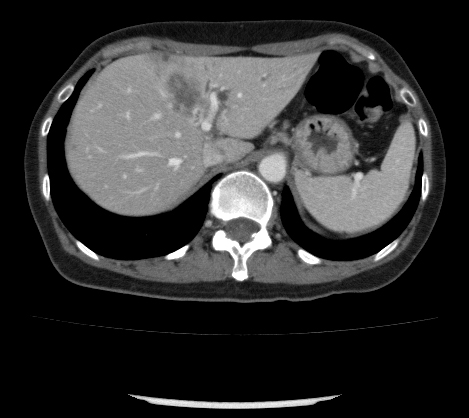
Intrahepatic cholangiocarcinoma, CT image. The quadrate robe contains a mass. Peripheral enhancement of the tumor and peripheral bile duct dilatation are shown.
Classification
Note
Tumor staging is separated by TNM classification.
Classification
TNM classification of tumors of the liver and intrahepatic bile ducts.
Clinics and Pathology
Etiology
Intrahepatic cholangiocarcinoma, unlike hepatocellular carcinoma, is not usually related to liver cirrhosis and is sometimes accompanied by severe fibrosis. This suggests that hepatocellular and cholangiocarcinoma might originate from hepatic precursor cells. Opisthorchis viverrini-induced cholangiocarcinomas are common in Thailand. Liver fluke infection causes chronic inflammation and enhances the susceptibility of bile duct epithelium to carcinogens/free radicals, leading to genetic and epigenetic damage in cells. Increased carcinogenic nitroso-compounds as a result of regional dietary factors are thought to have a synergistic effect on patients with liver fluke infestations. Hepatolithiasis represents a high-risk state for intrahepatic cholangiocarcinoma because of recurrent bacterial infections and bile stasis. Hepatitis C virus (HCV) infection has also been reported as a risk factor for cholangiocarcinoma; however, the relationship between HCV and cholangiocarcinoma formation is not unequivocally established. Patients with primary sclerosing cholangitis have a tendency to develop bile duct carcinoma including intrahepatic cholangiocarcinoma. However, most intrahepatic cholangiocarcinomas arise in the absence of known etiological factors.
Epidemiology
Intrahepatic cholangiocarcinoma is the second most prevalent intrahepatic primary cancer. It occurs in the middle-aged and elderly with no obvious sex differences. Its incidence reveals wide geographic variations: the highest incidence is reported in Southeast Asia especially in Laos and Northeast Thailand, areas suffering from endemic infection with the liver fluke, Opisthorchis viverrini. Hepatolithiasis, another risk-factor, is also more frequently seen in East Asian than in Western countries.
Clinics
The clinical features of intrahepatic cholangiocarcinoma are primarily governed by its anatomical location and growth pattern. Biliary obstructive symptoms are rare. Generally, early stages of intrahepatic cholangiocarcinoma do not produce specific clinical symptoms that are recognized by affected persons, and there is no specific or practical laboratory method for the diagnosis in early stages. Hence, diagnosis of tumors is frequently made when malignancies have progressed to an advanced stage with poor prognosis. In an advanced stage, abdominal pain, fever, general malaise, and weight loss can occur. On ultrasound imaging, there are no specific features for intrahepatic cholangiocarcinomas to distinguish them from other intrahepatic tumors. On magnetic resonance imaging, intrahepatic cholangiocarcinomas appear hypointense on T1-weighted images and hyperintense on T2-weighted images. On computed tomography, typical intrahepatic cholangiocarcinomas present as mass lesions with irregular margins though significant enhancement is not shown in the central portion of the lesion. For staging the disease, computed tomography and magnetic resonance imaging are effective. Percutaneous tumor biopsy is available for qualitative diagnosis but there is the possibility of tumor seeding. As tumor-associated markers, CA19-9, CEA, and CA125 are well studied, and CA19-9 is most useful.
Pathology
The Liver Cancer Study Group of Japan has proposed a classification of intrahepatic cholangiocarcinoma based on macroscopic features; mass-forming, periductal infiltrating, and intraductal, or mixed mass-forming and periductal infiltrating. The histopathological classification of biliary tract carcinoma follows the WHO classification:
adenocarcinoma,
adenosquamous carcinoma,
squamous carcinoma,
cholangiolocellular carcinoma,
mucinous carcinoma,
signet-ring cell carcinoma,
sarcomatous carcinoma,
lymphoepithelioma-like carcinoma,
clear cell variant,
mucoepidermoid carcinosarcoma.
The most common histology of intrahepatic cholangiocarcinoma is that of an adenocarcinoma showing tubular and/or papillary structures with a variable fibrous stroma.
adenocarcinoma,
adenosquamous carcinoma,
squamous carcinoma,
cholangiolocellular carcinoma,
mucinous carcinoma,
signet-ring cell carcinoma,
sarcomatous carcinoma,
lymphoepithelioma-like carcinoma,
clear cell variant,
mucoepidermoid carcinosarcoma.
The most common histology of intrahepatic cholangiocarcinoma is that of an adenocarcinoma showing tubular and/or papillary structures with a variable fibrous stroma.
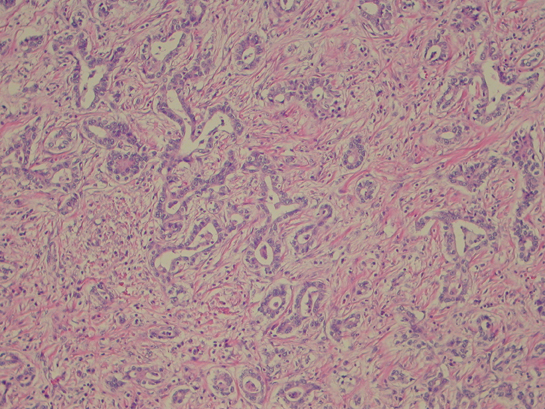
Intrahepatic cholangiocarcinoma. Well differentiated tubular adenocarcinoma.
Treatment
Surgical resection, chemotherapy, radiation therapy, and radiofrequency ablation.
Evolution
Recurrence should be given careful attention.
Prognosis
Surgical resection improves prognosis, but complete removal of cancer at an advanced stage is hardly possible. Chemotherapy, radiotherapy, and immunotherapy show little benefits. Therefore, the prognosis of patients with intrahepatic cholangiocarcinoma remains poor.
Cytogenetics
Note
In intrahepatic cholangiocarcinoma, losses of heterozygosity at chromosomal loci 3p13-p21, 5q35-qter, 8p22, 17p13, and 18q have been reported.
Genes Involved and Proteins
Gene name
KRAS (Kirsten rat sarcoma 2 viral oncogene homolog)
Location
12p12.1
Dna rna description
4 exons
Protein description
Proto-oncogene. GTP-GDP binding protein with GTPase activity. The K-ras proto-oncogene is thought to exert control over some of the mechanisms of cell growth and differentiation. This gene is converted to an active oncogene by point mutations significantly concentrated in codons 12, 13, or 61. The reported rates of K-ras mutations in intrahepatic cholangiocarcinomas vary widely. Variations are caused by racial and geographic variations, the use of different assay techniques; for example, a mutation rate of 50%-56% in Japanese patients versus 0%-8% in Thai patients. It has been reported that mutation rates are higher in periductal and spicular-forming tumors than mass-forming ones.
Gene name
TP53 (Tumour protein p53 (Li-Fraumeni syndrome))
Location
17p13.1
Dna rna description
11 exons
Protein description
Tumor suppressor gene. Wild-type p53 plays an important role in the regulation of the cell cycle process, cell growth, and apoptosis in the event of DNA damage. Inactivation of the p53 gene by missense or nonsense mutations and by loss of chromosome 17p, the chromosomal location of the p53 gene, induces disruption of critical growth-regulating mechanisms and may have a crucial role in carcinogenesis. The reported incidence of p53 mutation is 11-37% in intrahepatic cholangiocarcinomas. It has been reported that loss of chromosome 17p was present in 38% of intrahepatic cholangiocarcinomas.
Gene name
CDKN2A (cyclin dependent kinase 2a / p16)
Location
9p21.3
Dna rna description
3 exons
Protein description
A regulatory protein in the cell cycle and a cyclin-dependent kinase (cdk4/cdk6) inhibitor. The tumor suppressor gene p16 is commonly inactivated in many neoplasms. Three distinct mechanisms of p16 inactivation have been reported in biliary neoplasms: deletion and point mutations of the p16 gene, and hypermethylation of 5 regulatory regions of p16. A study of intrahepatic cholangiocarcinomas reports that no p16 gene mutations are present but alterations of p16 gene are frequent: methylation of CpG island is present in the 5 region of the gene (54%), allelic loss at the p16 locus on chromosome 9p21 (20%), and homozygous deletion (5%). Therefore, the p16 gene may possibly be crucial for intrahepatic biliary carcinogenesis and progression.
Gene name
ERBB2 (v-erb-b2 erythroblastic leukemia viral oncogene homolog 2, neuro/glioblastoma derived oncogene homolog (avian))
Location
17q12
Dna rna description
7 exons
Protein description
Proto-oncogene, a member of the family of tyrosine kinase growth factor receptors (epidermal growth factor receptor subfamily). Amplification and overexpression of c-erbB-2 are frequently seen in cancers of the biliary tract. It has been reported that, a high incidence of cholangiocarcinomas (intrahepatic and extrahepatic) and gallbladder cancers develop in transgenic mice overexpressing ErbB-2. Reported values of the frequency of tumors overexpressing ErbB-2 varies from 0% to 73%.
Gene name
EGFR (epidermal growth factor receptor)
Location
7p11.2
Dna rna description
14 exons
Protein description
Proto-oncogene; type I tyrosine kinase receptors. ErbB-1 can bind EGF and TGF-a. ErbB-1 and ErbB-2 share approximately 40% homology in their extracellular binding domains. It has been reported in intrahepatic cholangiocarcinoma that 44 % of cases are ErbB-1-positive cases and that ErbB-1 expression is correlated with grade and proliferative index.
Article Bibliography
| Pubmed ID | Last Year | Title | Authors |
|---|---|---|---|
| 12846405 | 2003 | Investigation of ErbB1 and ErbB2 expression for therapeutic targeting in primary liver tumours. | Altimari A et al |
| 17625428 | 2007 | Risk factors for cholangiocarcinoma. | Ben-Menachem T et al |
| 7645925 | 1995 | Significance of c-erbB-2 expression in normal and neoplastic epithelium of biliary tract. | Chow NH et al |
| 1380026 | 1992 | c-erbB-2 oncogene expression in hepatocellular carcinoma and cholangiocarcinoma. | Collier JD et al |
| 11260864 | 2001 | Multiple genetic alterations involved in the tumorigenesis of human cholangiocarcinoma: a molecular genetic and clinicopathological study. | Cong WM et al |
| 8388228 | 1993 | Loss of constitutional heterozygosity on chromosomes 5 and 17 in cholangiocarcinoma. | Ding SF et al |
| 8194013 | 1994 | K-ras codon 12 mutations in biliary tract tumors detected by polymerase chain reaction denaturing gradient gel electrophoresis. | Imai M et al |
| 11261824 | 2001 | Expression and clinical significance of the erbB family in intrahepatic cholangiocellular carcinoma. | Ito Y et al |
| 10212000 | 1999 | Mutation of p53 and K-ras, and loss of heterozygosity of APC in intrahepatic cholangiocarcinoma. | Kang YK et al |
| 11004673 | 2000 | Allelic loss in human intrahepatic cholangiocarcinoma: correlation between chromosome 8p22 and tumor progression. | Kawaki J et al |
| 8280380 | 1993 | Mutations of the p53 tumor suppressor gene and the ras gene family in intrahepatic cholangiocellular carcinomas in Japan and Thailand. | Kiba T et al |
| 16365819 | 2005 | Hepatolithiasis and intrahepatic cholangiocarcinoma: carcinogenesis based on molecular mechanisms. | Kuroki T et al |
| 1675933 | 1991 | Multiple K-ras codon 12 mutations in cholangiocarcinomas demonstrated with a sensitive polymerase chain reaction technique. | Levi S et al |
| 16629933 | 2006 | Review article: the modern diagnosis and therapy of cholangiocarcinoma. | Malhi H et al |
| 15892172 | 2005 | Amplification and overexpression of c-erbB-2, epidermal growth factor receptor, and c-met in biliary tract cancers. | Nakazawa K et al |
| 7557145 | 1995 | Ki-ras mutations and p53 protein expressions in intrahepatic cholangiocarcinomas: relation to gross tumor morphology. | Ohashi K et al |
| 16397610 | 2006 | Cholangiocarcinoma. | Patel T et al |
| 12607585 | 2002 | Cellular and molecular biology of biliary tract cancers. | Rashid A et al |
| 9864969 | 1998 | Prognostic significance of Ki-67 and p53 antigen expression in carcinomas of bile duct and gallbladder. | Shrestha ML et al |
| 16951395 | 2006 | What is the current state-of-the-art imaging for detection and staging of cholangiocarcinoma? | Slattery JM et al |
| 10982615 | 2000 | Comparative clinicopathological study of resected intrahepatic cholangiocarcinoma in northeast Thailand and Japan. | Suzuki H et al |
| 1739910 | 1992 | High incidence of ras gene mutation in intrahepatic cholangiocarcinoma. | Tada M et al |
| 11034592 | 2000 | Frequency of p16(INK4A) alterations and K-ras mutations in intrahepatic cholangiocarcinoma of the liver. | Tannapfel A et al |
| 9822921 | 1998 | c-erbB-2 protein is expressed in hepatolithiasis and cholangiocarcinoma. | Terada T et al |
| 16858537 | 2006 | Role of epigenetic alterations in cholangiocarcinoma. | Tischoff I et al |
| 1336666 | 1992 | Cholangiocarcinomas in Japanese and Thai patients: difference in etiology and incidence of point mutation of the c-Ki-ras proto-oncogene. | Tsuda H et al |
| 2574140 | 1989 | Oncogene expression in cholangiocarcinoma and in normal hepatic development. | Voravud N et al |
| 7926462 | 1994 | Point mutation of K-ras gene codon 12 in biliary tract tumors. | Watanabe M et al |
| 7796400 | 1995 | Mutations of p16Ink4/CDKN2 and p15Ink4B/MTS2 genes in biliary tract cancers. | Yoshida S et al |
Citation
Munechika Enjoji ; Shinichi Aishima
Gallbladder: Intrahepatic cholangiocarcinoma
Atlas Genet Cytogenet Oncol Haematol. 2008-01-01
Online version: http://atlasgeneticsoncology.org/solid-tumor/5330/gallbladder-intrahepatic-cholangiocarcinoma
