t(8;14)(q24;q32) IGH/MYC
t(2;8)(p12;q24) IGK/MYC
t(8;22)(q24;q11) IGL/MYC
2016-05-01 Eva van den Berg , Eva van den Berg
Affiliation
1.Department of Genetics, University Medical Centre Groningen, Groningen; Department of Human Genetics, Radboud university medical center, Nijmegen, The Netherlands [email protected]; [email protected]
Clinics and Pathology
Disease
Described both in B-cell acute lymphoblastic leukemia (ALL) and in non-Hodgkin lymphomas (NHL), especially in Burkitt lymphoma , and double-hit diffuse large B-cell lymphomas (DLBCL).
Phenotype stem cell origin
The postulated normal counterpart is the germinal centre or post-germinal centre B-cell.
Epidemiology
Most Burkitt lymphoma cases show the t(8;14)(q24;q32) [MYC-IGH] and less commonly the t(8;22)(q24;q11) or t(2;8)(p12;q24). The translocation is present in both the endemic African Burkitt lymphoma and in the non endemic tumor type (Europe, America, and Japan). In case the Burkitt lymphoma infiltrated the bone marrow (leukemic phase) the MYC-translocation can be demonstrated in the bone marrow or blood as well. If no immunophenotyping results are available, it is good practice to exclude a BCL2 rearrangement because a t(8;14) can be observed in other B cell neoplasms (such as double hit DLBCL see below).
Some DLBCL (double-hit) cases contain the t(8;14) translocation. In some clinical studies patients with DLBCL and MYC rearrangement will receive more aggressive treatment.
The disease defines the prognosis. Given the correct treatment regime Burkitt lymphoma patients do well, while the outcome in double-hit DLBCL patient is totally different.
Some DLBCL (double-hit) cases contain the t(8;14) translocation. In some clinical studies patients with DLBCL and MYC rearrangement will receive more aggressive treatment.
The disease defines the prognosis. Given the correct treatment regime Burkitt lymphoma patients do well, while the outcome in double-hit DLBCL patient is totally different.
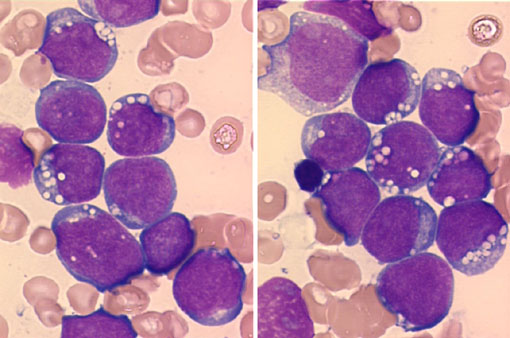
Bone marrow sample: the medium-sized cells show a diffuse monotonous pattern of infiltration. The nuclei are round, cytoplasm deeply basophilic and usually contain vacuoles. The morphological feature in this bone marrow smear (Giemsa), quite similar to tumor cells as seen in tissue imprints, is highly characteristic of Burkitt lymphoma - Text and iconography Courtesy Georges Flandrin 2005.
Cytology
ALL : L3 morphology according to the FAB classification, very occasionally L1 or L2 cytology reported.
Cytogenetics
Cytogenetics morphological
t(8;14) is described in 75-85% of the cases, t(2;8) in 5%, and t(8 ;22) in the remaining 10%; high-quality metaphases are required to detect t(8;14) and t(8;22).
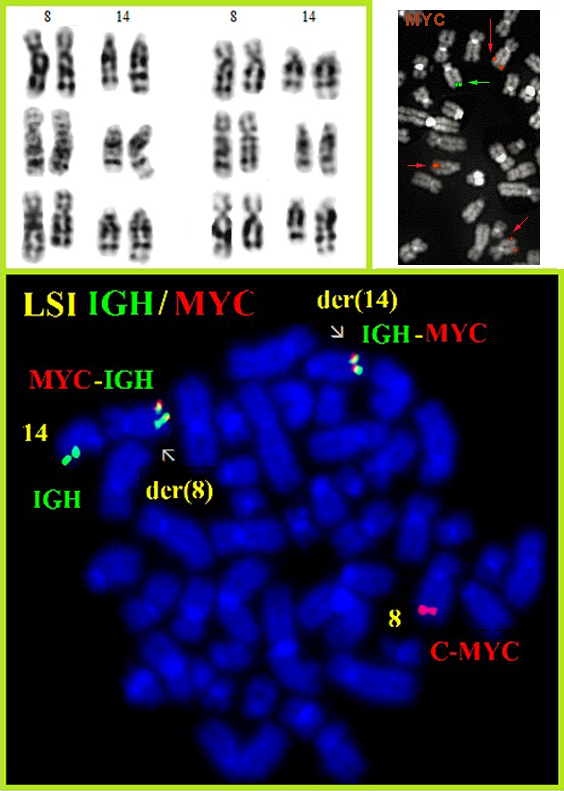
t(8;14)(q24;q32) IGH/MYC G-banding and Hybridization with Vysis LSI IGH/MYC dual color probe (Abbott Molecular, US) showing fused yellow signals on der(8) and der(14) chromosomes - Courtesy Adriana Zamecnikova. Top right: The figure illustrates the translocation of the MYC gene (probe 944B18, red) to 14q32.3 - Courtesy Mariano Rocchi, Resources for Molecular Cytogenetics.
Additional anomalies
Reported in 70% cases in Burkitt lymphoma and DLBCL, especially: t(14;18)(q32;q21) in double-hit DLBCL lymphomas, structural rearrangements of the long arm of chromosome 1 (30% cases) resulting in a partial trisomy 1q, rearrangements of 13q34 (15% cases).
Variants
t(2;8)(p12;q24) and t(8;22)(q24;q11) are variants of the t(8;14)(q24;q32); three-way rearrangements and translocations of submicroscopic chromosome fragments have also been described.
Genes Involved and Proteins
Note
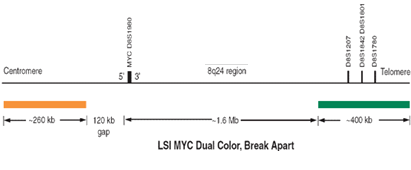
On the molecular point of view, in all these three translocations, the gene MYC is juxtaposed either with the immunoglobulin heavy chain locus IGH (14q32), the kappa light-chain locus IGK (2p12), or the lambda light-chain locus IGL (22q11); all these translocations share a breakpoint in 8q24 (MYC locus). The MYC breakpoints are diverse and distributed over a 2Mb region. Therefore it has to be noted that not all MYC-rearrangements can be detected by FISH.
Gene name
MYC v-myc myelocytomatosis viral oncogene homolog (avian)
Location
8q24.21
Dna rna description
Protein description
Myc protein is a transcription factor of the helix-loop-helix/leucine zipper family that activates transcription as obligate heterodimer with a partner protein, MAX.
Gene name
IGH (Immunoglobulin Heavy)
Location
14q32.33
Result of the Chromosomal Anomaly
Note
No hybrid transcript. The translocation leads to the MYC gene under direct regulation of the enhancer of the IGH (or IGK/IGL genes), thereby causing high level transcription of the MYC gene .
Description
MYC is translocated to der(14) in the t(8;14), whereas it remains on der(8) in the variant translocations; t(8;14) leads to a head-to-head fusion of MYC with the heavy chain immunogloulin locus : 8q24 is close to the 5 extremity of MYC exon 2, leading the all translated gene region to 14q32; the 8q24 breakpoint region is variable, scattered over a 190 Kb region, 5 far from MYC or within MYC; the 14q32 breakpoint region is mainly located in the constant region, very close within the switch or joining regions; MYC juxtaposed to the immunoglobin constant regions and enhancer is overexpressed, shutting down the normal remaining MYC; in both t(2;8) and t(8;22), the breakpoint is in 3 of or distal to the MYC gene which always remains on der(8); the rearrangement with respectively IGK or IGL and MYC is head-to-tail.
Note
The protein MYC resulting from the translation of the second and third exons, through DNA- binding properties, plays a role in regulating cell growth and differentiation.
Oncogenesis
Constitutive expression of MYC induces proliferation even in the absence of growth factors
Highly cited references
| Pubmed ID | Year | Title | Citations |
|---|---|---|---|
| 29132323 | 2017 | Integrative microRNA and mRNA deep-sequencing expression profiling in endemic Burkitt lymphoma. | 87 |
| 37746254 | 2023 | Clinicopathological analysis of diffuse large B-cell lymphoma using molecular biomarkers: a retrospective analysis from 7 Hungarian centers. | 74 |
| 37555980 | 2023 | Emerging entities: high-grade/large B-cell lymphoma with 11q aberration, large B-cell lymphoma with IRF4 rearrangement, and new molecular subgroups in large B-cell lymphomas. A report of the 2022 EA4HP/SH lymphoma workshop. | 68 |
| 34521752 | 2021 | DNA damage-induced phosphorylation of CtIP at a conserved ATM/ATR site T855 promotes lymphomagenesis in mice. | 65 |
| 31221783 | 2020 | Microhomology-mediated end joining drives complex rearrangements and overexpression of MYC and PVT1 in multiple myeloma. | 54 |
| 25482199 | 2014 | Nucleolar tethering mediates pairing between the IgH and Myc loci. | 53 |
| 30349647 | 2018 | 3'Igh enhancers hs3b/hs4 are dispensable for Myc deregulation in mouse plasmacytomas with T(12;15) translocations. | 50 |
| 35563017 | 2022 | Enhancer RNA AL928768.3 from the IGH Locus Regulates MYC Expression and Controls the Proliferation and Chemoresistance of Burkitt Lymphoma Cells with IGH/MYC Translocation. | 49 |
| 29903764 | 2018 | Inferior survival in high-grade B-cell lymphoma with MYC and BCL2 and/or BCL6 rearrangements is not associated with MYC/IG gene rearrangements. | 44 |
| 17639584 | 2007 | In a model of immunoglobulin heavy-chain (IGH)/MYC translocation, the Igh 3' regulatory region induces MYC expression at the immature stage of B cell development. | 41 |
| 15988016 | 2005 | Sites that direct nuclear compartmentalization are near the 5' end of the mouse immunoglobulin heavy-chain locus. | 40 |
| 16354839 | 2005 | Molecular signatures in childhood acute leukemia and their correlations to expression patterns in normal hematopoietic subpopulations. | 39 |
| 23775715 | 2013 | A capture-sequencing strategy identifies IRF8, EBF1, and APRIL as novel IGH fusion partners in B-cell lymphoma. | 37 |
| 38538317 | 2024 | Diverse B-cell tumors associated with t(14;19)(q32;q13)/IGH::BCL3 identified by G-banding and fluorescence in situ hybridization. | 35 |
| 27566574 | 2016 | Differential IgM expression distinguishes two types of pediatric Burkitt lymphoma in mouse and human. | 32 |
| 20453890 | 2010 | Genetic reporter system for oncogenic Igh-Myc translocations in mice. | 31 |
| 22726497 | 2012 | Sporadic Burkitt lymphomas of children and adolescents in Chinese: a clinicopathological study of 43 cases. | 31 |
| 27217970 | 2016 | Validation of break-apart and fusion MYC probes using a digital fluorescence in situ hybridization capture and imaging system. | 30 |
| 22915650 | 2012 | IgH partner breakpoint sequences provide evidence that AID initiates t(11;14) and t(8;14) chromosomal breaks in mantle cell and Burkitt lymphomas. | 30 |
| 29112016 | 2018 | B Lymphoblastic Leukemia/Lymphoma With Burkitt-like Morphology and IGH/MYC Rearrangement: Report of 3 Cases in Adult Patients. | 29 |
| 38468555 | 2024 | Childhood and Adolescent Relapsed/Refractory Aggressive B-Cell Lymphomas With t(8;14) and BCL2 Expression, Burkitt Lymphoma Versus Diffuse Large B-Cell Lymphoma: A Diagnostic Challenge. | 26 |
| 28634224 | 2017 | IGH/MYC Translocation Associates with BRCA2 Deficiency and Synthetic Lethality to PARP1 Inhibitors. | 20 |
| 33381329 | 2020 | Double-Hit Primary Plasma Cell Leukemia with IGH/MYC and IGH/CCND1 Translocations. | 20 |
| 27512341 | 2016 | Concomitant Classic Hodgkin Lymphoma of Lymph Node and cMYC-Positive Burkitt Leukemia/Lymphoma of the Bone Marrow Presented Concurrently at the Time of Presentation: A Rare Combination of Discordant Lymphomas. | 20 |
| 31872861 | 2020 | Comparison Between Integrated Genomic DNA/RNA Profiling and Fluorescence In Situ Hybridization in the Detection of MYC, BCL-2, and BCL-6 Gene Rearrangements in Large B-Cell Lymphomas. | 19 |
| 35024332 | 2022 | Anaplastic multiple myeloma with MYC rearrangement. | 18 |
| 38909266 | 2024 | Transformation of t(14;18)-negative follicular lymphoma to plasmablastic lymphoma: a case report with analysis of genetic evolution. | 17 |
| 19454496 | 2009 | Identification of the gene encoding cyclin E1 (CCNE1) as a novel IGH translocation partner in t(14;19)(q32;q12) in diffuse large B-cell lymphoma. | 17 |
| 23049564 | 2012 | Burkitt lymphoma presenting as unilateral deafness in an immunocompetent patient. | 16 |
| 34472720 | 2022 | Genetic features of precursor B-cell phenotype Burkitt leukemia with IGH-MYC rearrangement. | 15 |
| 25381133 | 2015 | A rare case of IGH/MYC and IGH/BCL2 double hit primary plasma cell leukemia. | 14 |
| 34868769 | 2021 | Adult Nodal Burkitt Lymphoma Forming Nodular Architectures. | 14 |
| 31160360 | 2019 | Elucidating a false-negative MYC break-apart fluorescence in situ hybridization probe study by next-generation sequencing in a patient with high-grade B-cell lymphoma with IGH/MYC and IGH/BCL2 rearrangements. | 13 |
| 33339535 | 2020 | Double-hit lymphoma of the male breast: a case report. | 13 |
| 22389885 | 2012 | A case of B-cell lymphoma, unclassifiable, with features intermediate between diffuse large B-cell lymphoma and Burkitt lymphoma in a Korean child. | 13 |
| 36171838 | 2022 | Burkitt Lymphoma of the Appendix Presenting With Acute Appendicitis and Acute Kidney Injury: A Case Report and Review of Literature. | 12 |
| 30012920 | 2018 | Transformation of double-hit follicular lymphoma to plasmablastic lymphoma: a partial role of MYC gene rearrangement. | 11 |
| 38175445 | 2023 | B-lymphoblastic leukemia/lymphoma with MYC and BCL2 gene rearrangements shows evidence for clonal evolution and mitotic recombination. | 10 |
| 39662784 | 2024 | Burkitt lymphoma. | 0 |
| 38722741 | 2024 | Identification of WNK1 as a therapeutic target to suppress IgH/MYC expression in multiple myeloma. | 0 |
| 37485649 | 2023 | Unexpected MYC::DMD translocation after transformation of follicular lymphoma with IGH::BCL2 and IGH::MYC. | 0 |
| 31695002 | 2019 | [Aggressive B-cell lymphoma with IGH/MYC, IGH/BCL2, and IGH/CCND1 translocations]. | 0 |
| 35766067 | 2022 | Looking for the truth: an IGH-MYC+ lymphoid neoplasm with immature B-cell phenotype (CD34 positivity) successfully treated with Burkitt lymphoma protocol. | 0 |
| 23307601 | 2013 | Double-hit myeloma with IGH/MYC and IGH/CCND1 translocations. | 0 |
| 15852472 | 2005 | Amplification of IGH/MYC fusion in clinically aggressive IGH/BCL2-positive germinal center B-cell lymphomas. | 0 |
| 1906344 | 1991 | Transcriptional deregulation of myc in IgH/myc 6;7 translocation carrying rat immunocytomas. | 0 |
| 16815105 | 2006 | Myc translocations in B cell and plasma cell neoplasms. | 0 |
| 8314330 | 1994 | Three exceptional IgH/myc-translocation-carrying rat immunocytomas have breakpoints 50 to 80 kb 5' of c-myc. | 0 |
| 31705772 | 2020 | Molecular characteristics of terminal deoxynucleotidyl transferase negative precursor B-cell phenotype Burkitt leukemia with IGH-MYC rearrangement. | 0 |
| 16140930 | 2005 | Insertion of Myc into Igh accelerates peritoneal plasmacytomas in mice. | 0 |
| 37186259 | 2023 | Transformations of marginal zone lymphomas and lymphoplasmacytic lymphomas: Report from the 2021 SH/EAHP Workshop. | 0 |
| 31172191 | 2019 | Histiocytic Sarcoma Following B-Lymphoblastic Leukemia/Lymphoma. | 0 |
| 23795946 | 2013 | MYC status determination in aggressive B-cell lymphoma: the impact of FISH probe selection. | 0 |
| 38175404 | 2023 | "Quadruple-hit" primary testicular diffuse large B-cell lymphoma with MYD88 L265P mutation, IGH::MYC, and IRF4- and BCL6-rearrangements. | 0 |
| 9290947 | 1997 | Immunoglobulin/Myc recombinations in murine Peyer's patch follicles. | 0 |
| 31831719 | 2019 | Molecular Cytogenetic Characterization of a Three-way t(8;14;22)(q24;q32;q11.2) with Involvement of MYC/IGH/IGL in a Case of a Diffuse Large B-cell Lymphoma (DLBCL). | 0 |
| 38569857 | 2024 | [Multiple myeloma with IgH::MYC and multiple extramedullary lesions]. | 0 |
| 24118498 | 2014 | MYC translocation partner gene determines survival of patients with large B-cell lymphoma with MYC- or double-hit MYC/BCL2 translocations. | 0 |
| 37094546 | 2023 | Comprehensive FISH testing using FFPE tissue microarray of primary lymph node tissue identifies secondary cytogenetic abnormalities in Mantle Cell Lymphoma. | 0 |
| 16888615 | 2006 | Novel FISH probes designed to detect IGK-MYC and IGL-MYC rearrangements in B-cell lineage malignancy identify a new breakpoint cluster region designated BVR2. | 0 |
| 2645221 | 1989 | Reversion of tumorigenicity and decreased agarose clonability after EBV conversion of an IgH/myc translocation-carrying BL line. | 0 |
| 20303018 | 2010 | Detection of cryptic and variant IGH-MYC rearrangements in high-grade non-Hodgkin's lymphoma by fluorescence in situ hybridization: implications for cytogenetic testing. | 0 |
| 26373676 | 2015 | MYC-IG rearrangements are negative predictors of survival in DLBCL patients treated with immunochemotherapy: a GELA/LYSA study. | 0 |
| 12481006 | 2002 | Mantle cell lymphoma with 8q24 chromosomal abnormalities: a report of 5 cases with blastoid features. | 0 |
| 38032739 | 2024 | How Many Tests Does It Take to Diagnose a Triple-Hit B-Lymphoblastic Lymphoma? (Hint, It's A Lot). | 0 |
| 15191563 | 2004 | Molecular cytogenetic analysis of chromosomal breakpoints in the IGH, MYC, BCL6, and MALT1 gene loci in primary cutaneous B-cell lymphomas. | 0 |
| 30983044 | 2019 | The accuracy of diagnosing Burkitt lymphoma in serous effusion specimen: A cytological-histological correlation with ancillary studies. | 0 |
| 18648000 | 2008 | Genetic and environmental cofactors of Myc translocations in plasma cell tumor development in mice. | 0 |
| 29629947 | 2019 | Identification of "Double Hit" Lymphomas Using Updated WHO Criteria: Insights From Routine MYC Immunohistochemistry in 272 Consecutive Cases of Aggressive B-Cell Lymphomas. | 0 |
| 37906138 | 2023 | [Genetic analysis of two cases with MYC "negative" Burkitt lymphoma]. | 0 |
| 24668946 | 2014 | Conventional and molecular cytogenetic characterization of Burkitt lymphoma with bone marrow involvement in Brazilian children and adolescents. | 0 |
| 16327438 | 2005 | Adult B-cell lymphomas with burkitt-like morphology are phenotypically and genotypically heterogeneous with aggressive clinical behavior. | 0 |
| 24336156 | 2014 | Rearrangements of MYC gene facilitate risk stratification in diffuse large B-cell lymphoma patients treated with rituximab-CHOP. | 0 |
| 36881639 | 2023 | Integrated Genomic DNA/RNA Profiling vs Fluorescence in Situ Hybridization in the Detection of MYC and BCL2 (and BCL6) Rearrangements in Large B-Cell Lymphomas: Updates Amid the New WHO Classification of Lymphoid Neoplasms. | 0 |
| 20799767 | 2010 | Primary bilateral Burkitt lymphoma of the lactating breast: a case report and review of the literature. | 0 |
| 25536568 | 2014 | MYC gene rearrangements detected by interphase fluorescence in situ hybridization in diffuse large B-cell lymphomas. | 0 |
| 15751044 | 2005 | Extraosseous IL-6 transgenic mouse plasmacytoma sometimes lacks Myc-activating chromosomal translocation. | 0 |
| 28388279 | 2017 | Investigation of AID, Dicer, and Drosha Expressions in Patients with Chronic Lymphocytic Leukemia. | 0 |
| 28515100 | 2017 | Detection of Chromosomal Translocation in Hematologic Malignancies by a Novel DNA-Based Looped Ligation Assay (LOLA). | 0 |
| 19336959 | 2009 | CD20-negative CD138-positive leukemic large cell lymphoma with plasmablastic differentiation with an IgH/MYC translocation in an HIV-positive patient. | 0 |
| 38522075 | 2024 | High-grade B-cell lymphoma with a quadruple-hit genetic profile including concurrent MYC, BCL2, BCL6, and CCND1 gene rearrangements. | 0 |
| 9865713 | 1998 | High incidence of translocations t(11;14)(q13;q32) and t(4;14)(p16;q32) in patients with plasma cell malignancies. | 0 |
| 21319257 | 2011 | Identification of IGHCδ-BACH2 fusion transcripts resulting from cryptic chromosomal rearrangements of 14q32 with 6q15 in aggressive B-cell lymphoma/leukemia. | 0 |
| 17405744 | 2007 | AIDS-related plasmablastic lymphoma of the oral cavity associated with an IGH/MYC translocation--treatment with autologous stem-cell transplantation in a patient with severe haemophilia-A. | 0 |
| 12139745 | 2002 | Philadelphia chromosome-positive mature B-cell (Burkitt cell) leukaemia. | 0 |
| 21215097 | 2010 | [Molecular genetic features of sporadic Burkitt's lymphoma in children]. | 0 |
| 25948177 | 2015 | [Cytogenetic characteristics of 163 children with acute lymphoblastic leukemia]. | 0 |
| 30963474 | 2019 | Double-hit pancreatic B-lymphoblastic lymphoma with a variant translocation t(2;18)(p11;q21). | 0 |
| 19653714 | 2009 | Chromosomal 3 and 8 status within hepatic metastasis of uveal melanoma. | 0 |
| 29882166 | 2018 | Co-fuse: a new class discovery analysis tool to identify and prioritize recurrent fusion genes from RNA-sequencing data. | 0 |
| 15843827 | 2005 | Gene expression profiling of leukemic cell lines reveals conserved molecular signatures among subtypes with specific genetic aberrations. | 0 |
| 11722412 | 2001 | Blastic mantle cell lymphoma associated with Burkitt-type translocation and hypodiploidy. | 0 |
| 16616107 | 2006 | Burkitt t(8;14)(q24;q32) and cryptic deletion in a CLL patient: report of a case and review of literature. | 0 |
| 26549090 | 2015 | Primary Burkitt's lymphoma of the breast without Epstein-Barr virus infection: A case report and literature review. | 0 |
| 22958176 | 2012 | Plasmablastic lymphoma of the elderly: a clinicopathological comparison with age-related Epstein-Barr virus-associated B cell lymphoproliferative disorder. | 0 |
| 21080889 | 2010 | A case of plasmablastic lymphoma harbouring an IgH/MYC translocation in a HIV negative individual. | 0 |
| 22018272 | 2011 | A novel five-way translocation, t(3;9;13;8;14)(q27;p13;q32;q24;q32), with concurrent MYC and BCL6 rearrangements in a primary bone marrow B-cell lymphoma. | 0 |
| 21120644 | 2010 | Modified cyclophosphamide, vincristine, doxorubicin, and methotrexate (CODOX-M)/ifosfamide, etoposide, and cytarabine (IVAC) therapy with or without rituximab in Japanese adult patients with Burkitt lymphoma (BL) and B cell lymphoma, unclassifiable, with features intermediate between diffuse large B cell lymphoma and BL. | 0 |
| 15291367 | 2004 | Burkitt's lymphoma of the stomach: a case report with molecular cytogenetic analysis. | 0 |
| 40020210 | 2025 | Challenging Conventional Diagnostic Methods by Comprehensive Molecular Diagnostics: A Nationwide Prospective Comparison in Children With ALL. | 0 |
Article Bibliography
| Pubmed ID | Last Year | Title | Authors |
|---|---|---|---|
| 10577857 | 1999 | World Health Organization classification of neoplastic diseases of the hematopoietic and lymphoid tissues: report of the Clinical Advisory Committee meeting-Airlie House, Virginia, November 1997. | Harris NL et al |
| 11054444 | 2000 | Molecular biology of Burkitt's lymphoma. | Hecht JL et al |
| 1869243 | 1991 | Chromosomal abnormalities in adult non-endemic Burkitt's lymphoma and leukemia: 22 new reports and a review of 148 cases from the literature. | Kornblau SM et al |
| 7523607 | 1994 | Diffuse small noncleaved-cell, non-Burkitt's lymphoma in adults: a high-grade lymphoma responsive to ProMACE-based combination chemotherapy. | Longo DL et al |
| 10556197 | 1999 | Clinicopathogenetic significance of chromosomal abnormalities in patients with blastic peripheral B-cell lymphoma. Kiel-Wien-Lymphoma Study Group. | Schlegelberger B et al |
Summary
Fusion gene
IGH/MYC
Fusion gene
IGK/MYC
Fusion gene
IGL/MYC
Note
The 3 translocations are variants of each other, and they share the same clinical significance.
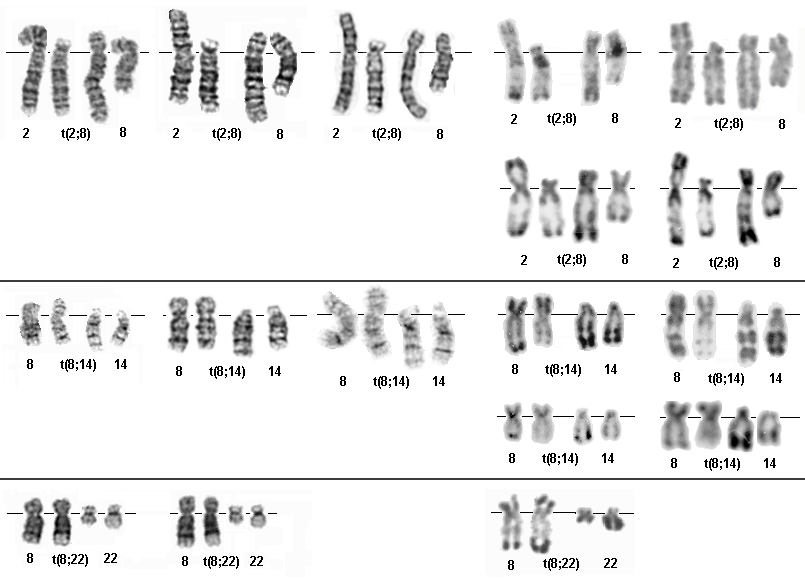
Top row: t(2;8)(p12;q24) G- banding - Courtesy Diane H.Norback, Eric B. Johnson, Sara Morrison-Delap; R- banding - (middle right) Courtesy Jean-Luc Lai; (right) Courtesy Hossein Mossafa; below: Courtesy Roland Berger. Middle rows: t(8;14)(q24;q32) G- banding - (left, middle left, center) Courtesy Diane H. Norback, Eric B. Johnson, Sara Morrison-Delap; R- banding - middle right Courtesy Jean-Luc Lai; right: Jean Loup Huret; below: Courtesy Roland Berger. Lower row: t(8;22)(q24;q11) G- banding (left and center) - Courtesy Diane H. Norback, Eric B.Johnson, Sara Morrison-Delap UW Cytogenetic Services; R- banding - (right) Courtesy Jacques Boyer.
Citation
Eva van den Berg ; Eva van den Berg
t(8;14)(q24;q32) IGH/MYC
t(2;8)(p12;q24) IGK/MYC
t(8;22)(q24;q11) IGL/MYC
Atlas Genet Cytogenet Oncol Haematol. 2016-05-01
Online version: http://atlasgeneticsoncology.org/haematological/1050/t(8;14)(q24;q32)-igh-myc-br-t(2;8)(p12;q24)-igk-myc-br-t(8;22)(q24;q11)-igl-myc
Historical Card
1999-02-01 t(8;14)(q24;q32) IGH/MYC
t(2;8)(p12;q24) IGK/MYC
t(8;22)(q24;q11) IGL/MYC by Chrystele Bilhou-Nabera
Affiliation
