t(14;18)(q32;q21) IGH/BCL2
t(2;18)(p11;q21) IGK/BCL2
t(18;22)(q21;q11) IGL/BCL2
1998-05-01 Jean-Loup Huret
Affiliation
1.Genetics, Dept Medical Information, University of Poitiers, CHU Poitiers Hospital, F-86021 Poitiers, France
Clinics and Pathology
Disease
B- cell NHL mainly; may (rarely) be found in ALL or in chronic lymphoproliferative diseases
Phenotype stem cell origin
B lymphocyte; the translocation occurs at the pre B cell stage
Epidemiology
found in 80 to 90 % of follicular lymphomas, 30% of diffuse large cell lymphomas (sometimes with prior follicular type), rarely in other lymphoproliferative disorders
Prognosis
small cleaved cell follicular lymphomas have a slow evolutivity and a median survival of 10 yrs or more; large cell lymphomas have a worse prognosis; the t(14;18) may have little or no prognostic significance, which would be in accordance with its oncogenic role (see below)
Cytogenetics
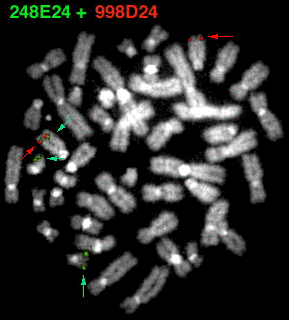
BAC248E24 (BCL2, 18q21, green) cohybridized with PAC PAC 998D24 (14q32.3, red, centromeric to the breakpoint) - Courtesy Mariano Rocchi, Resources for Molecular Cytogenetics
Cytogenetics morphological
the t(14;18) is well recognized with G-banding, may be overlocked with R-banding; the t(2;18)( p11;q21) and the t(18;22(q21;q11) are rare variants
Additional anomalies
Genes Involved and Proteins
Gene name
IGH (Immunoglobulin Heavy)
Location
14q32.33
Dna rna description
IGH is composed of IGHV genes, IGHD segments, IGHJ segments, and IGHC genes.
Protein description
IGH encodes the immunoglobulin heavy chains. They result from the DNA rearrangement (with deletion of the intermediary DNA) of IGHV, IGHD and IGHJ; an additional DNA rearrangement (switch) with constant genes IGHM --> IGHG, IGHA and IGHE can occur.
Gene name
BCL2 (B-cell leukemia/lymphoma 2)
Location
18q21.33
Dna rna description
3 exons; 2 alternative transcripts (a and b)
Result of the Chromosomal Anomaly
Description
5 BCL2 translocated on chromosome 14 near JH (junctions genes of IgH) and C in 3; the breakpoint in BCL2 is either in the 3 untranslated region of exon 3 (major breakpoint region (MBR) in 70% of cases) or more distal, in 3 of exon 3 (minor cluster region (MCR) in the remaining 30%); illegitimate recombinationno fusion protein, but promoter exchange; the immunoglobulin gene enhancer stimulates the expression of BCL2
Oncogenesis
as BCL2 is an apoptosis inhibitor, cell death is delayed, and there is cell accumulation more than real transformation (clones of long living B-cells with t(14;18) may even be seen in the normal population, and with frequency increasing with age)
Highly cited references
| Pubmed ID | Year | Title | Citations |
|---|---|---|---|
| 36765742 | 2023 | Follicular Lymphoma in the 5th Edition of the WHO-Classification of Haematolymphoid Neoplasms-Updated Classification and New Biological Data. | 101 |
| 32202535 | 2020 | The broad landscape of follicular lymphoma: Part II. | 81 |
| 37333831 | 2023 | Whole-genome informed circulating tumor DNA analysis by multiplex digital PCR for disease monitoring in B-cell lymphomas: a proof-of-concept study. | 76 |
| 37746254 | 2023 | Clinicopathological analysis of diffuse large B-cell lymphoma using molecular biomarkers: a retrospective analysis from 7 Hungarian centers. | 74 |
| 18830125 | 2009 | Follicular lymphoma of the thyroid gland. | 73 |
| 32031179 | 2020 | The broad landscape of follicular lymphoma: Part I. | 69 |
| 35030632 | 2022 | Distinct clinical and genetic features of hepatitis B virus-associated follicular lymphoma in Chinese patients. | 66 |
| 21497287 | 2011 | Demonstration of array-based analysis for highly multiplexed PCR assays application to detection of IGH@-BCL2 translocations in FFPE follicular lymphoma specimens. | 61 |
| 20118770 | 2010 | B-cell lymphomas with concurrent IGH-BCL2 and MYC rearrangements are aggressive neoplasms with clinical and pathologic features distinct from Burkitt lymphoma and diffuse large B-cell lymphoma. | 59 |
| 34624089 | 2022 | Oncogenic role of the SOX9-DHCR24-cholesterol biosynthesis axis in IGH-BCL2+ diffuse large B-cell lymphomas. | 55 |
| 29963140 | 2018 | Gastric follicular lymphoma: A report of 3 cases and a review of the literature. | 38 |
| 18549405 | 2008 | Diffuse large B-cell lymphoma after transformation from low-grade follicular lymphoma: morphological, immunohistochemical, and FISH analyses. | 37 |
| 22257663 | 2012 | Primary follicular lymphoma of the epididymis positive for t(14;18)(q32;q21)/IGH-BCL2 and negative for BCL2 protein expression: a case report. | 36 |
| 32459397 | 2020 | Establishment and characterization of a novel 'double-hit' follicular lymphoma cell line, FL-SJC. | 36 |
| 23297126 | 2013 | Hierarchy in somatic mutations arising during genomic evolution and progression of follicular lymphoma. | 33 |
| 29343880 | 2017 | Novel Application of Loop-mediated Isothermal Amplification for Rapid Detection of Gene Translocation. | 31 |
| 30575108 | 2019 | IGH translocations in chronic lymphocytic leukemia: Clinicopathologic features and clinical outcomes. | 29 |
| 12169675 | 2002 | Rapid detection of IgH/BCL2 rearrangement in follicular lymphoma by interphase fluorescence in situ hybridization with bacterial artificial chromosome probes. | 29 |
| 34802044 | 2022 | A novel diagnostic approach for the classification of small B-cell lymphoid neoplasms based on the NanoString platform. | 27 |
| 35720006 | 2022 | IGH Translocations in Chinese Patients With Chronic Lymphocytic Leukemia: Clinicopathologic Characteristics and Genetic Profile. | 26 |
| 33104794 | 2020 | Combined EZH2 and Bcl-2 inhibitors as precision therapy for genetically defined DLBCL subtypes. | 24 |
| 36313587 | 2022 | IGH/BCL2 Status Better Predicts Clinico-Pathological Behavior in Primary Splenic Follicular Lymphoma than Histological Grade and Other Molecular Markers. | 23 |
| 37345526 | 2023 | Divergent evolution of metachronous follicular lymphoma and extranodal marginal zone lymphoma of mucosa-associated lymphoid tissue from a common precursor. | 22 |
| 33777766 | 2021 | Case Report: Multiple Chromosomal Translocations Including Novel CIITA-CREBBP Fusion and Mutations in a Follicular Lymphoma. | 21 |
| 35116484 | 2021 | "Double hit" B-lymphoblastic lymphoma with concurrent IGH/BCL2 and 8q24/MYC translocations: a case report. | 20 |
| 38031233 | 2024 | Novel identification of t(14;18)(q32;q21)/IGH::MALT1 in chronic lymphocytic leukaemia. | 16 |
| 26719766 | 2015 | Rare double-hit with two translocations involving IGH both, with BCL2 and BCL3, in a monoclonal B-cell lymphoma/leukemia. | 16 |
| 25381133 | 2015 | A rare case of IGH/MYC and IGH/BCL2 double hit primary plasma cell leukemia. | 14 |
| 31160360 | 2019 | Elucidating a false-negative MYC break-apart fluorescence in situ hybridization probe study by next-generation sequencing in a patient with high-grade B-cell lymphoma with IGH/MYC and IGH/BCL2 rearrangements. | 13 |
| 26276770 | 2015 | B-acute lymphoblastic leukemia/lymphoblastic lymphoma. | 0 |
| 37485649 | 2023 | Unexpected MYC::DMD translocation after transformation of follicular lymphoma with IGH::BCL2 and IGH::MYC. | 0 |
| 33829512 | 2021 | Bcl-2-negative IGH-BCL2 translocation-negative follicular lymphoma of the thyroid differs genetically and epigenetically from Bcl-2-positive IGH-BCL2 translocation-positive follicular lymphoma. | 0 |
| 24942941 | 2014 | Pathology of follicular lymphoma. | 0 |
| 38608254 | 2024 | Two recurrent types of IGH::5' BCL2 breakpoints representing cytogenetic ins(14;18)(q32;q21q21) and t(14;18)(q32;q21), mediated by the VDJ and class switch recombination processes, respectively. | 0 |
| 31695002 | 2019 | [Aggressive B-cell lymphoma with IGH/MYC, IGH/BCL2, and IGH/CCND1 translocations]. | 0 |
| 36997030 | 2023 | Clinicopathological, cytogenetic, and molecular profiles of primary cutaneous diffuse large B-cell lymphomas. | 0 |
| 25315078 | 2015 | Clinicopathological characteristics of follicular lymphoma with peripheral blood involvement. | 0 |
| 26517296 | 2017 | Immunophenotypic and cytogenetic findings of B-lymphoblastic leukemia/lymphoma associated with combined IGH/BCL2 and MYC rearrangement. | 0 |
| 31789408 | 2020 | Molecular and clinical progress in follicular lymphoma lacking the t(14;18) translocation (Review). | 0 |
| 18767247 | 2008 | Leukemia/lymphoma-associated gene fusions in normal individuals. | 0 |
| 24048795 | 2011 | Translocation t(14;18)/IGH-BCL2 in gastrointestinal follicular lymphoma: correlation with clinicopathologic features in 48 patients. | 0 |
| 32955382 | 2021 | Lymphoma-like double-hit genetic abnormalities (MYC/IGH and IGH/BCL2) in a case of non-secretory multiple myeloma. | 0 |
| 24234731 | 2014 | Current perspectives in genetics of "double-hit" lymphoma with possible clinical implications. | 0 |
| 17519619 | 2007 | Primary cutaneous marginal zone B-cell lymphoma may exhibit both the t(14;18)(q32;q21) IGH/BCL2 and the t(14;18)(q32;q21) IGH/MALT1 translocation: an indicator for clonal transformation towards higher-grade B-cell lymphoma? | 0 |
| 36702355 | 2023 | Diagnostic clues of BCL2-negative, faint, or controversial follicular lymphomas: a study of 103 cases. | 0 |
| 18684042 | 2008 | Practical detection of t(14;18)(IgH/BCL2) in follicular lymphoma. | 0 |
| 18940474 | 2008 | BCL2 and BCL3 are recurrent translocation partners of the IGH locus. | 0 |
| 38380864 | 2024 | Potential genetic mechanisms driving B/myeloid conversion in patients with follicular lymphoma and Langerhans cell neoplasms. | 0 |
| 20952062 | 2011 | Cryptic IGH/BCL2 rearrangements with variant FISH patterns in follicular lymphoma. | 0 |
| 17134735 | 2007 | Interphase fluorescence in situ hybridization is more sensitive than BIOMED-2 polymerase chain reaction protocol in detecting IGH-BCL2 rearrangement in both fixed and frozen lymph node with follicular lymphoma. | 0 |
| 39490765 | 2024 | Bridging Clinicopathologic Features and Genetics in Follicular Lymphoma: Towards Enhanced Diagnostic Accuracy and Subtype Differentiation. | 0 |
| 38016420 | 2023 | Cytogenetics in the management of mature B-cell non-Hodgkin lymphomas: Guidelines from the Groupe Francophone de Cytogénétique Hematologique (GFCH). | 0 |
| 33964277 | 2021 | Relative frequency and clinicopathologic characteristics of MYC-rearranged follicular lymphoma. | 0 |
| 14717779 | 2004 | Reliable detection of clonal IgH/Bcl2 MBR rearrangement in follicular lymphoma: methodology and clinical significance. | 0 |
| 15852472 | 2005 | Amplification of IGH/MYC fusion in clinically aggressive IGH/BCL2-positive germinal center B-cell lymphomas. | 0 |
| 23666699 | 2013 | Molecular detection of t(14;18)(q32;q21) in follicular lymphoma. | 0 |
| 32196714 | 2020 | Clinicopathologic characteristics of follicular lymphoma in hepatitis C virus-infected patients. | 0 |
| 17964648 | 2008 | FISH is better than BIOMED-2 PCR to detect IgH/BCL2 translocation in follicular lymphoma at diagnosis using paraffin-embedded tissue sections. | 0 |
| 22002575 | 2012 | B-cell lymphomas with MYC/8q24 rearrangements and IGH@BCL2/t(14;18)(q32;q21): an aggressive disease with heterogeneous histology, germinal center B-cell immunophenotype and poor outcome. | 0 |
| 20032416 | 2009 | BCL6-translocations affect the phenotype of follicular lymphomas only in the absence of t(14;18)IgH/BCL2. | 0 |
| 22686190 | 2012 | In non-follicular lymphoproliferative disorders, IGH/BCL2-fusion is not restricted to chronic lymphocytic leukaemia. | 0 |
| 18628087 | 2008 | The spectrum of B-cell non-Hodgkin lymphomas with dual IgH-BCL2 and BCL6 translocations. | 0 |
| 39424725 | 2025 | MRD Detection in B-Cell Non-Hodgkin Lymphomas Using Ig Gene Rearrangements and Chromosomal Translocations as Targets for Real-Time Quantitative PCR and ddPCR. | 0 |
| 35297566 | 2022 | Clinicopathological analysis of follicular lymphoma with BCL2, BCL6, and MYC rearrangements. | 0 |
| 16625101 | 2006 | Molecular cytogenetic evidence of t(14;18)(IGH;BCL2) in a substantial proportion of primary cutaneous follicle center lymphomas. | 0 |
| 29045541 | 2018 | From hepatitis C virus infection to B-cell lymphoma. | 0 |
| 21560252 | 2011 | Cytopathology of "double-hit" non-Hodgkin lymphoma. | 0 |
| 23631722 | 2013 | Follicular lymphoma in Taiwan: a low frequency of t(14;18), with grade 3A tumours more closely related to grade 3B than to low-grade tumours. | 0 |
| 30695313 | 2016 | [Case Conference of Hematological Malignancies Based on the Morphology of Blood Cells: Chairmen's Introductory Remarks]. | 0 |
| 25807917 | 2015 | Multiplex sequencing for EZH2, CD79B, and MYD88 mutations using archival cytospin preparations from B-cell non-Hodgkin lymphoma aspirates previously tested for MYC rearrangement and IGH/BCL2 translocation. | 0 |
| 24694481 | 2014 | Histiocytic sarcoma of the bile duct. | 0 |
| 21560251 | 2011 | Cytomorphologic findings of B-cell lymphomas with concurrent IGH/BCL2 and MYC rearrangements (dual-translocation lymphomas). | 0 |
| 20698113 | 2010 | Detection of t(14;18) by PCR of IgH/BCL2 fusion gene in follicular lymphoma from archived cytological smears. | 0 |
| 12649111 | 2003 | Primary follicular lymphoma of the gastrointestinal tract: a study of 25 cases and a literature review. | 0 |
| 28624474 | 2017 | "Exposure to the insecticides permethrin and malathion induces leukemia and lymphoma-associated gene aberrations in vitro". | 0 |
| 34528680 | 2022 | Recurrent Chromosomal Abnormalities in Tissues Involved by Chronic Lymphocytic Leukemia/Small Lymphocytic Lymphoma. | 0 |
| 11781262 | 2002 | Follicular lymphoma with a novel t(14;18) breakpoint involving the immunoglobulin heavy chain switch mu region indicates an origin from germinal center B cells. | 0 |
| 15716988 | 2005 | Concurrent translocation of BCL2 and MYC with a single immunoglobulin locus in high-grade B-cell lymphomas. | 0 |
| 38156368 | 2024 | Relapses in early-stage follicular lymphoma frequently develop via a divergent evolution from their clonally related precursor cells. | 0 |
| 27888664 | 2017 | EBV-associated but HHV8-unrelated double-hit effusion-based lymphoma. | 0 |
| 39895407 | 2025 | Diagnosis and Classification of Follicular Lymphoma and Related Entities. | 0 |
| 31807922 | 2020 | Subsequent development of histiocytic sarcoma and follicular lymphoma: cytogenetics and next-generation sequencing analyses provide evidence for transdifferentiation of early common lymphoid precursor-a case report and review of literature. | 0 |
| 22968395 | 2012 | Frequencies of BCL2 and BCL6 translocations in representative Chinese follicular lymphoma patients: morphologic, immunohistochemical, and FISH analyses. | 0 |
| 21875318 | 2011 | Pediatric follicular lymphoma: a report of the first 3 cases from Taiwan and literature review. | 0 |
| 27095041 | 2016 | Clinicopathological prognostic factors of 24 patients with B-cell lymphoma, unclassifiable, with features intermediate between diffuse large B-cell lymphoma and Burkitt lymphoma. | 0 |
| 33676171 | 2021 | From the archives of MD Anderson Cancer Center: A case of concurrent follicular lymphoma and Langerhans cell sarcoma with a review of the literature. | 0 |
| 15676141 | 2005 | Variant t(14;18) in malignant lymphoma: a report of seven cases. | 0 |
| 38878262 | 2024 | Transdifferentiation of diffuse large B-cell lymphoma to a poorly differentiated neoplasm following CAR T-cell therapy. | 0 |
| 21997689 | 2011 | Clinicopathologic and genetic characterization of follicular lymphomas presenting in the ovary reveals 2 distinct subgroups. | 0 |
| 18670352 | 2008 | Fluorescence immunophenotypic and interphase cytogenetic characterization of nodal lymphoplasmacytic lymphoma. | 0 |
| 8019967 | 1994 | A new B-cell line showing a complex translocation (8;14;18) and BCL2 rearrangement. | 0 |
| 28038709 | 2017 | Signet-ring cell lymphoma: clinicopathologic, immunohistochemical, and fluorescence in situ hybridization studies of 7 cases. | 0 |
| 19343479 | 2009 | Histiocytic/dendritic cell sarcoma arising from follicular lymphoma involving the bone: a case report and review of literature. | 0 |
| 20660332 | 2010 | Expression of LMO2 is associated with t(14;18)/IGH-BCL2 fusion but not BCL6 translocations in diffuse large B-cell lymphoma. | 0 |
| 28873356 | 2017 | Follicular lymphoma with hyaline-vascular Castleman-like features: analysis of 6 cases and review of the literature. | 0 |
| 23916290 | 2013 | Prognostic implications of histologic grade and intensity of Bcl-2 expression in follicular lymphomas undergoing rituximab-containing therapy. | 0 |
| 32860376 | 2020 | Frequent loss of CD10 expression in follicular lymphoma with leukaemic presentation. | 0 |
| 16241994 | 2005 | Lymphomatous polyposis of the gastrointestinal tract, including mantle cell lymphoma, follicular lymphoma and mucosa-associated lymphoid tissue lymphoma. | 0 |
| 28321092 | 2017 | [Refractory double-hit lymphoma/leukemia in childhood mimicking B-precursor acute lymphoblastic leukemia at initial presentation]. | 0 |
| 32720348 | 2020 | Chronic lymphocytic leukemia patients with IGH translocations are characterized by a distinct genetic landscape with prognostic implications. | 0 |
Article Bibliography
| Pubmed ID | Last Year | Title | Authors |
|---|---|---|---|
| 9078287 | 1997 | Cytogenetics of lymphomas: a brief review of its theoretical and practical significance. | Donner LR et al |
| 7579360 | 1995 | Cytogenetic evolution patterns in non-Hodgkin's lymphoma. | Johansson B et al |
| 9547992 | 1997 | Cytogenetic mechanisms in the pathogenesis and progression of follicular lymphoma. | Knutsen T et al |
| 9372005 | 1995 | Non-Hodgkin's lymphoma. | Maloney DG et al |
Summary
Fusion gene
IGK/BCL2 IGK (14q32.33) BCL2 (18q21.33) M t(2;18)(p11;q21)
Note
the 3 translocations are variants of each other, and they share the same clinical significance
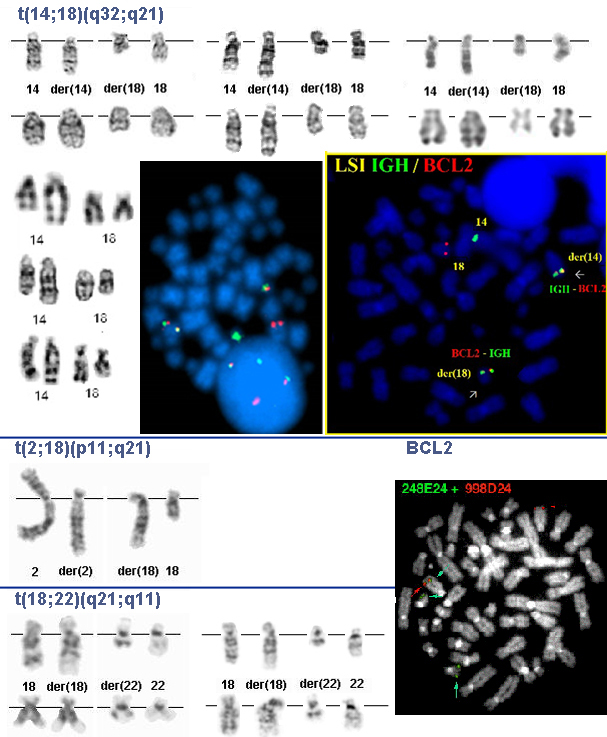
t(14;18)(q32;q21) IGH/BCL2 , t(2;18)(p11;q21), t(18;22)(q21;q11), BCL2 Top: 14;18)(q32;q21), G- banding - Courtesy Jean-Luc Lai and Alain Vanderhaegen (left), and H. Norback, Eric B. Johnson, Sara Morrison-Delap UW Cytogenetic Services (centre); - Courtesy Adriana Zamecnikova (bottom tree); R- banding - Jean Loup Huret (top), and Courtesy Hossein Mossafa (bottom). FISH - Courtesy Hossein Mossafa (center); Hybridization with Vysis LSI IGH/BCL dual color probe (Abbott Molecular, US) showing fused yellow signals on der(14) and der(18) chromosomes - Courtesy Adriana Zamecnikova. Middle: t(2;18)(p11;q21), G- banding - Courtesy Jean-Luc Lai and Alain Vanderhaegent. Bottom: t(18;22)(q21;q11), G- banding - Courtesy Jean-Luc Lai and Alain Vanderhaegen (left) ; and, H. Norback, Eric B. Johnson, Sara Morrison-Delap UW Cytogenetic Services (centre). BCL2: BAC248E24 (BCL2, 18q21, green) cohybridized with PAC PAC 998D24 (14q32.3, red, centromeric to the breakpoint) - Courtesy Mariano Rocchi, Resources for Molecular Cytogenetics
Citation
Jean-Loup Huret
t(14;18)(q32;q21) IGH/BCL2
t(2;18)(p11;q21) IGK/BCL2
t(18;22)(q21;q11) IGL/BCL2
Atlas Genet Cytogenet Oncol Haematol. 1998-05-01
Online version: http://atlasgeneticsoncology.org/haematological/2006/t(14;18)(q32;q21)-igh-bcl2-br-t(2;18)(p11;q21)-igk-bcl2-br-t(18;22)(q21;q11)-igl-bcl2
