Clinics and Pathology
Disease
Acute myeloid leukemia (AML) / myelodysplastic syndromes (MDS)
Phenotype stem cell origin
No specific phenotype but possibly a slight higher incidence in monocytic phenotypes (AML-M4 and -M5, chronic myelomonocytic leukemia (CMML)). AML-M7 with acquired +21 is exceptional , whereas AML-M7 is frequent in Down Syndrome.
Epidemiology
Prognosis
Disease
Acute lymphocytic leukemia (ALL)
Phenotype stem cell origin
Essentially B-cell lineage.
Epidemiology
Prognosis
Note
Genes Involved and Proteins
Article Bibliography
| Pubmed ID | Last Year | Title | Authors |
|---|---|---|---|
| 9078285 | 1997 | Acute lymphoblastic leukemia and chromosome 21. | Berger R et al |
| 7845005 | 1995 | Clinical and prognostic significance of trisomy 21 in adult patients with acute myelogenous leukemia and myelodysplastic syndromes. | Cortes JE et al |
| 2149957 | 1990 | Hematologic disorders in 13 patients with acquired trisomy 21 and 13 individuals with Down syndrome. | Dewald GW et al |
| 10451708 | 1999 | Trisomy 21 is a recurrent secondary aberration in childhood acute lymphoblastic leukemia with TEL/AML1 gene fusion. | Loncarevic IF et al |
| 2149959 | 1990 | Trisomy 21 in neoplastic cells. | Mitelman F et al |
| 1533007 | 1992 | Trisomy 21 as the sole acquired chromosomal abnormality in children with acute lymphoblastic leukemia. | Raimondi SC et al |
| 10576514 | 1999 | Trisomy 21 as the sole acquired karyotypic abnormality in acute myeloid leukemia and myelodysplastic syndrome. | Wan TS et al |
| 8219201 | 1993 | Trisomy 21 in childhood acute lymphoblastic leukemia: a Pediatric Oncology Group study (8602). | Watson MS et al |
| 8603351 | 1996 | Trisomy 21 in acute myeloid leukemia. | Wei CH et al |
Summary
Note
Acquired trisomy 21 is not to be confused with constitutional trisomy 21 (Down syndrome, DS) which is a factor of predisposition to childhood acute leukemia but whose significance and clinical context are quite different.
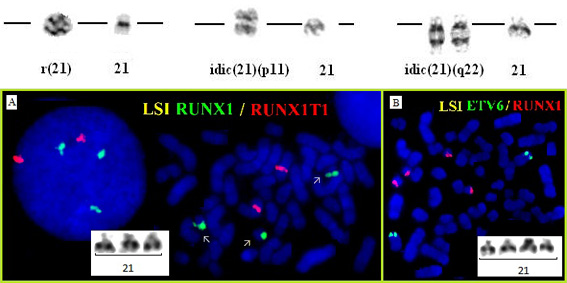
Trisomy 21 and partial trisomy 21 Top: various chromosome 21 rearrangements with partial trisomy 21: Ring(21) and dicentric(21) chromosomes, G-banding - Courtesy Elise Labis. Bottom: Fluorescence in situ hybridization with the Vysis LSI RUNX1/RUNX1T1 dual color dual fusion and LSI ETV6 /RUNX1probes (Abbott Molecular, US) showing 3 copies (green signals) (A) and 4 copies of chromosomes 21 (red signals) (B) - Courtesy Adriana Zamecnikova.
Citation
Franck Viguié
+21 or trisomy 21
Atlas Genet Cytogenet Oncol Haematol. 2001-08-01
Online version: http://atlasgeneticsoncology.org/haematological/1041/+21-or-trisomy-21
