FAU (Finkel-Biskis-Reilly murine sarcoma virus (FBR-MuSV) ubiquitously expressed)
2011-07-01 Mark Pickard AffiliationInstitute for Science, Technology in Medicine, Huxley Building, Keele University, Keele, ST5 5BG, UK
Identity
HGNC
LOCATION
11q13.1
LOCUSID
ALIAS
FAU1,Fub1,Fubi,MNSFbeta,RPS30,S30,asr1
FUSION GENES
DNA/RNA
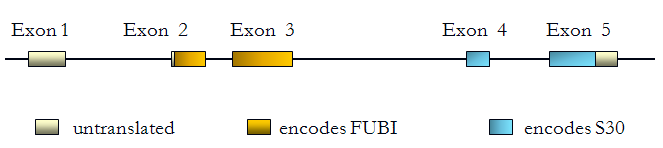
FAU comprises 5 exons - the coding sequence for FUBI is located within exons 2 and 3, whereas the coding sequence for S30 is located within exons 4 and 5.
Description
Transcription
Comprises 5 exons spanning -64888099: -64889672. The mRNA product length is 579 bases.
Pseudogene
A retropseudogene, FAU1P, has been described in the human genome and is located on chromosome 18. Retropseudogenes of FAU have also been described in the mouse genome.
Proteins

A. Protein products of FAU - FAU encodes a ubiquitin-like protein (FUBI) with ribosomal protein S30 as a C-terminal extension protein (CEP). These are cleaved post-translationally. B. FUBI has 37/57% sequence identity/similarity to ubiquitin (Ub; latter is fused to CEP80/S27a ribosomal protein). The C-terminal G-G dipeptide (shown in orange), which is required for cleavage from the CEP and for isopeptide bond formation to lysine of targets, is conserved. Note however, that lysine residues (shown in green) which serve as sites for polyubiquitin chain formation are absent. Consequently, FUBI is unlikely to have an analogous role to ubiquitin in protein degradation.
Description
The protein product comprises a ubiquitin-like protein, FUBI, with ribosomal protein S30 as a carboxy-terminal extension protein (CEP); other ribosomal proteins are produced as CEPs fused to ubiquitin. FUBI and S30 are thought to be cleaved post-translationally, but the enzyme catalyzing this step has not been identified. Whilst FUBI shows a high degree of sequence similarity to ubiquitin, notably retaining the C-terminal G-G dipeptide motif that is required for isopeptide bond formation between ubiquitin and lysines of target proteins, it lacks internal lysine residues (especially lysine-48) which serve as sites of polyubiquitin chain formation and usually facilitate proteasomal degradation of target molecules. Rather, modification of proteins with monomers of ubiquitin or ubiquitin-like proteins may influence the activity, intracellular localisation or inter-molecular interactions of target proteins. Little information exists regarding target proteins for FUBI in human cells. In mouse, four target proteins have been identified. Covalent modification occurs for: (i) a T-cell receptor alpha-like protein (resulting in the production of murine monoclonal non-specific suppressor factor, which exhibits immunomodulatory activity); (ii) Bcl-G (a pro-apoptotic member of the Bcl-2 family; and (iii) endophilin II (regulates phagocytosis in mouse macrophages). Non-covalent modification of histone 2A has also been reported.
Expression
Steady state FAU mRNA levels are highly abundant and largely invariant in normal tissues indicative of a house-keeping gene role. However, physiological variations occur in FAU expression, notably in endometrium. FAU transcript levels have been reported to be reduced in a number of human cancers, including those affecting the breast, the prostate and the ovary.
Localisation
Cytosolic, ribosomal and nuclear localisations have been reported for FAU products. In addition, secretion of FUBI (in association with a T-cell receptor-alpha-like molecule) has been reported for some immune system cell types.
Function
FAU regulates apoptosis in human epithelial and T-cell lines. It also possesses immunomodulatory and anti-microbial activities, and encodes a constituent of the ribosome.
Regulation of apoptosis
Functional expression cloning in mouse leukemic cell lines, with selection (dexamethasone and gamma-irradiation) for suppression of cell death, led to the isolation of a sequence which was antisense to FAU (Mourtada-Maarabouni et al., 2004). Subcloning experiments confirmed that this antisense sequence produced resistance to apoptosis induced by dexamethasone and, additionally, by cisplatin and by ultraviolet-C irradiation. The antisense sequence reduced endogenous FAU expression. Conversely, overexpression of FAU promoted cell death, and this effect could be prevented by co-transfection with a plasmid encoding Bcl-2 (an anti-apoptotic factor) or by inhibition of caspases. Further work in human T-cell lines and the epithelial cell line, 293T/17, has confirmed that ectopic FAU expression increases basal apoptosis, and that siRNA-mediated silencing of FAU attenuates apoptosis in response to ultraviolet-C irradiation (Pickard et al., 2011). FAU also regulates apoptosis in other human epithelial cell lines derived from breast (Pickard et al., 2009), ovarian (Moss et al., 2010) and prostate (Pickard et al., 2010) tumours (see Implicated in). FUBI has been shown to covalently modify Bcl-G (a pro-apoptotic member of the Bcl-2 family) in mouse cells (Nakamura and Tanigawa, 2003), and it is feasible therefore, that FAU regulates apoptosis via Bcl-G. Indeed, prior knockdown of Bcl-G ablated the stimulation of basal apoptosis by FAU in human cells (Pickard et al., 2011). This pro-apoptotic activity may underlie the putative tumour suppressor role of FAU, since failure of apoptosis is known to play a central role in the development of many cancers.
Immunomodulation
Monoclonal non-specific suppressor factor (MNSF) was first isolated from mouse cells in 1986 (Nakamura et al., 1988) and subsequently, from ascites fluid of a patient with systemic lupus erythematosus (Xavier et al., 1994); most studies of MNSF to-date have focussed on murine cells. This lymphokine-like molecule, which comprises alpha- and beta-chains, is secreted by CD8+ T-cells (Xavier et al., 1995). cDNA encoding MNSF-beta was first isolated from the mouse in 1995, and it was shown to be identical to FAU (Nakamura et al., 1995). MNSF inhibits, inter alia, proliferation of mitogen-stimulated T- and B-cells, immunoglobulin secretion by B-cells in an isotype-specific manner (IgE and IgG3 are especially affected), TNFalpha production by activated macrophages and interleukin-4 secretion by bone marrow-derived mast cells and by a type-2 helper T-cell clone (Nakamura et al., 1988; Nakamura et al., 1994; Xavier et al., 1994; Nakamura et al., 1995; Xavier et al., 1995; Nakamura et al., 1996; Suzuki et al., 1996). Inhibitory effects on T- and B-cell proliferation are subject to negative regulation by interleukin-2 (Nakamura et al., 1988). Many of these immunosuppresive effects of MNSF can be ascribed to the MNSFbeta subunit, and specifically to FUBI (aka Ubi-L) (Nakamura et al., 1996). Cell surface receptors for MNSF have been described in target cells (Nakamura et al., 1992), and these exhibit similarities to cytokine receptors (Nakamura and Tanigawa, 1999), with tyrosine phosphorylation being implicated in transmembrane signalling (Nakamura and Tanigawa, 2000; Nakamura et al., 2002). Both the expression of cell surface receptors on target cells and the secretion of MNSFbeta/FUBI by splenocytes are stimulated by interferon-gamma (Nakamura et al., 1992; Nakamura et al., 1996). In splenocytes, FUBI conjugates to a range of intracellular proteins, including a T-cell receptor-alpha-like molecule; the resulting complex, which comprises intact MNSF, is secreted by cells (Nakamura et al., 1998; Nakamura et al., 2002). FUBI also covalently modifies Bcl-G in spleen but not in testis, despite high levels of Bcl-G expression in the latter tissue (Nakamura and Tanigawa, 2003). In macrophages, the FUBI/Bcl-G adduct binds to ERKs and inhibits ERK activation by MEK1 (Nakamura and Yamaguchi, 2006). In liver and macrophages, FUBI also forms an adduct with endophilin II and inhibits phagocytosis by macrophages (Nakamura and Shimosaki, 2009; Nakamura and Watanabe, 2010).
Host defence
An anti-microbial protein, termed ubiquicidin, has been isolated from the cytosol of a mouse macrophage cell line treated with interferon-gamma; the protein is active against Listeria monocytogenes, Salmonella typhimurium, Escherichia coli, Staphylococcus aureus and Yersinia enterocolitica (Hiemstra et al., 1999). Ubiquicidin is identical to FAU-encoded ribosomal protein S30 (Hiemstra et al., 1999). Ubiquicidin is also produced by human colonic mucosa (Tollin et al., 2003) and rainbow trout skin (Fernandes and Smith, 2002). It is also active against methicillin-resistant Staphylococcus aureus and accumulates at sites of infection in mice (Brouwer et al., 2006). Radiolabelled ubiquicidin has applications in clinical imaging for microbial infections (Brouwer et al., 2008).
Regulation of apoptosis
Functional expression cloning in mouse leukemic cell lines, with selection (dexamethasone and gamma-irradiation) for suppression of cell death, led to the isolation of a sequence which was antisense to FAU (Mourtada-Maarabouni et al., 2004). Subcloning experiments confirmed that this antisense sequence produced resistance to apoptosis induced by dexamethasone and, additionally, by cisplatin and by ultraviolet-C irradiation. The antisense sequence reduced endogenous FAU expression. Conversely, overexpression of FAU promoted cell death, and this effect could be prevented by co-transfection with a plasmid encoding Bcl-2 (an anti-apoptotic factor) or by inhibition of caspases. Further work in human T-cell lines and the epithelial cell line, 293T/17, has confirmed that ectopic FAU expression increases basal apoptosis, and that siRNA-mediated silencing of FAU attenuates apoptosis in response to ultraviolet-C irradiation (Pickard et al., 2011). FAU also regulates apoptosis in other human epithelial cell lines derived from breast (Pickard et al., 2009), ovarian (Moss et al., 2010) and prostate (Pickard et al., 2010) tumours (see Implicated in). FUBI has been shown to covalently modify Bcl-G (a pro-apoptotic member of the Bcl-2 family) in mouse cells (Nakamura and Tanigawa, 2003), and it is feasible therefore, that FAU regulates apoptosis via Bcl-G. Indeed, prior knockdown of Bcl-G ablated the stimulation of basal apoptosis by FAU in human cells (Pickard et al., 2011). This pro-apoptotic activity may underlie the putative tumour suppressor role of FAU, since failure of apoptosis is known to play a central role in the development of many cancers.
Immunomodulation
Monoclonal non-specific suppressor factor (MNSF) was first isolated from mouse cells in 1986 (Nakamura et al., 1988) and subsequently, from ascites fluid of a patient with systemic lupus erythematosus (Xavier et al., 1994); most studies of MNSF to-date have focussed on murine cells. This lymphokine-like molecule, which comprises alpha- and beta-chains, is secreted by CD8+ T-cells (Xavier et al., 1995). cDNA encoding MNSF-beta was first isolated from the mouse in 1995, and it was shown to be identical to FAU (Nakamura et al., 1995). MNSF inhibits, inter alia, proliferation of mitogen-stimulated T- and B-cells, immunoglobulin secretion by B-cells in an isotype-specific manner (IgE and IgG3 are especially affected), TNFalpha production by activated macrophages and interleukin-4 secretion by bone marrow-derived mast cells and by a type-2 helper T-cell clone (Nakamura et al., 1988; Nakamura et al., 1994; Xavier et al., 1994; Nakamura et al., 1995; Xavier et al., 1995; Nakamura et al., 1996; Suzuki et al., 1996). Inhibitory effects on T- and B-cell proliferation are subject to negative regulation by interleukin-2 (Nakamura et al., 1988). Many of these immunosuppresive effects of MNSF can be ascribed to the MNSFbeta subunit, and specifically to FUBI (aka Ubi-L) (Nakamura et al., 1996). Cell surface receptors for MNSF have been described in target cells (Nakamura et al., 1992), and these exhibit similarities to cytokine receptors (Nakamura and Tanigawa, 1999), with tyrosine phosphorylation being implicated in transmembrane signalling (Nakamura and Tanigawa, 2000; Nakamura et al., 2002). Both the expression of cell surface receptors on target cells and the secretion of MNSFbeta/FUBI by splenocytes are stimulated by interferon-gamma (Nakamura et al., 1992; Nakamura et al., 1996). In splenocytes, FUBI conjugates to a range of intracellular proteins, including a T-cell receptor-alpha-like molecule; the resulting complex, which comprises intact MNSF, is secreted by cells (Nakamura et al., 1998; Nakamura et al., 2002). FUBI also covalently modifies Bcl-G in spleen but not in testis, despite high levels of Bcl-G expression in the latter tissue (Nakamura and Tanigawa, 2003). In macrophages, the FUBI/Bcl-G adduct binds to ERKs and inhibits ERK activation by MEK1 (Nakamura and Yamaguchi, 2006). In liver and macrophages, FUBI also forms an adduct with endophilin II and inhibits phagocytosis by macrophages (Nakamura and Shimosaki, 2009; Nakamura and Watanabe, 2010).
Host defence
An anti-microbial protein, termed ubiquicidin, has been isolated from the cytosol of a mouse macrophage cell line treated with interferon-gamma; the protein is active against Listeria monocytogenes, Salmonella typhimurium, Escherichia coli, Staphylococcus aureus and Yersinia enterocolitica (Hiemstra et al., 1999). Ubiquicidin is identical to FAU-encoded ribosomal protein S30 (Hiemstra et al., 1999). Ubiquicidin is also produced by human colonic mucosa (Tollin et al., 2003) and rainbow trout skin (Fernandes and Smith, 2002). It is also active against methicillin-resistant Staphylococcus aureus and accumulates at sites of infection in mice (Brouwer et al., 2006). Radiolabelled ubiquicidin has applications in clinical imaging for microbial infections (Brouwer et al., 2008).
Homology
At the amino acid level, FUBI has 37/57% sequence identity/similarity to ubiquitin.
Implicated in
Entity name
Various cancers
Note
Tumor suppression: The retrovirus, FBR-MuSV, which contains the transduced genes v-fos and fox, can induce osteosarcomas in mice. In vitro experiments have shown that fox increases the transforming capacity of FBR-MuSV approximately two-fold (Michiels et al., 1993). Fox is an antisense sequence to the cellular gene FAU, indicative of a tumour suppressor role for FAU. Retropseudogenes of FAU have been identified in human (Kas et al., 1995) and mouse (Casteels et al., 1995) genomes, suggesting a possible source for the viral fox gene (which is antisense to FAU). Further evidence for a tumour suppressor role for FAU has come from studies of the human carcinogen arsenite. Thus, functional cloning approaches in Chinese hamster V79 cells with selection for arsenite resistance, resulted in the isolation of the asr1 gene, which is homologous to FAU (Rossman and Wang, 1999). Subsequent work by this group using human osteogenic sarcoma cells, indicated that the ability to confer arsenite resistance resided in the S30 domain of FAU (Rossman et al., 2003).
Oncogenesis
Expression of the FUBI domain of FAU has been shown to transform human osteogenic sarcoma cells to anchorage-independent growth (Rossman et al., 2003).
Entity name
Breast cancer
Note
Serial analysis of gene expression (SAGE) identified FAU as an underexpressed gene in ductal carcinoma in situ when compared with normal breast epithelium (Abba et al., 2004). This was subsequently confirmed using quantitative RT-PCR analysis of matched (same patient) samples of breast cancer tissue and adjacent breast epithelial tissue (Pickard et al., 2009). Furthermore, in a separate group of breast cancer patients, expression levels of FAU (determined by cDNA microarray analysis) were shown to be related to patient survival in Kaplan-Meier analyses (Pickard et al., 2009). This analysis indicated that higher expression of Fau has a protective effect, consistent with its candidate tumour suppressor role. Whilst Bcl-G expression was also shown to be down-regulated in breast cancer, Bcl-G expression was not related to patient survival (Pickard et al., 2009), suggesting that the regulation of Bcl-G activity by post-translational modification is more important than Bcl-G expression per se in determining breast cancer patient survival. Functional studies in the T-47D breast cancer cell line demonstrated that down-regulation of either FAU or Bcl-G expression by siRNA-mediated silencing attenuated apoptosis induction by ultraviolet-C irradiation (Pickard et al., 2009). Notably, no additional effect was observed when the two genes were simultaneously silenced, consistent with a role for Bcl-G in mediating the pro-apoptotic activity of FAU.
Entity name
Ovarian cancer
Note
A reduction in FAU gene expression has been reported for malignant versus normal ovarian tissue, and for Type I ovarian tumours (typically include mucinous, endometrioid, clear cell, and low-grade serous cancers), in particular (Moss et al., 2010). Over-expression of FAU in a cisplatin-resistant ovarian cancer cell sub-line, A2780cis, resulted in increased sensitivity to carboplatin-induced apoptosis (Moss et al., 2010). Conversely, down-regulation of FAU in the A2780 parental cell line resulted in increased resistance to carboplatin-induced apoptosis (Moss et al., 2010). These in vitro findings suggest a role for FAU in the regulation of platinum-based drug resistance in ovarian cancer.
Entity name
Prostate cancer
Note
Steady state FAU mRNA levels are down-regulated in prostate cancer when compared with normal tissue and tissue from patients with benign prostate hyperplasia; a similar trend was found for Bcl-G (Pickard et al., 2010). siRNA-mediated silencing of FAU or Bcl-G expression in the prostate cell line, 22Rv1, attenuated apoptosis induction consequent upon ultraviolet-C irradiation. A similar degree of apoptosis resistance was observed when the two genes were simultaneously down-regulated, consistent with FAU and Bcl-G acting in the same pathway.
Entity name
Reproduction (implantation)
Note
FAU is expressed in endometrial stromal cells in non-pregnant mouse uterus (Salamonsen et al., 2002) and it is also expressed in human endometrium (Nie et al., 2005). In the mouse uterus, differential expression of FAU occurs during blastocyst implantation, with low expression levels noted in implantation versus interimplantation sites (Nie et al., 2000). Expression levels remain low as implantation advances (Nie et al., 2000). Administration of antisera to FAU into the mouse uterine lumen inhibits implantation in a dose-dependent manner (Wang et al., 2007), suggesting an essential role for secreted products in implantation. Trophoblast-derived interferons have been shown to induce endometrial FAU expression in pigs (Chwetzoff and dAndrea, 1997), also supporting an important role for FAU in early pregnancy.
Article Bibliography
| Pubmed ID | Last Year | Title | Authors |
|---|---|---|---|
| 15318932 | 2004 | Transcriptomic changes in human breast cancer progression as determined by serial analysis of gene expression. | Abba MC et al |
| 17786940 | 2008 | The pharmacology of radiolabeled cationic antimicrobial peptides. | Brouwer CP et al |
| 7774934 | 1995 | The mouse Fau gene: genomic structure, chromosomal localization, and characterization of two retropseudogenes. | Casteels D et al |
| 9089280 | 1997 | Ubiquitin is physiologically induced by interferons in luminal epithelium of porcine uterine endometrium in early pregnancy: global RT-PCR cDNA in place of RNA for differential display screening. | Chwetzoff S et al |
| 12147245 | 2002 | A novel antimicrobial function for a ribosomal peptide from rainbow trout skin. | Fernandes JM et al |
| 10496312 | 1999 | Ubiquicidin, a novel murine microbicidal protein present in the cytosolic fraction of macrophages. | Hiemstra PS et al |
| 1326960 | 1992 | Genomic structure and expression of the human fau gene: encoding the ribosomal protein S30 fused to a ubiquitin-like protein. | Kas K et al |
| 8406491 | 1993 | Assignment of the human FAU gene to a subregion of chromosome 11q13. | Kas K et al |
| 7642109 | 1995 | Characterization of a processed pseudogene of human FAU1 on chromosome 18. | Kas K et al |
| 10084702 | 1999 | Ubiquitin-like polypeptide inhibits the proliferative response of T cells in vivo. | Kondoh T et al |
| 8395683 | 1993 | fau cDNA encodes a ubiquitin-like-S30 fusion protein and is expressed as an antisense sequence in the Finkel-Biskis-Reilly murine sarcoma virus. | Michiels L et al |
| 19830698 | 2010 | FAU regulates carboplatin resistance in ovarian cancer. | Moss EL et al |
| 15543234 | 2004 | Regulation of apoptosis by fau revealed by functional expression cloning and antisense expression. | Mourtada-Maarabouni M et al |
| 9540822 | 1998 | Conjugation of ubiquitin-like polypeptide to intracellular acceptor proteins. | Nagata T et al |
| 20849826 | 2010 | Ubiquitin-like protein MNSFβ/endophilin II complex regulates Dectin-1-mediated phagocytosis and inflammatory responses in macrophages. | Nakamura M et al |
| 15792646 | 2005 | Identification of novel endometrial targets for contraception. | Nie G et al |
| 10694741 | 2000 | Identification of monoclonal nonspecific suppressor factor beta (mNSFbeta) as one of the genes differentially expressed at implantation sites compared to interimplantation sites in the mouse uterus. | Nie GY et al |
| 8394356 | 1993 | The carboxyl extension of a ubiquitin-like protein is rat ribosomal protein S30. | Olvera J et al |
| 21550398 | 2011 | Candidate tumour suppressor Fau regulates apoptosis in human cells: an essential role for Bcl-G. | Pickard MR et al |
| 12660817 | 2003 | fau and its ubiquitin-like domain (FUBI) transforms human osteogenic sarcoma (HOS) cells to anchorage-independence. | Rossman TG et al |
| 12842418 | 2003 | Complex regulation of decidualization: a role for cytokines and proteases--a review. | Salamonsen LA et al |
| 8877395 | 1996 | Monoclonal nonspecific suppressor factor beta (MNSF beta) inhibits the production of TNF-alpha by lipopolysaccharide-activated macrophages. | Suzuki K et al |
| 12860195 | 2003 | Antimicrobial peptides in the first line defence of human colon mucosa. | Tollin M et al |
| 17393421 | 2007 | Immunoneutralization of endometrial monoclonal nonspecific suppressor factor beta (MNSFbeta) inhibits mouse embryo implantation in vivo. | Wang J et al |
| 7512365 | 1993 | Molecular mapping of the chromosome 11 breakpoint of t(11;17)(q13;q21) in a t(11;14)(q13;q32)-positive B non-Hodgkin's lymphoma. | Wlodarska I et al |
| 7782099 | 1995 | Human nonspecific suppressor factor (hNSF): cell source and effects on T and B lymphocytes. | Xavier R et al |
| 8133068 | 1994 | Isolation and characterization of a human nonspecific suppressor factor from ascitic fluid of systemic lupus erythematosus. Evidence for a human counterpart of the monoclonal nonspecific suppressor factor and relationship to the T cell receptor alpha-chain. | Xavier RM et al |
Other Information
Locus ID:
NCBI: 2197
MIM: 134690
HGNC: 3597
Ensembl: ENSG00000149806
Variants:
dbSNP: 2197
ClinVar: 2197
TCGA: ENSG00000149806
COSMIC: FAU
RNA/Proteins
Expression (GTEx)
Pathways
Protein levels (Protein atlas)
References
| Pubmed ID | Year | Title | Citations |
|---|---|---|---|
| 33326956 | 2021 | MNSFβ Promotes the Proliferation and Migration of Human Extravillous Trophoblast Cells and the Villus Expression Level of MNSFβ Is Decreased in Recurrent Miscarriage Patients. | 3 |
| 34318747 | 2021 | Processing of the ribosomal ubiquitin-like fusion protein FUBI-eS30/FAU is required for 40S maturation and depends on USP36. | 8 |
| 34589082 | 2021 | MNSFβ Regulates TNFα Production by Interacting with RC3H1 in Human Macrophages, and Dysfunction of MNSFβ in Decidual Macrophages Is Associated With Recurrent Pregnancy Loss. | 5 |
| 33326956 | 2021 | MNSFβ Promotes the Proliferation and Migration of Human Extravillous Trophoblast Cells and the Villus Expression Level of MNSFβ Is Decreased in Recurrent Miscarriage Patients. | 3 |
| 34318747 | 2021 | Processing of the ribosomal ubiquitin-like fusion protein FUBI-eS30/FAU is required for 40S maturation and depends on USP36. | 8 |
| 34589082 | 2021 | MNSFβ Regulates TNFα Production by Interacting with RC3H1 in Human Macrophages, and Dysfunction of MNSFβ in Decidual Macrophages Is Associated With Recurrent Pregnancy Loss. | 5 |
| 29084471 | 2018 | The association between polymorphisms of genes related to inflammation and recurrent pregnancy loss. | 5 |
| 29158263 | 2018 | High-throughput screening identifies FAU protein as a regulator of mutant cystic fibrosis transmembrane conductance regulator channel. | 16 |
| 29084471 | 2018 | The association between polymorphisms of genes related to inflammation and recurrent pregnancy loss. | 5 |
| 29158263 | 2018 | High-throughput screening identifies FAU protein as a regulator of mutant cystic fibrosis transmembrane conductance regulator channel. | 16 |
| 21550398 | 2011 | Candidate tumour suppressor Fau regulates apoptosis in human cells: an essential role for Bcl-G. | 17 |
| 21550398 | 2011 | Candidate tumour suppressor Fau regulates apoptosis in human cells: an essential role for Bcl-G. | 17 |
| 19830698 | 2010 | FAU regulates carboplatin resistance in ovarian cancer. | 7 |
| 19830698 | 2010 | FAU regulates carboplatin resistance in ovarian cancer. | 7 |
| 19671159 | 2009 | Dysregulated expression of Fau and MELK is associated with poor prognosis in breast cancer. | 82 |
Citation
Mark Pickard
FAU (Finkel-Biskis-Reilly murine sarcoma virus (FBR-MuSV) ubiquitously expressed)
Atlas Genet Cytogenet Oncol Haematol. 2011-07-01
Online version: http://atlasgeneticsoncology.org/gene/40538/fau
