KLF5 : Kruppel-like factor 5 (intestinal)
2006-10-01 Ceshi Chen , Yinfa Zhou , Jin-Tang Dong AffiliationThe Center for Cell Biology, Cancer Research Albany Medical College MS355\\\/350, Mail code 165, 47 New Scotland Ave. Albany, NY 12208, USA
Identity
HGNC
LOCATION
13q22.1
IMAGE

LOCUSID
ALIAS
BTEB2,CKLF,IKLF
FUSION GENES
DNA/RNA

Black box: Exon
Description
KLF5 gene encompasses 4 exons which span about 18.7 kb of DNA. BAC clone RPCI-505F3 contains the complete KLF5 genome sequence.
Transcription
about 3.4 Kb mRNA, 1374 bp open reading frame
Proteins
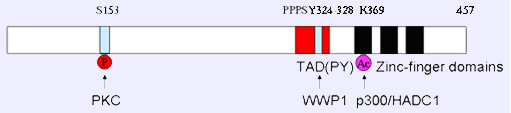
TAD: transactivation domain, PY: PPPSY sequence
Description
457 amino acids; about 55 kDa protein; KLF5 protein undergoes numerous post translational modifications: phosphorylation, acetylation, and ubiquitination. The major transactivation domain is proline rich and contains a PY motif (324-328), which can bind to E3 ubiquitin ligase WWP1. Three zinc finger domains at C-terminus can bind to GC rich DNA sequence.
Expression
widely expressed in intestine, prostate, breast, lung, bladder, pancreas, placenta, uterus, skin, and skeletal muscle.
Localisation
nucleus
Function
KLF5 is a transcription factor. Many KLF5 target genes, such as PDGFa, PPARg, NFkB, cyclinD1, KLF4, and TCR, have been identified in different cell models. KLF5 regulates cell proliferation, cell cycle, apoptosis, and differentiation. KLF5 is an important transcription factor for cardiovascular remodeling and tumor angiogenesis. KLF5 is essential for mouse embryo development. Additionally, KLF5 may play an important role in several tumor types including breast, prostate, bladder, colon, esophagus, and skin.
Homology
KLF5 gene is highly-conserved among species (from human to Drosophila). KLF5 belongs to the SP1/KLF transcription factor family
Mutations
Somatic
The KLF5 gene is rarely mutated in human prostate cancer. One point mutation (A --> G), which change Met294 to Val, has been found in the breast cancer cell line MDA-MB-231.
Implicated in
Entity name
Breast cancer
Disease
The KLF5 gene is deleted in about 43% breast cancer cell lines. Consistently, KLF5 mRNA is down-regulated in these cell lines. In 9 breast cancer cell lines without KLF5 mRNA loss, KLF5 protein is excessively degraded through ubiquitin-proteasome pathway. Forced expression of KLF5 inhibits T-47D cancer cell growth in vitro. In contrast, KLF5 expression is upregulated in clinical breast tumor samples (see below)
Prognosis
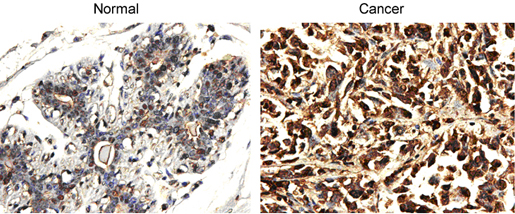
Recently, high level of KLF5 mRNA expression is found to be associated with shorter survival for breast cancer patients. Using tissue microarray, we performed immunohistochemical staining with the anti-KLF5 Ab. The results suggest that KLF5 protein is generally weak in normal breast epithelial cells but strongly positive in breast tumors. Therefore, KLF5 expression is probably a good prognosis marker for breast cancer.
Entity name
Prostate cancer
Disease
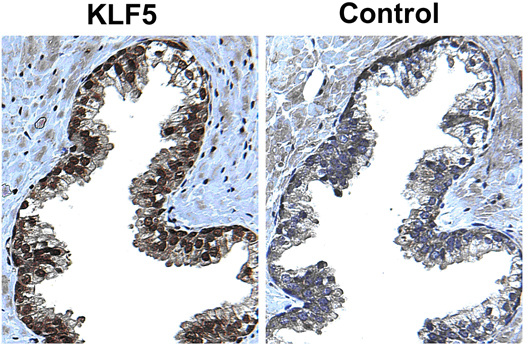
The KLF5 gene is deleted in about 33% prostate cancer cell lines/xenografts. Consistently, KLF5 mRNA is down-regulated in these samples compared to three immortalized prostate epithelial cell lines. In PC-3 prostate cancer cell line in which KLF5 mRNA is at normal high level, KLF5 protein is excessively degraded by over-expression of WWP1. KLF5 protein is highly expressed in normal prostate epithelial cells (Figure 5). Forced expression of KLF5 inhibits DU145 and 22Rv1 prostate cancer cell growth in vitro. In contrast, KLF5 knock-down decreases RWPE1 immortalized prostate epithelial cell growth in vitro. These results suggest that KLF5 may play a context dependent role in prostate cancer.
Entity name
Bladder cancer
Disease
KLF5 mRNA is down-regulated in several bladder cancer cell lines. In TSu-Pr1 cell line, KLF5 over-expression promotes tumorigenesis in SCID mice. Consistently, KLF5 promotes cell cycle progression from G1 to S phase. Interestingly, KLF5 appears to promote tumor angiogenesis. Microarray analysis identified a number of angiogenic factors that are potentially regulated by KLF5, including HBP17, TGFa, and PDGFa. These findings suggest that the KLF5 transcription factor may play an oncogenic role in bladder cancer.
Entity name
Intestinal and colon cancer
Disease
Down-regulation of KLF5 may be an early event in intestinal tumorigenesis. Expression of KLF5 in non-transformed intestinal epithelial cells enhances cell growth; however, KLF5 inhibits cell growth in colon cancer cell lines. Another group found that all-trans retinoic acid inhibits intestinal epithelial cell growth in vitro through inhibiting KLF5 expression. At the same time, lipopolysaccharide (LPS) induces proinflammatory response in intestinal epithelial cells through inducing KLF5 expression. These findings suggest that KLF5 may play an important but yet to be identified role in intestinal and colon cancer.
Entity name
Esophagus cancer
Disease
KLF5 is expressed in proliferating cells of the gastrointestinal tract, including the esophagus. Expression of KLF5 in a poorly differentiated esophageal squamous cancer cell line TE2 inhibits proliferation and invasion, decreases viability after treatment with hydrogen peroxide and UV irradiation, and increases anoikis. KLF5 upregulates the cdk inhibitor p21(waf1/cip1) and pro-apoptotic protein BAX following UV irradiation.
Entity name
Skin cancer
Disease
KLF5 is expressed predominantly in the basal layers of the developing epidermis, in the basal layers of cells of the inner root sheath, and in matrix cells of adult human hair follicles. In a transgenic mouse model, KLF5 over-expression in the basal layers of the epidermis causes abnormal epidermal development and differentiation. KLF5 over-expression may decrease the proliferation of stem cell populations of bulge keratinocytes.
Entity name
Cardiovascular remodeling
Disease
KLF5 hemizygous knock-out mice reduce cardiac hypertrophy and interstitial fibrosis upon infusion of angiotensin II. Additionally, KLF5 may play a role in antherosclerosis and restenosis through regulating vascular smooth muscle cells.
Article Bibliography
| Pubmed ID | Last Year | Title | Authors |
|---|---|---|---|
| 14573617 | 2004 | Regulation of platelet-derived growth factor-A chain by Krüppel-like factor 5: new pathway of cooperative activation with nuclear factor-kappaB. | Aizawa K et al |
| 14726538 | 2004 | Intestinal tumor progression is associated with altered function of KLF5. | Bateman NW et al |
| 16500892 | 2006 | Kruppel-like factor 5 is an important mediator for lipopolysaccharide-induced proinflammatory response in intestinal epithelial cells. | Chanchevalap S et al |
| 16184550 | 2006 | KLF5 promotes cell proliferation and tumorigenesis through gene regulation and the TSU-Pr1 human bladder cancer cell line. | Chen C et al |
| 12661032 | 2003 | KLF5 is frequently deleted and down-regulated but rarely mutated in prostate cancer. | Chen C et al |
| 15735697 | 2005 | Ubiquitin-proteasome degradation of KLF5 transcription factor in cancer and untransformed epithelial cells. | Chen C et al |
| 12087155 | 2002 | Opposing effects of Krüppel-like factor 4 (gut-enriched Krüppel-like factor) and Krüppel-like factor 5 (intestinal-enriched Krüppel-like factor) on the promoter of the Krüppel-like factor 4 gene. | Dang DT et al |
| 15668237 | 2005 | The deacetylase HDAC1 negatively regulates the cardiovascular transcription factor Krüppel-like factor 5 through direct interaction. | Matsumura T et al |
| 14612398 | 2003 | Positive and negative regulation of the cardiovascular transcription factor KLF5 by p300 and the oncogenic regulator SET through interaction and acetylation on the DNA-binding domain. | Miyamoto S et al |
| 12901861 | 2003 | Downregulation and growth inhibitory effect of epithelial-type Krüppel-like transcription factor KLF4, but not KLF5, in bladder cancer. | Ohnishi S et al |
| 16054042 | 2005 | Krüppel-like transcription factor KLF5 is a key regulator of adipocyte differentiation. | Oishi Y et al |
| 12101409 | 2002 | Krüppel-like zinc-finger transcription factor KLF5/BTEB2 is a target for angiotensin II signaling and an essential regulator of cardiovascular remodeling. | Shindo T et al |
| 16912082 | 2006 | Epidermal and craniofacial defects in mice overexpressing Klf5 in the basal layer of the epidermis. | Sur I et al |
| 12113473 | 2002 | Human Krüppel-like factor5/KLF5: synergy with NF-kappaB/Rel factors and expression in human skin and hair follicles. | Sur I et al |
| 12576331 | 2003 | Regulation of T-cell receptor D beta 1 promoter by KLF5 through reiterated GC-rich motifs. | Yang XO et al |
| 16357509 | 2005 | KLF4 and KLF5 regulate proliferation, apoptosis and invasion in esophageal cancer cells. | Yang Y et al |
| 12682370 | 2003 | Phosphorylation of Kruppel-like factor 5 (KLF5/IKLF) at the CBP interaction region enhances its transactivation function. | Zhang Z et al |
Other Information
Locus ID:
NCBI: 688
MIM: 602903
HGNC: 6349
Ensembl: ENSG00000102554
Variants:
dbSNP: 688
ClinVar: 688
TCGA: ENSG00000102554
COSMIC: KLF5
RNA/Proteins
| Gene ID | Transcript ID | Uniprot |
|---|---|---|
| ENSG00000102554 | ENST00000377687 | Q13887 |
| ENSG00000102554 | ENST00000377687 | Q5T6X2 |
| ENSG00000102554 | ENST00000539231 | Q13887 |
Expression (GTEx)
Pathways
| Pathway | Source | External ID |
|---|---|---|
| Developmental Biology | REACTOME | R-HSA-1266738 |
| Transcriptional regulation of white adipocyte differentiation | REACTOME | R-HSA-381340 |
Protein levels (Protein atlas)
References
| Pubmed ID | Year | Title | Citations |
|---|---|---|---|
| 37738301 | 2024 | Circ_0068481 Affects the Human Pulmonary Artery Smooth Muscle Cells' Progression by miR-361-3p/KLF5 Axis. | 0 |
| 38147910 | 2024 | Suppression of KLF5 basal expression in oral carcinoma-derived cells through three intact CREB1-binding sites in the silencer region. | 0 |
| 38217587 | 2024 | KLF5 inhibits the migration and invasion in cervical cancer cell lines by regulating SNAI1. | 0 |
| 38409551 | 2024 | Ubiquitin specific peptidase 38 epigenetically regulates KLF transcription factor 5 to augment malignant progression of lung adenocarcinoma. | 0 |
| 38433576 | 2024 | Abrogation of KLF5 sensitizes BRCA1-proficient pancreatic cancer to PARP inhibition. | 0 |
| 38514264 | 2024 | [Overexpression of tuftelin and KLF-5 and its clinicopathological features in hepatitis B virus-related hepatocellular carcinoma]. | 0 |
| 38609873 | 2024 | Depression of LncRNA DANCR alleviates tubular injury in diabetic nephropathy by regulating KLF5 through sponge miR-214-5p. | 0 |
| 38622696 | 2024 | KLF5 promotes the ossification process of ligamentum flavum by transcriptionally activating CX43. | 0 |
| 38649438 | 2024 | KLF5 regulates actin remodeling to enhance the metastasis of nasopharyngeal carcinoma. | 0 |
| 37738301 | 2024 | Circ_0068481 Affects the Human Pulmonary Artery Smooth Muscle Cells' Progression by miR-361-3p/KLF5 Axis. | 0 |
| 38147910 | 2024 | Suppression of KLF5 basal expression in oral carcinoma-derived cells through three intact CREB1-binding sites in the silencer region. | 0 |
| 38217587 | 2024 | KLF5 inhibits the migration and invasion in cervical cancer cell lines by regulating SNAI1. | 0 |
| 38409551 | 2024 | Ubiquitin specific peptidase 38 epigenetically regulates KLF transcription factor 5 to augment malignant progression of lung adenocarcinoma. | 0 |
| 38433576 | 2024 | Abrogation of KLF5 sensitizes BRCA1-proficient pancreatic cancer to PARP inhibition. | 0 |
| 38514264 | 2024 | [Overexpression of tuftelin and KLF-5 and its clinicopathological features in hepatitis B virus-related hepatocellular carcinoma]. | 0 |
Citation
Ceshi Chen ; Yinfa Zhou ; Jin-Tang Dong
KLF5 : Kruppel-like factor 5 (intestinal)
Atlas Genet Cytogenet Oncol Haematol. 2006-10-01
Online version: http://atlasgeneticsoncology.org/gene/41074/klf5
