L1CAM (L1 cell adhesion molecule)
2008-12-01 Heiner Schäfer , Susanne Sebens Müerköster AffiliationLaboratory of Molecular Gastroenterology, 1st Dept. of Medicine, UKSH Campus Kiel, Schittenhelmstr. 12, 24105 Kiel, Germany
Identity
HGNC
LOCATION
Xq28
IMAGE

LEGEND
Picture from Genetics Home Reference; Reviewed March 2008.
LOCUSID
ALIAS
CAML1,CD171,HSAS,HSAS1,MASA,MIC5,N-CAML1,S10,SPG1
FUSION GENES
DNA/RNA
Description
The L1CAM gene is 24,657 bp in length, consisting of 28 exons according to Ensembl and Entrez-gene.
Transcription
There are 7 transcripts of the gene according to Ensembl.
Proteins
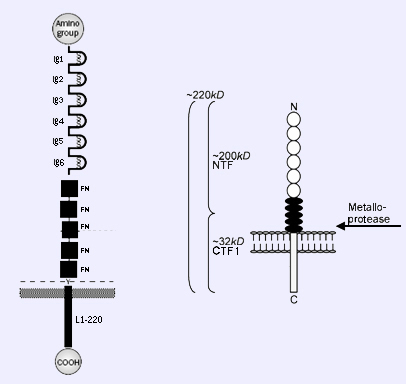
Protein domain structure (left) and cleavage sites (right) of L1CAM. NTF, 200 kDa N-terminal cleavage product; CTF1, 32 kDa C-terminal cleavage product; Ig, immunoglobulin like domain; FN, fibronectin like domain (From Fogel et al., 2003 and Maretzky et al., 2005).
Description
L1CAM (L1) is a 200-220 kD glycoprotein and a member of the immunoglobulin superfamily. This type-1 transmembrane protein consists of six immunoglobulin like domains at the amino terminal end of the molecule followed by five fibronectin type III homologous repeats, a single transmembrane region and a short intracellular domain (Moos et al., 1988). Two splicing variants are known encoding for 1257 and 1253 amino acids proteins.
Expression
Neural, hematopoietic and transformed epithelial cells.
Localisation
Cell surface, extracellular matrix and nucleus (C-terminal fragment).
Function
L1 plays a critical role in axon outgrowth and fasciculation, neuronal migration and survival, synaptic plasticity and regeneration after trauma (Maness et al., 2007). L1 can interact with itself (homophilic) but also with a variety of heterophilic ligands such as integrins, CD24, neurocan, neuropilin-1 and other members of the neural cell adhesion family. In many incidences the binding sites in the L1 molecule have been mapped. The RGD site in the sixth Ig domain supports α5β1, αvβ3,5 integrin-mediated cell binding and the first Ig domain can bind to the proteoglycan neurocan or the VEGF-R2-coreceptor neuropilin-1.
Beside its cell surface localization, L1CAM can also be cleaved by several proteases, i.e. the matrix metalloproteinases ADAM10 and ADAM17, metalloprotease PC5A proprotein convertase or by γ-secretases (Maretzky et al., 2005). Soluble L1CAM has been reported to be important for migration of neuronal as well as of tumor cells (Maretzky et al., 2005; Mechtersheimer et al., 2001), and several studies support a role for L1CAM in tumor growth (Arlt et al., 2006), tumor cell invasion, metastasis of melanoma, ovarial and colon cancer (Mechtersheimer et al., 2001; Gavert et al., 2005; Fogel et al., 2003) and chemoresistance (Sebens Müerköster et al., 2007; Stoeck et al., 2007).
L1 transiently activates pp60c-src, phosphoinositide 3-kinase (PI3 kinase), the VAV2 guanine nucleotide exchange factor, the RAC1 GTPase and p21-activated kinase (PAK1) in a pathway culminating in MEK and ERK activation.
Beside its cell surface localization, L1CAM can also be cleaved by several proteases, i.e. the matrix metalloproteinases ADAM10 and ADAM17, metalloprotease PC5A proprotein convertase or by γ-secretases (Maretzky et al., 2005). Soluble L1CAM has been reported to be important for migration of neuronal as well as of tumor cells (Maretzky et al., 2005; Mechtersheimer et al., 2001), and several studies support a role for L1CAM in tumor growth (Arlt et al., 2006), tumor cell invasion, metastasis of melanoma, ovarial and colon cancer (Mechtersheimer et al., 2001; Gavert et al., 2005; Fogel et al., 2003) and chemoresistance (Sebens Müerköster et al., 2007; Stoeck et al., 2007).
L1 transiently activates pp60c-src, phosphoinositide 3-kinase (PI3 kinase), the VAV2 guanine nucleotide exchange factor, the RAC1 GTPase and p21-activated kinase (PAK1) in a pathway culminating in MEK and ERK activation.
Homology
NrCAM/BRABO, CHL1, neurofascin; in invertebrates, neuroglian and sax-7.
Mutations
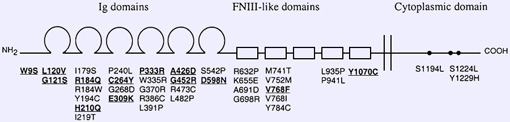
Germinal
Numerous mutations in the L1CAM gene are known (De Angelis et al., 1999) accounting for X-linked neurological syndromes (corpus callosum hypoplasia, retardation, aphasia, spastic paraplegia and hydrocephalus). Alternative splicing of a neuron-specific exon is thought to be functionally relevant.
Implicated in
Note
Various cancers
Disease
Overexpression of L1 has been reported in ovarian cancer, colon cancer, glioma, renal cell cancer, neuroblastoma, endometrial cancer, melanoma, pancreatic cancer. L1 expression promotes invasiveness of the tumor as well as chemoresistance. Thus, L1 expression is mainly found in the invasive front of coloretal cancer and blockade of L1 reduces tumor growth in mouse models. Blockade of L1 dimishes resistance of ovarian and pancreatic cancer towards anti-cancer drugs.
Prognosis
In ovarian cancer, L1 expression associates with poor prognosis. Other L1 expressing tumor entities include those with extremely poor prognosis, i.e. pancreatic or renal cell cancer.
Entity name
Various diseases
Disease
L1 mutations associate with X-linked mental retardation (=L1 syndrome: mental retardation, hydrocephalus, aphasia, spastic paraplegia, agenesis of corpus callosum, optic nerve atrophy), Hirschprungs disease and schizophrenia in some populations.
Article Bibliography
| Pubmed ID | Last Year | Title | Authors |
|---|---|---|---|
| 16424028 | 2006 | Efficient inhibition of intra-peritoneal tumor growth and dissemination of human ovarian carcinoma cells in nude mice by anti-L1-cell adhesion molecule monoclonal antibody treatment. | Arlt MJ et al |
| 10469653 | 1999 | Pathological missense mutations of neural cell adhesion molecule L1 affect homophilic and heterophilic binding activities. | De Angelis E et al |
| 13678974 | 2003 | L1 expression as a predictor of progression and survival in patients with uterine and ovarian carcinomas. | Fogel M et al |
| 15716380 | 2005 | L1, a novel target of beta-catenin signaling, transforms cells and is expressed at the invasive front of colon cancers. | Gavert N et al |
| 17189949 | 2007 | Neural recognition molecules of the immunoglobulin superfamily: signaling transducers of axon guidance and neuronal migration. | Maness PF et al |
| 16199880 | 2005 | L1 is sequentially processed by two differently activated metalloproteases and presenilin/gamma-secretase and regulates neural cell adhesion, cell migration, and neurite outgrowth. | Maretzky T et al |
| 11706054 | 2001 | Ectodomain shedding of L1 adhesion molecule promotes cell migration by autocrine binding to integrins. | Mechtersheimer S et al |
| 3412448 | 1988 | Neural adhesion molecule L1 as a member of the immunoglobulin superfamily with binding domains similar to fibronectin. | Moos M et al |
| 17086212 | 2007 | Drug-induced expression of the cellular adhesion molecule L1CAM confers anti-apoptotic protection and chemoresistance in pancreatic ductal adenocarcinoma cells. | Sebens Müerköster S et al |
| 17030349 | 2007 | L1-CAM in a membrane-bound or soluble form augments protection from apoptosis in ovarian carcinoma cells. | Stoeck A et al |
Other Information
Locus ID:
NCBI: 3897
MIM: 308840
HGNC: 6470
Ensembl: ENSG00000198910
Variants:
dbSNP: 3897
ClinVar: 3897
TCGA: ENSG00000198910
COSMIC: L1CAM
RNA/Proteins
Expression (GTEx)
Pathways
Protein levels (Protein atlas)
References
| Pubmed ID | Year | Title | Citations |
|---|---|---|---|
| 38183514 | 2024 | Reciprocal regulation of forkhead box C1 and L1 cell adhesion molecule contributes to triple-negative breast cancer progression. | 0 |
| 38263290 | 2024 | Cyclic increase in the ADAMTS1-L1CAM-EGFR axis promotes the EMT and cervical lymph node metastasis of oral squamous cell carcinoma. | 0 |
| 38183514 | 2024 | Reciprocal regulation of forkhead box C1 and L1 cell adhesion molecule contributes to triple-negative breast cancer progression. | 0 |
| 38263290 | 2024 | Cyclic increase in the ADAMTS1-L1CAM-EGFR axis promotes the EMT and cervical lymph node metastasis of oral squamous cell carcinoma. | 0 |
| 36674445 | 2023 | The KDET Motif in the Intracellular Domain of the Cell Adhesion Molecule L1 Interacts with Several Nuclear, Cytoplasmic, and Mitochondrial Proteins Essential for Neuronal Functions. | 2 |
| 36708044 | 2023 | L1CAM promotes vasculogenic mimicry formation by miR-143-3p-induced expression of hexokinase 2 in glioma. | 5 |
| 36825596 | 2023 | Clinical significance of L1CAM expression and its biological role in the progression of oral squamous cell carcinoma. | 3 |
| 36852510 | 2023 | L1-CAM in Mucinous Ovarian Carcinomas and Borderline Tumors: Impact on Tumor Recurrence and Potential Role in Tumor Progression. | 0 |
| 37116166 | 2023 | Prognostic Value of β-Catenin and L1CAM Expressions in Type I Endometrial Carcinoma. | 0 |
| 37221223 | 2023 | ZNF133 is a potent suppressor in breast carcinogenesis through dampening L1CAM, a driver for tumor progression. | 1 |
| 37286800 | 2023 | Knocking out alpha-synuclein in melanoma cells downregulates L1CAM and decreases motility. | 2 |
| 37478615 | 2023 | Clinical significance of L1CAM expression in metastatic tubo-ovarian high-grade serous carcinoma. | 0 |
| 37489051 | 2023 | A novel splicing variation in L1CAM is responsible for recurrent fetal hydrocephalus. | 2 |
| 37652517 | 2023 | L1CAM Is Not a Predictive Factor in Early-stage Squamous-cell Cervical Cancer. | 0 |
| 37686224 | 2023 | An Increase in Mucin2 Expression Is Required for Colon Cancer Progression Mediated by L1. | 0 |
Citation
Heiner Schäfer ; Susanne Sebens Müerköster
L1CAM (L1 cell adhesion molecule)
Atlas Genet Cytogenet Oncol Haematol. 2008-12-01
Online version: http://atlasgeneticsoncology.org/gene/44110/l1cam
