Atlas of Genetics and Cytogenetics in Oncology and Haematology


Home   Genes   Leukemias   Solid Tumours   Cancer-Prone   Deep Insight   Case Reports   Journals  Portal   Teaching   

X Y 1 2 3 4 5 6 7 8 9 10 11 12 13 14 15 16 17 18 19 20 21 22 NA

MBD2 (methyl CpG binding domain protein 2)

Identity

Other namesDKFZp586O0821
DMTase
Demethylase
NY-CO-41
HGNC (Hugo) MBD2
LocusID (NCBI) 8932
Location 18q21.2
Location_base_pair Starts at 51677971 and ends at 51751158 bp from pter ( according to hg19-Feb_2009)  [Mapping]
Note Homologous to MBD3 gene.

DNA/RNA

 
  MBD2 is expressed as 2 transcripts. NM_003927.3 coding sequence in blue and NM_015832.3 in red. Boxes represent exons and arrows represent transcriptional start sites.
Description MBD2 (NM_003927.3) is a gene of 70,583 bp coded by 7 exons from 33,240,260 to 33,169,677 according to NCBI reference sequence NT_010966.14 or 51,751,158 to 51,680,575 according to Genome reference consortium human build 37 GRCh37. There is an alternative transcript for MBD2 (NM_015832.3) of 22,111 bp from 33,240,260 to 33,218,149 on NCBI reference sequence NT_010966.14. This transcript shares the first 2 exons (coding for the methyl binding domain) but differs in the 3rd exon, resulting in a shorter truncated protein.
Transcription The longer transcript encoded by NM_003927.3, mRNA length of 2584bp, is expressed ubiquitiously (according to symatlas).
The shorter transcript NM_015832.3, mRNA length of 1357bp is expressed in germ cells (according to symatlas).

Protein

 
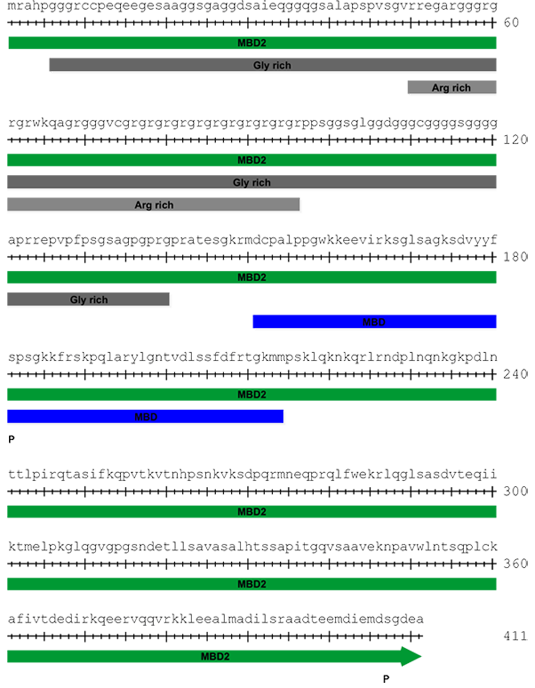
  MBD: methyl binding domain, P: phosphorylation detected.
Description In somatic tissues MBD2 is expressed from a single transcript, and is detected by western blot as 2 stable proteins at approximately 50 kDa (MBD2a) and 30 kDa (MBD2b). Human MBD2a (Q9UBB5) has 411 amino acids. It is unknown whether MBD2b is due to use of an alternative translation start site (creating protein of 262 amino acids) or due to protein cleavage/processing/degradation.
Human germ cells express a short form of MBD2 from the alternative transcript with an expected length of 302 amino acids.
Expression MBD2a and MBD2b are expressed in all tissues tested with highest levels in spleen and colon nuclei (non-published observation).
Localisation MBD2 is a nuclear protein. MBD2-GFP localises to major satellite in mouse ES cells, but not in DNA methylation deficient cells (Hendrich and Bird, 1998).
Function MBD2 is a methyl binding protein that is thought to repress gene expression as part of the NuRD complex. The NuRD complex was identified independently by four separate groups (Wade et al., 1998; Tong et al., 1998; Xue et al., 1998; Zhang et al., 1998). NuRD consists of a chromatin remodelling ATPase Mi2alpha or beta, histone deacetylase HDAC1/HDAC2, MTA1 or MTA2, RbAp46/RbAp48, p66alpha/beta and can also contain MBD2 or MBD3. TAP tagged MBD2a associates with NuRD with equimolar stoichometry implying that most MBD2a is complexed with NuRD in cells (Le Guezennec et al., 2006). MBD2 is required for repression of methylated reporter genes (Hendrich, 2001) and many endogenous target genes of MBD2 have been reported. However the global genomic targets of MBD2 have not been characterised. MBD2 knock out are viable and fertile, and show only mild physiological defects. These are abnormal maternal behaviour and T helper cell deficiencies (Hendrich, 2001; Hutchins, 2002; Hutchins, 2005).
Homology MBD2 is a member of the methyl-binding domain proteins (Hendrich and Bird, 1998). Other members of this family are MeCp2, MBD2, MBD3 and MBD4 (Klose and Bird, 2006). These proteins share a region of homology (145-213 of MBD2a), which have been shown to form a stable domain consisting of a beta sheet, an alpha helix and a positioned loop (Ohki et al., 2001). The crystal structure of the MBD of MeCP2 complexed with a methylated CpG containing 20mer of DNA indicates that the protein-DNA interactions are dependent on water molecules (Ho et al., 2008). The protein with closest homology to MBD2 is MBD3, however MBD3 has two crucial amino acid substitutions in the MBD and does not specifically bind to methylated DNA (Hendrich and Tweedie, 2003).

Mutations

Note MBD2 is mutated only infrequently in human cancer tissues.

Implicated in

Entity Intestinal tumorigenesis
Note MBD2-/- APCmin/+ mice have fewer intestinal tumors and survive longer than MBD2+/+ APCmin/+ mice (Sansom, 2003).
These results imply MBD2 is required for tumorigenesis. Although the mechanism is unknown, possibilities are listed below:
1) MBD2 may repress tumor supressor genes (therefore in the absence of MBD2, tumor repressor expression would be upregulated). In cancer cell lines MBD2 has been found to bind to methylated regions of tumor supressor genes GSTP1, p14 and p16 (Stirzaker, 2004; Le Guezennec, 2006; Martin, 2008).
2) MBD2 may repress a repressor of WNT signalling (therefore in the absence of MBD2, WNT signalling would be reduced). One candidate for this is Lect2 (Phesse, 2008).
3) In mice MBD2 is required for normal T cell differentiation and MBD2-/- mice have impaired immune responses. This could contribute to the MBD2 requirement in tumor formation in the APCmin/+ strain (Hutchins, 2002; Hutchins, 2005).
4) Other mechanisms are possible, such as a role of mbd2 in higher order chromatin or silencing of heterochromatin regulating tumorigenesis. However this has not been tested.

Knock down of MBD2 in human cancer cell lines reduced tumor volume when implanted into nude mice (Campbell, 2004).
MBD2 expression levels in human cancer tissues have been analysed in multiple studies with differing results. One study found MBD2 expression was low in colorectal and stomach cancers (Kanai, 1999), whereas other studies found high expression in cancer tissues. These discrepancies are likely due to differences between control genes used as well as differences between cancer tissues.


External links

Nomenclature
HGNC (Hugo)MBD2   6917
Entrez_Gene (NCBI)MBD2  8932  methyl-CpG binding domain protein 2
Cards
AtlasMBD2ID41309ch18q21
GeneCards (Weizmann)MBD2
Ensembl (Hinxton)ENSG00000134046 [Gene_View]  chr18:51677971-51751158 [Contig_View]  MBD2 [Vega]
AceView (NCBI)MBD2
Genatlas (Paris)MBD2
SOURCE (Stanford)NM_003927 NM_015832
Genomic and cartography
GoldenPath (UCSC)MBD2  -  18q21.2   chr18:51677971-51751158 -  18q21   [Description]    (hg19-Feb_2009)
EnsemblMBD2 - 18q21 [CytoView]
Mapping of homologs : NCBIMBD2 [Mapview]
OMIM603547   
Gene and transcription
Genbank (Entrez)AF039701 AF072242 AF072246 AF072252 AL110266
RefSeq transcript (SRS)NM_003927 NM_015832
RefSeq transcript (Entrez)NM_003927 NM_015832
RefSeq genomic (SRS)AC_000150 NC_000018 NC_018929 NG_029550 NT_010966 NW_001838468 NW_004078095
RefSeq genomic (Entrez)AC_000150 NC_000018 NC_018929 NG_029550 NT_010966 NW_001838468 NW_004078095
Consensus coding sequences : CCDS (NCBI)MBD2
Cluster EST : UnigeneHs.25674 [ SRS ] Hs.25674 [ NCBI ]
CGAP (NCI)Hs.25674
Alternative Splicing : Fast-db (Paris)GSHG0014312
Alternative Splicing GalleryENSG00000134046
Gene ExpressionMBD2 [ NCBI-GEO ]   MBD2 [ EBI - ARRAY_EXPRESS ]
Protein : pattern, domain, 3D structure
UniProt/SwissProtQ9UBB5 (SRS) Q9UBB5 (Uniprot)
NextProtQ9UBB5
With graphics : InterProQ9UBB5
Splice isoforms : SwissVarQ9UBB5(Swissvar)
Domaine pattern : Prosite (SRS)MBD (PS50982)   
Domaine pattern : Prosite (Expaxy)MBD (PS50982)   
Domains : Interpro (SRS)DNA-bd_integrase-typ    MeCpG-bd_2/3_C_dom    Methyl_CpG_DNA-bd   
Domains : Interpro (EBI)DNA-bd_integrase-typ    MeCpG-bd_2/3_C_dom    Methyl_CpG_DNA-bd   
Related proteins : CluSTrQ9UBB5
Domain families : Pfam (SRS)MBD (PF01429)    MBD_C (PF14048)   
Domain families : Pfam (Sanger)MBD (PF01429)    MBD_C (PF14048)   
Domain families : Pfam (NCBI)pfam01429    pfam14048   
Domain families : Smart (EMBL)MBD (SM00391)  
DMDM8932
Blocks (Seattle)Q9UBB5
PDB (SRS)2L2L   
PDB (PDBSum)2L2L   
PDB (IMB)2L2L   
PDB (RSDB)2L2L   
Human Protein AtlasENSG00000134046
HPRD04647
IPIIPI00434623   IPI00434624   IPI00434625   
Protein Interaction databases
DIP (DOE-UCLA)Q9UBB5
IntAct (EBI)Q9UBB5
FunCoupENSG00000134046
REACTOMEMBD2
Protein Interaction Database8932
BioGRIDMBD2
InParanoidQ9UBB5
Interologous Interaction database Q9UBB5
IntegromeDBMBD2
Polymorphism : SNP, mutations, diseases
SNP Single Nucleotide Polymorphism (NCBI)MBD2
SNP (GeneSNP Utah)MBD2
SNP : HGBaseMBD2
Genetic variants : HAPMAPMBD2
Somatic Mutations in Cancer : COSMICMBD2 
CONAN: Copy Number AnalysisMBD2 
Mutations and Diseases : HGMDMBD2
OMIM603547   
GENETests603547   
Disease Genetic AssociationMBD2
Huge Navigator MBD2 [HugePedia]  MBD2 [HugeCancerGEM]
Genomic VariantsMBD2  MBD2 [DGVbeta]
ClinVarMBD2
snp3D : Map Gene to Disease8932
General knowledge
Homologs : HomoloGeneMBD2
Homology/Alignments : Family Browser (UCSC)MBD2
Phylogenetic Trees/Animal Genes : TreeFamMBD2
Chemical/Protein Interactions : CTD8932
Chemical/Pharm GKB GenePA30660
Clinical trialMBD2
Cancer Resource (Charite)ENSG00000134046
Ontology : AmiGOhistone deacetylase complex  negative regulation of transcription from RNA polymerase II promoter  heterochromatin  chromatin binding  satellite DNA binding  mRNA binding  protein binding  nucleus  nucleus  cytoplasm  transcription, DNA-dependent  methyl-CpG binding  methyl-CpG binding  protein domain specific binding  positive regulation of Wnt receptor signaling pathway  siRNA binding  regulation of cell proliferation  maternal behavior  cellular protein complex assembly  negative regulation of transcription, DNA-dependent  C2H2 zinc finger domain binding  
Ontology : EGO-EBIhistone deacetylase complex  negative regulation of transcription from RNA polymerase II promoter  heterochromatin  chromatin binding  satellite DNA binding  mRNA binding  protein binding  nucleus  nucleus  cytoplasm  transcription, DNA-dependent  methyl-CpG binding  methyl-CpG binding  protein domain specific binding  positive regulation of Wnt receptor signaling pathway  siRNA binding  regulation of cell proliferation  maternal behavior  cellular protein complex assembly  negative regulation of transcription, DNA-dependent  C2H2 zinc finger domain binding  
Other databases
Probes
Litterature
PubMed83 Pubmed reference(s) in Entrez
PubGeneMBD2
iHOPMBD2

Bibliography

Identification and characterization of a family of mammalian methyl-CpG binding proteins.
Hendrich B, Bird A.
Mol Cell Biol. 1998 Nov;18(11):6538-47.
PMID 9774669
 
Chromatin deacetylation by an ATP-dependent nucleosome remodelling complex.
Tong JK, Hassig CA, Schnitzler GR, Kingston RE, Schreiber SL.
Nature. 1998 Oct 29;395(6705):917-21.
PMID 9804427
 
A multiple subunit Mi-2 histone deacetylase from Xenopus laevis cofractionates with an associated Snf2 superfamily ATPase.
Wade PA, Jones PL, Vermaak D, Wolffe AP.
Curr Biol. 1998 Jul 2;8(14):843-6.
PMID 9663395
 
NURD, a novel complex with both ATP-dependent chromatin-remodeling and histone deacetylase activities.
Xue Y, Wong J, Moreno GT, Young MK, Cote J, Wang W.
Mol Cell. 1998 Dec;2(6):851-61.
PMID 9885572
 
The dermatomyositis-specific autoantigen Mi2 is a component of a complex containing histone deacetylase and nucleosome remodeling activities.
Zhang Y, LeRoy G, Seelig HP, Lane WS, Reinberg D.
Cell. 1998 Oct 16;95(2):279-89.
PMID 9790534
 
Genomic structure and chromosomal mapping of the murine and human Mbd1, Mbd2, Mbd3, and Mbd4 genes.
Hendrich B, Abbott C, McQueen H, Chambers D, Cross S, Bird A.
Mamm Genome. 1999 Sep;10(9):906-12.
PMID 10441743
 
Reduced mRNA expression of the DNA demethylase, MBD2, in human colorectal and stomach cancers.
Kanai Y, Ushijima S, Nakanishi Y, Hirohashi S.
Biochem Biophys Res Commun. 1999 Nov 2;264(3):962-6.
PMID 10544038
 
MBD2 is a transcriptional repressor belonging to the MeCP1 histone deacetylase complex.
Ng HH, Zhang Y, Hendrich B, Johnson CA, Turner BM, Erdjument-Bromage H, Tempst P, Reinberg D, Bird A.
Nat Genet. 1999 Sep;23(1):58-61.
PMID 10471499
 
Closely related proteins MBD2 and MBD3 play distinctive but interacting roles in mouse development.
Hendrich B, Guy J, Ramsahoye B, Wilson VA, Bird A.
Genes Dev. 2001 Mar 15;15(6):710-23.
PMID 11274056
 
Solution structure of the methyl-CpG binding domain of human MBD1 in complex with methylated DNA.
Ohki I, Shimotake N, Fujita N, Jee J, Ikegami T, Nakao M, Shirakawa M.
Cell. 2001 May 18;105(4):487-97.
PMID 11371345
 
Gene silencing quantitatively controls the function of a developmental trans-activator.
Hutchins AS, Mullen AC, Lee HW, Sykes KJ, High FA, Hendrich BD, Bird AP, Reiner SL.
Mol Cell. 2002 Jul;10(1):81-91.
PMID 12150909
 
MBD1, MBD2 and CGBP genes at chromosome 18q21 are infrequently mutated in human colon and lung cancers.
Bader S, Walker M, McQueen HA, Sellar R, Oei E, Wopereis S, Zhu Y, Peter A, Bird AP, Harrison DJ.
Oncogene. 2003 May 29;22(22):3506-10.
PMID 12776203
 
The methyl-CpG binding domain and the evolving role of DNA methylation in animals.
Hendrich B, Tweedie S.
Trends Genet. 2003 May;19(5):269-77.
PMID 12711219
 
Methyl-CpG-binding domain protein-2 mediates transcriptional repression associated with hypermethylated GSTP1 CpG islands in MCF-7 breast cancer cells.
Lin X, Nelson WG.
Cancer Res. 2003 Jan 15;63(2):498-504.
PMID 12543808
 
Deficiency of Mbd2 suppresses intestinal tumorigenesis.
Sansom OJ, Berger J, Bishop SM, Hendrich B, Bird A, Clarke AR.
Nat Genet. 2003 Jun;34(2):145-7.
PMID 12730693
 
Methylated DNA-binding protein 2 antisense inhibitors suppress tumourigenesis of human cancer cell lines in vitro and in vivo.
Campbell PM, Bovenzi V, Szyf M.
Carcinogenesis. 2004 Apr;25(4):499-507. Epub 2003 Dec 19.
PMID 14688029
 
Transcriptional gene silencing promotes DNA hypermethylation through a sequential change in chromatin modifications in cancer cells.
Stirzaker C, Song JZ, Davidson B, Clark SJ.
Cancer Res. 2004 Jun 1;64(11):3871-7.
PMID 15172996
 
Role of MBD2 in gene regulation and tumorigenesis.
Berger J, Bird A.
Biochem Soc Trans. 2005 Dec;33(Pt 6):1537-40.
PMID 16246164
 
Cutting edge: a critical role for gene silencing in preventing excessive type 1 immunity.
Hutchins AS, Artis D, Hendrich BD, Bird AP, Scott P, Reiner SL.
J Immunol. 2005 Nov 1;175(9):5606-10.
PMID 16237047
 
Genomic DNA methylation: the mark and its mediators.
Klose RJ, Bird AP.
Trends Biochem Sci. 2006 Feb;31(2):89-97. Epub 2006 Jan 5.
PMID 16403636
 
MBD2/NuRD and MBD3/NuRD, two distinct complexes with different biochemical and functional properties.
Le Guezennec X, Vermeulen M, Brinkman AB, Hoeijmakers WA, Cohen A, Lasonder E, Stunnenberg HG.
Mol Cell Biol. 2006 Feb;26(3):843-51.
PMID 16428440
 
MeCP2 binding to DNA depends upon hydration at methyl-CpG.
Ho KL, McNae IW, Schmiedeberg L, Klose RJ, Bird AP, Walkinshaw MD.
Mol Cell. 2008 Feb 29;29(4):525-31.
PMID 18313390
 
MBD2-mediated transcriptional repression of the p14ARF tumor suppressor gene in human colon cancer cells.
Martin V, Jorgensen HF, Chaubert AS, Berger J, Barr H, Shaw P, Bird A, Chaubert P.
Pathobiology. 2008;75(5):281-7. Epub 2008 Oct 15.
PMID 18931530
 
Deficiency of Mbd2 attenuates Wnt signaling.
Phesse TJ, Parry L, Reed KR, Ewan KB, Dale TC, Sansom OJ, Clarke AR.
Mol Cell Biol. 2008 Oct;28(19):6094-103. Epub 2008 Jul 21.
PMID 18644872
 
REVIEW articlesautomatic search in PubMed
Last year publicationsautomatic search in PubMed

Search in all EBI   NCBI

Contributor(s)

Written10-2009Heather Owen
Wellcome Trust Centre for Cell Biology, University of Edinburgh, Michael Swann Building, King's Buildings, Mayfield Road, Edinburgh EH9 3JR, UK

Citation

This paper should be referenced as such :
Owen H . MBD2 (methyl CpG binding domain protein 2). Atlas Genet Cytogenet Oncol Haematol. October 2009 .
URL : http://AtlasGeneticsOncology.org/Genes/MBD2ID41309ch18q21.html

This paper is referenced by INIST as such :
http://documents.irevues.inist.fr/bitstream/2042/44826/1/10-2009-MBD2ID41309ch18q21.pdf   [ Bibliographic record ]

© Atlas of Genetics and Cytogenetics in Oncology and Haematology
indexed on : Fri Jun 14 16:55:22 CEST 2013

Home   Genes   Leukemias   Solid Tumours   Cancer-Prone   Deep Insight   Case Reports   Journals  Portal   Teaching   

For comments and suggestions or contributions, please contact us

jlhuret@AtlasGeneticsOncology.org.