TRA (T cell Receptor Alpha)
2000-07-01 Marie-Paule Lefranc AffiliationIMGT, LIGM, IGH, UPR CNRS 1142, 141 rue de la Cardonille, 34396 Montpellier Cedex 5, France
Identity
HGNC
LOCATION
14q11.2
IMAGE

LEGEND
for complete Figure, see: chromosome 14, IMGT (The International ImMunoGeneTics information system ®) © Copyright 1995-2017 IMGT, IMGT is a CNRS trademark
IMAGE

LEGEND
TRA (T cell Receptor Alpha) Top: Probe bA60K12 - Courtesy Mariano Rocchi; Bottom: Hybridization with Vysis TRA/D Break Apart probe (Abbott Molecular, US) showing the gene on 14q11.2 (red-green or a fused yellow signal) - Courtesy Adriana Zamecnikova.
LOCUSID
ALIAS
IMD7,TCRA,TRA@
DNA/RNA
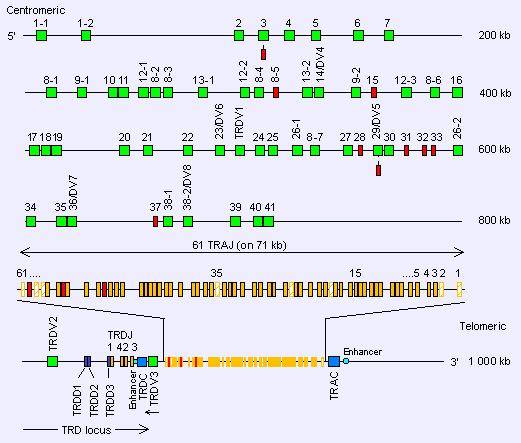
TRA/TRD
V-GENE: Green box: Functional; Red: Pseudogene.
D-GENE: Blue: Functional.
J-GENE: Yellow: Functional; Pale yellow: Open reading frame; Red: pseudogene.
C-GENE: Blue: Functional.
for complete Figure, see: locus TRA, IMGT (The International ImMunoGeneTics information system ®) © Copyright 1995-2017 IMGT, IMGT is a CNRS trademark
V-GENE: Green box: Functional; Red: Pseudogene.
D-GENE: Blue: Functional.
J-GENE: Yellow: Functional; Pale yellow: Open reading frame; Red: pseudogene.
C-GENE: Blue: Functional.
for complete Figure, see: locus TRA, IMGT (The International ImMunoGeneTics information system ®) © Copyright 1995-2017 IMGT, IMGT is a CNRS trademark
Description
Mutations
Note
Mutations which correspond to allelic polymorphisms of the functional germline TRAV, TRAJ and TRAC genes are described in the IMGT database: (IMGT Repertoire>Alignments of alleles)
Implicated in
Entity name
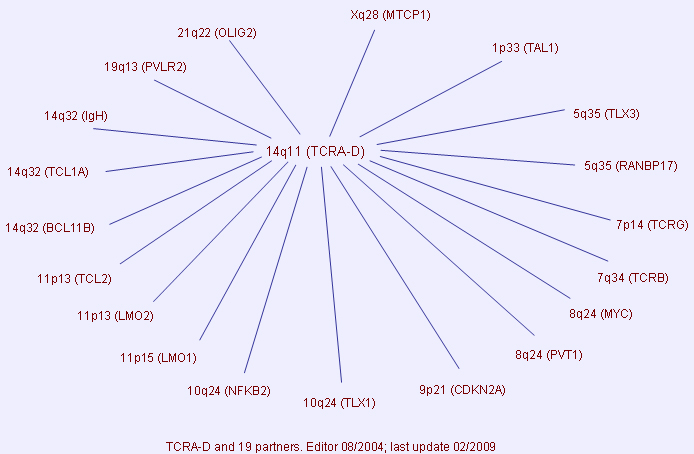
Translocations which frequently result from errors of the recombinase enzyme complex (RAG1, RAG2, etc.), which is responsable of the Immunoglobulin and T cell receptor V-J and V-D-J rearrangements. TRAV or TRAJ recombination signals or isolated heptamer are observed at the breakpoints.
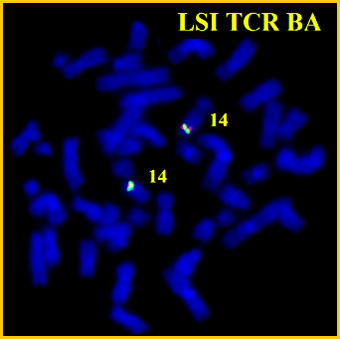
TRA (T cell Receptor Alpha) Hybridization with Vysis TRA/D Break Apart probe (Abbott Molecular, US) showing the gene on 14q11.2 (red-green or a fused yellow signal) - Courtesy Adriana Zamecnikova.
Entity name
Prognosis
median survival > 5 yrs in children
Disease
T-cell acute lymphocytic leukemia (ALL); rare
Entity name
Disease
T- cell acute lymphoblastic leukemia (ALL) and non-Hodgkin lymphoma (NHL)
Prognosis
not unfavourable
Entity name
t(11;14)(p13;q11); involve RBTN2 in 11p13
Disease
T-cell acute lymphocytic leukemia (ALL)
Entity name
Disease
T-cell prolymphocytic leukemia (T-PLL) and adult T cell leukemia/lymphoma
Prognosis
poor
Entity name
t(14;21)(q11;q22); involve TRA - OLIG2 in 21q22
Disease
T-cell acute lymphoblastic leukemia (ALL)
Prognosis
unknown
Breakpoints
Article Bibliography
| Pubmed ID | Last Year | Title | Authors |
|---|---|---|---|
| 9519406 | 1998 | Crystal structure of p14TCL1, an oncogene product involved in T-cell prolymphocytic leukemia, reveals a novel beta-barrel topology. | Hoh F et al |
Other Information
Locus ID:
Variants:
dbSNP: 6955
ClinVar: 6955
COSMIC: TRA
References
| Pubmed ID | Year | Title | Citations |
|---|---|---|---|
| 38723105 | 2024 | Type B thymomas in patients with myasthenia gravis display a distinctive pattern of αβ TCR and IL-7 receptor α expression on CD4(+)CD8(+) thymocytes. | 0 |
| 38723105 | 2024 | Type B thymomas in patients with myasthenia gravis display a distinctive pattern of αβ TCR and IL-7 receptor α expression on CD4(+)CD8(+) thymocytes. | 0 |
| 37153742 | 2023 | Selective ablation of TRA-1-60(+) pluripotent stem cells suppresses tumor growth of prostate cancer. | 0 |
| 37153742 | 2023 | Selective ablation of TRA-1-60(+) pluripotent stem cells suppresses tumor growth of prostate cancer. | 0 |
| 33482200 | 2021 | T cell receptor-dependent S-acylation of ZAP-70 controls activation of T cells. | 9 |
| 33616477 | 2021 | Electrostatic Complementarity of T-Cell Receptor-Alpha CDR3 Domains and Mutant Amino Acids Is Associated with Better Survival Rates for Sarcomas. | 4 |
| 33482200 | 2021 | T cell receptor-dependent S-acylation of ZAP-70 controls activation of T cells. | 9 |
| 33616477 | 2021 | Electrostatic Complementarity of T-Cell Receptor-Alpha CDR3 Domains and Mutant Amino Acids Is Associated with Better Survival Rates for Sarcomas. | 4 |
| 31237711 | 2020 | The 3A6-TCR/superagonist/HLA-DR2a complex shows similar interface and reduced flexibility compared to the complex with self-peptide. | 0 |
| 31589793 | 2020 | Geometrical characterization of T cell receptor binding modes reveals class-specific binding to maximize access to antigen. | 12 |
| 32532817 | 2020 | T cell receptor interactions with human leukocyte antigen govern indirect peptide selectivity for the cancer testis antigen MAGE-A4. | 14 |
| 31237711 | 2020 | The 3A6-TCR/superagonist/HLA-DR2a complex shows similar interface and reduced flexibility compared to the complex with self-peptide. | 0 |
| 31589793 | 2020 | Geometrical characterization of T cell receptor binding modes reveals class-specific binding to maximize access to antigen. | 12 |
| 32532817 | 2020 | T cell receptor interactions with human leukocyte antigen govern indirect peptide selectivity for the cancer testis antigen MAGE-A4. | 14 |
| 31558465 | 2019 | Mismatched related vs matched unrelated donors in TCRαβ/CD19-depleted HSCT for primary immunodeficiencies. | 21 |
Citation
Marie-Paule Lefranc
TRA (T cell Receptor Alpha)
Atlas Genet Cytogenet Oncol Haematol. 2000-07-01
Online version: http://atlasgeneticsoncology.org/gene/39/tra
