TGFB1 (transforming growth factor, beta 1)
2013-02-01 Isabel Fuentes-Calvo , Carlos Martínez-Salgado AffiliationIdentity
HGNC
LOCATION
19q13.2
LOCUSID
ALIAS
CED,DPD1,IBDIMDE,LAP,TGF-beta1,TGFB,TGFbeta
FUSION GENES
DNA/RNA
Description
The human TGFB1 gene encodes 7 exons (Derynck et al., 1987).
Transcription
A 2,5 kb transcript of TGF-β1 has been described (Derynck et al., 1985). A subsequent study showed that human TGF-β1 transcript is 381 bases shorter than the original because the ATTAAA polyadenylation signal is located at position 2136 instead of 2517 (Scotto et al., 1990).
Proteins
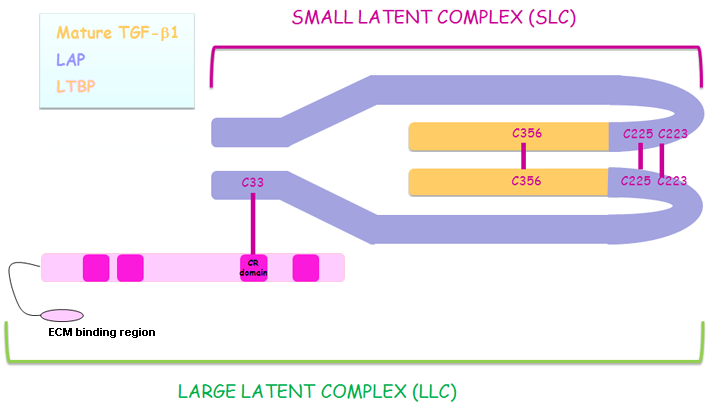
Figure 1: TGF-β1 structure. Small latent complex (SLC) is formed by one LAP segment and the mature TGF-β1. Monomers of these proteins dimerize forming disulfide bridges between C223 and C225 in the LAP and C356 in mature TGF-β1 forming a dimeric structure. Large latent complex (LLC) is formed by SLC and LTBP protein. Disulfide bridges are formed between C33 of LAP protein and the third 8-Cys repeat (CR domain) of LTBP. LLC can bind to extracellular matrix (ECM) through ECM domain in LTBP.
Description
TGF-β1 is a dimeric cytokine which shares a cysteine knot structure connected together by intramolecular disulfide bonds.
It is synthesized as a 390-amino acid precursor protein (pre-pro-TGF-β1 or small latent complex (SLC)) with a molecular weight of 25 kDa (Massague, 1990; Annes et al., 2003). The pre-pro-TGF-β1 is a monomer with three distinct parts: the signal peptide (SP: aminoacids 1-29), the latency associated peptide (LAP: aminoacids 30-278) and the mature peptide (mature TGF-β1: aminoacids 279-390) (Figure 1).
The SP targets the protein to a secretory pathway and it is cleaved off in the rough endoplasmatic reticulum where two monomers dimerize forming a disulfide bridge between cys 223 and 225 in the LAP and cys 278 in the mature TGF-β1. SLC is formed by the cleavage of arginine in position 278 by a furin convertase. The LAP peptide prevents the interaction between TGF-β1 and its receptors.
The SLC might associate covalently with a latent TGF-β1 binding protein (LTBP) which helps in SLC secretion and storage in the extracellular matrix (Koli et al., 2001).
It is synthesized as a 390-amino acid precursor protein (pre-pro-TGF-β1 or small latent complex (SLC)) with a molecular weight of 25 kDa (Massague, 1990; Annes et al., 2003). The pre-pro-TGF-β1 is a monomer with three distinct parts: the signal peptide (SP: aminoacids 1-29), the latency associated peptide (LAP: aminoacids 30-278) and the mature peptide (mature TGF-β1: aminoacids 279-390) (Figure 1).
The SP targets the protein to a secretory pathway and it is cleaved off in the rough endoplasmatic reticulum where two monomers dimerize forming a disulfide bridge between cys 223 and 225 in the LAP and cys 278 in the mature TGF-β1. SLC is formed by the cleavage of arginine in position 278 by a furin convertase. The LAP peptide prevents the interaction between TGF-β1 and its receptors.
The SLC might associate covalently with a latent TGF-β1 binding protein (LTBP) which helps in SLC secretion and storage in the extracellular matrix (Koli et al., 2001).
Expression
TGF-β1 is a growth factor ubiquitously expressed. It was initially discovered as a factor inducing colony formation of normal rat kidney fibroblasts in soft agar in the presence of epidermal growth factor (EGF) (Roberts et al., 1980; Roberts et al., 1981). By immunohistochemical techniques TGF-β1 was strongly detected in adrenal cortex, megakaryocytes and other bone marrow cells, cardiac myocytes, chondrocytes, renal distal tubules, ovarian glandular cells and chorionic cells of the placenta and also in cartilage, heart, pancreas, skin, and uterus (Thompson et al., 1989).
Localisation
TGF-β1 is secreted as an inactive precursor bound to the Latency Associated Peptide (LAP), forming the complex called Small Latent Complex (SLC). SLCs are secreted from cells and deposited into the extracellular matrix as covalent complexes with its binding proteins, also known as Latent TGF-β Binding Proteins, LTBPs (Koli et al., 2001). The latency proteins contribute to TGF-β1 stability. Active TGF-β1 half-life is about two minutes whereas LTBPs half-life is about 90 minutes. In cells, active TGF-β1 is forming a large ligand-receptor complex involving a ligand dimer and four receptor molecules.
Function
TGF-β1 has an important role in controlling development, tissue repair, immune defense, inflammation and tumorigenesis (Roberts, 1998). Moreover, TGF-β1 is involved in the interactions between epithelia and the surrounding mesenchyme, promoting epithelial-to-mesenchymal transition (EMT) (Massague et al., 2000).
Active TGF-β1 is released as a dimer due to proteolytic cleavage of LAP at low pH or via interactions with other proteins such as thrombospondins and αVβ6 integrin (Koli et al., 2001; Derynck et al., 2003). TGF-β1 bounds to the serine-threonine kinase TGF-β type I receptor (TβRI) and recruits a constitutively phosphorylated TGF-β type II receptor (TβRII) that phosphorylates the regulatory segment, a 30-amino-acid region of the TβRI and forms a heterotetrameric receptor complex.
This complex activates both SMAD dependent and independent pathways such as STRAP (Datta et al., 1998), TRAP-1 (Charng et al., 1998), FKBP12 (Wang et al., 1994) and Ras/Raf/ERK (Matsuzaki, 2011). In the SMAD-dependent pathways, the receptor complex (or directly the type I receptor) phosphorylates receptor-regulated SMADs (R-SMADs: SMAD1, SMAD2, SMAD3, SMAD5 and SMAD8) which can now bind the cooperative SMAD (co-SMAD) SMAD4. SMAD6 and SMAD7 have inhibitory effects on TGF-β1 (Feng and Derynck, 2005). The R-SMAD/coSMAD complexes accumulate in the nucleus where they interact with DNA and other transcription factors and participate in the regulation of 100-300 target genes expression (Massague et al., 2005) (Figure 2).
Active TGF-β1 is released as a dimer due to proteolytic cleavage of LAP at low pH or via interactions with other proteins such as thrombospondins and αVβ6 integrin (Koli et al., 2001; Derynck et al., 2003). TGF-β1 bounds to the serine-threonine kinase TGF-β type I receptor (TβRI) and recruits a constitutively phosphorylated TGF-β type II receptor (TβRII) that phosphorylates the regulatory segment, a 30-amino-acid region of the TβRI and forms a heterotetrameric receptor complex.
This complex activates both SMAD dependent and independent pathways such as STRAP (Datta et al., 1998), TRAP-1 (Charng et al., 1998), FKBP12 (Wang et al., 1994) and Ras/Raf/ERK (Matsuzaki, 2011). In the SMAD-dependent pathways, the receptor complex (or directly the type I receptor) phosphorylates receptor-regulated SMADs (R-SMADs: SMAD1, SMAD2, SMAD3, SMAD5 and SMAD8) which can now bind the cooperative SMAD (co-SMAD) SMAD4. SMAD6 and SMAD7 have inhibitory effects on TGF-β1 (Feng and Derynck, 2005). The R-SMAD/coSMAD complexes accumulate in the nucleus where they interact with DNA and other transcription factors and participate in the regulation of 100-300 target genes expression (Massague et al., 2005) (Figure 2).
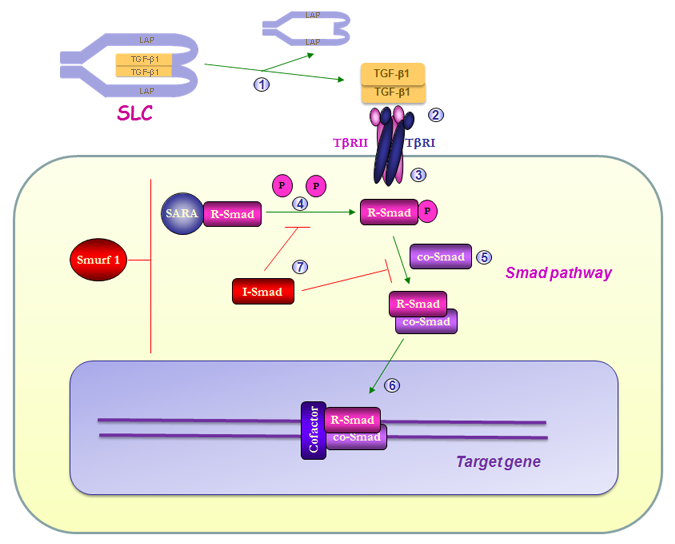
Figure 2: TGF-β1 signalling through the Smad-dependent pathway. 1) Mature TGF-β1 is released by different mechanisms such as degradation of LAP by proteases, induction of conformational change in LAP by interaction with thrombospondin or by rupture of noncovalent bonds between LAP and TGFβ-1. 2) Active TGFβ-1 binds to receptor type II (TβRII) which is constitutively phosphorylated and active. 3) The TGF-β1-TβRII complex recruits and activates TβRI by transphosphorylation of the GS domain. 4) The heterotetrameric receptor complex phosphorylates R-SMAD at the C-terminal SSXS domain. SARA protein promotes the binding of R-SMAD with TβRI. 5) The phosphorylation of R-SMAD allows the interaction with Co-SMADs. 6) This complex can translocate to the nucleus, joining the DNA and inducing or modulating the transcription of different target genes. 7) I-SMAD can inhibit signalling through the blockade of the access of the receptor complex to R-SMAD by mechanical interaction or inducing TβRI degradation by ubiquitination.
Homology
TGF-β1 shares a high degree of amino acid sequence homology (70%) with TGF-β2 (Massague et al., 1987).
Mutations
Germinal
Heterozygous mutations in TGFB1 gene result in Camurati-Engelmann disease type I (CED; MIM#131300). One of the most common mutations replaces the amino acid arginine with the amino acid cysteine at position 218 in the TGFβ-1 protein (written as Arg218Cys or R218C).
Somatic
Overexpression or alteration of active TGFβ-1 protein induced by somatic mutations in the TGFB1 gene are implicated in certain types of cancers (prostate, breast, colon, lung and bladder cancers).
Implicated in
Entity name
Cancer
Note
TGF-β1 has a relevant and complex role in cancer cell growth and development (Roberts et al., 1993). Alterations in TGF-β signalling pathway modify cancer risk. Overall, decreases in TGF-β1 signalling induce an increase in cancer risk, whereas increases in TGF-β secretion and signaling activation enhance the aggressiveness of tumors. TGF-β also stimulates invasion, angiogenesis, and metastasis, and inhibits immune surveillance.
Entity name
Colorectal cancer
Note
TGF-β1 is involved in colorectal cancer (Kemik et al., 2013), modulating the degree of angiogenesis (Xiong et al., 2002). TGF-β induces a prometastatic program in stromal cells associated with a high risk of colorectal cancer relapse upon treatment (Calon et al., 2012). A polymorphism in TGFB1 (gene promoter -509C allele variant) is a possible risk factor for developing colorectal cancer (Wang et al., 2013).
Entity name
Breast cancer
Note
The TGFB1 LP10 polymorphism has been associated with breast cancer risk inducing an increase in TGF-β1 cellular expression and elevating plasma TGF-β1 levels, which might suppress the immune regulatory activities of macrophages and increase the risk of breast cancer (Dunning et al., 2003; Lee et al., 2005; Breast Cancer Association Consortium, 2006; Ivanovic et al., 2006; Cox et al., 2007; Sun et al., 2013), although other authors suggest that lower levels of circulating TGF-β1 are associated with a higher metastatic risk and poor disease prognosis (Panis et al., 2013).
Entity name
Glioma
Note
TGF-β1 is also involved in human gliomas, decreasing anti-tumour immunity (Lee et al., 1997; Dong et al., 2001; Zagzag et al., 2005) and increasing the motility of glioma cells by enhancing the expression of collagen and α2,5,β3 integrin, as well as up-regulating the activity of metalloproteinases MMP-2 and MMP-9 at the cell surface of glioma cells (Wick et al., 2001).
Entity name
Prostate cancer
Note
Cancer progression and metastasis are associated with an increase in TGF-β1 circulating levels in patients with prostate cancer (Shariat et al., 2004; Ivanovic et al., 2006). Local expression of TGF-β1 is associated with tumor grade, tumor invasion and metastasis. The TGFB1 L10 polymorphism is associated with a poorer outcome and more aggressive tumors in patients with prostate cancer, and the TGFB1 509T polymorphism may play a role in advanced stage prostate cancer affecting TGF-β1 expression and increasing TGF-β1 serum levels (Ewart-Toland and Balmain, 2004). However, an association between single nucleotide polymorphisms of TGFB1 at C-509T and a decreased risk of aggressive prostate cancer has been described (Brand et al., 2008). On the other hand, the codon 10 polymorphism in TGFB1 may have a significant influence on the development of prostate cancer and benign prostatic hyperplasia (Omrani et al., 2009).
Entity name
Lung cancer
Note
Elevated plasma TGF-β1 levels occur frequently in patients with lung cancer (Kong et al., 1996; Kang et al., 2006). TGF-β1 may offer protection against development of lung cancer acting as a suppressor of tumor initiation (Blobe et al., 2000; Rich et al., 2001; Siegel and Massague, 2003).
Entity name
Bladder cancer
Note
TGF-β is also overexpressed in bladder cancer. In this context, TGF-β1 may facilitate tumor escape from the immune system (de Visser and Kast, 1999; Wojtowicz-Praga, 2003; Helmy et al., 2007).
Entity name
Fibrosis
Note
The role of TGF-β1 in fibrosis is widely accepted (Verrecchia and Mauviel, 2002; Schnaper et al., 2003). In the kidney, TGF-β1 mediates apoptosis and epithelial-mesenchimal transition (EMT), causing progressive loss of differentiated renal cells, thus inducing chronic progression of renal disease. TGF-β1-induced apoptosis is likely to have a pathogenetic role in podocyte depletion and glomerulosclerosis, tubular degeneration/atrophy, and loss of glomerular and peritubular capillaries. In addition, EMT induced by TGF-β1 may contribute to tubular atrophy and generation of interstitial myofibroblasts, leading to concomitant tubulointerstitial fibrosis (Bottinger and Bitzer, 2002).
TGF-β1 is involved in liver fibrosis (Kanzler et al., 1999), inducing cirrhosis, liver failure, and portal hypertension, and is also involved in pulmonary fibrosis (Kang et al., 2007), inducing chronic obstructive pulmonary disease. Patients with cystic fibrosis and homozygosity for the common phe508del mutation had an increased risk of severe pulmonary disease if they are also homozygous for C at nucleotide 29 of the TGFB1 gene, corresponding to a change in codon 10 (Drumm et al., 2005). High TGF-β1 protein production has been associated with pulmonary sarcoidosis, which can develop into pulmonary fibrosis (Limper et al., 1994).
Cardiac fibrosis is associated with the emergence of fibroblasts originating from endothelial cells, suggesting an endothelial-mesenchymal transition (EndMT). TGF-β1 induced endothelial cells to undergo EndMT, which contributes to the progression of cardiac fibrosis (Zeisberg et al., 2007). TGFbeta1 mRNA expression is greater in Duchenne muscular dystrophy (DMD) and Becker muscular dystrophy patients than in controls. Expression of TGF-β1 in the early stages of DMD may be critical in initiating muscle fibrosis, and antifibrosis treatment might slow progression of the disease (Bernasconi et al., 1995).
TGF-β1 is involved in liver fibrosis (Kanzler et al., 1999), inducing cirrhosis, liver failure, and portal hypertension, and is also involved in pulmonary fibrosis (Kang et al., 2007), inducing chronic obstructive pulmonary disease. Patients with cystic fibrosis and homozygosity for the common phe508del mutation had an increased risk of severe pulmonary disease if they are also homozygous for C at nucleotide 29 of the TGFB1 gene, corresponding to a change in codon 10 (Drumm et al., 2005). High TGF-β1 protein production has been associated with pulmonary sarcoidosis, which can develop into pulmonary fibrosis (Limper et al., 1994).
Cardiac fibrosis is associated with the emergence of fibroblasts originating from endothelial cells, suggesting an endothelial-mesenchymal transition (EndMT). TGF-β1 induced endothelial cells to undergo EndMT, which contributes to the progression of cardiac fibrosis (Zeisberg et al., 2007). TGFbeta1 mRNA expression is greater in Duchenne muscular dystrophy (DMD) and Becker muscular dystrophy patients than in controls. Expression of TGF-β1 in the early stages of DMD may be critical in initiating muscle fibrosis, and antifibrosis treatment might slow progression of the disease (Bernasconi et al., 1995).
Entity name
Pulmonary edema
Note
The TGF-β1 latency-associated peptide (LAP) is a ligand for the integrin alpha-V-beta-6, and alpha-V-beta-6-expressing cells induce spatially restricted activation of TGFβ-1 (Munger et al., 1999). Mice lacking this integrin develop exaggerated inflammation and are protected from pulmonary fibrosis. Integrin-mediated local activation of TGF-β is critical to the development of pulmonary edema in acute lung injury and thus, the blockade of either TGF-β or its activation could be effective treatments (Pittet et al., 2001).
Entity name
Skeleton anomalies, dysplasia - Camurati-Engelmann disease
Note
A 673T-C transition in the TGFB1 gene resulting in a cys225-to-arg (C225R) missense mutation was found in Japanese and European patients with Camurati-Engelmann disease (CED) (Janssens et al., 2000; Kinoshita et al., 2000). That mutation causes the instability of the LAP homodimer and consequently leads to the activation of a constitutively active form of TGFβ-1 and increased proliferation of osteoblasts (Saito et al., 2001). Other mutations in the TGFB1 gene (653G-A transition resulting in an arg218-to-his (R218H) missense amino acid substitution, 652C-T transition resulting in an arg218-to-cys (R218C) missense mutation, tyr81-to-his (Y81H) substitution, 667T-C transition in exon 4, resulting in a cys223-to-arg (C223R) mutation, 667T-G transition in exon 4 resulting in a cys223-to-gly (C223G) mutation) were found in several Japanese and European families with Camurati-Engelmann disease. The most frequent mutation was R218C (Janssens et al., 2000; Kinoshita et al., 2000; Kinoshita et al., 2004). Osteoclast formation was enhanced approximately 5-fold and bone resorption approximately 10-fold in CED patients harbouring the R218C mutation (McGowan et al., 2003); the R218C mutation increases TGFB1 bioactivity and enhances osteoclast formation in vitro. The activation of osteoclast activity was consistent with clinical reports that showed biochemical evidence of increased bone resorption as well as bone formation in CED.
Entity name
Genetic disorder of the connective tissue - Marfan syndrome
Note
Circulating total TGF-β1 levels are significantly higher in patients with Marfan syndrome than in controls. TGF-β1 levels might serve as a prognostic or therapeutic marker in Marfan syndrome (Matt et al., 2009).
Entity name
Inflammatory skin disorder - Psoriasis
Note
Although TGF-β1 is known as an anti-inflammation cytokine (Letterio and Roberts, 1998), the inflammatory effect of TGF-β1 on skin has been described in inducible TGF-β1 transgenic mice, where inflammation is correlated with TGF-β1 expression (Han et al., 2001; Mohammed et al., 2010).
Entity name
Muscle atrophy - Amyotrophic lateral sclerosis (Lou Gehrings disease, motor neurone disease)
Note
In amyotrophic lateral sclerosis (ALS) the plasma concentration of TGF-β1 increases significantly with the duration of illness, suggesting that TGF-β1 is involved in the disease process of ALS (Houi et al., 2002).
Entity name
Cerebrovascular amyloidosis - Alzheimer
Note
Chronic overproduction of TGFβ1 triggers a pathogenic cascade leading to Alzheimer disease-like cerebrovascular amyloidosis, microvascular degeneration, and local alterations in brain metabolic activity (Wyss-Coray et al., 2000).
Entity name
Obesity - Diabetes, hypertension
Note
Increased expression and a polymorphism of TGFB1 had been associated with abdominal obesity and body mass index (BMI) in humans (Long et al., 2003).
Article Bibliography
| Pubmed ID | Last Year | Title | Authors |
|---|---|---|---|
| 12482908 | 2003 | Making sense of latent TGFbeta activation. | Annes JP et al |
| 7635950 | 1995 | Expression of transforming growth factor-beta 1 in dystrophic patient muscles correlates with fibrosis. Pathogenetic role of a fibrogenic cytokine. | Bernasconi P et al |
| 10793168 | 2000 | Role of transforming growth factor beta in human disease. | Blobe GC et al |
| 12239251 | 2002 | TGF-beta signaling in renal disease. | Böttinger EP et al |
| 18082198 | 2008 | Association of polymorphisms in TGFB1 and prostate cancer prognosis. | Brand TC et al |
| 17018785 | 2006 | Commonly studied single-nucleotide polymorphisms and breast cancer: results from the Breast Cancer Association Consortium. | |
| 23153532 | 2012 | Dependency of colorectal cancer on a TGF-β-driven program in stromal cells for metastasis initiation. | Calon A et al |
| 9545258 | 1998 | A novel protein distinguishes between quiescent and activated forms of the type I transforming growth factor beta receptor. | Charng MJ et al |
| 17293864 | 2007 | A common coding variant in CASP8 is associated with breast cancer risk. | Cox A et al |
| 9856985 | 1998 | Identification of STRAP, a novel WD domain protein in transforming growth factor-beta signaling. | Datta PK et al |
| 3861940 | 1985 | Human transforming growth factor-beta complementary DNA sequence and expression in normal and transformed cells. | Derynck R et al |
| 3470709 | 1987 | Intron-exon structure of the human transforming growth factor-beta precursor gene. | Derynck R et al |
| 14534577 | 2003 | Smad-dependent and Smad-independent pathways in TGF-beta family signalling. | Derynck R et al |
| 11487055 | 2001 | Concurrent hypermethylation of multiple genes is associated with grade of oligodendroglial tumors. | Dong SM et al |
| 16207846 | 2005 | Genetic modifiers of lung disease in cystic fibrosis. | Drumm ML et al |
| 12750287 | 2003 | A transforming growth factorbeta1 signal peptide variant increases secretion in vitro and is associated with increased incidence of invasive breast cancer. | Dunning AM et al |
| 15209400 | 2004 | The genetics of cancer susceptibility: from mouse to man. | Ewart-Toland A et al |
| 16212511 | 2005 | Specificity and versatility in tgf-beta signaling through Smads. | Feng XH et al |
| 11285402 | 2001 | Proliferation and differentiation of the keratinocytes in hyperplastic epidermis overlying dermatofibroma: immunohistochemical characterization. | Han KH et al |
| 18311384 | 2007 | The role of TGF-beta-1 protein and TGF-beta-R-1 receptor in immune escape mechanism in bladder cancer. | Helmy A et al |
| 12371924 | 2002 | Increased plasma TGF-beta1 in patients with amyotrophic lateral sclerosis. | Houi K et al |
| 16650397 | 2006 | Elevated plasma TGF-beta1 levels correlate with decreased survival of metastatic breast cancer patients. | Ivanović V et al |
| 11062463 | 2000 | Mutations in the gene encoding the latency-associated peptide of TGF-beta 1 cause Camurati-Engelmann disease. | Janssens K et al |
| 16499994 | 2006 | Polymorphisms in TGF-beta1 gene and the risk of lung cancer. | Kang HG et al |
| 17209037 | 2007 | Transforming growth factor (TGF)-beta1 stimulates pulmonary fibrosis and inflammation via a Bax-dependent, bid-activated pathway that involves matrix metalloproteinase-12. | Kang HR et al |
| 10198351 | 1999 | TGF-beta1 in liver fibrosis: an inducible transgenic mouse model to study liver fibrogenesis. | Kanzler S et al |
| 21669914 | 2013 | Human neutrophil peptides 1, 2 and 3 (HNP 1-3): elevated serum levels in colorectal cancer and novel marker of lymphatic and hepatic metastasis. | Kemik O et al |
| 15103729 | 2004 | TGFB1 mutations in four new families with Camurati-Engelmann disease: confirmation of independently arising LAP-domain-specific mutations. | Kinoshita A et al |
| 11170294 | 2001 | Latency, activation, and binding proteins of TGF-beta. | Koli K et al |
| 9017584 | 1996 | Plasma transforming growth factor-beta 1 reflects disease status in patients with lung cancer after radiotherapy: a possible tumor marker. | Kong FM et al |
| 15803361 | 2005 | Genetic polymorphisms of TGF-beta1 & TNF-beta and breast cancer risk. | Lee KM et al |
| 9036950 | 1997 | TGF-beta suppresses IFN-gamma induction of class II MHC gene expression by inhibiting class II transactivator messenger RNA expression. | Lee YJ et al |
| 9597127 | 1998 | Regulation of immune responses by TGF-beta. | Letterio JJ et al |
| 8111583 | 1994 | Immunohistochemical localization of transforming growth factor-beta 1 in the nonnecrotizing granulomas of pulmonary sarcoidosis. | Limper AH et al |
| 14684691 | 2003 | APOE and TGF-beta1 genes are associated with obesity phenotypes. | Long JR et al |
| 16322555 | 2005 | Smad transcription factors. | Massagué J et al |
| 2177343 | 1990 | The transforming growth factor-beta family. | Massagué J et al |
| 21798854 | 2011 | Smad phosphoisoform signaling specificity: the right place at the right time. | Matsuzaki K et al |
| 19635970 | 2009 | Circulating transforming growth factor-beta in Marfan syndrome. | Matt P et al |
| 12843182 | 2003 | A mutation affecting the latency-associated peptide of TGFbeta1 in Camurati-Engelmann disease enhances osteoclast formation in vitro. | McGowan NW et al |
| 20410912 | 2010 | TGFbeta1-induced inflammation in premalignant epidermal squamous lesions requires IL-17. | Mohammed J et al |
| 10025398 | 1999 | The integrin alpha v beta 6 binds and activates latent TGF beta 1: a mechanism for regulating pulmonary inflammation and fibrosis. | Munger JS et al |
| 19829035 | 2009 | Association of codon 10 polymorphism of the transforming growth factor beta 1 gene with prostate cancer and hyperplasia in an Iranian population. | Omrani MD et al |
| 23393376 | 2013 | Screening of circulating TGF-β levels and its clinicopathological significance in human breast cancer. | Panis C et al |
| 11413161 | 2001 | TGF-beta is a critical mediator of acute lung injury. | Pittet JF et al |
| 11170295 | 2001 | Transforming growth factor-beta signaling in cancer. | Rich J et al |
| 8448037 | 1993 | Physiological actions and clinical applications of transforming growth factor-beta (TGF-beta). | Roberts AB et al |
| 9525693 | 1998 | Molecular and cell biology of TGF-beta. | Roberts AB et al |
| 11278244 | 2001 | Domain-specific mutations of a transforming growth factor (TGF)-beta 1 latency-associated peptide cause Camurati-Engelmann disease because of the formation of a constitutively active form of TGF-beta 1. | Saito T et al |
| 12456333 | 2003 | Renal fibrosis. | Schnaper HW et al |
| 2298744 | 1990 | Type beta 1 transforming growth factor gene expression. A corrected mRNA structure reveals a downstream phorbol ester responsive element in human cells. | Scotto L et al |
| 15117988 | 2004 | Association of preoperative plasma levels of vascular endothelial growth factor and soluble vascular cell adhesion molecule-1 with lymph node status and biochemical progression after radical prostatectomy. | Shariat SF et al |
| 14557817 | 2003 | Cytostatic and apoptotic actions of TGF-beta in homeostasis and cancer. | Siegel PM et al |
| 23290315 | 2013 | Regulation of epithelial cell turnover and macrophage phenotype by epithelial cell-derived transforming growth factor beta1 in the mammary gland. | Sun X et al |
| 2645303 | 1989 | Expression of transforming growth factor-beta 1 in specific cells and tissues of adult and neonatal mice. | Thompson NL et al |
| 11890880 | 2002 | Control of connective tissue gene expression by TGF beta: role of Smad proteins in fibrosis. | Verrecchia F et al |
| 7518616 | 1994 | Specific interaction of type I receptors of the TGF-beta family with the immunophilin FKBP-12. | Wang T et al |
| 23084539 | 2013 | An updated meta-analysis on the association of TGF-β1 gene promoter -509C/T polymorphism with colorectal cancer risk. | Wang Y et al |
| 11716069 | 2001 | Glioma cell invasion: regulation of metalloproteinase activity by TGF-beta. | Wick W et al |
| 12795527 | 2003 | Reversal of tumor-induced immunosuppression by TGF-beta inhibitors. | Wojtowicz-Praga S et al |
| 10818521 | 2000 | Alzheimer's disease-like cerebrovascular pathology in transforming growth factor-beta 1 transgenic mice and functional metabolic correlates. | Wyss-Coray T et al |
| 12046078 | 2002 | TGF beta1 expression and angiogenesis in colorectal cancer tissue. | Xiong B et al |
| 15716863 | 2005 | Downregulation of major histocompatibility complex antigens in invading glioma cells: stealth invasion of the brain. | Zagzag D et al |
| 17660828 | 2007 | Endothelial-to-mesenchymal transition contributes to cardiac fibrosis. | Zeisberg EM et al |
| 10450746 | 1999 | Effects of TGF-beta on the immune system: implications for cancer immunotherapy. | de Visser KE et al |
Other Information
Locus ID:
NCBI: 7040
MIM: 190180
HGNC: 11766
Ensembl: ENSG00000105329
Variants:
dbSNP: 7040
ClinVar: 7040
TCGA: ENSG00000105329
COSMIC: TGFB1
RNA/Proteins
| Gene ID | Transcript ID | Uniprot |
|---|---|---|
| ENSG00000105329 | ENST00000221930 | A0A499FJK2 |
| ENSG00000105329 | ENST00000598758 | M0R2S0 |
Expression (GTEx)
Pathways
Protein levels (Protein atlas)
PharmGKB
| Entity ID | Name | Type | Evidence | Association | PK | PD | PMIDs |
|---|---|---|---|---|---|---|---|
| PA443434 | Arthritis, Rheumatoid | Disease | ClinicalAnnotation | associated | PD | 22129793 | |
| PA446108 | Colorectal Neoplasms | Disease | ClinicalAnnotation | associated | PD | 27160286 | |
| PA448497 | aspirin | Chemical | ClinicalAnnotation | associated | PD | 19138248 | |
| PA450085 | irinotecan | Chemical | ClinicalAnnotation | associated | PD | 27160286 | |
| PA451261 | rituximab | Chemical | ClinicalAnnotation | associated | PD | 22129793 |
References
| Pubmed ID | Year | Title | Citations |
|---|---|---|---|
| 37642183 | 2024 | Intercellular Interactions Mediated by HGF And TGF-Β Promote the 3D Spherical and Xenograft Growth of Liver Cancer Cells. | 0 |
| 37678798 | 2024 | Hepatocyte FoxO1 Deficiency Protects From Liver Fibrosis via Reducing Inflammation and TGF-β1-mediated HSC Activation. | 4 |
| 37832870 | 2024 | Exogenous Transforming Growth Factor-β1 and Its Helminth-Derived Mimic Attenuate the Heart's Inflammatory Response to Ischemic Injury and Reduce Mature Scar Size. | 1 |
| 37880426 | 2024 | EGR1 Mediated Reduction of Fibroblast Secreted-TGF-β1 Exacerbated CD8(+) T Cell Inflammation and Migration in Vitiligo. | 0 |
| 37933422 | 2024 | Altered ventricular longitudinal strain in children with sickle cell disease: Role of TGF-β and IL-18. | 0 |
| 37989866 | 2024 | Tumor-mesothelium HOXA11-PDGF BB/TGF β1-miR-181a-5p-Egr1 feedforward amplifier circuity propels mesothelial fibrosis and peritoneal metastasis of gastric cancer. | 1 |
| 38151761 | 2024 | Exploring the impact of TGF-β family gene mutations and expression on skin wound healing and tissue repair. | 1 |
| 38166771 | 2024 | Association between single nucleotide polymorphisms, TGF-β1 promoter methylation, and polycystic ovary syndrome. | 1 |
| 38171389 | 2024 | The roles and mechanisms of TGFB1 in acute myeloid leukemia chemoresistance. | 2 |
| 38241399 | 2024 | TGFβ prevents IgE-mediated allergic disease by restraining T follicular helper 2 differentiation. | 1 |
| 38243615 | 2024 | The effects of TGF-β1 and IFN-α2b on decorin, decorin isoforms and type I collagen in hypertrophic scar dermal fibroblasts. | 0 |
| 38246328 | 2024 | Lrg1 silencing attenuates ischemia-reperfusion renal injury by regulating autophagy and apoptosis through the TGFβ1- Smad1/5 signaling pathway. | 1 |
| 38247878 | 2024 | TGFβ and Hippo Signaling Pathways Coordinate to Promote Acinar to Ductal Metaplasia in Human Pancreas. | 1 |
| 38254097 | 2024 | TEM1/endosialin/CD248 promotes pathologic scarring and TGF-β activity through its receptor stability in dermal fibroblasts. | 0 |
| 38256406 | 2024 | Role of Elevated Serum TGF-β1 and the Common Promoter TGFB1-509C/T Polymorphism in the Development and Progression of Primary Glial Tumors and Brain Metastases. | 0 |
Citation
Isabel Fuentes-Calvo ; Carlos Martínez-Salgado
TGFB1 (transforming growth factor, beta 1)
Atlas Genet Cytogenet Oncol Haematol. 2013-02-01
Online version: http://atlasgeneticsoncology.org/gene/42534/tgfb1
