TP53BP2 (tumor protein p53 binding protein, 2)
2011-01-01 Kathryn Van Hook , Zhiping Wang , Charles Lopez AffiliationDepartment of Medicine, Division of Hematology, Medical Oncology, Oregon Health, Science University, Portland, OR, USA
Identity
HGNC
LOCATION
1q41
LOCUSID
ALIAS
53BP2,ASPP2,BBP,P53BP2,PPP1R13A
FUSION GENES
DNA/RNA

TSS=transcription start site.
Description
The TP53BP2 gene spans about 66 kb on chromosome 1q42.1 on the minus strand (Yang et al., 1997). There are two transcripts as a result of alternative splicing (Takahashi et al., 2004). The transcript variant 1, which is shorter (4670 bp), does not contain exon 3 and gives rise to a longer form of the protein named TP53BPL (long) or ASPP2. The transcript variant 2, which is longer (4802 bp), contains exon 3 which harbors a stop codon. As a result, the transcription initiates at exon 6 giving rise to a shorter form of the protein named TP53BPS (short) or BBP.
Transcription
ASPP2 is a serum inducible protein and subject to transcriptional regulation by E2F and its family members (Chen et al., 2005; Fogal et al., 2005).
Pseudogene
Not known.
Proteins
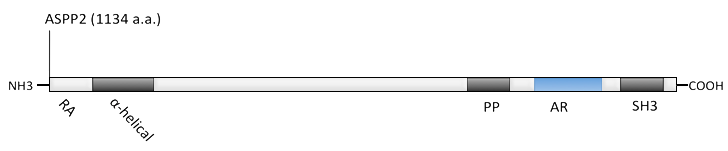
ASPP2 protein domains. RA=Ras-association domain; PP=polyproline domain; AR=ankyrin repeats.
Description
ASPP2 is a pro-apoptotic protein with a predicted size of approximately 135 kDa. It is the founding member of a family of ASPP proteins that all share the common motifs of four Ankyrin-repeats, a Src-homology 3 (SH3) domain, and a Polyproline domain in their C-terminus (Iwabuchi et al., 1994). The N-terminus of ASPP2 is thought to be important for regulating its apoptotic function and contains a putative Ras-association domain as well as a ubiquitin-like fold (Tidow et al., 2007). ASPP2 has been most widely studied for its ability to interact with and stimulate the apoptotic function of the tumor suppressor p53 (and p63/p73) but several studies have also demonstrated p53-independent as well as apoptosis-independent functions for ASPP2 as well (Kampa et al., 2009a).
ASPP2 was originally pulled out of a yeast two-hybrid screen using the p53-binding domain as bait as a partial C-terminal clone named 53BP2 (Iwabuchi et al., 1994). In 1996, Naumovski and Cleary determined that 53BP2 was a partial clone of a longer transcript they named Bcl-2 binding protein (Bbp or Bbp/53BP2) for its ability to bind the anti-apoptotic protein Bcl-2. It was later determined that Bbp is a splice isoform of the full length gene product from this locus, ASPP2 (Samuels-Lev et al., 2001).
ASPP2 was originally pulled out of a yeast two-hybrid screen using the p53-binding domain as bait as a partial C-terminal clone named 53BP2 (Iwabuchi et al., 1994). In 1996, Naumovski and Cleary determined that 53BP2 was a partial clone of a longer transcript they named Bcl-2 binding protein (Bbp or Bbp/53BP2) for its ability to bind the anti-apoptotic protein Bcl-2. It was later determined that Bbp is a splice isoform of the full length gene product from this locus, ASPP2 (Samuels-Lev et al., 2001).
Expression
Northern blot analysis, using a C-terminal probe, shows elevated levels of ASPP2 mRNA in several human tissues including heart, testis, and peripheral blood leukocytes (Yang et al., 1999). ASPP2 protein levels are controlled by proteasomal degradation (Zhu et al., 2005).
Localisation
ASPP2 contains a nuclear localization signal within its ankyrin repeat domain (amino acid residues 795-894) that when expressed alone or as a fusion with other proteins localizes in the nucleus of cells (Sachdev et al., 1998; Yang et al., 1999). Despite this signal however, full length ASPP2 is predominantly located in the cytoplasm and often seen near the cell periphery (Naumovski and Cleary, 1996; Iwabuchi et al., 1998; Yang et al., 1999).
Function
Apoptosis. Before ASPP2 was known to be the full length gene product from the TP53BP2 locus, Yang and colleagues showed that overexpression of Bbp/53BP2 in cells induces apoptosis (Yang et al., 1999). In 2000, Lopez et al. demonstrated that Bbp/53BP2 was UV-damage inducible and that loss of this endogenous protein promotes cell survival in response to damage, thus implicating a function in the damage response pathway. In 2001, Samuels-Lev et al. provided evidence that not only does full length ASPP2 promote apoptosis but that it does so, at least in part, through a p53-mediated mechanism that may involve preferential binding of p53 to its apoptotic target genes. ASPP2 has also been shown to modulate the apoptotic activity of the p53 family members, p63/p73 (Bergamaschi et al., 2004), and is known to bind other proteins involved in apoptosis such as Bcl-2 and NF-kappaB (Naumovski and Cleary, 1996; Yang et al., 1999). However, the functional ramifications of these interactions remain unclear. Additionally, there is evidence to indicate ASPP2 as a player in mitochondrial-mediated apoptosis (Kobayashi et al., 2005).
Tumor suppressor. Several clinical studies demonstrate low ASPP2 expression in a variety of human tumors (breast, lung, lymphoma) and this low expression often correlates with poor clinical outcome, suggesting that ASPP2 may function as a tumor suppressor (Mori et al., 2000; Samuels-Lev et al., 2001; Lossos et al., 2002; Cobleigh et al., 2005). In support of this concept, Iwabuchi et al. demonstrated in 1998 that transfection of 53BP2 inhibits Ras/E1A-mediated transformation in rat embryonic fibroblasts. Since then two separate mouse models targeting the ASPP2 locus via homologous recombination have demonstrated that loss of only one copy of ASPP2 increases spontaneous and irradiation-induced tumor formation in vivo (Vives et al., 2006; Kampa et al., 2009b). Taken together these data strongly suggest that ASPP2 is a haplo-insufficient tumor suppressor.
Cell cycle. Bbp, a splice isoform of ASPP2, can induce accumulation of cells in G2/M and thus impede cell cycle progression (Naumovski and Cleary, 1996). Additionally, ASPP2 appears to play a role in the G0/G1 cell cycle checkpoint in response to gamma-irradiation as murine thymocytes that lack one copy of the ASPP2 locus did not arrest at G0/G1 as efficiently as wild type thymocytes (Kampa et al., 2009b).
Cell polarity. ASPP2 is often seen near the cell periphery and has been shown to co-localize with and bind to the tight junction protein PAR-3. Furthermore, loss of ASPP2 expression correlates with a loss of tight junction integrity and an impaired ability to maintain apical domains in polarized cells in culture (Cong et al., 2010). Interestingly these findings hold true in vivo as well. ASPP2 co-localizes with the PAR-3 complex and apical junctions in the brain and is necessary for tight junction integrity. Targeted deletion of ASPP2 in the mouse leads to defects associated with a loss of structural organization in the brain and retina (Sottocornola et al., 2010).
Senescence. Senescence, a type of irreversible cell cycle arrest, is considered an intrinsic protective response against malignant transformation. Wang et al. recently identified ASPP2 as a mediator of Ras-induced senescence by demonstrating that mouse embryonic fibroblasts with a targeted deletion of exon 3 of the ASPP2 gene (TP53BP2) are less prone to senescence in the presence of activated Ras as compared to wild type fibroblasts (as measured by beta-galactosidase staining). Data also suggests that Ras-induced senescence may be mediated by ASPP2 through its ability to inhibit Ras from inducing accumulation of cyclin D1 in the nucleus (Wang et al., 2011).
Tumor suppressor. Several clinical studies demonstrate low ASPP2 expression in a variety of human tumors (breast, lung, lymphoma) and this low expression often correlates with poor clinical outcome, suggesting that ASPP2 may function as a tumor suppressor (Mori et al., 2000; Samuels-Lev et al., 2001; Lossos et al., 2002; Cobleigh et al., 2005). In support of this concept, Iwabuchi et al. demonstrated in 1998 that transfection of 53BP2 inhibits Ras/E1A-mediated transformation in rat embryonic fibroblasts. Since then two separate mouse models targeting the ASPP2 locus via homologous recombination have demonstrated that loss of only one copy of ASPP2 increases spontaneous and irradiation-induced tumor formation in vivo (Vives et al., 2006; Kampa et al., 2009b). Taken together these data strongly suggest that ASPP2 is a haplo-insufficient tumor suppressor.
Cell cycle. Bbp, a splice isoform of ASPP2, can induce accumulation of cells in G2/M and thus impede cell cycle progression (Naumovski and Cleary, 1996). Additionally, ASPP2 appears to play a role in the G0/G1 cell cycle checkpoint in response to gamma-irradiation as murine thymocytes that lack one copy of the ASPP2 locus did not arrest at G0/G1 as efficiently as wild type thymocytes (Kampa et al., 2009b).
Cell polarity. ASPP2 is often seen near the cell periphery and has been shown to co-localize with and bind to the tight junction protein PAR-3. Furthermore, loss of ASPP2 expression correlates with a loss of tight junction integrity and an impaired ability to maintain apical domains in polarized cells in culture (Cong et al., 2010). Interestingly these findings hold true in vivo as well. ASPP2 co-localizes with the PAR-3 complex and apical junctions in the brain and is necessary for tight junction integrity. Targeted deletion of ASPP2 in the mouse leads to defects associated with a loss of structural organization in the brain and retina (Sottocornola et al., 2010).
Senescence. Senescence, a type of irreversible cell cycle arrest, is considered an intrinsic protective response against malignant transformation. Wang et al. recently identified ASPP2 as a mediator of Ras-induced senescence by demonstrating that mouse embryonic fibroblasts with a targeted deletion of exon 3 of the ASPP2 gene (TP53BP2) are less prone to senescence in the presence of activated Ras as compared to wild type fibroblasts (as measured by beta-galactosidase staining). Data also suggests that Ras-induced senescence may be mediated by ASPP2 through its ability to inhibit Ras from inducing accumulation of cyclin D1 in the nucleus (Wang et al., 2011).
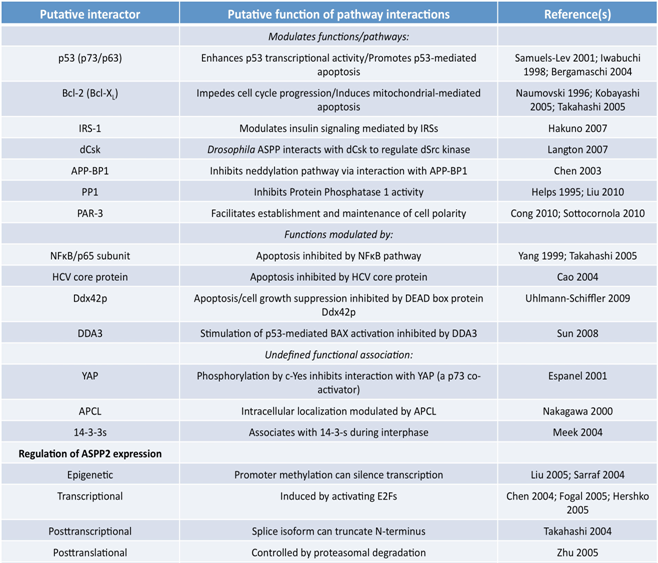
Potential functions and putative interacting partners of ASPP2. Modified from Kampa et al., 2009a.
Homology
ASPP2 is a member of the ASPP family of proteins that share a significant amount of homology in their C-terminal domains. ASPP1, ASPP2, and the splice isoform of ASPP2, BBP, share homology in both their N-terminal and C-terminal domains while the family member iASPP only retains C-terminal homology (Samuels-Lev et al., 2001; Bergamaschi et al., 2003).
Mutations
Note
No mutations at the ASPP2 locus, TP53BP2, have been reported. However, single nucleotide polymorphisms in TP53BP2 have been found associated with gastric cancer susceptibility (Ju et al., 2005) and epigenetic silencing of the promoter by methylation is frequently observed (Sarraf and Stancheva, 2004; Liu et al., 2005; Zhao et al., 2010).
Implicated in
Entity name
Breast cancer
Note
ASPP2 mRNA expression is frequently downregulated in human breast cancer samples as compared to adjacent normal tissue (Sgroi et al., 1999; Samuels-Lev et al., 2001; Cobleigh et al., 2005). Reduced levels of ASPP2 expression are seen in both invasive and metastatic breast tumor tissue (Sgroi et al., 1999) and ASPP2 downregulation may be favored in tumor cells expressing wild type but not mutant p53 (Samuels-Lev et al., 2001).
Prognosis
Elevated levels of ASPP2 mRNA were correlated with a lower risk of distant recurrence of disease among a panel of 78 patients with extensive lymph node involvement (Cobleigh et al., 2005).
Entity name
Non-Hodgkins lymphoma specifically diffuse large B-cell lymphoma, follicular center lymphoma, and Burkitts lymphoma
Note
Overall, ASPP2 expression (as measured by Real-time RT-PCR) was found to be significantly higher in diffuse large B-cell lymphoma as compared to follicular center lymphoma. However, the variability of ASPP2 expression in diffuse large B-cell lymphoma was much greater than that seen in follicular center lymphoma. ASPP2 expression appeared inversely proportional to serum lactate dehydrogenase levels. Additionally, levels of ASPP2 expression are extremely low or undetectable in cell lines derived from Burkitts lymphoma (Lossos et al., 2002).
Prognosis
In general, patients with high ASPP2 expression tended to have a longer median survival than those with low ASPP2 expression (Lossos et al., 2002).
Entity name
Gastric cancer
Note
Four single nucleotide polymorphisms within the ASPP2 gene locus, TP53BP2, show significant correlation with gastric cancer susceptibility (Ju et al., 2005).
Entity name
Hepatitis B virus-positive hepatocellular carcinoma
Note
Downregulation of ASPP2 (and ASPP1) as a result of promoter hypermethylation (as measured by methylation-specific PCR) is frequently observed in human patient samples of HBV-positive hepatocellular carcinoma as compared to surrounding non-tumor tissue (Zhao et al., 2010).
Article Bibliography
| Pubmed ID | Last Year | Title | Authors |
|---|---|---|---|
| 14729977 | 2004 | ASPP1 and ASPP2: common activators of p53 family members. | Bergamaschi D et al |
| 14985081 | 2004 | Hepatitis C virus core protein interacts with p53-binding protein, 53BP2/Bbp/ASPP2, and inhibits p53-mediated apoptosis. | Cao Y et al |
| 15592436 | 2005 | Apoptosis-stimulating protein of p53-2 (ASPP2/53BP2L) is an E2F target gene. | Chen D et al |
| 12694406 | 2003 | ASPP2 inhibits APP-BP1-mediated NEDD8 conjugation to cullin-1 and decreases APP-BP1-induced cell proliferation and neuronal apoptosis. | Chen Y et al |
| 16361546 | 2005 | Tumor gene expression and prognosis in breast cancer patients with 10 or more positive lymph nodes. | Cobleigh MA et al |
| 20619648 | 2010 | ASPP2 regulates epithelial cell polarity through the PAR complex. | Cong W et al |
| 11278422 | 2001 | Yes-associated protein and p53-binding protein-2 interact through their WW and SH3 domains. | Espanel X et al |
| 15731768 | 2005 | ASPP1 and ASPP2 are new transcriptional targets of E2F. | Fogal V et al |
| 17965023 | 2007 | 53BP2S, interacting with insulin receptor substrates, modulates insulin signaling. | Hakuno F et al |
| 8549741 | 1995 | Protein phosphatase 1 interacts with p53BP2, a protein which binds to the tumour suppressor p53. | Helps NR et al |
| 15706352 | 2005 | Novel link between E2F and p53: proapoptotic cofactors of p53 are transcriptionally upregulated by E2F. | Hershko T et al |
| 9748285 | 1998 | Stimulation of p53-mediated transcriptional activation by the p53-binding proteins, 53BP1 and 53BP2. | Iwabuchi K et al |
| 15986435 | 2005 | TP53BP2 locus is associated with gastric cancer susceptibility. | Ju H et al |
| 19251665 | 2009 | Apoptosis-stimulating protein of p53 (ASPP2) heterozygous mice are tumor-prone and have attenuated cellular damage-response thresholds. | Kampa KM et al |
| 19657229 | 2009 | New insights into the expanding complexity of the tumor suppressor ASPP2. | Kampa KM et al |
| 15743414 | 2005 | 53BP2 induces apoptosis through the mitochondrial death pathway. | Kobayashi S et al |
| 18061561 | 2007 | Drosophila ASPP regulates C-terminal Src kinase activity. | Langton PF et al |
| 21189257 | 2011 | PP1 cooperates with ASPP2 to dephosphorylate and activate TAZ. | Liu CY et al |
| 15757645 | 2005 | Downregulated mRNA expression of ASPP and the hypermethylation of the 5'-untranslated region in cancer cell lines retaining wild-type p53. | Liu ZJ et al |
| 11027272 | 2000 | Proapoptotic p53-interacting protein 53BP2 is induced by UV irradiation but suppressed by p53. | Lopez CD et al |
| 12613517 | 2002 | Apoptosis stimulating protein of p53 (ASPP2) expression differs in diffuse large B-cell and follicular center lymphoma: correlation with clinical outcome. | Lossos IS et al |
| 15161933 | 2004 | Comprehensive proteomic analysis of interphase and mitotic 14-3-3-binding proteins. | Meek SE et al |
| 10631318 | 2000 | Aberrant overexpression of 53BP2 mRNA in lung cancer cell lines. | Mori T et al |
| 10646860 | 2000 | APCL, a central nervous system-specific homologue of adenomatous polyposis coli tumor suppressor, binds to p53-binding protein 2 and translocates it to the perinucleus. | Nakagawa H et al |
| 8668206 | 1996 | The p53-binding protein 53BP2 also interacts with Bc12 and impedes cell cycle progression at G2/M. | Naumovski L et al |
| 9566872 | 1998 | Nuclear localization of IkappaB alpha is mediated by the second ankyrin repeat: the IkappaB alpha ankyrin repeats define a novel class of cis-acting nuclear import sequences. | Sachdev S et al |
| 11684014 | 2001 | ASPP proteins specifically stimulate the apoptotic function of p53. | Samuels-Lev Y et al |
| 15327775 | 2004 | Methyl-CpG binding protein MBD1 couples histone H3 methylation at lysine 9 by SETDB1 to DNA replication and chromatin assembly. | Sarraf SA et al |
| 10582678 | 1999 | In vivo gene expression profile analysis of human breast cancer progression. | Sgroi DC et al |
| 20619750 | 2010 | ASPP2 binds Par-3 and controls the polarity and proliferation of neural progenitors during CNS development. | Sottocornola R et al |
| 18793611 | 2008 | p53 target DDA3 binds ASPP2 and inhibits its stimulation on p53-mediated BAX activation. | Sun WT et al |
| 16098144 | 2005 | Inhibition of the 53BP2S-mediated apoptosis by nuclear factor kappaB and Bcl-2 family proteins. | Takahashi N et al |
| 17594908 | 2007 | Solution structure of ASPP2 N-terminal domain (N-ASPP2) reveals a ubiquitin-like fold. | Tidow H et al |
| 19377511 | 2009 | The DEAD box protein Ddx42p modulates the function of ASPP2, a stimulator of apoptosis. | Uhlmann-Schiffler H et al |
| 16702401 | 2006 | ASPP2 is a haploinsufficient tumor suppressor that cooperates with p53 to suppress tumor growth. | Vives V et al |
| 20798689 | 2011 | SUMO-modified nuclear cyclin D1 bypasses Ras-induced senescence. | Wang XD et al |
| 10498867 | 1999 | NF-kappaB subunit p65 binds to 53BP2 and inhibits cell death induced by 53BP2. | Yang JP et al |
| 9345910 | 1997 | Assignment of p53 binding protein (TP53BP2) to human chromosome band 1q42.1 by in situ hybridization. | Yang JP et al |
| 20034025 | 2010 | Epigenetic silence of ankyrin-repeat-containing, SH3-domain-containing, and proline-rich-region- containing protein 1 (ASPP1) and ASPP2 genes promotes tumor growth in hepatitis B virus-positive hepatocellular carcinoma. | Zhao J et al |
| 16091363 | 2005 | Control of ASPP2/(53BP2L) protein levels by proteasomal degradation modulates p53 apoptotic function. | Zhu Z et al |
Other Information
Locus ID:
NCBI: 7159
MIM: 602143
HGNC: 12000
Ensembl: ENSG00000143514
Variants:
dbSNP: 7159
ClinVar: 7159
TCGA: ENSG00000143514
COSMIC: TP53BP2
RNA/Proteins
Expression (GTEx)
Pathways
Protein levels (Protein atlas)
References
| Pubmed ID | Year | Title | Citations |
|---|---|---|---|
| 37858684 | 2024 | Higher TP53BP2 expression is associated with HBsAg loss in peginterferon-α-treated patients with chronic hepatitis B. | 0 |
| 37858684 | 2024 | Higher TP53BP2 expression is associated with HBsAg loss in peginterferon-α-treated patients with chronic hepatitis B. | 0 |
| 36877271 | 2023 | mRNA sequencing and CyTOF analysis revealed ASPP2 altered the response patterns of hepatocellular carcinoma HepG2 cells to usnic acid. | 1 |
| 37750869 | 2023 | ASPP2 binds to hepatitis C virus NS5A protein via an SH3 domain/PxxP motif-mediated interaction and potentiates infection. | 0 |
| 36877271 | 2023 | mRNA sequencing and CyTOF analysis revealed ASPP2 altered the response patterns of hepatocellular carcinoma HepG2 cells to usnic acid. | 1 |
| 37750869 | 2023 | ASPP2 binds to hepatitis C virus NS5A protein via an SH3 domain/PxxP motif-mediated interaction and potentiates infection. | 0 |
| 35177595 | 2022 | ASPP2 maintains the integrity of mechanically stressed pseudostratified epithelia during morphogenesis. | 2 |
| 35780096 | 2022 | Alternative splicing of Apoptosis Stimulating Protein of TP53-2 (ASPP2) results in an oncogenic isoform promoting migration and therapy resistance in soft tissue sarcoma (STS). | 0 |
| 35177595 | 2022 | ASPP2 maintains the integrity of mechanically stressed pseudostratified epithelia during morphogenesis. | 2 |
| 35780096 | 2022 | Alternative splicing of Apoptosis Stimulating Protein of TP53-2 (ASPP2) results in an oncogenic isoform promoting migration and therapy resistance in soft tissue sarcoma (STS). | 0 |
| 34085409 | 2021 | ASPP2 inhibits hepatitis B virus replication by preventing nucleus translocation of HSF1 and attenuating the transactivation of ATG7. | 4 |
| 34085409 | 2021 | ASPP2 inhibits hepatitis B virus replication by preventing nucleus translocation of HSF1 and attenuating the transactivation of ATG7. | 4 |
| 31964836 | 2020 | CagA-ASPP2 complex mediates loss of cell polarity and favors H. pylori colonization of human gastric organoids. | 29 |
| 32266459 | 2020 | ASPP2 suppression promotes malignancy via LSR and YAP in human endometrial cancer. | 10 |
| 32420372 | 2020 | Mir-30b-5p Promotes Proliferation, Migration, and Invasion of Breast Cancer Cells via Targeting ASPP2. | 6 |
Citation
Kathryn Van Hook ; Zhiping Wang ; Charles Lopez
TP53BP2 (tumor protein p53 binding protein, 2)
Atlas Genet Cytogenet Oncol Haematol. 2011-01-01
Online version: http://atlasgeneticsoncology.org/gene/42667/tp53bp2
