Juvenile myelomonocytic leukemia (JMML)
2019-08-01 Karen M. Chisholm Affiliation1.Department of Laboratories, Seattle Childrens Hospital, Seattle, WA, USA; [email protected]
2.Department of Pathology, The University of Michigan, M5240 Medical Science I, 1301 Catherine Avenue, Ann Arbor, MI 48109-0602, USA
Abstract
Review on juvenile myelomonocytic leukemia, with data on clinics, pathology, and involved genes.
Clinics and Pathology
Disease
JMML is a chronic myeloproliferative disorder that typically affects young children: more than 95% of cases are diagnosed before age 4
Phenotype stem cell origin
JMML arises from pluripotent hematopoietic stem cells (Cooper et al., 2000). Clonal proliferations of myeloid, monocyte-macrophages, erythroid, and sometimes lymphoid progenitor cells are seen.
Epidemiology
The annual incidence of JMML is estimated to be roughly 0.67/million (Passmore et al, 2003). The median age is 1.1-1.8 years with a male to female ratio of 2-3:1. (Hasle et al., 1999; Niemeyer et al., 1997; Passmore et al., 2003). Those with neurofibromatosis type 1 (NF-1) have a 200-fold increased risk of JMML (Stiller et al., 1994)
Clinics
| Clinical and hematologic features (all 4 required) | ||
Genetic criteria (1 finding is sufficient) | ||
Other criteria* | ||
or |
| |
* (those not meeting genetic criteria but having clinical and hematologic criteria must also have).
(Locatelli and Neimeyer, 2015; Baumann, et al., 2017)
Cytology
Typical peripheral blood findings include leukocytosis (usually less than 100 x 109/L) with variable degree of left shift, monocytosis, and thrombocytopenia. Nucleated red blood cells are often identified in the peripheral blood. Myeloblasts average about 1-5% of total nucleated cells, and by definition, blasts account for
Pathology
Bone marrow findings are not specific. The marrow is usually hypercellular with a mildly increased M:E ratio (typically 3-5:1), dispersed erythroid elements, and decreased numbers of megakaryocytes. Dysplasia is usually not prominent. Blasts are required to be less than 20%; monocytes are less prominent in the marrow than in the peripheral blood, and are usually enumerated at 5-10% (Hess et al., 1996; Niemeyer et al., 1997).
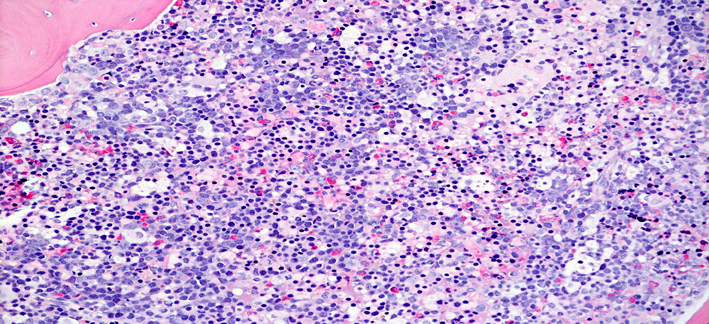
A 21 month old boy presented with peripheral monocytosis, increased fetal hemoglobin. His bone marrow aspirate showed
Other features
Aberrant flow immunophenotype antigens can be seen in monocytes, neutrophils, and blasts in JMML. Monocytes can show decreased expression of CD4 and heterogeneous CD33. Maturing neutrophils may show decreased expression of CD10, CD64, CD13, and/or CD15. Myeloid blasts can express aberrant CD7. B cell precursors (hematogones) are often decreased (Maioli et al. 2016).
Treatment
Curative therapy involves an allogeneic hematopoietic stem cell transplant (HSCT). Locatelli and Neimeyer (2015) recommend swift HSCT for those with germline NF1 mutations, somatic PTPN11 mutations, somatic KRAS mutations, and most children with somatic NRAS mutations. Most children with germline CBL mutations demonstrate spontaneous regression, though if there is disease progression, a HSCT should be considered. In children with Noonan syndrome (germline mutations of PTPN11, KRAS, and/or NRAS), the disease may be transient, and hence one can consider a watch and wait scenario, with mild cytoreductive therapy for symptoms, usually 6-mercaptopruine.
In the rare patients with tyrosine kinase fusions, ALK/ROS1 inhibitors, such as crizotinib, may be beneficial (Murakami et al., 2018).
In the rare patients with tyrosine kinase fusions, ALK/ROS1 inhibitors, such as crizotinib, may be beneficial (Murakami et al., 2018).
Evolution
As stated above, those with Noonan syndrome with germline mutations in PTPN11, KRAS, and/or NRAS as well as those with germline CBL mutations have disease that may spontaneously regress without therapy (Locatelli and Neimeyer, 2015). However, in other cases, in those who did not receive an allogeneic hematopoietic stem cell transplant (HSCT), the median survival after diagnosis is
Prognosis
High risk features include older age (>1.4-4 years), PTPN11 mutation, monosomy 7, HbF >40%, low platelets (20% bone marrow blasts (Dvorak and Loh, 2014; Locatelli et al., 2005; Niemeyer et al., 1997; Novitzky et al., 2000; Passmore et al., 2003). In genetic studies, patients with
Note
Approximately 85-90% of children with JMML have identified mutations, either germline and/or somatic. Somatic, gain-of-function mutations occur in PTPN11, KRAS, and NRAS, in 35-38%, 18%, and 14% of cases respectively. NF1 germline mutations with acquired loss of the normal allele are seen in 5-15% of patients, and CBL germline mutations with acquired loss of the normal allele and duplication of the mutant allele (acquired uniparental disomy) are seen in 9-18% of patients. (Chan et al., 2009; Niemeyer and Flotho, 2019). Rare cases without any of the above mutations have been found to harbor RRAS or RRAS2 somatic mutations (Stieglitz et al., 2015).
Secondary mutations in SETBP1, JAK3, ASXL1, and SH2B3 are also identified and are often subclonal. Additional mutations in the RAS pathway genes are also sometimes detected, coined Ras double mutants (Caye et al., 2015; Stieglitz et al., 2015).
A recent study reported receptor tyrosine kinase fusions ( DCTN1 /ALK, RANBP2 /ALK, and TBL1XR1 / ROS1) in patients without identified RAS pathway mutations (Murakami et al., 2018).
Secondary mutations in SETBP1, JAK3, ASXL1, and SH2B3 are also identified and are often subclonal. Additional mutations in the RAS pathway genes are also sometimes detected, coined Ras double mutants (Caye et al., 2015; Stieglitz et al., 2015).
A recent study reported receptor tyrosine kinase fusions ( DCTN1 /ALK, RANBP2 /ALK, and TBL1XR1 / ROS1) in patients without identified RAS pathway mutations (Murakami et al., 2018).
Genes Involved and Proteins
Gene name
Location
11q23.3
Note
There is a high rate of spontaneous resolution of disease without stem cell transplant in those with homozygous mutations including a germline mutation (Chang et al., 2014).
Dna rna description
16 exons.
Protein description
This oncogene encodes a RING finger E3 ubiquitin ligase which marks activated receptor and nonreceptor tyrosine kinases and other proteins for degradation by ubiquitination. Homozygous mutations lead to continuous activation of RAS. (Chang et al., 2014).
Germinal mutations
Germline heterozygous mutations (autosomal dominant) lead to a Noonan syndrome-like disorder. The most common mutation is c.1111T>C (Y371H); other common mutations are missense mutations in exons 8 and 9 or in introns 7 or 8 (Loh et al., 2009).
Somatic mutations
Loss of wild-type allele with duplication of mutant allele.
Gene name
Location
12p12.1
Note
Somatic mutations also occur in RALD (Ras-associated lymphoproliferative disease).
Dna rna description
6 exons.
Protein description
A Ras oncogene which encodes a member of the small GTPase superfamily. Mutations lead to activation.
Germinal mutations
Germline heterozygous mutations (autosomal dominant) lead to Noonan syndrome.
Somatic mutations
Somatic mutations are usually point mutations at codons G12, G13, and Q61 (exons 2 and 3) leading to amino acid substitutions (Chan et al., 2009; Chang et al., 2014).
Gene name
NF1 (neurofibromin 1)
Location
17q11.2
Dna rna description
57-58 exons (depending on transcript variant).
Protein description
GTPase activating protein for Ras. Normally acts as tumor suppressor by inhibiting Ras signaling
Germinal mutations
Germline mutations cause neurofibromatosis type 1 (NF1) characterized by café-au-lait spots, Lisch nodules, neurofibromas, optic pathway gliomas.
Somatic mutations
Somatic mutations are usually deletions leading to loss of heterozygosity with duplication of the mutated germline allele.
Gene name
Location
1p13.2
Note
Somatic mutations also occur in RALD (Ras-associated lymphoproliferative disease).
Dna rna description
7 exons.
Protein description
A Ras oncogene which encodes a membrane protein with intrinsic GTPase activity that shuttles between the Golgi apparatus and the plasma membrane.
Germinal mutations
Germline heterozygous mutations (autosomal dominant) lead to Noonan syndrome.
Somatic mutations
Somatic mutations are usually point mutations at codons G12, G13, and Q61 (exons 2 and 3) leading to amino acid substitutions (Chan et al., 2009; Chang et al., 2014).
Gene name
Location
12q24.13
Dna rna description
16 exons
Protein description
A member of the protein tyrosine phosphatase family which relays signals from activated GM-CSF receptor complexes, regulating proliferation, differentiation, and migration.
Germinal mutations
Germline mutations (autosomal dominant) lead to Noonan syndrome, usually within exons 3, 4, and 13.
Somatic mutations
Somatic mutations usually involve exons 3, 4, and 13, with most common mutations being: c.226G>A (E76K), c.214G>A, c.227A>G, c.1508G>C. (Chan et al., 2009; Chang et al., 2014).
Article Bibliography
| Pubmed ID | Last Year | Title | Authors |
|---|---|---|---|
| 9226148 | 1997 | Juvenile myelomonocytic leukemia. | Aricò M et al |
| 794710 | 1976 | Biological assay of fungicides against yeasts in vitro using a coulter counter. | Brotherton J et al |
| 25691160 | 2015 | JMML and RALD (Ras-associated autoimmune leukoproliferative disorder): common genetic etiology yet clinically distinct entities. | Calvo KR et al |
| 26457648 | 2015 | Juvenile myelomonocytic leukemia displays mutations in components of the RAS pathway and the PRC2 network. | Caye A et al |
| 18954903 | 2009 | Juvenile myelomonocytic leukemia: a report from the 2nd International JMML Symposium. | Chan RJ et al |
| 25163700 | 2014 | Bedside to bench in juvenile myelomonocytic leukemia: insights into leukemogenesis from a rare pediatric leukemia. | Chang TY et al |
| 10979983 | 2000 | Evidence that juvenile myelomonocytic leukemia can arise from a pluripotential stem cell. | Cooper LJ et al |
| 24734223 | 2014 | Juvenile myelomonocytic leukemia: molecular pathogenesis informs current approaches to therapy and hematopoietic cell transplantation. | Dvorak CC et al |
| 3067044 | 1988 | [Immunotoxicology]. | Hanke J et al |
| 10086728 | 1999 | Myelodysplastic syndrome, juvenile myelomonocytic leukemia, and acute myeloid leukemia associated with complete or partial monosomy 7. European Working Group on MDS in Childhood (EWOG-MDS). | Hasle H et al |
| 8607451 | 1996 | Juvenile chronic myelogenous leukemia. | Hess JL et al |
| 29259247 | 2017 | RAS-pathway mutation patterns define epigenetic subclasses in juvenile myelomonocytic leukemia. | Lipka DB et al |
| 25564399 | 2015 | How I treat juvenile myelomonocytic leukemia. | Locatelli F et al |
| 19571318 | 2009 | Mutations in CBL occur frequently in juvenile myelomonocytic leukemia. | Loh ML et al |
| 25956043 | 2016 | Flow cytometry as a diagnostic support tool in juvenile myelomonocytic leukemia. | Maioli MC et al |
| 29437595 | 2018 | Integrated molecular profiling of juvenile myelomonocytic leukemia. | Murakami N et al |
| 9160658 | 1997 | Chronic myelomonocytic leukemia in childhood: a retrospective analysis of 110 cases. European Working Group on Myelodysplastic Syndromes in Childhood (EWOG-MDS). | Niemeyer CM et al |
| 10706766 | 2000 | Myelodysplastic syndromes in children. A critical review of the clinical manifestations and management. | Novitzky N et al |
| 12780790 | 2003 | Paediatric myelodysplastic syndromes and juvenile myelomonocytic leukaemia in the UK: a population-based study of incidence and survival. | Passmore SJ et al |
| 29259179 | 2017 | Genome-wide DNA methylation is predictive of outcome in juvenile myelomonocytic leukemia. | Stieglitz E et al |
Summary
Note
This current topic of JMML does not include discussion on Ras-associated autoimmune leukoproliferative disorder (RALD), which is a nonmalignant disorder with myelomonocytic hyperplasia and somatic mutations in KRAS or NRAS, often showing clinical overlap with JMML (Calvo et al., 2015)
Citation
Karen M. Chisholm
Juvenile myelomonocytic leukemia (JMML)
Atlas Genet Cytogenet Oncol Haematol. 2019-08-01
Online version: http://atlasgeneticsoncology.org/haematological/1099/juvenile-myelomonocytic-leukemia-(jmml)
Historical Card
2000-12-01 Juvenile myelomonocytic leukemia (JMML) by Jay L. Hess Affiliation
Department of Pathology, The University of Michigan, M5240 Medical Science I, 1301 Catherine Avenue, Ann Arbor, MI 48109-0602, USA
