Abstract
CDC25A phosphatase is essential for cell cycle progression by activating the cyclin-associated kinases CDK4\/6, CDK2 and CDK1. Its invalidation in mice is embryonic lethal. Its expression is tigthtly regulated at many levels and its overexpression is observed in various cancers, often associated with high grade tumors and poor prognosis.
DNA/RNA
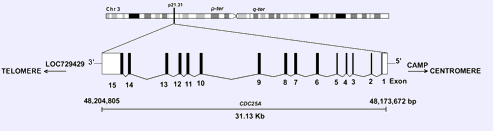
Description
Transcription
Proteins
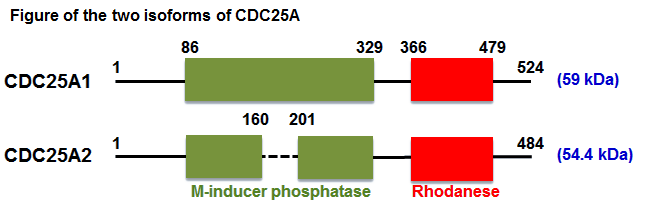
Description
Expression
Localisation
Function
- It is a member of the M-phase inducer (MPI) phosphatase family protein, which not only regulates mitotic progression by activating mitotic CDKs in a dosage-dependent manner, it is also equally important in G1 and for G1 to S-phase transition.
- During G1, CDC25A dephosphorylates CDK4/CDK6 on tyrosine 17 and 24, respectively, allowing their association with D-type cyclins and thus their activation (Bertero et al., 2013). During G1 to S transition, it activates CDK2 by removing two inhibitory phosphates on residues threonine 14 and tyrosine 15. During G2/M transition CDC25A similarly regulates the activity of CDK1 (CDC2).
- It is an inhibitor of apoptosis by inhibiting apoptosis signal-regulating kinase 1 (ASK1). in a phosphatase-independent manner, by activating the AKT-survival pathway in the cytoplasm and also by stimulating NF-kB activity through NFKBIA (IκB- α) destabilization (review Fernandez-Vidal et al., 2008; review Shen and Huang, 2012; Hong et al., 2012). But overexpressed nuclear CDC25A also exhibits pro apoptotic activity by activating the pro-apoptotic factor FKHLR1 (review Fernandez-Vidal et al., 2008; review Shen and Huang, 2012).
- CDC25A plays an important role in spermatogenesis as decreased transcript level of Cdc25A is correlated with spermatogenic failure and failed sperm retrieval in infertile men. (Cheng et al., 2009).
-CDC25A also plays a role in meiotic maturation of oocytes, its activity is required for the metaphase II arrest in mouse oocytes (Oh et al., 2013).
- CDC25A was shown to function as a androgen receptor corepressor in prostate cancer cells (Chiu et al., 2009).
Regulation
- CDC25A is transcriptionally regulated by E2F, a transcription factor implicated at the G1/S transition, c-myc, STAT3, the p53-pathway via the transcription factor ATF3, TCF/beta-catenin, FOXM1, NANOG in embryonic stem cell and PROX1 in neural precursor (review Fernandez-Vidal et al., 2008; review Shen and Huang, 2012).
- CDC25A is also regulated at the translational level by the translation initiation factors EIF2S1 (eIF2alpha), EIF3M, the RNA-binding proteins BOLL in spermatogenesis, and various miRNAs such as let7b, 15a, 21, 449a, 449b, 483-3p, 424/503 cluster and 141-3p. Some of these miRNAs being deregulated in cancers can contribute to the overexpression of CDC25A in cancers.
- CDC25A activity can be regulated by phosphorylation events (review Fernandez-Vidal et al., 2008; review Shen and Huang, 2012). The kinases PIM-1, RAF1, CDK2, RSK, ROCK1 (p160Rock) and the phosphatase CDC14B have been shown to regulate CDC25A activity. The kinase CHK1 has been shown to phosphorylate CDC25A on serine 178 and threonine 507 preventing its interaction with its CDK/cyclin substrates.
- CDC25A is an unstable protein in interphase, or under several different stress conditions (DNA damage induced by ionizing radiation, ultraviolet light, replicative stress) being degraded by the proteasome after ubiquitination by SCFβTrCP E3 ubiquitin ligase. This ubiquitination is dependent on several phosphorylation events in the N-terminal part of the protein carried out by many kinases such as CHK1 (on serine 76, 124, 178, 279 and 293), CHK2 (on serine 124, 178 and 293), p38MAPK (on serine 76), GSK3-β (on serine 76), Plk3 (on threonine 80), NEK11 (on serine 82 and 88) and CK1alpha and epsilon (on serine 82) (review Fernandez-Vidal et al., 2008; review Shen and Huang, 2012).
- CDC25A protein is stabilized during mitosis due to phosphorylation on serine 18 and 116 by CDK1/cyclinB occuring at the G2/M transition (Mailand et al., 2002). At the mitotic exit and in early G1, CDC25A is degraded by the proteasome after ubiquitination by the E3 ubiquitine ligase APC/C (cyclosome) (review Fernandez-Vidal et al., 2008; review Shen and Huang, 2012).
- CDC25A protein level is important for oncogene-induced transformation and mouse mammary tumor virus (MMTV)-neu/ras induced mammary tumorigenesis (Ray et al., 2007).
- During early cell cycle progression glycogen synthase kinase 3-beta (GSK-3β) can phosphorylate allowing its proteasomal degradation. Interestingly, the same report showed that overproduction of CDC25A in some human cancers is correlated to the inactivation of GSK-3β (Kang et al., 2008).
- Overexpression of CDC25A in some human sarcomas has also been shown to be the result of transcriptional upregulation involving the transcription factor TCF/β-catenin upregulated upon activation of the wnt canonical signaling (Vijayakumar et al.,2011). HOMOLOGY CDC25A gene is highly conserved among mammals (99% homology with Chimpanzee; 90% with dog; about 86% with rat and about 85% with mouse). In mammals, CDC25A has two orthologs, CDC25B and CDC25C. Among them, the N-terminal regulatory region show low sequence homology (20-25% identity), however, the C-terminal catalytic region is quite conserved with about 64% homology with CDC25B and about 58% homology to CDC25C.
Mutations
Note
Implicated in
- An upregulation of CDC25A activity due to its phosphorylation by deregulated CDK5 has been observed in Alzheimers disease (Chang et al., 2012).
- In some breast cancer cell lines it was reported that CDC25A overexpression is mainly due to increased protein stability as oppose to gene amplification or transcriptional upregulation. (Löffler et al., 2003). In a subset of human breast cancers overexpression of the ubiquitin hydrolase DUB3, which deubiquitinates CDC25A preventing its degradation, is shown to be responsible for overexpression of CDC25A (Pereg et al., 2010).
- In mice, overexpression of CDC25A alone in mammary gland using mouse mammary tumor virus (MMTV) promoter, is not sufficient to induce mammary tumorigenesis. However, such mammary specific overexpression of CDC25A does cooperate with HER2/neu-ras signaling to form more aggressive tumors with enhanced genomic instability. (Ray et al., 2007).
- In contrast, hemizygous loss of Cdc25A in mice protected them significantly from MMTV-neu/ras-induced mammary tumorigenesis, possibly by restricting precancerous cell proliferation and also by enhancing G2-checkpoint response. Thus the protein level of CDC25A is crucial for the initiation and/or progression of breast tumorigenesis in mice (Ray and Kiyokawa, 2007).
Article Bibliography
| Pubmed ID | Last Year | Title | Authors |
|---|---|---|---|
| 21310058 | 2011 | A human cancer-predisposing polymorphism in Cdc25A is embryonic lethal in the mouse and promotes ASK-1 mediated apoptosis. | Bahassi el M et al |
| 11698191 | 2001 | Mammalian G1- and S-phase checkpoints in response to DNA damage. | Bartek J et al |
| 23429262 | 2013 | CDC25A targeting by miR-483-3p decreases CCND-CDK4/6 assembly and contributes to cell cycle arrest. | Bertero T et al |
| 16488126 | 2006 | The when and wheres of CDC25 phosphatases. | Boutros R et al |
| 17568790 | 2007 | CDC25 phosphatases in cancer cells: key players? Good targets? | Boutros R et al |
| 22899714 | 2012 | Deregulated Cdk5 triggers aberrant activation of cell cycle kinases and phosphatases inducing neuronal death. | Chang KH et al |
| 16720623 | 2006 | Association of spermatogenic failure with decreased CDC25A expression in infertile men. | Cheng YS et al |
| 19013180 | 2009 | CDC25A functions as a novel Ar corepressor in prostate cancer cells. | Chiu YT et al |
| 20368335 | 2010 | Pro-apoptotic role of Cdc25A: activation of cyclin B1/Cdc2 by the Cdc25A C-terminal domain. | Chou ST et al |
| 8276402 | 1993 | Chromosome mapping of human CDC25A and CDC25B phosphatases. | Demetrick DJ et al |
| 19305144 | 2009 | Upregulation of the CDC25A phosphatase down-stream of the NPM/ALK oncogene participates to anaplastic large cell lymphoma enhanced proliferation. | Fernandez-Vidal A et al |
| 1836978 | 1991 | Specific activation of cdc25 tyrosine phosphatases by B-type cyclins: evidence for multiple roles of mitotic cyclins. | Galaktionov K et al |
| 22065597 | 2012 | The cell cycle regulator CDC25A is a target for JAK2V617F oncogene. | Gautier EF et al |
| 22417828 | 2012 | Cdc25A promotes cell survival by stimulating NF-κB activity through IκB-α phosphorylation and destabilization. | Hong HY et al |
| 15572030 | 2005 | Cdc25A localisation and shuttling: characterisation of sequences mediating nuclear export and import. | Källström H et al |
| 18167338 | 2008 | GSK-3 beta targets Cdc25A for ubiquitin-mediated proteolysis, and GSK-3 beta inactivation correlates with Cdc25A overproduction in human cancers. | Kang T et al |
| 18246350 | 2008 | 2-Methoxyestradiol inhibits hepatocellular carcinoma cell growth by inhibiting Cdc25 and inducing cell cycle arrest and apoptosis. | Kar S et al |
| 14603247 | 2003 | Distinct modes of deregulation of the proto-oncogenic Cdc25A phosphatase in human breast cancer cell lines. | Löffler H et al |
| 10827953 | 2000 | Rapid destruction of human Cdc25A in response to DNA damage. | Mailand N et al |
| 12411508 | 2002 | Regulation of G(2)/M events by Cdc25A through phosphorylation-dependent modulation of its stability. | Mailand N et al |
| 18927589 | 2009 | A caspase-dependent cleavage of CDC25A generates an active fragment activating cyclin-dependent kinase 2 during apoptosis. | Mazars A et al |
| 12411323 | 2002 | A naturally occurring point substitution in Cdc25A, and not Fv2/Stk, is associated with altered cell-cycle status of early erythroid progenitor cells. | Melkun E et al |
| 23345398 | 2013 | Cdc25A activity is required for the metaphase II arrest in mouse oocytes. | Oh JS et al |
| 20228808 | 2010 | Ubiquitin hydrolase Dub3 promotes oncogenic transformation by stabilizing Cdc25A. | Pereg Y et al |
| 18073536 | 2007 | CDC25A levels determine the balance of proliferation and checkpoint response. | Ray D et al |
| 17638870 | 2007 | Hemizygous disruption of Cdc25A inhibits cellular transformation and mammary tumorigenesis in mice. | Ray D et al |
| 22263797 | 2012 | The role of Cdc25A in the regulation of cell proliferation and apoptosis. | Shen T et al |
| 25326518 | 2015 | Expression of CDC25A and CDC25B phosphatase proteins in human retinoblastoma and its correlation with clinicopathological parameters. | Singh L et al |
| 21575861 | 2011 | High-frequency canonical Wnt activation in multiple sarcoma subtypes drives proliferation through a TCF/β-catenin target gene, CDC25A. | Vijayakumar S et al |
| 11585757 | 2001 | Involvement of Cdc25A phosphatase in Hep3B hepatoma cell growth inhibition induced by novel K vitamin analogs. | Wang Z et al |
| 11139144 | 2000 | Alternative splicing in the regulatory region of the human phosphatases CDC25A and CDC25C. | Wegener S et al |
| 17934831 | 2008 | Expression of CDC25 phosphatases in human gastric cancer. | Xing X et al |
| 12738732 | 2003 | Overexpression of CDC25A phosphatase is associated with hypergrowth activity and poor prognosis of human hepatocellular carcinomas. | Xu X et al |
| 11416155 | 2001 | The cell cycle-regulatory CDC25A phosphatase inhibits apoptosis signal-regulating kinase 1. | Zou X et al |
Other Information
Locus ID:
NCBI: 993
MIM: 116947
HGNC: 1725
Ensembl: ENSG00000164045
Variants:
dbSNP: 993
ClinVar: 993
TCGA: ENSG00000164045
COSMIC: CDC25A
RNA/Proteins
Expression (GTEx)
Pathways
References
| Pubmed ID | Year | Title | Citations |
|---|---|---|---|
| 38279484 | 2023 | Regulatory mechanism of interaction between Y-box-binding protein 1 and heterogenous nuclear ribonucleoprotein K in cell division cycle 25a signal pathway and lung cancer metastasis. | 0 |
| 38279484 | 2023 | Regulatory mechanism of interaction between Y-box-binding protein 1 and heterogenous nuclear ribonucleoprotein K in cell division cycle 25a signal pathway and lung cancer metastasis. | 0 |
| 33742524 | 2021 | FBXW8 regulates G1 and S phases of cell cycle progression by restricting β-TrCP1 function. | 1 |
| 34071237 | 2021 | Ubiquitin-Specific Protease 29 Regulates Cdc25A-Mediated Tumorigenesis. | 9 |
| 34156324 | 2021 | Activation of CDC25A phosphatase is limited by CDK2/cyclin A-mediated feedback inhibition. | 12 |
| 34314996 | 2021 | miR-199a-5p inhibits the proliferation of hepatocellular carcinoma cells by regulating CDC25A to induce cell cycle arrest. | 11 |
| 34743185 | 2021 | Cdc25A inhibits autophagy-mediated ferroptosis by upregulating ErbB2 through PKM2 dephosphorylation in cervical cancer cells. | 25 |
| 33742524 | 2021 | FBXW8 regulates G1 and S phases of cell cycle progression by restricting β-TrCP1 function. | 1 |
| 34071237 | 2021 | Ubiquitin-Specific Protease 29 Regulates Cdc25A-Mediated Tumorigenesis. | 9 |
| 34156324 | 2021 | Activation of CDC25A phosphatase is limited by CDK2/cyclin A-mediated feedback inhibition. | 12 |
| 34314996 | 2021 | miR-199a-5p inhibits the proliferation of hepatocellular carcinoma cells by regulating CDC25A to induce cell cycle arrest. | 11 |
| 34743185 | 2021 | Cdc25A inhibits autophagy-mediated ferroptosis by upregulating ErbB2 through PKM2 dephosphorylation in cervical cancer cells. | 25 |
| 31922225 | 2020 | Silencing CDC25A inhibits the proliferation of liver cancer cells by downregulating IL‑6 in vitro and in vivo. | 7 |
| 32024878 | 2020 | STAT5-dependent regulation of CDC25A by miR-16 controls proliferation and differentiation in FLT3-ITD acute myeloid leukemia. | 5 |
| 32415280 | 2020 | Genome-scale screening of deubiquitinase subfamily identifies USP3 as a stabilizer of Cdc25A regulating cell cycle in cancer. | 26 |
Citation
Christine Dozier ; Stéphane Manenti
CDC25A (Cell division cycle 25A)
Atlas Genet Cytogenet Oncol Haematol. 2015-08-01
Online version: http://atlasgeneticsoncology.org/gene/40004/cdc25a
Historical Card
2008-02-01 CDC25A (Cell division cycle 25A) by Dipankar Ray,Hiroaki Kiyokawa Affiliation
