E2F1 (E2F transcription factor 1)
2008-12-01 Michael Zachariadis , Vassilios G Gorgoulis AffiliationUniversity of Athens, Faculty of Medicine, Department of Anatomy, Greece (MZ); Department of Histology, Embryology, Molecular Carcinogenesis Group, Greece (VGG)
Identity
HGNC
LOCATION
20q11.22
LOCUSID
ALIAS
E2F-1,RBAP1,RBBP3,RBP3
FUSION GENES
DNA/RNA
Note
Start: 31,727,147 bp from pter
End: 31,737,871 bp from pter
Size: 10,725 bases
Orientation: minus strand
End: 31,737,871 bp from pter
Size: 10,725 bases
Orientation: minus strand
Transcription
The gene is comprised of 7 exons, building one main transcript of 2506 bps.
Pseudogene
Non known pseudogenes.
Proteins
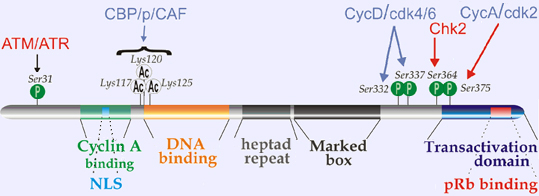
Schematic representation of human E2F1, depicting conserved domains and post-translational modification sites (see description for details).
Description
Length: 437 aa, molecular weight: 46920 Da.
The protein contains a number of conserved domains, including a cyclin A binding domain (aa 67-108); a nuclear localization signal (NLS, aa 85-91); a helix-loop-helix DNA binding domain (aa 120-191); a heptad repeat (aa 201-243), which mediates homo/hetero dimerization; a marked box (245-317), which is implicated in the E2F/DP and E2F/E4 ORF 6/7 interaction, and is also essential for the apoptotic activity of E2F1; and a transactivation domain (aa 368-437) containing the pRB binding domain (aa 409-426). The E2F1 protein molecule is subject to a number of post-translational modifications, including phosphorylation by cyclin D / CDK4 / CDK6 at serine residues 332 and 337, which stabilizes E2F1 and prevents its binding to pRB regardless of its phosphorylation status; acetylation of lysine residues 117, 120, and 125 by the factor acetyltransferase (FAT) complex CBP/p/CAF, which enhances DNA binding and stabilizes E2F1 further; phosphorylation by cyclin A / CDK2 at serine residue 375, which reduces DNA binding; and phosphorylation at serine residues 31 and 364 by ATM/ATR and CHK2 kinases, respectively, in response to DNA damage, which stabilizes E2F1 and promotes its apoptotic activity.
The protein contains a number of conserved domains, including a cyclin A binding domain (aa 67-108); a nuclear localization signal (NLS, aa 85-91); a helix-loop-helix DNA binding domain (aa 120-191); a heptad repeat (aa 201-243), which mediates homo/hetero dimerization; a marked box (245-317), which is implicated in the E2F/DP and E2F/E4 ORF 6/7 interaction, and is also essential for the apoptotic activity of E2F1; and a transactivation domain (aa 368-437) containing the pRB binding domain (aa 409-426). The E2F1 protein molecule is subject to a number of post-translational modifications, including phosphorylation by cyclin D / CDK4 / CDK6 at serine residues 332 and 337, which stabilizes E2F1 and prevents its binding to pRB regardless of its phosphorylation status; acetylation of lysine residues 117, 120, and 125 by the factor acetyltransferase (FAT) complex CBP/p/CAF, which enhances DNA binding and stabilizes E2F1 further; phosphorylation by cyclin A / CDK2 at serine residue 375, which reduces DNA binding; and phosphorylation at serine residues 31 and 364 by ATM/ATR and CHK2 kinases, respectively, in response to DNA damage, which stabilizes E2F1 and promotes its apoptotic activity.
Expression
E2F1 is expressed in all actively proliferating tissues in a cell-cycle specific manner. It is expressed mainly at late G1 and G1/S transition, and its mRNA is absent or low during the rest of the cell cycle.
Localisation
E2F1 is constitutively nuclear, due to a Nuclear Localization Signal (NLS) located around aa 90.
Function
E2F1 represents a controversial player in cell cycle control, exhibiting a dual behavior, sometimes acting as a tumor-suppressor and others as an oncogene. E2F1 exerts transcriptional control over the cell cycle, induces apoptosis via distinct pathways, and participates in DNA damage response and checkpoint.Transcriptional control
E2F1 belongs to the E2F family of transcription factors, coordinating the expression of key genes involved in cell cycle regulation and progression. It is active during the G1 to S transition, and thus its target genes, which include regulatory elements of the cell cycle, such as CDC2, CDC25A and cyclin E, and essential components of DNA replication machinery, including DHFR, and DNA polymerase alpha, are expressed in a cell cycle dependent manner (i.e. only in late G1 and early S phase of the cell cycle). E2F1 recognizes and binds to specific DNA sequences (5-TTTSSCGS-3, where S = C/G) that lie within the promoter of target genes, in the form of functional heterodimers with members of the DP family of transcription factors. Apoptosis
E2F1 can induce apoptosis via distinct P53-dependent and independent pathways.
The P53-independent pathways involve the p53 homolog P73 and APAF1, which are both transcriptionally controlled by E2F1. Transcriptional activation of P73 by E2F1 may lead to the activation of P53-responsive target genes, while induction of APAF1 transcription leads to activation of the caspase cascade. Ultimately, both pathways lead to cell death by apoptosis. Moreover, E2F1 is implicated in the upregulation of the pro-apoptotic members of the BCL2 family, but also in the downregulation of anti-apoptotic signals, by inhibiting NF-kB activity, thereby enhancing also apoptosis.
There are many pathways linking E2F1 to P53-dependent apoptosis. The main mechanism involves direct transcriptional activation of the tumor suppressor gene by E2F1. ARF sequesters MDM2 away from P53, leading consequently to P53 stabilization and activation. Nevertheless, ARF overexpression may lead to E2F1 downregulation, as ARF targets the latter for proteasomal degradation through -dependent pathways. On the other hand, E2F1 can induce P53-dependent apoptosis in the absence of ARF. For instance, E2F1 can interact directly with P53 through the cyclin A-binding domain of E2F1, enhancing its apoptotic activity in response to DNA damage. Additionally, some reports argue that E2F1 uses the ATM pathway in order to activate both P53 and CHK2. Finally, E2F1 can augment the apoptotic capacity of P53 by enhancing the transcription of pro-apoptotic P53 cofactors such as P53-ASPP1, ASPP2, JMY and TP53INP1. DNA Damage Response
In response to DNA damage, E2F1 is upregulated through phosporylation-mediated stabilization. E2F1 is phosphorylated at S31 by ATM/ATR kinases and at S364 by CHK2 kinase, which are all integral components of the DNA damage signaling pathway. These phosphorylations interfere with the ARF/SKP2- and MDM2-dependent degradation of E2F1, thus stabilizing the latter by decreasing its turnover rate. In response to IR or other agents that cause DNA double strand breaks, phosphorylation by ATM/ATR seems to prime E2F1 for acetylation at specific lysine residues. These acetylations are a prerequisite for the targeting of the P73 gene promoter by E2F1, which ultimately leads to apoptosis (see above paragraph). UV radiation does not trigger E2F1 acetylation and apoptosis. Instead, E2F1 seems to play a role in DNA repair and cell survival, either directly at the sites of DNA repair or through modulation of DNA repair genes that are under its transcriptional control.
E2F1 belongs to the E2F family of transcription factors, coordinating the expression of key genes involved in cell cycle regulation and progression. It is active during the G1 to S transition, and thus its target genes, which include regulatory elements of the cell cycle, such as CDC2, CDC25A and cyclin E, and essential components of DNA replication machinery, including DHFR, and DNA polymerase alpha, are expressed in a cell cycle dependent manner (i.e. only in late G1 and early S phase of the cell cycle). E2F1 recognizes and binds to specific DNA sequences (5-TTTSSCGS-3, where S = C/G) that lie within the promoter of target genes, in the form of functional heterodimers with members of the DP family of transcription factors.
E2F1 can induce apoptosis via distinct P53-dependent and independent pathways.
The P53-independent pathways involve the p53 homolog P73 and APAF1, which are both transcriptionally controlled by E2F1. Transcriptional activation of P73 by E2F1 may lead to the activation of P53-responsive target genes, while induction of APAF1 transcription leads to activation of the caspase cascade. Ultimately, both pathways lead to cell death by apoptosis. Moreover, E2F1 is implicated in the upregulation of the pro-apoptotic members of the BCL2 family, but also in the downregulation of anti-apoptotic signals, by inhibiting NF-kB activity, thereby enhancing also apoptosis.
There are many pathways linking E2F1 to P53-dependent apoptosis. The main mechanism involves direct transcriptional activation of the tumor suppressor gene by E2F1. ARF sequesters MDM2 away from P53, leading consequently to P53 stabilization and activation. Nevertheless, ARF overexpression may lead to E2F1 downregulation, as ARF targets the latter for proteasomal degradation through -dependent pathways. On the other hand, E2F1 can induce P53-dependent apoptosis in the absence of ARF. For instance, E2F1 can interact directly with P53 through the cyclin A-binding domain of E2F1, enhancing its apoptotic activity in response to DNA damage. Additionally, some reports argue that E2F1 uses the ATM pathway in order to activate both P53 and CHK2. Finally, E2F1 can augment the apoptotic capacity of P53 by enhancing the transcription of pro-apoptotic P53 cofactors such as P53-ASPP1, ASPP2, JMY and TP53INP1.
In response to DNA damage, E2F1 is upregulated through phosporylation-mediated stabilization. E2F1 is phosphorylated at S31 by ATM/ATR kinases and at S364 by CHK2 kinase, which are all integral components of the DNA damage signaling pathway. These phosphorylations interfere with the ARF/SKP2- and MDM2-dependent degradation of E2F1, thus stabilizing the latter by decreasing its turnover rate. In response to IR or other agents that cause DNA double strand breaks, phosphorylation by ATM/ATR seems to prime E2F1 for acetylation at specific lysine residues. These acetylations are a prerequisite for the targeting of the P73 gene promoter by E2F1, which ultimately leads to apoptosis (see above paragraph). UV radiation does not trigger E2F1 acetylation and apoptosis. Instead, E2F1 seems to play a role in DNA repair and cell survival, either directly at the sites of DNA repair or through modulation of DNA repair genes that are under its transcriptional control.
Mutations
Note
No known mutations.
Implicated in
Note
In non-small cell lung carcinomas (NSCLCs) E2F1 is significantly increased due to aberrant pRB status. In these cases the elevated levels of E2F1 are positively associated with the tumour growth index whereas apoptosis is not influenced as deregulation of the P53-MDM2 regulatory loop is a common phenomenon in NSCLC. Breast, thyroid and pancreatic cancer, seem to follow this same scenario, where aberrations in the pRB pathway coupled with defective P53 status, enhance E2F1 levels promoting tumor growth. In all these cases, the higher levels of E2F1 are also correlated with poorer outcome. Nevertheless, in other cases, like colon cancer, and diffuse large B-cell lymphomas the more aggressive disease is linked to lower E2F1 expression, as E2F1 in these cases acts as an oncosuppressor, enhancing apoptosis. Likewise, in adenocarcinomas of Barrett oesophagus E2F1 expression is negatively associated with tumor progression and positively with patient survival. In the case of transitional cell bladder carcinomas (TCCs) the findings are controversial. In one series of invasive bladder tumors E2F1 seems to play a tumor suppressive role, while in another series of superficial low-grade TCCs E2F1 is positively correlated with proliferation, but not with apoptosis. This discrepancy seems to lie in the type of TCC examined and the molecular characteristics of the tissue.
The most usual genetic alteration of the E2F1 gene is amplification, as has been reported in several leukemic (e.g. the HEL human erythroleukemia cell line) and melanoma cell lines. The gene has also been found amplified in various esophageal, colorectal, cervical and ovarian cancers, as well as in lymph node metastases of melanoma, and is often linked to chromosome 20q gains in these entities. Importantly, in esophageal squamous cell carcinomas, the 20q gains and the amplification of the E2F1 gene are linked with greater aggressiveness and poorer prognosis.
The most usual genetic alteration of the E2F1 gene is amplification, as has been reported in several leukemic (e.g. the HEL human erythroleukemia cell line) and melanoma cell lines. The gene has also been found amplified in various esophageal, colorectal, cervical and ovarian cancers, as well as in lymph node metastases of melanoma, and is often linked to chromosome 20q gains in these entities. Importantly, in esophageal squamous cell carcinomas, the 20q gains and the amplification of the E2F1 gene are linked with greater aggressiveness and poorer prognosis.
Article Bibliography
| Pubmed ID | Last Year | Title | Authors |
|---|---|---|---|
| 7647312 | 1995 | Transcriptional control by E2F. | Adams PD et al |
| 8943316 | 1996 | Identification of a cyclin-cdk2 recognition motif present in substrates and p21-like cyclin-dependent kinase inhibitors. | Adams PD et al |
| 18334281 | 2008 | E2F1 in gliomas: a paradigm of oncogene addiction. | Alonso MM et al |
| 17907153 | 2007 | Gene amplification is a relatively frequent event leading to ZBTB7A (Pokemon) overexpression in non-small cell lung cancer. | Apostolopoulou K et al |
| 15538380 | 2004 | The E2F family: specific functions and overlapping interests. | Attwooll C et al |
| 14526389 | 2004 | Life and death decisions by E2F-1. | Bell LA et al |
| 12726857 | 2003 | Emerging roles for E2F: beyond the G1/S transition and DNA replication. | Cam H et al |
| 9122175 | 1997 | Regulation of E2F through ubiquitin-proteasome-dependent degradation: stabilization by the pRB tumor suppressor protein. | Campanero MR et al |
| 9281303 | 1997 | Transcription factors and the down-regulation of G1/S boundary genes in human diploid fibroblasts during senescence. | Chen KY et al |
| 8321204 | 1993 | Cell cycle analysis of E2F in primary human T cells reveals novel E2F complexes and biochemically distinct forms of free E2F. | Chittenden T et al |
| 15662116 | 2004 | Opposing roles of E2Fs in cell proliferation and death. | Crosby ME et al |
| 17100600 | 2006 | Distinct and Overlapping Roles for E2F Family Members in Transcription, Proliferation and Apoptosis. | DeGregori J et al |
| 17908803 | 2008 | E2F-1 overexpression correlates with decreased proliferation and better prognosis in adenocarcinomas of Barrett oesophagus. | Evangelou K et al |
| 8346196 | 1993 | E2F-1-mediated transactivation is inhibited by complex formation with the retinoblastoma susceptibility gene product. | Flemington EK et al |
| 14696419 | 2003 | Chromosome arm 20q gains and other genomic alterations in esophageal squamous cell carcinoma, as analyzed by comparative genomic hybridization and fluorescence in situ hybridization. | Fujita Y et al |
| 18358829 | 2008 | E2F1 contributes to the transcriptional activation of the KIR3DL1 gene. | Gao XN et al |
| 12354623 | 2002 | E2F1 pathways to apoptosis. | Ginsberg D et al |
| 12237873 | 2002 | Transcription factor E2F-1 acts as a growth-promoting factor and is associated with adverse prognosis in non-small cell lung carcinomas. | Gorgoulis VG et al |
| 12954980 | 2003 | Specificity in the activation and control of transcription factor E2F-dependent apoptosis. | Hallstrom TC et al |
| 8413249 | 1993 | Inhibition of E2F-1 transactivation by direct binding of the retinoblastoma protein. | Helin K et al |
| 9529602 | 1998 | Regulation of cell proliferation by the E2F transcription factors. | Helin K et al |
| 18294958 | 2008 | TGFbeta-mediated formation of pRb-E2F complexes in human myeloid leukemia cells. | Hu XT et al |
| 10504464 | 1999 | Regulation of the G1/S transition phase in mesangial cells by E2F1. | Inoshita S et al |
| 17100599 | 2006 | Putting the Oncogenic and Tumor Suppressive Activities of E2F into Context. | Johnson DG et al |
| 18440323 | 2008 | Regulation of the human mitotic centromere-associated kinesin (MCAK) promoter by the transcription factors Sp1 and E2F1. | Jun DY et al |
| 15466399 | 2004 | Overexpression of the replication licensing regulators hCdt1 and hCdc6 characterizes a subset of non-small-cell lung carcinomas: synergistic effect with mutant p53 on tumor growth and chromosomal instability--evidence of E2F-1 transcriptional control over hCdt1. | Karakaidos P et al |
| 18302937 | 2008 | Identification of E2F1 as a positive transcriptional regulator for delta-catenin. | Kim K et al |
| 15107604 | 2004 | Role of E2F1 in apoptosis: a case study in feedback loops. | Knezevic D et al |
| 12414510 | 2002 | Proliferation, but not apoptosis, is associated with distinct beta-catenin expression patterns in non-small-cell lung carcinomas: relationship with adenomatous polyposis coli and G(1)-to S-phase cell-cycle regulators. | Kotsinas A et al |
| 16739112 | 2006 | Centrosome abnormalities are frequently observed in non-small-cell lung cancer and are associated with aneuploidy and cyclin E overexpression. | Koutsami MK et al |
| 8248803 | 1993 | Binding to DNA and the retinoblastoma gene product promoted by complex formation of different E2F family members. | Krek W et al |
| 7917337 | 1994 | DP and E2F proteins: components of a heterodimeric transcription factor implicated in cell cycle control. | La Thangue NB et al |
| 7880534 | 1994 | DP and E2F proteins: coordinating transcription with cell cycle progression. | Lam EW et al |
| 12502741 | 2002 | Structural basis for the recognition of the E2F transactivation domain by the retinoblastoma tumor suppressor. | Lee C et al |
| 18524851 | 2008 | The aryl hydrocarbon receptor binds to E2F1 and inhibits E2F1-induced apoptosis. | Marlowe JL et al |
| 11274364 | 2001 | p19ARF targets certain E2F species for degradation. | Martelli F et al |
| 10559858 | 1999 | Interaction between ubiquitin-protein ligase SCFSKP2 and E2F-1 underlies the regulation of E2F-1 degradation. | Marti A et al |
| 9271426 | 1997 | Induction of S-phase entry by E2F transcription factors depends on their nuclear localization. | Müller H et al |
| 12665469 | 2003 | Evolving intricacies and implications of E2F1 regulation. | Mundle SD et al |
| 7935380 | 1994 | Transcription of the E2F-1 gene is rendered cell cycle dependent by E2F DNA-binding sites within its promoter. | Neuman E et al |
| 8964493 | 1996 | Structure and partial genomic sequence of the human E2F1 gene. | Neuman E et al |
| 7933066 | 1994 | Mutually exclusive interaction of the adenovirus E4-6/7 protein and the retinoblastoma gene product with internal domains of E2F-1 and DP-1. | O'Connor RJ et al |
| 11245432 | 2001 | Phosphorylation- and Skp1-independent in vitro ubiquitination of E2F1 by multiple ROC-cullin ligases. | Ohta T et al |
| 15467444 | 2004 | Regulation in S phase by E2F. | Pardee AB et al |
| 11388666 | 2001 | E2F-1 induced apoptosis. | Phillips AC et al |
| 17488475 | 2007 | E2F1 death pathways as targets for cancer therapy. | Pützer BM et al |
| 15190206 | 2004 | Life, death and E2F: linking proliferation control and DNA damage signaling via E2F1. | Rogoff HA et al |
| 16360038 | 2005 | Structure of the Rb C-terminal domain bound to E2F1-DP1: a mechanism for phosphorylation-induced E2F release. | Rubin SM et al |
| 7774910 | 1995 | Amplification of the E2F1 transcription factor gene in the HEL erythroleukemia cell line. | Saito M et al |
| 18506748 | 2008 | Identification of copy number gain and overexpressed genes on chromosome arm 20q by an integrative genomic approach in cervical cancer: potential role in progression. | Scotto L et al |
| 1448092 | 1992 | Molecular cloning of cellular genes encoding retinoblastoma-associated proteins: identification of a gene with properties of the transcription factor E2F. | Shan B et al |
| 9375022 | 1997 | E2F transcription factor action, regulation and possible role in human cancer. | Sladek TL et al |
| 8441401 | 1993 | A protein synthesis-dependent increase in E2F1 mRNA correlates with growth regulation of the dihydrofolate reductase promoter. | Slansky JE et al |
| 15279795 | 2004 | The emerging role of E2F-1 in the DNA damage response and checkpoint control. | Stevens C et al |
| 11823794 | 2002 | Sibling rivalry in the E2F family. | Trimarchi JM et al |
| 17178208 | 2007 | Implication of the transcription factor E2F-1 in the modulation of neuronal apoptosis. | Verdaguer E et al |
| 18003834 | 2007 | E2F1 works as a cell cycle suppressor in mature neurons. | Wang L et al |
| 12598654 | 2003 | Crystal structure of the retinoblastoma tumor suppressor protein bound to E2F and the molecular basis of its regulation. | Xiao B et al |
| 10214348 | 1999 | Balancing proliferation and apoptosis in vivo: the Goldilocks theory of E2F/DP action. | Yamasaki L et al |
| 15221933 | 2004 | Distinct expression patterns of the transcription factor E2F-1 in relation to tumour growth parameters in common human carcinomas. | Zacharatos P et al |
| 10090723 | 1999 | Structural basis of DNA recognition by the heterodimeric cell cycle transcription factor E2F-DP. | Zheng N et al |
| 17222786 | 2007 | Rb loss causes cancer by driving mitosis mad. | van Deursen JM et al |
Other Information
Locus ID:
NCBI: 1869
MIM: 189971
HGNC: 3113
Ensembl: ENSG00000101412
Variants:
dbSNP: 1869
ClinVar: 1869
TCGA: ENSG00000101412
COSMIC: E2F1
RNA/Proteins
| Gene ID | Transcript ID | Uniprot |
|---|---|---|
| ENSG00000101412 | ENST00000343380 | Q01094 |
Expression (GTEx)
Pathways
Protein levels (Protein atlas)
References
| Pubmed ID | Year | Title | Citations |
|---|---|---|---|
| 36168932 | 2024 | E2F1 induced neuroblastoma cell migration and invasion via activation of CENPE/FOXM1 signaling pathway. | 1 |
| 37824372 | 2024 | Transcription Factor E2F1 Enhances Hepatocellular Carcinoma Cell Proliferation and Stemness by Activating GINS1. | 1 |
| 37992567 | 2024 | NEIL3 promotes cell proliferation of ccRCC via the cyclin D1-Rb-E2F1 feedback loop regulation. | 0 |
| 38182895 | 2024 | DLGAP5 triggers proliferation and metastasis of bladder cancer by stabilizing E2F1 via USP11. | 0 |
| 38242392 | 2024 | Analysis of E2F1 single-nucleotide polymorphisms reveals deleterious non-synonymous substitutions that disrupt E2F1-RB protein interaction in cancer. | 1 |
| 38360622 | 2024 | The association of E2F1 and E2F2 single nucleotide polymorphisms with laryngeal squamous cell carcinoma pathomorphological features. | 0 |
| 38378679 | 2024 | Hsa_circ_0007990 promotes breast cancer growth via inhibiting YBX1 protein degradation to activate E2F1 transcription. | 0 |
| 38386202 | 2024 | E2F1 Mediates Traumatic Brain Injury and Regulates BDNF-AS to Promote the Progression of Alzheimer's Disease. | 0 |
| 38424195 | 2024 | RNA m(5)C modification upregulates E2F1 expression in a manner dependent on YBX1 phase separation and promotes tumor progression in ovarian cancer. | 0 |
| 38783241 | 2024 | New link between RNH1 and E2F1: regulates the development of lung adenocarcinoma. | 1 |
| 38978058 | 2024 | CDCA5 accelerates progression of breast cancer by promoting the binding of E2F1 and FOXM1. | 0 |
| 36168932 | 2024 | E2F1 induced neuroblastoma cell migration and invasion via activation of CENPE/FOXM1 signaling pathway. | 1 |
| 37824372 | 2024 | Transcription Factor E2F1 Enhances Hepatocellular Carcinoma Cell Proliferation and Stemness by Activating GINS1. | 1 |
| 37992567 | 2024 | NEIL3 promotes cell proliferation of ccRCC via the cyclin D1-Rb-E2F1 feedback loop regulation. | 0 |
| 38182895 | 2024 | DLGAP5 triggers proliferation and metastasis of bladder cancer by stabilizing E2F1 via USP11. | 0 |
Citation
Michael Zachariadis ; Vassilios G Gorgoulis
E2F1 (E2F transcription factor 1)
Atlas Genet Cytogenet Oncol Haematol. 2008-12-01
Online version: http://atlasgeneticsoncology.org/gene/40382/e2f1
