HLA-G (major histocompatibility complex, class I, G)
2012-01-01 Shang-Mian Yie AffiliationThe Second Medical College\\\/Teaching Hospital, Chengdu University of Traditional Chinese Medicine, Chengdu, Sichuan, PR China
DNA/RNA
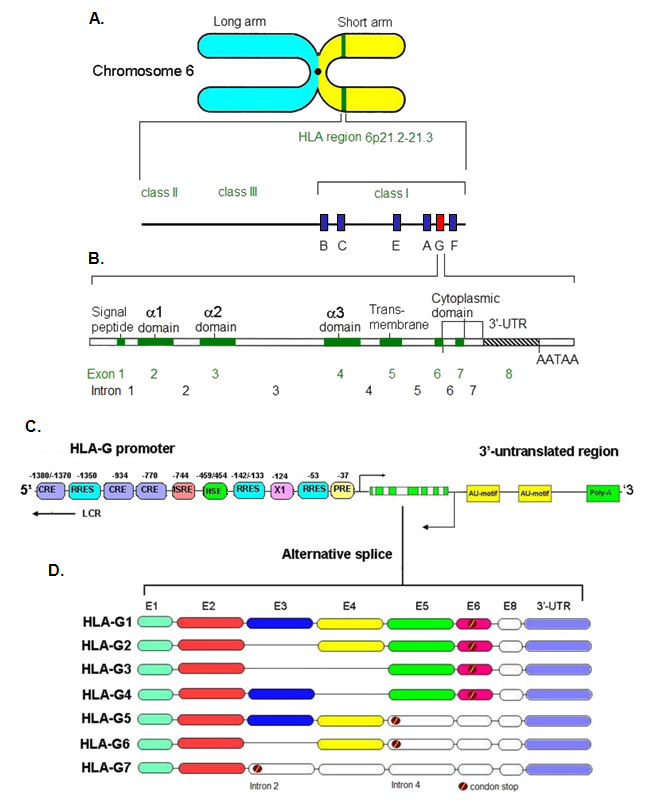
Figure 1. The human leukocyte antigen-G (HLA-G) gene and transcription. A. HLA-G gene location. B. HLA-G gene structure consisting of 7 introns (white color) and 8 exons (green color). C. HLA-G gene promoter exhibiting regulatory elements to regulate HLA-G gene transcription and 3-UTR of the HLA-G gene exhibiting several regulatory elements including AU-rich motifs and a Poly-A signal to influence mRNA stability, turnover, mobility and splicing pattern. CRE stands for cAMP responsive element, RRES for ras response elements, ISRE for interferon-sensitive response element, HSE for heat shock response element, PRE for progesterone response element, and X1 for X1 box.D. HLA-G primary transcript can be spliced into 7 alternative mRNAs ranging from HLA-G1 to -G7.
Description
HLA-G is one of the non-classical class I (Ib) HLA molecules. The HLA-G gene is located at the short arm of chromosome 6 in the HLA region (6p21.2-21.3) between HLA-A and HLA-F genes (figure 1A). The gene structure of HLA-G is homologous to other HLA class I (Ia) genes consisting of 7 introns and 8 exons coding the heavy chain of the molecule. Exon 1 encodes the peptide signal, while exons 2, 3 and 4 encode the extracellular α1, α2 and α3 domains, respectively. Exons 5 and 6 encode the transmembrane and cytoplasmic domains of the heavy chain. Exon 7 is always absent from mature mRNA and due to the stop codon in exon 6; exon 8 is not translated (figure 1B).
Transcription
The functional mRNA level of a particular gene is regulated by the rate of synthesis, mainly driven by the promoter region (5-UTR) of the given gene, as well as by the rate of degradation, stability, localization and translatability of the specific mRNA (Kuersten and Goodwin, 2003). The HLA-G gene promoter has a modified enhancer A (enhA), S and X1 sequence, and a few alternative regulatory elements to regulate HLA-G gene transcription (figure 1C). So far, these regulatory elements include the locus control region (LCR) (Schmidt et al., 1993; Yelavarthi et al., 1993), which is located approximately 1,2 kb from the ATG initiation codon of the HLA-G gene. The CREB1 factor binds to this region (-1380/-1370), as well as to two additional cAMP response elements (CRE) dispersed through the promoter region at positions -934 and -770 from the ATG. An interferon-sensitive response element (ISRE) is located at position -744 from the ATG (Lefebvre et al., 2001). A heat shock element (HSE) is located within the HLA-G promoter at position -459/-454 that binds heat shock factor 1 (HSF-1) (Ibrahim et al., 2000). A progesterone receptor response element (PRE) is located at position -37 from the ATG (Yie et al., 2006), and three ras response elements (RRES) are situated along the HLA-G gene promoter (-1356, -142, -53) (Flajollet et al., 2009).
The 3-UTR of the HLA-G gene also exhibits several regulatory elements including AU-rich motifs and a poly-A signal to influence mRNA stability, turnover, mobility and splicing pattern (Donadi et al., 2011).
The primary transcript of HLA-G can be spliced into 7 alternative mRNAs (figure 1D) that encode membrane-bound (HLA-G1, -G2, -G3, -G4) and soluble (HLA-G5, -G6, -G7) protein isoforms (Carosella et al., 2003). HLA-G1 is the full-length HLA-G molecule, HLA-G2 lacks exon 3, HLA-G3 lacks exons 3 and 4, and HLA-G4 lacks exon 4. HLA-G1 to -G4 are membrane-bound molecules due to the presence of the transmembrane and cytoplasmic tail encoded by exons 5 and 6. HLA-G5 is similar to HLA-G1 but retains intron 4, HLA-G6 lacks exon 3 but retains intron 4, and HLA-G7 lacks exon 3 but retains intron 2. HLA-G5 and -G6 are soluble forms due to the presence of intron 4, which contains a premature stop codon to prevent the translation of the transmembrane and cytoplasmic tail. HLA-G7 is soluble due to the presence of intron 2, which contains a premature stop codon.
The 3-UTR of the HLA-G gene also exhibits several regulatory elements including AU-rich motifs and a poly-A signal to influence mRNA stability, turnover, mobility and splicing pattern (Donadi et al., 2011).
The primary transcript of HLA-G can be spliced into 7 alternative mRNAs (figure 1D) that encode membrane-bound (HLA-G1, -G2, -G3, -G4) and soluble (HLA-G5, -G6, -G7) protein isoforms (Carosella et al., 2003). HLA-G1 is the full-length HLA-G molecule, HLA-G2 lacks exon 3, HLA-G3 lacks exons 3 and 4, and HLA-G4 lacks exon 4. HLA-G1 to -G4 are membrane-bound molecules due to the presence of the transmembrane and cytoplasmic tail encoded by exons 5 and 6. HLA-G5 is similar to HLA-G1 but retains intron 4, HLA-G6 lacks exon 3 but retains intron 4, and HLA-G7 lacks exon 3 but retains intron 2. HLA-G5 and -G6 are soluble forms due to the presence of intron 4, which contains a premature stop codon to prevent the translation of the transmembrane and cytoplasmic tail. HLA-G7 is soluble due to the presence of intron 2, which contains a premature stop codon.
Proteins
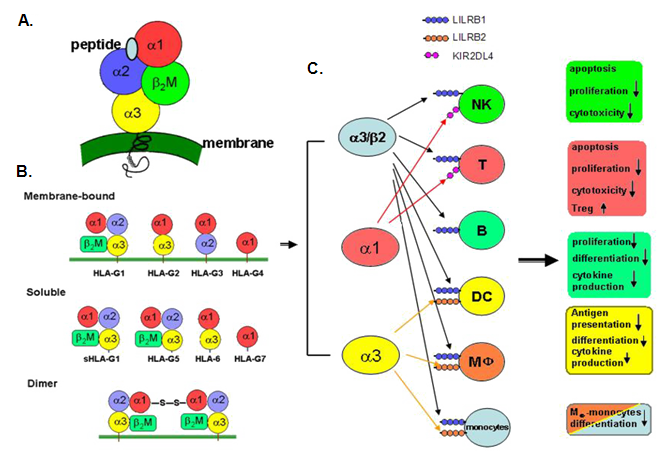
Figure 2. HLA-G protein and its function. A. HLA-G protein exhibits a heterodimer consisting of globular domains (α1, α2 and α3 domains, transmembrane and cytoplasmic domains) and a light chain (β2-microglobulin). B. Alternative splicing of the primary transcript yields 7 protein isoforms: truncated isoforms are generated by excision of one or two exons encoding the globular domains, whereas translation of intron 4 or intron 2 yields soluble isoforms that lack the transmembrane domain. HLA-G molecules can form homomultimers through the generation of Cys42-Cys42 or Cys42-Cys147 disulphide bonds. C. Immunoregulatory activities mediated by HLA-G, where the involved target cells and receptors are indicated.
Description
The HLA-G protein exhibits a heterodimer consisting of globular domains (α1, α2 and α3 domains, transmembrane and cytoplasmic domains) and a light chain (β2-microglobulin) called monomer (figure 2A). However, there may be 7 protein isoforms, generated by alternative splicing of the primary transcript: four of them being membrane-bound (HLA-G1, -G2, -G3 and -G4) and three soluble (HLA-G5, -G6 and -G7) (figure 2B). HLA-G1 is the complete isoform associated with β2-microglobulin. The HLA-G2 isoform has no α2 domain, while HLA-G3 has no α2 and α3 domains, and HLA-G4 has no α3 domain. The soluble HLA-G5 and -G6 isoforms contain the same extra globular domains as HLA-G1 and -G2, respectively, generated by transcripts conserving intron 4, which blocks the translation of the transmembrane domain. The 5-region of intron 4 is translated until the generation of a stop codon, which gives the HLA-G5 and -G6 isoforms a tail of 21 amino acids responsible for their solubility. The HLA-G7 isoform has only the α1 domain linked to two amino acids encoded by intron 2, which is retained in the corresponding transcript (Fujii et al., 1994; Ishitani and Geraghty, 1992; Paul et al., 2000).
In addtion, HLA-G molecules can form dimers through the creation of disulphide bonds between two unique cysteine residues at positions 42 (Cys42-Cys42 bonds) and 147 (Cys42-Cys147 bonds) of the HLA-G heavy chain (figure 2B) (Boyson et al., 2002; Gonen-Gross et al., 2003). The dimerization has an oblique orientation that exposes the HLA-G receptor binding sites of the α3 domain upwards, making them more accessible to the receptors. Consequently, HLA-G dimers bind receptors with higher affinity and slower dissociation rates than monomers, and signal more efficiently than monomers as well (Shiroishi et al., 2006).
In addtion, HLA-G molecules can form dimers through the creation of disulphide bonds between two unique cysteine residues at positions 42 (Cys42-Cys42 bonds) and 147 (Cys42-Cys147 bonds) of the HLA-G heavy chain (figure 2B) (Boyson et al., 2002; Gonen-Gross et al., 2003). The dimerization has an oblique orientation that exposes the HLA-G receptor binding sites of the α3 domain upwards, making them more accessible to the receptors. Consequently, HLA-G dimers bind receptors with higher affinity and slower dissociation rates than monomers, and signal more efficiently than monomers as well (Shiroishi et al., 2006).
Expression
Classical class Ia antigens are ubiquitously expressed, whereas the expression of HLA-G is restrictive. HLA-G protein expression is only found in trophoblast cells in the placenta, certain immune cells (in most cases monocytes), thymus, cornea, proximal nail matrix, erythroblasts and mesenchymal stem cells (Kovats et al., 1990; Crisa et al., 1997; Lila et al., 2001; Ishitani et al., 2003; Rebmann et al., 2003; Morandi et al., 2008). The reasons for HLA-G expression in some but not other tissues have not been fully elucidated. However, soluble HLA-G (sHLA-G) can be detected in the serum/plasma of both men and women. The main source of sHLA-G in the blood of men and non-pregnant women is most likely monocytes. Both CD4+ and CD8+ T cells and B cells also seem to be able to secrete HLA-G5 although to a lesser extent (Rebmann et al., 2003). The presence or level of sHLA-G in serum/plasma samples is associated with HLA-G polymorphism (Rebmann et al., 2001; Hviid et al., 2004a; Hviid et al., 2004b; Rizzo et al., 2005).
As mentioned earlier, HLA-G expression is mainly controlled at the transcriptional level by a unique gene promoter and at the post-transcriptional level by alternative splicing, mRNA stability, translation and protein transport to the cell surface. Many factors have been described that can potentially affect transcriptional and post-transcriptional mechanisms responsible for HLA-G regulation (Moreau et al., 2009).
As mentioned earlier, HLA-G expression is mainly controlled at the transcriptional level by a unique gene promoter and at the post-transcriptional level by alternative splicing, mRNA stability, translation and protein transport to the cell surface. Many factors have been described that can potentially affect transcriptional and post-transcriptional mechanisms responsible for HLA-G regulation (Moreau et al., 2009).
Function
It has been demonstrated that HLA-G is an immune tolerogenic molecule, which plays an important role in the suppression of the immune responses (Carosella et al., 2008) (figure 2C). The immune-inhibitory function of HLA-G is realized by interacting with leukocyte receptors including leukocyte immunoglobulin-like receptor subfamily B member 1 (LILRB1) and member 2 (LILRB2), and killer cell immunoglobulin-like receptor 2DL4 (KIR2DL4) (Shiroishi et al., 2006; Gao et al., 2000).
LILRB1s are expressed on the surface of several leukocytes, such as NK and lymphomononuclear cells, while LILRB2s are primarily expressed on the surface of a restricted set of cells, including monocytes and dendritic cells (Brown et al., 2004). Both LILRB1 and LILRB2 have several inhibitory motifs (ITIM) receptors based on the immunoreceptor tyrosine in their cytoplasmic tail, which inhibits signaling events triggered by stimulatory receptors (Dietrich et al., 2001). LILRB1 and LILRB2 both interact with classical HLA class I molecules. However, their binding with HLA-G presents three- to four-fold higher affinity when compared to classical molecules (Shiroishi et al., 2003). LILRB1 and LILRB2 also bind to the α3 domain and β2-microglobulin of the HLA-G molecule, although LILRB2 binds with higher affinity than LILRB1. LILRB2 binds more to the α3 domain than to the β2-microglobulin domain. The binding sites of LILRB1 and LILRB2 are distinct. The Tyr36 and Arg38 residues of LILRB2 bind to the 195-197 loop of the α3 domain of HLA-G, whereas the Tyr38 and Tyr76 residues of LILRB1 bind to the Phe195 of HLA-G (Shiroishi et al., 2006).
KIRs are transmembrane glycoproteins expressed by natural killer cells and subsets of T cells, exhibiting two (KIR2D) or three (KIR3D) extracellular immunoglobulin-like domains, which also contain ITIMs. The KIR2DL4 binds to the α1 domain of the HLA-G molecule (Yan and Fan, 2005). However, the binding site of KIR2DL4 to HLA-G remains unknown (Donadi et al., 2011). Moreover, since an array of activator and inhibitor receptors is expressed on the surface of most NK cells and macrophages, and the final effector function is dependent on the balance between activator and inhibitor receptors (Hsu et al., 2002), the role of the interaction between KIR2DL4 and HLA-G in the modulation of the immune response has been a matter of much debate (LeMaoult et al., 2003; Apps et al., 2008).
HLA-G has an inhibitory effect on cytotoxic cells exhibiting CD8 on their surface through the interaction of the α3 domain of HLA-G with the CD8 α/α molecule. The α3 domain of HLA-G is the same site of interaction with CD8 α/α and LILRBs. Even though the CD8 α/α and LILIRBs binding sites overlap, LILIRBs inhibit the binding of CD8 α/α to HLA molecules by displacing CD8 α/α and activating ITIMs (Shiroishi et al., 2003).
Beside the extracellular domains of HLA-G, all segments of the molecule may contribute to its function. The short cytoplasmic tail retains HLA-G longer in the endoplasmic reticulum and prolongs the half-life of the molecule on the cell surface because of the lack of an endocytosis motif (Park et al., 2001; Park and Ahn, 2003). This permits multiple interactions with cells of the immune system.
Soluble HLA-G molecule can induce apoptosis in CD8+ activated T lymphocytes as well as in CD8+ NK cells (lacking the T cell receptor) at similar rates. The binding of soluble HLA molecules to CD8 leads to apoptosis upregulating Fas production and Fas/FasL interaction (Puppo et al., 2002; Contini et al., 2003). This mechanism represents an additional immunomodulatory effect of HLA-G.
LILRB1s are expressed on the surface of several leukocytes, such as NK and lymphomononuclear cells, while LILRB2s are primarily expressed on the surface of a restricted set of cells, including monocytes and dendritic cells (Brown et al., 2004). Both LILRB1 and LILRB2 have several inhibitory motifs (ITIM) receptors based on the immunoreceptor tyrosine in their cytoplasmic tail, which inhibits signaling events triggered by stimulatory receptors (Dietrich et al., 2001). LILRB1 and LILRB2 both interact with classical HLA class I molecules. However, their binding with HLA-G presents three- to four-fold higher affinity when compared to classical molecules (Shiroishi et al., 2003). LILRB1 and LILRB2 also bind to the α3 domain and β2-microglobulin of the HLA-G molecule, although LILRB2 binds with higher affinity than LILRB1. LILRB2 binds more to the α3 domain than to the β2-microglobulin domain. The binding sites of LILRB1 and LILRB2 are distinct. The Tyr36 and Arg38 residues of LILRB2 bind to the 195-197 loop of the α3 domain of HLA-G, whereas the Tyr38 and Tyr76 residues of LILRB1 bind to the Phe195 of HLA-G (Shiroishi et al., 2006).
KIRs are transmembrane glycoproteins expressed by natural killer cells and subsets of T cells, exhibiting two (KIR2D) or three (KIR3D) extracellular immunoglobulin-like domains, which also contain ITIMs. The KIR2DL4 binds to the α1 domain of the HLA-G molecule (Yan and Fan, 2005). However, the binding site of KIR2DL4 to HLA-G remains unknown (Donadi et al., 2011). Moreover, since an array of activator and inhibitor receptors is expressed on the surface of most NK cells and macrophages, and the final effector function is dependent on the balance between activator and inhibitor receptors (Hsu et al., 2002), the role of the interaction between KIR2DL4 and HLA-G in the modulation of the immune response has been a matter of much debate (LeMaoult et al., 2003; Apps et al., 2008).
HLA-G has an inhibitory effect on cytotoxic cells exhibiting CD8 on their surface through the interaction of the α3 domain of HLA-G with the CD8 α/α molecule. The α3 domain of HLA-G is the same site of interaction with CD8 α/α and LILRBs. Even though the CD8 α/α and LILIRBs binding sites overlap, LILIRBs inhibit the binding of CD8 α/α to HLA molecules by displacing CD8 α/α and activating ITIMs (Shiroishi et al., 2003).
Beside the extracellular domains of HLA-G, all segments of the molecule may contribute to its function. The short cytoplasmic tail retains HLA-G longer in the endoplasmic reticulum and prolongs the half-life of the molecule on the cell surface because of the lack of an endocytosis motif (Park et al., 2001; Park and Ahn, 2003). This permits multiple interactions with cells of the immune system.
Soluble HLA-G molecule can induce apoptosis in CD8+ activated T lymphocytes as well as in CD8+ NK cells (lacking the T cell receptor) at similar rates. The binding of soluble HLA molecules to CD8 leads to apoptosis upregulating Fas production and Fas/FasL interaction (Puppo et al., 2002; Contini et al., 2003). This mechanism represents an additional immunomodulatory effect of HLA-G.
Mutations
Somatic
44 HLA-G coding alleles have been defined based upon 72 single nucleotide polymorphisms (SNP) observed between exon 1 and intron 6. Nucleotide variability in the coding region of the HLA-G gene is evenly distributed throughout exons 2, 3 and 4, as well as in introns (Donadi et al., 2011). The heavy chain encoding region exhibits 33 SNPs but only 13 amino acid variations are observed, 4 of them in α1, 6 in α2 and 3 in the α3 domain (Donadi et al., 2011). The amino acid substitutions may account for the biological function of HLA-G, including peptide binding, isoform production, and ability to polymerize and modulate immune system cells.
The HLA-G promoter exhibits 29 SNPs to date. Since many of these polymorphisms either coincide with or are closed to the known regulatory elements, they may affect the binding of the corresponding regulatory factors (Tan et al., 2005; Hviid et al., 2006; Hviid et al., 2004a; Hviid et al., 2004b). Polymorphisms located at CpG sites may affect promoter methylation (Ober et al., 2006). In some cases, polymorphism in the promoter region may be in linkage disequilibrium with 3-UTR variants (Nicolae et al., 2005), and some of them could influence alternative splicing (Auboeuf et al., 2002) and mRNA stability (Rousseau et al., 2003).
In contrast to the coding region, the 3-UTR of the HLA-G locus presents a high degree of variation. Since the 3-UTR of HLA-G gene exhibits several regulatory elements including AU-rich motifs, a poly-A signal, as well as signals that regulate the spatial and temporal expression of an mRNA, the polymorphic sites may influence mRNA stability, turnover, mobility and splicing pattern. The polymorphic sites at the 3-UTR seem to bear ranged in several haplotypes (Alvarez et al., 2009; Castelli et al., 2010; Donadi et al., 2011), their influence seems to occur simultaneously.
The HLA-G promoter exhibits 29 SNPs to date. Since many of these polymorphisms either coincide with or are closed to the known regulatory elements, they may affect the binding of the corresponding regulatory factors (Tan et al., 2005; Hviid et al., 2006; Hviid et al., 2004a; Hviid et al., 2004b). Polymorphisms located at CpG sites may affect promoter methylation (Ober et al., 2006). In some cases, polymorphism in the promoter region may be in linkage disequilibrium with 3-UTR variants (Nicolae et al., 2005), and some of them could influence alternative splicing (Auboeuf et al., 2002) and mRNA stability (Rousseau et al., 2003).
In contrast to the coding region, the 3-UTR of the HLA-G locus presents a high degree of variation. Since the 3-UTR of HLA-G gene exhibits several regulatory elements including AU-rich motifs, a poly-A signal, as well as signals that regulate the spatial and temporal expression of an mRNA, the polymorphic sites may influence mRNA stability, turnover, mobility and splicing pattern. The polymorphic sites at the 3-UTR seem to bear ranged in several haplotypes (Alvarez et al., 2009; Castelli et al., 2010; Donadi et al., 2011), their influence seems to occur simultaneously.
Implicated in
Entity name
Various cancers
Disease
Cancer is essentially considered a complex cell disease caused by abnormalities in the genetic material of transformed cells. However, cancer development is a complicated progressive process that involves a sequence of gene-environment interactions with dysfunctions in multiple systems, including immune functions. The immune system can specifically identify and eliminate tumor cells based on their expression of tumor-specific antigens or molecules induced during malignant cell transformation. This process is referred to as tumor immune surveillance (Swann and Smyth, 2007). Despite tumor immune surveillance, tumors can still develop in the presence of a functioning immune system. This occurs through tumor immunoediting, a process that comprises three major phases (Urosevic and Dummer, 2008): 1) the elimination phase in which most immuno-genic tumor cells are eliminated by cytotoxic T and NK cells; 2) the equilibrium phase in which tumor cells with reduced immunogenicity are selected; and 3) the escape phase in which variants that no longer respond to the host immune system are maintained (Urosevic and Dummer, 2008). HLA-G is involved in every phase of tumor immunoediting by decreasing the elimination of tumor cells, by inhibiting the cytotoxic function of T and NK cells, and by trogocytosis, (i.e. the intercell transference of viable HLA-G molecules), which renders competent cytotoxic cells unresponsive to tumor antigens (LeMaoult et al., 2007; Caumartin et al., 2007) (figure 3).
Prognosis
HLA-G is aberrantly expressed in many human solid malignant tumors in situ and malignant hematopoietic diseases including breast, ovarian, clear renal cell, colorectal, gastric, esophageal, lung, and hepatocellular cancers, as well as acute myeloid leukaemia and chronic lymphocytic leukemia (B-CLL) (Carosella et al., 2008; Yie and Hu, 2011). The aberrant expression of HLA-G in malignant neoplasm is significantly correlated with poor clinical outcome of patients with colorectal cancer (CRC) (Ye et al., 2007), gastric cancer (GC) (Yie et al., 2007b), non-small cell lung cancer (NSCLC) (Yie et al., 2007c), esophageal squamous cell cancer (ESCC) (Yie et al., 2007a), breast cancer (He et al., 2010), hepatocellular cancers (Cai et al., 2009), and B-CLL (Nückel et al., 2005). This is due to the fact that HLA-G expression favors tumor development and metastasis in every phase of cancer immunoediting by impairing anti-tumor immune responses (Urosevic and Dummer, 2008).
A reverse correlation between HLA-G expression in tumors and the degree of tumor-infiltrating lymphocytes (TILs) has been demonstrated in a variety of cancer types (Yie and Hu, 2011). The presence of TILs indicates an anti-tumor cellular immune response (Yu and Fu, 2006). Also, it has been documented that HLA-G can increase regulatory T cells within TILs in breast and hepatocellular cancers (Chen et al., 2010; Cai et al., 2009). The regulatory T cells are a subset of immune T cells that inhibit the anti-tumor functions of tumor-specific T cells (Shevach, 2002). Therefore, current data suggest that the estimation of HLA-G expression is a novel prognostic marker useful in assessing host immune response since cancer can be explained, at least in part, as an abnormal immune system tolerance to uncontrolled cells (de la Cruz-Merino et al., 2008).
Furthermore, serum soluble HLA-G is increased in various types of cancer patients (Pistoia et al., 2007; Yie and Hu, 2011) including patients with melanoma (Ugurel et al., 2001), acute leukemia (Gros et al., 2006), multiple myeloma (Leleu et al., 2005), neuroblastoma (Morandi et al., 2007), lymphoproliferative disorders (Sebti et al., 2007), breast or ovarian cancer (Singer et al., 2003; Chen et al., 2010; He et al., 2010), non-small cell lung cancer (Cao et al., 2011), esophageal cancer (Cao et al., 2011), colorectal cancer (Zhu et al., 2011; Cao et al., 2011), gastric cancer (Cao et al., 2011) and hepatocellular carcinoma (Wang et al., 2011), when compared to normal healthy controls or benign disease cases. Although numerous and different cancer studies show preferential up-regulation of HLA-G in advanced diseases rather than in initial tumor lesions, currently available HLA-G data do support the notion that HLA-G can be used as a potential biomarker in the diagnosis of human carcinomas (Yie and Hu, 2011).
A reverse correlation between HLA-G expression in tumors and the degree of tumor-infiltrating lymphocytes (TILs) has been demonstrated in a variety of cancer types (Yie and Hu, 2011). The presence of TILs indicates an anti-tumor cellular immune response (Yu and Fu, 2006). Also, it has been documented that HLA-G can increase regulatory T cells within TILs in breast and hepatocellular cancers (Chen et al., 2010; Cai et al., 2009). The regulatory T cells are a subset of immune T cells that inhibit the anti-tumor functions of tumor-specific T cells (Shevach, 2002). Therefore, current data suggest that the estimation of HLA-G expression is a novel prognostic marker useful in assessing host immune response since cancer can be explained, at least in part, as an abnormal immune system tolerance to uncontrolled cells (de la Cruz-Merino et al., 2008).
Furthermore, serum soluble HLA-G is increased in various types of cancer patients (Pistoia et al., 2007; Yie and Hu, 2011) including patients with melanoma (Ugurel et al., 2001), acute leukemia (Gros et al., 2006), multiple myeloma (Leleu et al., 2005), neuroblastoma (Morandi et al., 2007), lymphoproliferative disorders (Sebti et al., 2007), breast or ovarian cancer (Singer et al., 2003; Chen et al., 2010; He et al., 2010), non-small cell lung cancer (Cao et al., 2011), esophageal cancer (Cao et al., 2011), colorectal cancer (Zhu et al., 2011; Cao et al., 2011), gastric cancer (Cao et al., 2011) and hepatocellular carcinoma (Wang et al., 2011), when compared to normal healthy controls or benign disease cases. Although numerous and different cancer studies show preferential up-regulation of HLA-G in advanced diseases rather than in initial tumor lesions, currently available HLA-G data do support the notion that HLA-G can be used as a potential biomarker in the diagnosis of human carcinomas (Yie and Hu, 2011).
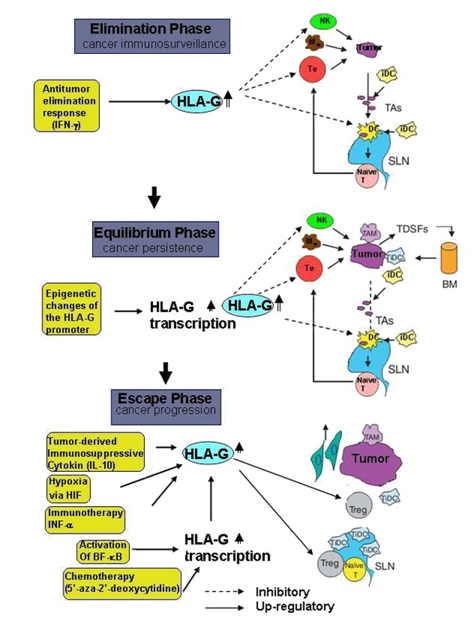
Figure 3. The role of HLA-G in tumor immunoediting. HLA-G is involved in every phase of tumor immunoediting to inhibit host immune response. During the tumor immunoediting process, HLA-G can be activated and up-regulated by many factors. Aberrant expression of HLA-G can: 1) disable effectors of innate and adaptive immunity in the elimination phase; 2) alter antigen presentation and contribute less immunogenic phenotype in the equilibrium phase; and 3) induce immunosuppressive cytokines and peripheral tolerance to the tumor (plus processes described in the two previous phases) in the escape phase.
Article Bibliography
| Pubmed ID | Last Year | Title | Authors |
|---|---|---|---|
| 19821846 | 2009 | HLA-G 3'-UTR SNP and 14-bp deletion polymorphisms in Portuguese and Guinea-Bissau populations. | Alvarez M et al |
| 18538632 | 2008 | A critical look at HLA-G. | Apps R et al |
| 12376702 | 2002 | Coordinate regulation of transcription and splicing by steroid receptor coregulators. | Auboeuf D et al |
| 12454284 | 2002 | Disulfide bond-mediated dimerization of HLA-G on the cell surface. | Boyson JE et al |
| 15304001 | 2004 | The LILR family: modulators of innate and adaptive immune pathways in health and disease. | Brown D et al |
| 19584149 | 2009 | Human leukocyte antigen-G protein expression is an unfavorable prognostic predictor of hepatocellular carcinoma following curative resection. | Cai MY et al |
| 21726203 | 2011 | Plasma soluble HLA-G is a potential biomarker for diagnosis of colorectal, gastric, esophageal and lung cancer. | Cao M et al |
| 18249584 | 2008 | HLA-G: from biology to clinical benefits. | Carosella ED et al |
| 19798077 | 2010 | The genetic structure of 3'untranslated region of the HLA-G gene: polymorphisms and haplotypes. | Castelli EC et al |
| 17318190 | 2007 | Trogocytosis-based generation of suppressive NK cells. | Caumartin J et al |
| 20547193 | 2010 | Upregulation of human leukocyte antigen-G expression and its clinical significance in ductal breast cancer. | Chen HX et al |
| 12594841 | 2003 | Soluble HLA-A,-B,-C and -G molecules induce apoptosis in T and NK CD8+ cells and inhibit cytotoxic T cell activity through CD8 ligation. | Contini P et al |
| 9221758 | 1997 | Identification of a thymic epithelial cell subset sharing expression of the class Ib HLA-G molecule with fetal trophoblasts. | Crisa L et al |
| 11160312 | 2001 | Ig-like transcript 2 (ILT2)/leukocyte Ig-like receptor 1 (LIR1) inhibits TCR signaling and actin cytoskeleton reorganization. | Dietrich J et al |
| 21107637 | 2011 | Implications of the polymorphism of HLA-G on its function, regulation, evolution and disease association. | Donadi EA et al |
| 19890057 | 2009 | RREB-1 is a transcriptional repressor of HLA-G. | Flajollet S et al |
| 7989753 | 1994 | A soluble form of the HLA-G antigen is encoded by a messenger ribonucleic acid containing intron 4. | Fujii T et al |
| 10809759 | 2000 | Classical and nonclassical class I major histocompatibility complex molecules exhibit subtle conformational differences that affect binding to CD8alphaalpha. | Gao GF et al |
| 12874224 | 2003 | Complexes of HLA-G protein on the cell surface are important for leukocyte Ig-like receptor-1 function. | Gonen-Gross T et al |
| 16611416 | 2006 | Soluble HLA-G molecules increase during acute leukemia, especially in subtypes affecting monocytic and lymphoid lineages. | Gros F et al |
| 20052552 | 2010 | HLA-G expression in human breast cancer: implications for diagnosis and prognosis, and effect on allocytotoxic lymphocyte response after hormone treatment in vitro. | He X et al |
| 12493005 | 2002 | The killer cell immunoglobulin-like receptor (KIR) genomic region: gene-order, haplotypes and allelic polymorphism. | Hsu KC et al |
| 15373761 | 2004 | HLA-G expression in placenta in relation to HLA-G genotype and polymorphisms. | Hviid TV et al |
| 16698426 | 2006 | Polymorphism in the 5' upstream regulatory and 3' untranslated regions of the HLA-G gene in relation to soluble HLA-G and IL-10 expression. | Hviid TV et al |
| 11005379 | 2000 | Heat shock and arsenite induce expression of the nonclassical class I histocompatibility HLA-G gene in tumor cell lines. | Ibrahim EC et al |
| 12874228 | 2003 | Protein expression and peptide binding suggest unique and interacting functional roles for HLA-E, F, and G in maternal-placental immune recognition. | Ishitani A et al |
| 2326636 | 1990 | A class I antigen, HLA-G, expressed in human trophoblasts. | Kovats S et al |
| 12897774 | 2003 | The power of the 3' UTR: translational control and development. | Kuersten S et al |
| 17077329 | 2007 | Immune regulation by pretenders: cell-to-cell transfers of HLA-G make effector T cells act as regulatory cells. | LeMaoult J et al |
| 11087747 | 2001 | A specific interferon (IFN)-stimulated response element of the distal HLA-G promoter binds IFN-regulatory factor 1 and mediates enhancement of this nonclassical class I gene by IFN-beta. | Lefebvre S et al |
| 16243800 | 2005 | Total soluble HLA class I and soluble HLA-G in multiple myeloma and monoclonal gammopathy of undetermined significance. | Leleu X et al |
| 11572934 | 2001 | Soluble HLA-G protein secreted by allo-specific CD4+ T cells suppresses the allo-proliferative response: a CD4+ T cell regulatory mechanism. | Lila N et al |
| 17616704 | 2007 | Human neuroblastoma cells trigger an immunosuppressive program in monocytes by stimulating soluble HLA-G release. | Morandi F et al |
| 18292209 | 2008 | Immunogenicity of human mesenchymal stem cells in HLA-class I-restricted T-cell responses against viral or tumor-associated antigens. | Morandi F et al |
| 19508383 | 2009 | Non-classical transcriptional regulation of HLA-G: an update. | Moreau P et al |
| 15611928 | 2005 | Fine mapping and positional candidate studies identify HLA-G as an asthma susceptibility gene on chromosome 6p21. | Nicolae D et al |
| 15466928 | 2005 | HLA-G expression is associated with an unfavorable outcome and immunodeficiency in chronic lymphocytic leukemia. | Nückel H et al |
| 16501035 | 2006 | The miscarriage-associated HLA-G -725G allele influences transcription rates in JEG-3 cells. | Ober C et al |
| 12582157 | 2003 | An essential function of tapasin in quality control of HLA-G molecules. | Park B et al |
| 11520457 | 2001 | The truncated cytoplasmic tail of HLA-G serves a quality-control function in post-ER compartments. | Park B et al |
| 11137219 | 2000 | Identification of HLA-G7 as a new splice variant of the HLA-G mRNA and expression of soluble HLA-G5, -G6, and -G7 transcripts in human transfected cells. | Paul P et al |
| 17825579 | 2007 | Soluble HLA-G: Are they clinically relevant? | Pistoia V et al |
| 12806026 | 2002 | Soluble HLA class I molecules/CD8 ligation trigger apoptosis of CD8+ cells by Fas/Fas-ligand interaction. | Puppo F et al |
| 14708717 | 2003 | Secretion of sHLA-G molecules in malignancies. | Rebmann V et al |
| 11169254 | 2001 | Association of soluble HLA-G plasma levels with HLA-G alleles. | Rebmann V et al |
| 15753897 | 2005 | Defective production of soluble HLA-G molecules by peripheral blood monocytes in patients with asthma. | Rizzo R et al |
| 14602228 | 2003 | The 14 bp deletion-insertion polymorphism in the 3' UT region of the HLA-G gene influences HLA-G mRNA stability. | Rousseau P et al |
| 8360483 | 1993 | Extraembryonic expression of the human MHC class I gene HLA-G in transgenic mice. Evidence for a positive regulatory region located 1 kilobase 5' to the start site of transcription. | Schmidt CM et al |
| 17593027 | 2007 | Expression of functional soluble human leucocyte antigen-G molecules in lymphoproliferative disorders. | Sebti Y et al |
| 12093005 | 2002 | CD4+ CD25+ suppressor T cells: more questions than answers. | Shevach EM et al |
| 16455647 | 2006 | Efficient leukocyte Ig-like receptor signaling and crystal structure of disulfide-linked HLA-G dimer. | Shiroishi M et al |
| 14555519 | 2003 | HLA-G is a potential tumor marker in malignant ascites. | Singer G et al |
| 17476343 | 2007 | Immune surveillance of tumors. | Swann JB et al |
| 16236759 | 2005 | Evidence of balancing selection at the HLA-G promoter region. | Tan Z et al |
| 11466692 | 2001 | Soluble human leukocyte antigen--G serum level is elevated in melanoma patients and is further increased by interferon-alpha immunotherapy. | Ugurel S et al |
| 18245459 | 2008 | Human leukocyte antigen-G and cancer immunoediting. | Urosevic M et al |
| 21459722 | 2011 | Expression of HLA-G in patients with hepatocellular carcinoma. | Wang Y et al |
| 15780179 | 2005 | Residues Met76 and Gln79 in HLA-G alpha1 domain involve in KIR2DL4 recognition. | Yan WH et al |
| 17277760 | 2007 | Human leukocyte antigen G expression: as a significant prognostic indicator for patients with colorectal cancer. | Ye SR et al |
| 8376798 | 1993 | Cellular distribution of HLA-G mRNA in transgenic mouse placentas. | Yelavarthi KK et al |
| 21210353 | 2011 | Human leukocyte antigen-G (HLA-G) as a marker for diagnosis, prognosis and tumor immune escape in human malignancies. | Yie SM et al |
| 16684846 | 2006 | Progesterone regulates HLA-G gene expression through a novel progesterone response element. | Yie SM et al |
| 17673327 | 2007 | Expression of human leucocyte antigen G (HLA-G) is associated with prognosis in non-small cell lung cancer. | Yie SM et al |
| 16446705 | 2006 | Tumor-infiltrating T lymphocytes: friends or foes? | Yu P et al |
| 20473865 | 2011 | Serum sHLA-G levels: a useful indicator in distinguishing colorectal cancer from benign colorectal diseases. | Zhu CB et al |
| 19056856 | 2008 | Cancer and immune response: old and new evidence for future challenges. | de la Cruz-Merino L et al |
Other Information
Locus ID:
NCBI: 3135
MIM: 142871
HGNC: 4964
Ensembl: ENSG00000204632
Variants:
dbSNP: 3135
ClinVar: 3135
TCGA: ENSG00000204632
COSMIC: HLA-G
RNA/Proteins
Expression (GTEx)
Pathways
Protein levels (Protein atlas)
PharmGKB
| Entity ID | Name | Type | Evidence | Association | PK | PD | PMIDs |
|---|---|---|---|---|---|---|---|
| PA128406956 | fluorouracil | Chemical | ClinicalAnnotation | associated | PD | ||
| PA133950441 | hmg coa reductase inhibitors | Chemical | ClinicalAnnotation | associated | PD | ||
| PA443434 | Arthritis, Rheumatoid | Disease | ClinicalAnnotation | associated | PD | 16906016, 19088262 | |
| PA443450 | Asthma | Disease | ClinicalAnnotation | associated | PD | ||
| PA446108 | Colorectal Neoplasms | Disease | ClinicalAnnotation | associated | PD | ||
| PA448771 | capecitabine | Chemical | ClinicalAnnotation | associated | PD | ||
| PA450428 | methotrexate | Chemical | ClinicalAnnotation | associated | PD | 16906016, 19088262 |
References
| Pubmed ID | Year | Title | Citations |
|---|---|---|---|
| 37981615 | 2024 | IDO-1 impairs antitumor immunity of natural killer cells in triple-negative breast cancer via up-regulation of HLA-G. | 0 |
| 38284259 | 2024 | [Research progress on HLA-G in non-small cell lung cancer]. | 0 |
| 38473890 | 2024 | HLA-G Expression/Secretion and T-Cell Cytotoxicity in Missed Abortion in Comparison to Normal Pregnancy. | 0 |
| 38492472 | 2024 | HLA-G isoforms, HLA-C allotype and their expressions differ between early abortus and placenta in relation to spontaneous abortions. | 0 |
| 38956724 | 2024 | Hypoimmunogenic human iPSCs expressing HLA-G, PD-L1, and PD-L2 evade innate and adaptive immunity. | 0 |
| 37981615 | 2024 | IDO-1 impairs antitumor immunity of natural killer cells in triple-negative breast cancer via up-regulation of HLA-G. | 0 |
| 38284259 | 2024 | [Research progress on HLA-G in non-small cell lung cancer]. | 0 |
| 38473890 | 2024 | HLA-G Expression/Secretion and T-Cell Cytotoxicity in Missed Abortion in Comparison to Normal Pregnancy. | 0 |
| 38492472 | 2024 | HLA-G isoforms, HLA-C allotype and their expressions differ between early abortus and placenta in relation to spontaneous abortions. | 0 |
| 38956724 | 2024 | Hypoimmunogenic human iPSCs expressing HLA-G, PD-L1, and PD-L2 evade innate and adaptive immunity. | 0 |
| 33902385 | 2023 | HLA-G 5'URR regulatory polymorphisms are associated with the risk of developing gliomas. | 1 |
| 36053326 | 2023 | Dynamic changes of soluble HLA-G and cytokine plasma levels in cervical cancer patients: potential role in cancer progression and immunotherapy. | 4 |
| 36473577 | 2023 | Soluble HLA-G levels in heart transplant recipients: Dynamics and correlation with clinical outcomes. | 1 |
| 36628848 | 2023 | Effect of SARS-CoV-2 infection in pregnancy on CD147, ACE2 and HLA-G expression. | 2 |
| 36768880 | 2023 | HLA-G and Recurrent Pregnancy Loss. | 7 |
Citation
Shang-Mian Yie
HLA-G (major histocompatibility complex, class I, G)
Atlas Genet Cytogenet Oncol Haematol. 2012-01-01
Online version: http://atlasgeneticsoncology.org/gene/43744/hla-g
