Birt-Hogg-Dubé syndrome (BHDS)
2014-01-01 Antonella Maffé , Benedetta Toschi , Maurizio Genuardi AffiliationGenetics, Molecular Biology Unit, S Croce e Carle Hospital, Cuneo, Italy (AM); Medical Genetics Laboratory, Santa Chiara Hospital, Pisa (BT); Department of Biomedical, Experimental, Clinical Sciences, University of Florence, Viale Gaetano Pieraccini 6, 50139 Firenze, Italy (MG)
Identity
Name
Birt-Hogg-Dubé syndrome (BHDS)
Alias
Hornstein-Knickenberg Syndrome , Fibrofolliculomas with Trichodiscomas and Acrochordons
Note
Birt-Hogg-Dubé syndrome (BHDS) is characterized by renal oncocytic tumors, benign skin tumors (fibrofolliculomas and trichodiscomas), and spontaneous pneumothorax. The first description of an affected family was provided by Birt, Hogg, and Dubé in 1977.
Inheritance
Autosomal Dominant with intrafamilial and interfamilial phenotypic variability. Prevalence is estimated at about 1\/200000 although the condition is probably under-diagnosed because of the wide phenotypic variability.
Omim
135150
Mesh
D058249
Orphanet
122 Birt-Hogg-Dubé syndrome
Umls
C0346010
Clinics
Phenotype and clinics
BHDS is a genodermatosis characterized by the triad of benign tumors of the hair follicle, spontaneous pneumothorax and kidney tumors. These manifestations do not have to be simultaneously present in the same individual in order to establish a diagnosis of BHDS, since the phenotype is variable and penetrance is not complete. Other manifestations, such as parotid oncocytomas, parathyroid adenomas, neural tissue tumors, lipomas, angiolipomas, colorectal adenomas, and connective tissue abnormalities, have been occasionally observed but their association with the syndrome is not yet proven.
Cutaneous tumors are fibrofolliculomas, trichodiscomas and\/or acrochordons. Fibrofolliculomas and trichodiscomas tend to appear in the third or fourth decade of life as small white or skin-colored multiple papules on the face, neck and upper trunk. Acrochordon is a non specific designation for small and soft skin tags.
Almost all BHDS patients have lung cysts (80%-100%), and one-fifth develop spontaneous pneumothorax. Typically there are multiple, irregularly-shaped, thin-walled pulmonary cysts of various sizes, predominantly distributed in the lower medial and subpleural regions of the lung. Pathological characteristics indicate that the BHDS lung cyst is a hamartoma-like lesion associated with deranged mTOR signaling.
The presence of spontaneous pneumothorax in a member of a BHDS family could be used as a criterion for the diagnosis of BHDS due to its strong association with BHDS.
Cutaneous tumors are fibrofolliculomas, trichodiscomas and\/or acrochordons. Fibrofolliculomas and trichodiscomas tend to appear in the third or fourth decade of life as small white or skin-colored multiple papules on the face, neck and upper trunk. Acrochordon is a non specific designation for small and soft skin tags.
Almost all BHDS patients have lung cysts (80%-100%), and one-fifth develop spontaneous pneumothorax. Typically there are multiple, irregularly-shaped, thin-walled pulmonary cysts of various sizes, predominantly distributed in the lower medial and subpleural regions of the lung. Pathological characteristics indicate that the BHDS lung cyst is a hamartoma-like lesion associated with deranged mTOR signaling.
The presence of spontaneous pneumothorax in a member of a BHDS family could be used as a criterion for the diagnosis of BHDS due to its strong association with BHDS.
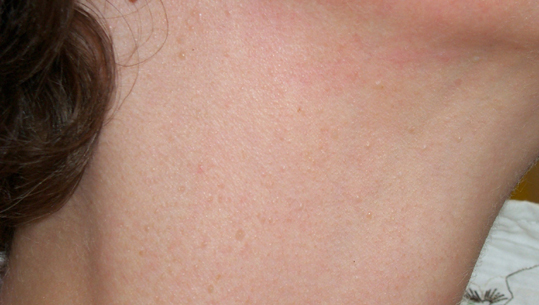
Multiple trichodiscomas of the neck.
Differential diagnosis
BHDS manifestations occur in other diseases. These include renal cancer syndromes, namely von Hippel-Lindau disease, hereditary leiomyomatosis\/renal cell cancer, hereditary papillary renal cancer, hereditary clear cell renal cell cancer, tuberous sclerosis complex, familial paraganglioma syndrome, and familial oncocytoma.
Tuberous sclerosis, Cowden syndrome and Brooke-Spiegler syndrome are characterized by cutaneous manifestations that can present similaraties with BHDS lesions. However, the cutaneous hamartomas in these conditions are angiofibromas, trichilemmomas and trichoepitheliomas, respectively.
BHDS should also be differentiated from syndromes associated with cystic lung disease and pneumothorax. Lymphangioleiomyomatosis and pulmonary endometriosis should be considered in women of reproductive age.
Tuberous sclerosis, Cowden syndrome and Brooke-Spiegler syndrome are characterized by cutaneous manifestations that can present similaraties with BHDS lesions. However, the cutaneous hamartomas in these conditions are angiofibromas, trichilemmomas and trichoepitheliomas, respectively.
BHDS should also be differentiated from syndromes associated with cystic lung disease and pneumothorax. Lymphangioleiomyomatosis and pulmonary endometriosis should be considered in women of reproductive age.
Neoplastic risk
Approximately 27% of BHDS patients develop renal tumors of different histological type:
- chromophobe (34%),
- hybrid chromophobe\/oncocytic (50%),
- oncocytoma (5%), and
- clear cell renal carcinoma (9%).
Hybrid tumors are most characteristic of this condition, and several lesions initially diagnosed as oncocytomas or chromofobe tumors have been defined as hybrid tumors upon reappraisal. Multiple histological types of kidney tumors can be found in the same BHDS family, in the same patient or even in the same kidney.
BHDS patients with bilateral renal masses and oncocytoma\/oncocytic neoplasm on one side have significantly lower histological concordance rates in the contralateral kidney compared to non-BHDS patients; this underscores the need for careful periodic surveillance, to detect lesions with a higher malignant potential.
- chromophobe (34%),
- hybrid chromophobe\/oncocytic (50%),
- oncocytoma (5%), and
- clear cell renal carcinoma (9%).
Hybrid tumors are most characteristic of this condition, and several lesions initially diagnosed as oncocytomas or chromofobe tumors have been defined as hybrid tumors upon reappraisal. Multiple histological types of kidney tumors can be found in the same BHDS family, in the same patient or even in the same kidney.
BHDS patients with bilateral renal masses and oncocytoma\/oncocytic neoplasm on one side have significantly lower histological concordance rates in the contralateral kidney compared to non-BHDS patients; this underscores the need for careful periodic surveillance, to detect lesions with a higher malignant potential.
Treatment
- No specific medical treatment exists for the cutaneous lesions of BHDS. Surgical removal has provided definitive treatment of solitary perifollicular fibromas and electrodesiccation may be helpful in removal of multiple lesions, which, however, can recur.
- High-resolution CT scan should be performed to identify lung cysts. Patients should be educated about the risk of pneumothorax.
- Individuals at risk or affected by BHDS should be radiographically screened for renal tumors at periodic intervals and they are best treated with nephron sparing surgical approaches.
- Colonoscopy should be considered, although there is as yet no evidence that the risk of colorectal tumors is increased in BHDS.
FLCN loss has been shown to result in upregulation of the AKT-mTOR pathway both in vitro and in a conditional Flcn mouse knockout model. These results suggest that mTOR inhibitors such as rapamycin analogues (i.e. sirolimus) might be useful potential therapeutic agents for BHDS-associated renal tumors.
- High-resolution CT scan should be performed to identify lung cysts. Patients should be educated about the risk of pneumothorax.
- Individuals at risk or affected by BHDS should be radiographically screened for renal tumors at periodic intervals and they are best treated with nephron sparing surgical approaches.
- Colonoscopy should be considered, although there is as yet no evidence that the risk of colorectal tumors is increased in BHDS.
FLCN loss has been shown to result in upregulation of the AKT-mTOR pathway both in vitro and in a conditional Flcn mouse knockout model. These results suggest that mTOR inhibitors such as rapamycin analogues (i.e. sirolimus) might be useful potential therapeutic agents for BHDS-associated renal tumors.
Prognosis
Prognosis depends on the number, type and age at diagnosis of kidney tumors. Hybrid and chromophobe tumors have malignant potential, while pure renal oncocytomas are benign. Mean age at diagnosis of kidney tumors is 50.7 years.
Genes involved and Proteins
Note
Genomic coordinates (GRCh37): 17: 17115522 - 17140501.
Description
Total gene size: 24971 bp.
Transcription
Alternative splicing results in two transcript variants encoding different isoforms. mRNA is expressed in a variety of tissues, including the skin, the kidney, the lung, the pancreas, parotid gland, and the brain. Tissues with reduced expression of FLCN mRNA include heart, muscle and liver. FLCN mRNA is not expressed in renal tumors from BHDS patients.
Note
Folliculin
Description
The protein contains a conserved SLS potential phosphorylation site, a glutamic acid-rich coiled-coil domain, an N-glycosylation site, and 3 myristoylation sites.
Function
FLCN function is not yet completely understood. It binds to FNIP1 and FNIP2 (via its C-terminus) and colocalizes with them in the cytoplasm. However, unbound FLCN is mainly localized in the nucleus. FLCN-FNP1 and FLCN-FNP2 complexes interact with AMPK and seem to modulate mTOR activity with opposite effects in a context-dependent manner. FLCN is phosphorylated by AMPK and mTOR, and phosphorylation is enhanced by binding with FNIP1 and FNIP2.
FLCN has also a role in the regulation of key TGF-beta signalling. Its inactivation leads to activation of the transcription factor TFE3 and to overexpression of nuclear genes involved in the transcription and replication of the mitochondrial genome.
Structure: The crystal structure of folliculin carboxy-terminal domain suggests that it is distantly related to Differentially Expressed in Normal cells and Neoplasia (DENN) domain proteins, that serve as guanine exchange factors (GEFs) for Rab GTPases. In particular, folliculin displays GEF activity towards Rab35, facilitating its role in vesicle membrane transport.
FLCN has also a role in the regulation of key TGF-beta signalling. Its inactivation leads to activation of the transcription factor TFE3 and to overexpression of nuclear genes involved in the transcription and replication of the mitochondrial genome.
Structure: The crystal structure of folliculin carboxy-terminal domain suggests that it is distantly related to Differentially Expressed in Normal cells and Neoplasia (DENN) domain proteins, that serve as guanine exchange factors (GEFs) for Rab GTPases. In particular, folliculin displays GEF activity towards Rab35, facilitating its role in vesicle membrane transport.
Note
Frameshift insertions or deletions within a mononucleotide repeat tract containing 8 cytosines within exon 11 are the most frequent FLCN constitutional mutations, detected in approximately 50% of BHDS families. The spectrum of additional mutations is heterogeneous. Overall, FLCN point mutations are found in 60%-88% of BHDS cases, depending on selection criteria. Large FLCN intragenic deletions and duplications may account for approximately 5% of BHDS cases. The tract including the 5 UTR and exon 1 seems to be a hot-spot for large deletions.
Animal Models: Hereditary multifocal renal cystadenocarcinoma and nodular dermatofibrosis is a naturally occurring canine kidney cancer syndrome that was originally described in German shepherd dogs, and is caused by canine Bhd gene mutations.
In a colony of Sprague-Dawley rats in Japan, designated the Nihon rat, a germline frameshift mutation in the Bhd gene resulting in a premature stop codon was found to be associated with hereditary renal carcinoma. The homozygous mutant condition was lethal at an early stage of foetal life in the rat.
Other rat or mouse BHDS models were generated deleting FLCN homologues: targeted homozygous deletion of Bhd in rat and mice was embryonic lethal whereas heterozygous animals manifested hyperproliferative diseases of various organs including preneoplastic kidney lesions and kidney tumors.
Deletion of the FLCN homologue in Drosophila causes growth delay. In this model, growth can be rescued by dietary changes, suggesting that modulation of the local nutrient conditions might be a potential treatment for BHDS lesions.
Animal Models: Hereditary multifocal renal cystadenocarcinoma and nodular dermatofibrosis is a naturally occurring canine kidney cancer syndrome that was originally described in German shepherd dogs, and is caused by canine Bhd gene mutations.
In a colony of Sprague-Dawley rats in Japan, designated the Nihon rat, a germline frameshift mutation in the Bhd gene resulting in a premature stop codon was found to be associated with hereditary renal carcinoma. The homozygous mutant condition was lethal at an early stage of foetal life in the rat.
Other rat or mouse BHDS models were generated deleting FLCN homologues: targeted homozygous deletion of Bhd in rat and mice was embryonic lethal whereas heterozygous animals manifested hyperproliferative diseases of various organs including preneoplastic kidney lesions and kidney tumors.
Deletion of the FLCN homologue in Drosophila causes growth delay. In this model, growth can be rescued by dietary changes, suggesting that modulation of the local nutrient conditions might be a potential treatment for BHDS lesions.
Article Bibliography
| Pubmed ID | Last Year | Title | Authors |
|---|---|---|---|
| 18182616 | 2008 | Kidney-targeted Birt-Hogg-Dube gene inactivation in a mouse model: Erk1/2 and Akt-mTOR activation, cell hyperproliferation, and polycystic kidneys. | Baba M et al |
| 17028174 | 2006 | Folliculin encoded by the BHD gene interacts with a binding protein, FNIP1, and AMPK, and is involved in AMPK and mTOR signaling. | Baba M et al |
| 21412933 | 2011 | Identification of intragenic deletions and duplication in the FLCN gene in Birt-Hogg-Dubé syndrome. | Benhammou JN et al |
| 596896 | 1977 | Hereditary multiple fibrofolliculomas with trichodiscomas and acrochordons. | Birt AR et al |
| 21496834 | 2011 | The impact of germline BHD mutation on histological concordance and clinical treatment of patients with bilateral renal masses and known unilateral oncocytoma. | Boris RS et al |
| 18165647 | 2008 | Efficacy of sunitinib and sorafenib in metastatic papillary and chromophobe renal cell carcinoma. | Choueiri TK et al |
| 8734663 | 1996 | Multiple lipomas, angiolipomas, and parathyroid adenomas in a patient with Birt-Hogg-Dube syndrome. | Chung JY et al |
| 7458379 | 1981 | Multiple fibrofolliculomas with trichodiscomas and acrochordons. | Fujita WH et al |
| 22441547 | 2012 | Pulmonary cysts of Birt-Hogg-Dubé syndrome: a clinicopathologic and immunohistochemical study of 9 families. | Furuya M et al |
| 23150719 | 2012 | Regulation of mitochondrial oxidative metabolism by tumor suppressor FLCN. | Hasumi H et al |
| 20573232 | 2010 | Tumor suppressor FLCN inhibits tumorigenesis of a FLCN-null renal cancer cell line and regulates expression of key molecules in TGF-beta signaling. | Hong SB et al |
| 11526515 | 2001 | Birt-Hogg-Dubé syndrome: mapping of a novel hereditary neoplasia gene to chromosome 17p12-q11.2. | Khoo SK et al |
| 12471204 | 2002 | Clinical and genetic studies of Birt-Hogg-Dubé syndrome. | Khoo SK et al |
| 21162720 | 2010 | Birt-Hogg-Dubé renal tumors are genetically distinct from other renal neoplasias and are associated with up-regulation of mitochondrial gene expression. | Klomp JA et al |
| 9390023 | 1997 | The Heidelberg classification of renal cell tumours. | Kovacs G et al |
| 9835964 | 1998 | [Multiple trichodiscomas associated with colonic polyposis]. | Le Guyadec T et al |
| 14532326 | 2003 | A mutation in the canine BHD gene is associated with hereditary multifocal renal cystadenocarcinoma and nodular dermatofibrosis in the German Shepherd dog. | Lingaas F et al |
| 11100034 | 2000 | Parotid oncocytoma in the Birt-Hogg-Dubé syndrome. | Liu V et al |
| 23799055 | 2013 | Genetic characterization of the Drosophila birt-hogg-dubé syndrome gene. | Liu W et al |
| 12204536 | 2002 | Mutations in a novel gene lead to kidney tumors, lung wall defects, and benign tumors of the hair follicle in patients with the Birt-Hogg-Dubé syndrome. | Nickerson ML et al |
| 22977732 | 2012 | Crystal structure of folliculin reveals a hidDENN function in genetically inherited renal cancer. | Nookala RK et al |
| 14769940 | 2004 | A germ-line insertion in the Birt-Hogg-Dubé (BHD) gene gives rise to the Nihon rat model of inherited renal cancer. | Okimoto K et al |
| 15821464 | 2005 | Evaluation and management of renal tumors in the Birt-Hogg-Dubé syndrome. | Pavlovich CP et al |
| 2805394 | 1989 | Fibrofolliculomas, tricodiscomas and acrochordons (Birt-Hogg-Dubé) associated with intestinal polyposis. | Rongioletti F et al |
| 8245249 | 1993 | Bilateral renal cell carcinoma in the Birt-Hogg-Dubé syndrome. | Roth JS et al |
| 15852235 | 2005 | Germline BHD-mutation spectrum and phenotype analysis of a large cohort of families with Birt-Hogg-Dubé syndrome. | Schmidt LS et al |
| 1986711 | 1991 | Familial multiple desmoplastic trichoepitheliomas. | Shapiro PE et al |
| 4015134 | 1985 | Familial multiple trichodiscomas. A clinicopathologic study. | Starink TM et al |
| 18663353 | 2008 | Interaction of folliculin (Birt-Hogg-Dubé gene product) with a novel Fnip1-like (FnipL/Fnip2) protein. | Takagi Y et al |
| 19782489 | 2011 | Characteristics of pulmonary cysts in Birt-Hogg-Dubé syndrome: thin-section CT findings of the chest in 12 patients. | Tobino K et al |
| 10522666 | 1999 | Birt-Hogg-Dubé syndrome: a novel marker of kidney neoplasia. | Toro JR et al |
| 3819093 | 1987 | Fibrofolliculomas, trichodiscomas, and acrochordons: the Birt-Hogg-Dubé syndrome. | Ubogy-Rainey Z et al |
| 14512924 | 2003 | Birt-Hogg-Dubé syndrome: two patients with neural tissue tumors. | Vincent A et al |
| 15143337 | 2004 | Expression of Birt-Hogg-Dubé gene mRNA in normal and neoplastic human tissues. | Warren MB et al |
| 753849 | 1977 | Multiple fibrofolliculomas (Birt-Hogg-Dubé) associated with a large connective tissue nevus. | Weintraub R et al |
| 9679872 | 1998 | Familial renal oncocytoma: clinicopathological study of 5 families. | Weirich G et al |
| 11927500 | 2002 | Risk of renal and colonic neoplasms and spontaneous pneumothorax in the Birt-Hogg-Dubé syndrome. | Zbar B et al |
External Links
Citation
Antonella Maffé ; Benedetta Toschi ; Maurizio Genuardi
Birt-Hogg-Dubé syndrome (BHDS)
Atlas Genet Cytogenet Oncol Haematol. 2014-01-01
Online version: http://atlasgeneticsoncology.org/cancer-prone-disease/10091/birt-hogg-dub-eacute
Historical Card
2006-02-01 Birt-Hogg-Dubé syndrome (BHDS) by Benedetta Toschi,Maurizio Genuardi Affiliation
Genetics, Molecular Biology Unit, S Croce e Carle Hospital, Cuneo, Italy (AM); Medical Genetics Laboratory, Santa Chiara Hospital, Pisa (BT); Department of Biomedical, Experimental, Clinical Sciences, University of Florence, Viale Gaetano Pieraccini 6, 50139 Firenze, Italy (MG)
