NCOA4 (Nuclear Receptor Coactivator 4)
2008-10-01 Dario de Biase , Luca Morandi , Giovanni Tallini AffiliationBologna University School of Medicine, Anatomia Patologica, Ospedale Bellaria, Via Altura 3, 40139 Bologna, Italy
Identity
HGNC
LOCATION
10q11.23
LOCUSID
ALIAS
ARA70,ELE1,PTC3,RFG
FUSION GENES
DNA/RNA
Description
10 exons, 3431bp.
Transcription
Isoforms due to alternative splicing.
Proteins
Description
Two isoforms:
- Isoform alfa (614 aa, mass around 70kD)
- Isoform beta: missing of aa 239-565 (mass around 32kD)
- Isoform alfa (614 aa, mass around 70kD)
- Isoform beta: missing of aa 239-565 (mass around 32kD)
Expression
NCOA4 is widely expressed in several tissues, including testis, adrenal and thyroid glands, thymus, prostate. A truncated NCOA4 corresponding to the beta isoform is fused to RET exon 12 and is aberrantly expressed in papillary thyroid carcinoma as a consequence of intrachromosomal rearrangements at 10q11.2 (RET/NCOA4).
Function
NCOA4 is involved in the androgen receptor signaling pathway and in the development of the male gonade. It is a ligand-dependent associated protein for the androgen receptor (AR), that functions as coactivator to enhance AR transcriptional activity (7-10 fold in human prostate cancer cells) and protein stability. NCOA4 also enhances the agonist activity of anti-androgens in human prostate cancer cells (3-30 fold in the prostate cancer cell line DU145), with relevant implications for hormonal treatment of prostate cancer. Albeit to a lesser degree (up to 2-fold), NCO4 also enhances transcription activity of other steroid receptors, such as glucocorticoid receptor (GR), progesterone receptor (PR) and oestrogen receptor (ER).
In addition to the interaction with steroid hormone receptors, NCOA4 functions as coactivator of peroxisome proliferator-activated receptor gamma (PPARG). PPARG is a peroxisome proliferator-activated receptor and as such belongs to the nuclear hormone receptor superfamily. PPARG is highly expressed in adipose tissue (were it is involved in adipogenesis and in the regulation of adipocyte-specific genes), as well as in other human tissues. Interestingly, PPARG is rearranged with PAX8 in a subset of follicular thyroid tumors.
Unlike the AR-NCOA4 interaction, which requires the presence of androgen, the PPARG-NCOA4 interaction can occur in the absence of exogenous ligand. However, the presence of the ligand enhances PPARG-NCOA4 transactivation and NCOA4 is thus regarded as a ligand-enhanced coactivator of PPARG.
In addition to the interaction with steroid hormone receptors, NCOA4 functions as coactivator of peroxisome proliferator-activated receptor gamma (PPARG). PPARG is a peroxisome proliferator-activated receptor and as such belongs to the nuclear hormone receptor superfamily. PPARG is highly expressed in adipose tissue (were it is involved in adipogenesis and in the regulation of adipocyte-specific genes), as well as in other human tissues. Interestingly, PPARG is rearranged with PAX8 in a subset of follicular thyroid tumors.
Unlike the AR-NCOA4 interaction, which requires the presence of androgen, the PPARG-NCOA4 interaction can occur in the absence of exogenous ligand. However, the presence of the ligand enhances PPARG-NCOA4 transactivation and NCOA4 is thus regarded as a ligand-enhanced coactivator of PPARG.

Ligand-specific interaction between AR (Androgen receptor), NCOA4, and the androgen receptor ligand DHT (dihydrotestosterone).
Mutations
Germinal
LINE S94L; F154L; C350R; P474R; L561P.
Somatic
NCOA4 breakpoint for rearrangement to form RET/NCOA4 oncogene at cDNA bp791, corresponding to aa 238-239.
Implicated in
Entity name
inv(10)(q11q11) with RET/NCOA4 rearrangement in thyroid cancer
Disease
Papillary thyroid carcinoma. RET/NCOA4 may occur in non radiation-associated carcinomas but it is particularly common in radiation-associated tumors like those linked to the Chernobyl nuclear accident (1986).
Prognosis
RET/NCOA4 may be associated with aggressive behaviour. Among post-Chernobyl papillary carcinomas, RET/NCOA4 has been associated with tumors that were of shorter latency after radiation exposure, of larger size, with extrathyroidal extension, and that were classified as solid variant papillary carcinomas.
Cytogenetics
Simple karyotypes with balanced chromosomal inversions due to structural rearrangement of NCOA4 and RET gene on chromosome 10 [inv(10)(q11.2-q21)], resulting in RET/NCOA4.
Hybrid gene
RET/NCOA4
Fusion protein
NCOA4/RET (RP3)
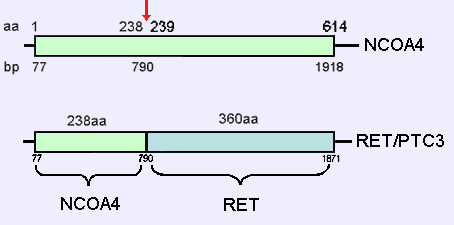
Diagram of RET/NCOA4 oncogene. The red arrow indicates the breakpoint region.
Oncogenesis
RET/PTC oncogenes are generated by chromosomal rearrangements resulting in the fusion of the RET tyrosine-kinase (RET-TK) domain to the 5-terminal region of heterologous genes (e.g. H4, RIa, RFG5, hTIF1, RFG7, ELKS). All are balanced inversions or translocations which involve the 3.0 kb intron 11 of RET. RET-fused genes are widely expressed in human tissues, including thyroid follicular cells, and have putative dimerization domains. As the chimeric forms of RET-TK are translated into fusion proteins, these domains of the translocated amino terminal regions allow dimerization and thus ligand independent activation of RET-TK, which is considered essential for the transformation of thyroid cells. To date, at least 16 chimeric mRNAs involving 10 different genes have been reported, of which RET/PTC1 (consisting in the fusion of RET with H4) and RET/NCOA4 (consisting in the fusion of RET with NCOA4) are by far the most common.
ANIMAL MODELS RET/NCOA4 transgenic mice have been generated by Powell and coworkers using a construct with the RET/NCOA4 fusion gene downstream and under the control of the bovine thyroglobulin gene regulatory region; they express RET/NCOA4 selectively in the thyroid gland and develop thyroid hyperplasia and solid tumor variants of papillary carcinomas.
ANIMAL MODELS RET/NCOA4 transgenic mice have been generated by Powell and coworkers using a construct with the RET/NCOA4 fusion gene downstream and under the control of the bovine thyroglobulin gene regulatory region; they express RET/NCOA4 selectively in the thyroid gland and develop thyroid hyperplasia and solid tumor variants of papillary carcinomas.
Article Bibliography
| Pubmed ID | Last Year | Title | Authors |
|---|---|---|---|
| 9892017 | 1999 | Interaction of the putative androgen receptor-specific coactivator ARA70/ELE1alpha with multiple steroid receptors and identification of an internally deleted ELE1beta isoform. | Alen P et al |
| 15663989 | 2004 | Expression and function of androgen receptor coactivators in prostate cancer. | Culig Z et al |
| 10347167 | 1999 | Identification of ARA70 as a ligand-enhanced coactivator for the peroxisome proliferator-activated receptor gamma. | Heinlein CA et al |
| 16762319 | 2006 | Functional interaction of nuclear receptor coactivator 4 with aryl hydrocarbon receptor. | Kollara A et al |
| 9636157 | 1998 | Promotion of agonist activity of antiandrogens by the androgen receptor coactivator, ARA70, in human prostate cancer DU145 cells. | Miyamoto H et al |
| 18156210 | 2008 | Stimulation of prostate cancer cellular proliferation and invasion by the androgen receptor co-activator ARA70. | Peng Y et al |
| 9850089 | 1998 | The RET/PTC3 oncogene: metastatic solid-type papillary carcinomas in murine thyroids. | Powell DJ Jr et al |
| 10741739 | 2000 | Pattern of radiation-induced RET and NTRK1 rearrangements in 191 post-chernobyl papillary thyroid carcinomas: biological, phenotypic, and clinical implications. | Rabes HM et al |
| 8290261 | 1994 | Molecular characterization of RET/PTC3; a novel rearranged version of the RETproto-oncogene in a human thyroid papillary carcinoma. | Santoro M et al |
| 17412801 | 2007 | Direct regulation of androgen receptor-associated protein 70 by thyroid hormone and its receptors. | Tai PJ et al |
| 11707626 | 2001 | RET oncogene activation in papillary thyroid carcinoma. | Tallini G et al |
| 8643607 | 1996 | Cloning and characterization of a specific coactivator, ARA70, for the androgen receptor in human prostate cells. | Yeh S et al |
Other Information
Locus ID:
NCBI: 8031
MIM: 601984
HGNC: 7671
Ensembl: ENSG00000266412
Variants:
dbSNP: 8031
ClinVar: 8031
TCGA: ENSG00000266412
COSMIC: NCOA4
RNA/Proteins
Expression (GTEx)
Pathways
| Pathway | Source | External ID |
|---|---|---|
| Thyroid cancer | KEGG | ko05216 |
| Pathways in cancer | KEGG | hsa05200 |
| Thyroid cancer | KEGG | hsa05216 |
| Ferroptosis | KEGG | ko04216 |
| Ferroptosis | KEGG | hsa04216 |
Protein levels (Protein atlas)
References
| Pubmed ID | Year | Title | Citations |
|---|---|---|---|
| 38159858 | 2024 | NCOA4 requires a [3Fe-4S] to sense and maintain the iron homeostasis. | 3 |
| 38159858 | 2024 | NCOA4 requires a [3Fe-4S] to sense and maintain the iron homeostasis. | 3 |
| 36660932 | 2023 | The PTBP1‑NCOA4 axis promotes ferroptosis in liver cancer cells. | 6 |
| 36907253 | 2023 | JNK-JUN-NCOA4 axis contributes to chondrocyte ferroptosis and aggravates osteoarthritis via ferritinophagy. | 20 |
| 37188126 | 2023 | RET rearrangements are relevant to histopathologic subtypes and clinicopathological features in Thai papillary thyroid carcinoma patients. | 0 |
| 38049396 | 2023 | HECW1 induces NCOA4-regulated ferroptosis in glioma through the ubiquitination and degradation of ZNF350. | 0 |
| 36660932 | 2023 | The PTBP1‑NCOA4 axis promotes ferroptosis in liver cancer cells. | 6 |
| 36907253 | 2023 | JNK-JUN-NCOA4 axis contributes to chondrocyte ferroptosis and aggravates osteoarthritis via ferritinophagy. | 20 |
| 37188126 | 2023 | RET rearrangements are relevant to histopathologic subtypes and clinicopathological features in Thai papillary thyroid carcinoma patients. | 0 |
| 38049396 | 2023 | HECW1 induces NCOA4-regulated ferroptosis in glioma through the ubiquitination and degradation of ZNF350. | 0 |
| 35386390 | 2022 | NCOA4-Mediated Ferroptosis in Bronchial Epithelial Cells Promotes Macrophage M2 Polarization in COPD Emphysema. | 15 |
| 36067704 | 2022 | TRIM7 modulates NCOA4-mediated ferritinophagy and ferroptosis in glioblastoma cells. | 25 |
| 36552889 | 2022 | C-MYC Inhibited Ferroptosis and Promoted Immune Evasion in Ovarian Cancer Cells through NCOA4 Mediated Ferritin Autophagy. | 14 |
| 35386390 | 2022 | NCOA4-Mediated Ferroptosis in Bronchial Epithelial Cells Promotes Macrophage M2 Polarization in COPD Emphysema. | 15 |
| 36067704 | 2022 | TRIM7 modulates NCOA4-mediated ferritinophagy and ferroptosis in glioblastoma cells. | 25 |
Citation
Dario de Biase ; Luca Morandi ; Giovanni Tallini
NCOA4 (Nuclear Receptor Coactivator 4)
Atlas Genet Cytogenet Oncol Haematol. 2008-10-01
Online version: http://atlasgeneticsoncology.org/gene/218/
