DMTF1 (cyclin D binding myb-like transcription factor 1)
2008-11-01 Kazushi Inoue AffiliationDept. of Pathology, Wake Forest University Health Sciences, 2102 Gray Building, Medical Center Boulevard, Winston-Salem, NC 27157-0001, USA
Identity
HGNC
LOCATION
7q21.12
LOCUSID
ALIAS
DMP1,DMTF,MRUL,hDMP1
FUSION GENES
DNA/RNA
Note
There are at least three splicing variants for hDMTF1 alpha, beta and gamma.
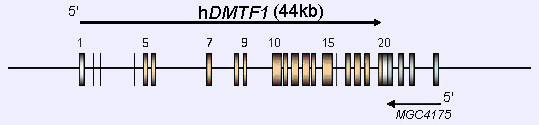
The human DMTF1 genomic locus. DMTF1 consists of 20 exons and a gene named MGC4175 is localized at its 3 end in a reverse orientation.
Description
20 Exons.
Transcription
Major transcript: 3.9kb (human) (and 3.75kb in the mouse).
Pseudogene
In mus musculus, the pseudogene of Dmtf1 exists on chromosome XE3.
NT 039716, gi:149272292.
NT 039716, gi:149272292.
Proteins
Note
The human DMTF1alpha protein consists of 760 amino acids; DMTF1beta, 272 amino acids; and DMTF1gamma, 285 amino acids. Mouse Dmp1 consists of 761 amino acids.
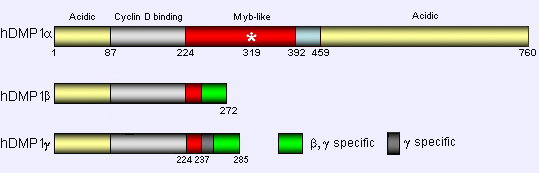
Proteins generated from splicing variants of the human DMTF1 gene. The hDMTF1 beta and gamma isoforms lack most of the Myb-like repeats and the principal transactivation domains, and thus, they do not bind to DNA.
Description
Dmtf1 is a MYB-like transcription factor isolated in a yeast two-hybrid screen of a mouse T lymphocyte library with cyclin D2 bait. It binds to a consensus sequence CCCG(G/T)ATG(T/C) that is also recognized by Ets family proteins. DMTF1 is a novel tumor suppressor that receives signals from oncogenic RAS and activates the ARF - P53 pathway. D-type cyclins antagonize the activity of Dmtf1 when E2F sites are not on the promoter; however, they synergize with Dmtf1 on the Arf promoter. Recent study shows significant involvement of DMTF1 in human non-small-cell lung carcinomas.
Expression
Mouse Dmtf1 protein is expressed in the testis, thymus, spleen, brain, lung, and kidney.
Localisation
Both human and mouse DMTF1 alpha proteins are localized in the nucleus.
Function
Dmtf1-null mice are prone to spontaneous tumor development, which was accelerated when the animals were neonatally treated with ionizing radiation or dimethylbenzanthracene. Lung adenomas/adenocarcinomas were the most common tumors found in Dmtf1-deficient mice. Eµ-Myc-induced lymphomagenesis was significantly accelerated in Dmtf1-deficient mice. The retention and expression of the wild-type Dmtf1 allele in tumors arising in heterozygotes indicated that Dmtf1 is haplo-insufficient for tumor suppression. The low frequency of Arf deletion and p53 mutation in tumors from Dmtf1-knockout mice suggested that Dmtf1 is a physiological regulator of the Arf-p53 pathway in vivo.
The DMTF1 promoter is activated by the oncogenic RAS - RAF - MEK - ERK - JUN pathway, and the induction of ARF by RAS is DMTF1-dependent. Thus, DMTF1 is a critical mediator of p19ARF in response to oncogenic RAS signaling. The importance of dmp1 in P53 regulation was recently demonstrated by crossing Dmtf1-deficient mice with K-rasLA transgenic mice. The Dmtf1 promoter is repressed by overexpression of E2Fs and also by physiological mitogenic signaling. Thus, DMTF1 is a marker of cells that have exited from the cell cycle. The DMTF1 promoter is repressed by genotoxic stimuli mediated by NF-kappa B, and repression of the ARF promoter by genotoxic stimuli is DMP1-dependent. Very little studies have been conducted on the post-translational modifications for DMTF1.
The DMTF1 promoter is activated by the oncogenic RAS - RAF - MEK - ERK - JUN pathway, and the induction of ARF by RAS is DMTF1-dependent. Thus, DMTF1 is a critical mediator of p19ARF in response to oncogenic RAS signaling. The importance of dmp1 in P53 regulation was recently demonstrated by crossing Dmtf1-deficient mice with K-rasLA transgenic mice. The Dmtf1 promoter is repressed by overexpression of E2Fs and also by physiological mitogenic signaling. Thus, DMTF1 is a marker of cells that have exited from the cell cycle. The DMTF1 promoter is repressed by genotoxic stimuli mediated by NF-kappa B, and repression of the ARF promoter by genotoxic stimuli is DMP1-dependent. Very little studies have been conducted on the post-translational modifications for DMTF1.
Homology
Human DMTF1 vs. mouse Dmtf1: 95% (723/761), positives 97% (739/761) at the amino acids level.
Mouse Dmtf1 vs. mouse TTF-1 (transcription termination factor 1): Identities 29% (90/309), positives 47% (148/309).
Mouse Dmtf1 vs. mouse C-myb: Identities 32% (23/71), positives 54% (39/71).
Mouse Dmtf1 vs. mouse A-myb: Identities 29% (31/106), positives 50% (54/106).
Mouse Dmtf1 vs. mouse B-myb: Identities 27% (22/80), positives 53% (43/80)
Mouse Dmtf1 vs. mouse TTF-1 (transcription termination factor 1): Identities 29% (90/309), positives 47% (148/309).
Mouse Dmtf1 vs. mouse C-myb: Identities 32% (23/71), positives 54% (39/71).
Mouse Dmtf1 vs. mouse A-myb: Identities 29% (31/106), positives 50% (54/106).
Mouse Dmtf1 vs. mouse B-myb: Identities 27% (22/80), positives 53% (43/80)
Mutations
Note
Point mutations for human DMTF1 in human cancer or other human disorders have not been reported.
Promoter hypermethylation for the hDMTF1 promoter is very rare ( around 2%) in human non-small-cell lung carcinomas.
Single nucleotide polymorphisms for hDMTF1 are shown in http://www.ncbi.nlm.nih.gov/SNP/snp_ref.cgi?locusId=9988.
Promoter hypermethylation for the hDMTF1 promoter is very rare ( around 2%) in human non-small-cell lung carcinomas.
Single nucleotide polymorphisms for hDMTF1 are shown in http://www.ncbi.nlm.nih.gov/SNP/snp_ref.cgi?locusId=9988.
Germinal
N/A.
Somatic
N/A.
Implicated in
Entity name
Non-small-cell lung carcinoma
Disease
One report shows that loss of heterozygosity (LOH) for the human DMTF1 gene was found in around 35 % of human non-small-cell lung cancers, especially those without deletions or methylation of p14ARF and/or mutations of p53. NSCLC with LOH for hDMTF1 showed significantly weaker nuclear staining for DMTF1 protein than tumors without LOH.
Prognosis
The correlation between LOH for hDMTF1 and the prognoses of non-small-cell lung cancer patients has not been reported.
Hybrid gene
Not reported.
Fusion protein
Not reported.
Oncogenesis
N/A
Entity name
Hematopoietic malignancies involving chromosome del(7q)
Prognosis
The prognoses of human leukemias with del(7q) abnormalities are generally poor.
Cytogenetics
One allele of the hDMTF1 locus was deleted in 9 of 9 leukemic cells with chromosome 7q abnormalities by FISH analysis, regardless of the detailed karyotype at 7q, suggesting that mono-allelic loss of hDMTF1 could contribute to 7q- leukemias.
Hybrid gene
Not reported.
Fusion protein
Not reported.
Oncogenesis
N/A
Article Bibliography
| Pubmed ID | Last Year | Title | Authors |
|---|---|---|---|
| 10095122 | 1999 | Cloning and chromosomal localization of the gene encoding human cyclin D-binding Myb-like protein (hDMP1). | Bodner SM et al |
| 8887674 | 1996 | Interaction of D-type cyclins with a novel myb-like transcription factor, DMP1. | Hirai H et al |
| 17237816 | 2007 | Dmp1 and tumor suppression. | Inoue K et al |
| 10097151 | 1999 | Induction of ARF tumor suppressor gene expression and cell cycle arrest by transcription factor DMP1. | Inoue K et al |
| 9786929 | 1998 | Regulation of the CD13/aminopeptidase N gene by DMP1, a transcription factor antagonized by D-type cyclins. | Inoue K et al |
| 18559489 | 2008 | Emerging roles of DMP1 in lung cancer. | Inoue K et al |
| 10898794 | 2000 | Disruption of the ARF transcriptional activator DMP1 facilitates cell immortalization, Ras transformation, and tumorigenesis. | Inoue K et al |
| 11711428 | 2001 | Dmp1 is haplo-insufficient for tumor suppression and modifies the frequencies of Arf and p53 mutations in Myc-induced lymphomas. | Inoue K et al |
| 17936562 | 2007 | Mutually exclusive inactivation of DMP1 and ARF/p53 in lung cancer. | Mallakin A et al |
| 15601844 | 2005 | Ras-Raf-Arf signaling critically depends on the Dmp1 transcription factor. | Sreeramaneni R et al |
| 17546045 | 2007 | Repression of Dmp1 and Arf transcription by anthracyclins: critical roles of the NF-kappaB subunit p65. | Taneja P et al |
| 12917399 | 2003 | Alternative splicing of the human cyclin D-binding Myb-like protein (hDMP1) yields a truncated protein isoform that alters macrophage differentiation patterns. | Tschan MP et al |
| 17972942 | 2008 | The hDMP1 tumor suppressor is a new WT1 target in myeloid leukemias. | Tschan MP et al |
Other Information
Locus ID:
NCBI: 9988
MIM: 608491
HGNC: 14603
Ensembl: ENSG00000135164
Variants:
dbSNP: 9988
ClinVar: 9988
TCGA: ENSG00000135164
COSMIC: DMTF1
RNA/Proteins
Expression (GTEx)
Protein levels (Protein atlas)
References
| Pubmed ID | Year | Title | Citations |
|---|---|---|---|
| 33367929 | 2021 | Mechanisms regulating DMTF1β/γ expression and their functional interplay with DMTF1α. | 1 |
| 33367929 | 2021 | Mechanisms regulating DMTF1β/γ expression and their functional interplay with DMTF1α. | 1 |
| 33120969 | 2020 | Survival of Lung Cancer Patients Dependent on the LOH Status for DMP1, ARF, and p53. | 3 |
| 33120969 | 2020 | Survival of Lung Cancer Patients Dependent on the LOH Status for DMP1, ARF, and p53. | 3 |
| 30592263 | 2019 | miR‑675 promotes colorectal cancer cell growth dependent on tumor suppressor DMTF1. | 12 |
| 30599775 | 2019 | c-MYB and DMTF1 in Cancer. | 18 |
| 30592263 | 2019 | miR‑675 promotes colorectal cancer cell growth dependent on tumor suppressor DMTF1. | 12 |
| 30599775 | 2019 | c-MYB and DMTF1 in Cancer. | 18 |
| 30100063 | 2018 | Cisplatin sensitivity in breast cancer cells is associated with particular DMTF1 splice variant expression. | 4 |
| 30100063 | 2018 | Cisplatin sensitivity in breast cancer cells is associated with particular DMTF1 splice variant expression. | 4 |
| 28257090 | 2017 | From General Aberrant Alternative Splicing in Cancers and Its Therapeutic Application to the Discovery of an Oncogenic DMTF1 Isoform. | 12 |
| 28257090 | 2017 | From General Aberrant Alternative Splicing in Cancers and Its Therapeutic Application to the Discovery of an Oncogenic DMTF1 Isoform. | 12 |
| 25965824 | 2015 | MicroRNA-155 promotes bladder cancer growth by repressing the tumor suppressor DMTF1. | 27 |
| 26187004 | 2015 | Human DMTF1β antagonizes DMTF1α regulation of the p14(ARF) tumor suppressor and promotes cellular proliferation. | 17 |
| 25965824 | 2015 | MicroRNA-155 promotes bladder cancer growth by repressing the tumor suppressor DMTF1. | 27 |
Citation
Kazushi Inoue
DMTF1 (cyclin D binding myb-like transcription factor 1)
Atlas Genet Cytogenet Oncol Haematol. 2008-11-01
Online version: http://atlasgeneticsoncology.org/gene/40340/dmtf1
