Identity
HGNC
LOCATION
5q31.3
LOCUSID
ALIAS
AFGF,ECGF,ECGF-beta,ECGFA,ECGFB,FGF-1,FGF-alpha,FGFA,GLIO703,HBGF-1,HBGF1
FUSION GENES
DNA/RNA
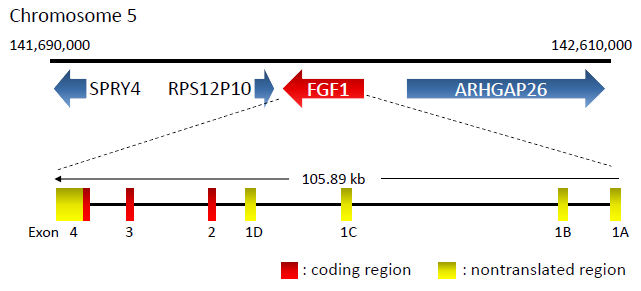
Figure1. FGF1 gene spans 105,89 kb on chromosome 5 in the region of q31.3 on the minus strand. It consists of 3 coding exons and 4 untranslated exons. The transcription is regulated by four distinct promoters. These are separated in the different 5 untranslated exons, designated 1A, 1B, 1C and 1D.
Description
The FGF1 gene is located chromosome 5 from 141971743 to 142077617 (105893 bp) on the minus strand.
Transcription
The FGF1 gene has 12 splice variants shown in Ensembl database. Nine of transcripts are protein-coding isoforms and 3 of those have no protein product. The FGF1 gene transcript is basically composed of 4 exons and second to fourth exons are protein-coding. The transcription is regulated by at least 4 distinct promoters in different upstream untranslated exons, designated 1A, 1B, 1C, and 1D. These are alternatively spliced to the first protein-coding exon (Chiu et al., 2001). The promoter 1A derived transcript dominantly expresses in the kidney (Myers et al., 1993), 1B in the brain and retina (Myers et al., 1993; Myers et al., 1995), and 1C and 1D in vascular smooth muscle cells and fibroblasts (Chotani et al., 2000).
Proteins
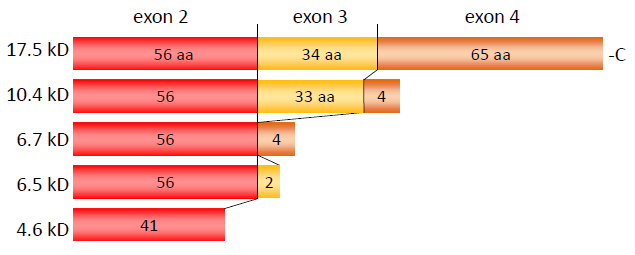
Figure 2. Schematic representation of the human FGF1 isoforms.
Description
FGFs control multiple biological processes such as proliferation, survival, migration and differentiation of a variety of cell types (Lanner and Rossant, 2010; Guillemot and Zimmer, 2011). The human and mouse FGF family consists of 22 members that are expressed in almost all tissues. Among the FGF family, FGF1 and FGF2 are prototypic FGF and have been extensively characterized. They were originally isolated from the brain and pituitary as mitogens for fibroblast cells in vitro (Gospodarowicz, 1975; Itoh and Ornitz, 2011).
FGF1 contains characteristic β-trefoil structure, since FGF1 contains 12 antiparallel β strands which assemble into a pattern with threefold internal symmetry (Zhu et al., 1991, Brych et al., 2001). Key residues responsible for Interaction between FGF1 and heparin or its receptor are characterized by crystal structure (Pellegrini et al., 2000; Mohammadi et al., 2005a; Mohammadi et al., 2005b).
FGF1 is unique among FGFs because of its ability to bind and activate all known FGFRs, FGF1 is considered to be the universal FGFR ligand (Zhang et al., 2006). Comparison of the crystal structures of FGF1-FGFR1c, FGF1-FGFR2c, and FGF1-FGFR3c complexes has provided key insights into the unique FGFR binding promiscuity of FGF1 (Olsen et al., 2004).
FGF1 contains characteristic β-trefoil structure, since FGF1 contains 12 antiparallel β strands which assemble into a pattern with threefold internal symmetry (Zhu et al., 1991, Brych et al., 2001). Key residues responsible for Interaction between FGF1 and heparin or its receptor are characterized by crystal structure (Pellegrini et al., 2000; Mohammadi et al., 2005a; Mohammadi et al., 2005b).
FGF1 is unique among FGFs because of its ability to bind and activate all known FGFRs, FGF1 is considered to be the universal FGFR ligand (Zhang et al., 2006). Comparison of the crystal structures of FGF1-FGFR1c, FGF1-FGFR2c, and FGF1-FGFR3c complexes has provided key insights into the unique FGFR binding promiscuity of FGF1 (Olsen et al., 2004).

Figure 3. Domaine structure of FGF1. FGF1 contains a nuclear localization signal (NLS) at N-terminal region and heparin binding site is located C-terminal.
Expression
Although first isolated from brain and pituitary on the basis of their ability to induce fibroblasts proliferation, FGF1 is widely expressed in developing and adult tissues (Gospodarowicz, 1974; Gospodarowicz, 1975; Gospodarowicz et al., 1978; Itoh and Ornitz, 2004). Immunohistochemical staining has shown that colorectal and gastric tissues, both normal and tumor, express FGF1, and the immunoreactivity is mainly cytoplasmic (el-Hariry et al., 1997). Various amounts of FGF1 are detected in hepatocellular carcinoma, whereas it cannot be detected in normal (Chow et al., 1998). FGF1 mRNA is detected in several types of breast epithelial cell lines such as normal (NMEC), transformed (HBL-100) (Renaud et al., 1996) and cancer cell lines MCF7, BT-20, MDA-MB-231 (Penault-Llorca et al., 1995; Renaud et al., 1996), while BT474, T47D and ZR75.1 do not express FGF1 mRNAs (Penault-Llorca et al., 1995).
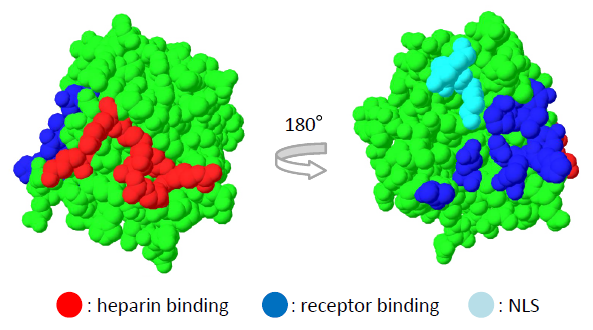
Figure 4. Crystal structure of FGF1. Ternary structures are depicted by its crystal structure and representative residues for the binding to its receptor (blue) and heparin (red) are shown.
Localisation
FGF1 lacks the classical signal sequence, since it employs non-classical pathway to be secreted. FGF1-S100A13-SYT complex formation is required for passing through the cell membrane (Mouta Carreira et al., 1998; Tarantini et al., 1998; Landriscina et al., 2001). Secreted extracellular FGF1 can be internalized following its binding to cell surface receptors by the clathrin-mediated pathway (Wiedlocha and Sørensen, 2004). FGF1 induces FGF receptor translocation from the cell membrane to the nucleus upon interaction with its receptor during the G1 phase of the fibroblast cell cycle (Prudovsky et al., 1994). FGF1 could be enters the nucleus by its putative nuclear localization sequence (NLS) (Imamura et al., 1990; Rodriguez-Enfedaque et al., 2009). Other groups suggest that nuclear translocation of FGF1 is controled not only by NLS, but also an additional sequence which prevents endogenously expressed FGF1 from NLS dependent translocation to the nucleus, and also FGF1 could move to the nucleus by free diffusion because a molecular weight of FGF1 is only 16500 (Zhan et al., 1992; Cao et al., 1993).
Function
FGF1 is a mitogen for numerous different cell types in vitro. FGF1 has been implicated in a range of physiological processes, including development, morphogenesis, wound healing and angiogenesis (Beenken and Mohammadi, 2009). However, FGF1/FGF2 double-knockout mice do not exhibit any of the phenotypic abnormalities. This results suggest that the developmental and physiological roles of FGF1 are highly restricted, even though its functions remain unclear (Miller et al., 2000).
FGF1 binds to integrin ανβ3 (Mori et al., 2008), and the integrin-binding site of FGF1 overlapps with the heparin-binding site (but not identical). The FGF1 mutant that does not bind to ανβ3 (R50E) is dominant-negative (antagonistic), while it still binds to FGFR1 and heparin (Yamaji et al., 2010). FGF1 induces integin-FGF1-FGFR ternary complex, but R50E does not (Yamaji et al., 2010). R50E suppresses angiogenesis and tumorigenesis (Mori et al., 2013).
FGF1 binds to integrin ανβ3 (Mori et al., 2008), and the integrin-binding site of FGF1 overlapps with the heparin-binding site (but not identical). The FGF1 mutant that does not bind to ανβ3 (R50E) is dominant-negative (antagonistic), while it still binds to FGFR1 and heparin (Yamaji et al., 2010). FGF1 induces integin-FGF1-FGFR ternary complex, but R50E does not (Yamaji et al., 2010). R50E suppresses angiogenesis and tumorigenesis (Mori et al., 2013).
Homology
Length of FGFs is in the range of 150 to 300 amino acids. The conserved core 120-amino acid have been shown a 30-60% identity (Itoh and Ornitz, 2004; Itoh and Ornitz, 2007).
Implicated in
Entity name
Gastrointestinal tumor
Note
FGF1 is overexpressed in 42% of colorectal adenomas, 76% of colorectal cancers, and 54% of gastric cancers as compared to the normal mucosal tissues. These results imply that overexpression of FGF1 often arises in a human colorectal and gastric cancers. FGF1 may play a role in the progression of these tumours (el-Hariry et al., 1997). Cancer-associated fibroblasts expressing fibroblast activation protein (FAP) is implicated in the invasive behavior of colorectal cancer. FAP enhances fibroblast cells to produce FGF1 and activates FGFR3 of colon cancer cells in vitro resulted in the increased cell migration and invasion (Henriksson et al., 2011).
Entity name
Breast cancer
Note
The majority of breast cancer, including cancer adjacent cells expresses active FGF1 protein (Smith et al., 1994); however, mRNA of FGF1 is expressed higher level in benign neoplastic and hyperplastic tissue than in malignant tissue (Anandappa et al., 1994). Another group demonstrates that the extent and intensity of immunoreactivity of FGF1 in cancer cells is much greater than those of cells from fibroadenoma or mastopathy (Yoshimura et al., 1998). FGF1 is detected in epithelial cells of breast fibroadenomas, and FGFR4 is expressed both in epithelial cells and stromal fibroblasts. These suggest a paracrine/autocrine regulation of epithelial and stromal cells of fibroadenomas through an FGF1-FGFR4 interaction (La Rosa et al., 2001).
Entity name
Nerve injury
Note
FGF1 is one of neuronotrophic factor and enhances nerve regeneration process (Walter et al., 1993). FGF1 increases the branching number of myelinated axons that regenerate damaged neurons and FGF1 also induces the axon elongation of primary sensory and motor neurons through the nerve guide in animals (Cordeiro et al., 1989). Protein expression profiles throughout 28 days of peripheral nerve regeneration reveals that FGF1 increases throughout the experimental period in the both proximal and distal nerve segments (Bryan et al., 2012).
Entity name
Cardiac ischemia
Note
Level of FGF1 in pericardial fluid is associated with severe myocardial ischemia. FGF1 is released from the myocardial tissue into pericardial result from the myocardial ischemia (Iwakura et al., 2000). FGF1 may contribute to the functional preservation for the myocardium damage. In fact, treatment with FGF1 by extravascular delivery system increases coronary flow in the artificially constricted territory (Lopez et al., 1998), and also systemic bolus of FGF1 immediately after myocardial ischemia reduces apoptosis in animal model (Cuevas et al., 1997).
Article Bibliography
| Pubmed ID | Last Year | Title | Authors |
|---|---|---|---|
| 7511406 | 1994 | Comparative expression of fibroblast growth factor mRNAs in benign and malignant breast disease. | Anandappa SY et al |
| 19247306 | 2009 | The FGF family: biology, pathophysiology and therapy. | Beenken A et al |
| 22325251 | 2012 | Spatiotemporal expression profiling of proteins in rat sciatic nerve regeneration using reverse phase protein arrays. | Bryan DJ et al |
| 11714927 | 2001 | Structure and stability effects of mutations designed to increase the primary sequence symmetry within the core region of a beta-trefoil. | Brych SR et al |
| 7680660 | 1993 | Characterization of the nuclear translocation of acidic fibroblast growth factor. | Cao Y et al |
| 11642361 | 2001 | Multiple controlling mechanisms of FGF1 gene expression through multiple tissue-specific promoters. | Chiu IM et al |
| 10849427 | 2000 | The small GTPases Ras, Rac, and Cdc42 transcriptionally regulate expression of human fibroblast growth factor 1. | Chotani MA et al |
| 9790463 | 1998 | Expression of fibroblast growth factor-1 and fibroblast growth factor-2 in normal liver and hepatocellular carcinoma. | Chow NH et al |
| 2727148 | 1989 | Acidic fibroblast growth factor enhances peripheral nerve regeneration in vivo. | Cordeiro PG et al |
| 9385115 | 1997 | Fibroblast growth factor-1 prevents myocardial apoptosis triggered by ischemia reperfusion injury. | Cuevas P et al |
| 649600 | 1978 | Purification of the fibroblast growth factor activity from bovine brain. | Gospodarowicz D et al |
| 21867876 | 2011 | From cradle to grave: the multiple roles of fibroblast growth factors in neural development. | Guillemot F et al |
| 21356388 | 2011 | Colorectal cancer cells activate adjacent fibroblasts resulting in FGF1/FGFR3 signaling and increased invasion. | Henriksson ML et al |
| 1699274 | 1990 | Recovery of mitogenic activity of a growth factor mutant with a nuclear translocation sequence. | Imamura T et al |
| 20940169 | 2011 | Fibroblast growth factors: from molecular evolution to roles in development, metabolism and disease. | Itoh N et al |
| 11289498 | 2000 | Myocardial ischemia enhances the expression of acidic fibroblast growth factor in human pericardial fluid. | Iwakura A et al |
| 11271786 | 2001 | Expression of acidic fibroblast growth factor (aFGF) and fibroblast growth factor receptor 4 (FGFR4) in breast fibroadenomas. | La Rosa S et al |
| 11432880 | 2001 | Copper induces the assembly of a multiprotein aggregate implicated in the release of fibroblast growth factor 1 in response to stress. | Landriscina M et al |
| 20876656 | 2010 | The role of FGF/Erk signaling in pluripotent cells. | Lanner F et al |
| 9530206 | 1998 | Angiogenic potential of perivascularly delivered aFGF in a porcine model of chronic myocardial ischemia. | Lopez JJ et al |
| 10688672 | 2000 | Compensation by fibroblast growth factor 1 (FGF1) does not account for the mild phenotypic defects observed in FGF2 null mice. | Miller DL et al |
| 15863029 | 2005 | Structural basis for fibroblast growth factor receptor activation. | Mohammadi M et al |
| 23469107 | 2013 | A dominant-negative FGF1 mutant (the R50E mutant) suppresses tumorigenesis and angiogenesis. | Mori S et al |
| 18441324 | 2008 | Direct binding of integrin alphavbeta3 to FGF1 plays a role in FGF1 signaling. | Mori S et al |
| 9712836 | 1998 | S100A13 is involved in the regulation of fibroblast growth factor-1 and p40 synaptotagmin-1 release in vitro. | Mouta Carreira C et al |
| 7544453 | 1995 | Different fibroblast growth factor 1 (FGF-1) transcripts in neural tissues, glioblastomas and kidney carcinoma cell lines. | Myers RL et al |
| 7678925 | 1993 | Gene structure and differential expression of acidic fibroblast growth factor mRNA: identification and distribution of four different transcripts. | Myers RL et al |
| 14732692 | 2004 | Insights into the molecular basis for fibroblast growth factor receptor autoinhibition and ligand-binding promiscuity. | Olsen SK et al |
| 11069186 | 2000 | Crystal structure of fibroblast growth factor receptor ectodomain bound to ligand and heparin. | Pellegrini L et al |
| 7705943 | 1995 | Expression of FGF and FGF receptor genes in human breast cancer. | Penault-Llorca F et al |
| 7527394 | 1994 | Intact and functional fibroblast growth factor (FGF) receptor-1 trafficks near the nucleus in response to FGF-1. | Prudovsky I et al |
| 8645241 | 1996 | Expression and regulation by serum of multiple FGF1 mRNA in normal transformed, and malignant human mammary epithelial cells. | Renaud F et al |
| 19765618 | 2009 | FGF1 nuclear translocation is required for both its neurotrophic activity and its p53-dependent apoptosis protection. | Rodriguez-Enfedaque A et al |
| 7517151 | 1994 | Acidic and basic fibroblast growth factors in human breast tissue. | Smith J et al |
| 9712834 | 1998 | The extravesicular domain of synaptotagmin-1 is released with the latent fibroblast growth factor-1 homodimer in response to heat shock. | Tarantini F et al |
| 7688578 | 1993 | Enhanced peripheral nerve regeneration by acidic fibroblast growth factor. | Walter MA et al |
| 15645710 | 2004 | Signaling, internalization, and intracellular activity of fibroblast growth factor. | Wiedłocha A et al |
| 20422052 | 2010 | A novel fibroblast growth factor-1 (FGF1) mutant that acts as an FGF antagonist. | Yamaji S et al |
| 9756721 | 1998 | The expression and localization of fibroblast growth factor-1 (FGF-1) and FGF receptor-1 (FGFR-1) in human breast cancer. | Yoshimura N et al |
| 1280137 | 1992 | Analysis of endogenous and exogenous nuclear translocation of fibroblast growth factor-1 in NIH 3T3 cells. | Zhan X et al |
| 16597617 | 2006 | Receptor specificity of the fibroblast growth factor family. The complete mammalian FGF family. | Zhang X et al |
| 1702556 | 1991 | Three-dimensional structures of acidic and basic fibroblast growth factors. | Zhu X et al |
| 9072001 | 1997 | Fibroblast growth factor 1 and fibroblast growth factor 2 immunoreactivity in gastrointestinal tumours. | el-Hariry I et al |
Other Information
Locus ID:
NCBI: 2246
MIM: 131220
HGNC: 3665
Ensembl: ENSG00000113578
Variants:
dbSNP: 2246
ClinVar: 2246
TCGA: ENSG00000113578
COSMIC: FGF1
RNA/Proteins
Expression (GTEx)
Pathways
Protein levels (Protein atlas)
References
| Pubmed ID | Year | Title | Citations |
|---|---|---|---|
| 38253356 | 2024 | The optimized priming effect of FGF-1 and FGF-2 enhances preadipocyte lineage commitment in human adipose-derived mesenchymal stem cells. | 0 |
| 38253356 | 2024 | The optimized priming effect of FGF-1 and FGF-2 enhances preadipocyte lineage commitment in human adipose-derived mesenchymal stem cells. | 0 |
| 37659992 | 2023 | FGF1 reduces cartilage injury in osteoarthritis via regulating AMPK/Nrf2 pathway. | 0 |
| 37783936 | 2023 | Intracellular FGF1 protects cells from apoptosis through direct interaction with p53. | 0 |
| 37659992 | 2023 | FGF1 reduces cartilage injury in osteoarthritis via regulating AMPK/Nrf2 pathway. | 0 |
| 37783936 | 2023 | Intracellular FGF1 protects cells from apoptosis through direct interaction with p53. | 0 |
| 33637374 | 2022 | Expression and function of fibroblast growth factor 1 in the hypertrophied ligamentum flavum of lumbar spinal stenosis. | 2 |
| 34796419 | 2022 | FGF Exhibits an Important Biological Role on Regulating Cell Proliferation of Breast Cancer When it Transports Into The Cell Nuclei. | 2 |
| 35159330 | 2022 | Nuclear Localization Sequence of FGF1 Is Not Required for Its Intracellular Anti-Apoptotic Activity in Differentiated Cells. | 2 |
| 35818245 | 2022 | MiR-143-3p Increases the Radiosensitivity of Breast Cancer Cells Through FGF1. | 4 |
| 33637374 | 2022 | Expression and function of fibroblast growth factor 1 in the hypertrophied ligamentum flavum of lumbar spinal stenosis. | 2 |
| 34796419 | 2022 | FGF Exhibits an Important Biological Role on Regulating Cell Proliferation of Breast Cancer When it Transports Into The Cell Nuclei. | 2 |
| 35159330 | 2022 | Nuclear Localization Sequence of FGF1 Is Not Required for Its Intracellular Anti-Apoptotic Activity in Differentiated Cells. | 2 |
| 35818245 | 2022 | MiR-143-3p Increases the Radiosensitivity of Breast Cancer Cells Through FGF1. | 4 |
| 33745974 | 2021 | Dissecting biological activities of fibroblast growth factor receptors by the coiled-coil-mediated oligomerization of FGF1. | 9 |
Citation
Seiji Mori ; Yoshikazu Takada
FGF1 (fibroblast growth factor 1 (acidic))
Atlas Genet Cytogenet Oncol Haematol. 2013-08-01
Online version: http://atlasgeneticsoncology.org/gene/40549
