ITGA11 (integrin, alpha 11)
2008-04-01 Svetlana N Popova , Donald Gullberg AffiliationDepartment of Biomedicine, University of Bergen, Jonas Lies vei 91, NO-5009 Bergen, Norway
DNA/RNA
Description
The gene contains 30 exons and 29 introns; it is composed of a 30 nt long 5 untranslated region, a 3564-nucleotide open reading frame, a 329-nucleotide 3 noncoding sequence and a polyA tail.
Transcription
Gene analysis in silico reveals several potential splice variants, which still remain to be validated at the RNA level. The basal promoter is regulated by Sp1/ Sp3/ Ets-1 binding sites. How occupation of these cis-binding sites in the promoter results in a fibroblast-specific α11 expression pattern remains to be shown. One working hypothesis is that the combined binding of Sp1 with a specific member of the Ets family of transcription factors contributes to the tissue-specific expression pattern.
Proteins
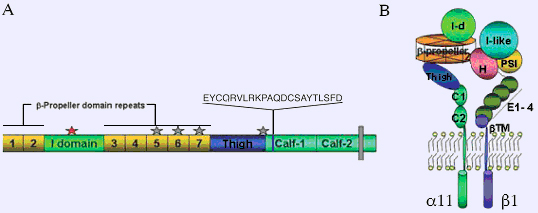
Scematic structure of the I-domain containing α11 integrin.
A. The integrins α subunit primary structure, including predicted divalent cation-binding sites (Mg2 as red star, and Ca2 as gray stars) is shown. The position of the inserted sequence of 22 amino acids in the Calf-1 domain is marked.
B. Schematic representations of straightened (active) conformations of the integrin. The arrangement of domains is based on the 3-dimensional crystal structure of the αvβ3-integrin, with an I domain added between the second and third β-propeller repeats.
I-d indicates I domain; PSI, plexin/semaphorin/integrin; and TM, -tail domain of integrin β subunit.
Description
The mature α11 peptide is 1166-amino acid-long (M.W. 145 kDa in SDS-PAGE under non-reducing conditions), which is longer than any other currently identified integrin α-chain (with the closest being αE, which is composed of 1160 amino acids). The extracellular domain contains seven FG-GAP repeats in the amino-terminal end with an inserted I domain between repeats 2 and 3. The I domain consists of 195 amino acids and includes a conserved metal ion-dependent adhesion site motif. In addition to the metal chelating site in the I domain, three potential divalent cation binding motifs with the consensus sequence DXD/NXDXXXD are present in repeats 5-7. A total of 20 cysteines are located in the extracellular domain. Of these, 16 are conserved in the most closely related integrin α10- and α1-chains, and they may contribute to intramolecular disulfide bonds. There is an inserted 22 amino acid sequence in the calf-1 domain in the stalk region at amino acids 804-826, distinguishing α11 from other integrin α-chains. The transmembrane region (amino acids 1142-1164) is 23 amino acids long and is followed by a cytoplasmic tail of 24 amino acids. The cytoplasmic tail contains the sequence GFFRS instead of the conserved GFFKR sequence found in all other alpha-chains except ITGA8 - alpha 10.
Expression
Analysis of α11 protein and mRNA expression and distribution in human and mouse embryos revealed a restricted expression on mesenchymal non-muscle cells in areas of highly organized interstitial collagen networks.
Localisation
Membrane-bound
Function
Integrin α11 subunit binds integrin beta 1 subunit to form a heterodimer and function as a receptor for interstitial collagens (with highest affinity for collagen type I). It is involved in cell attachment, cell migration and collagen reorganization on mesenchymal non-muscle cells.
Homology
When compared with other I domain-containing collagen-binding integrin subunits, α11 amino acid sequence shows the highest overall identity with integrin alpha 10 (42% identity) followed by integrin alpha 1 (37% identity), and integrin alpha 2 (35% identity). Of the non-I domain-containing integrins, integrin alpha 4 and integrin alpha 9 show the highest sequence similarity to α11. ITGA11 shows 86% identity with mouse integrin α11 at the nucleotide level, translating to 89% identity at the amino-acid level.
Implicated in
Entity name
Lung cancer
Disease
Lung cancer, the most common cause of cancer-related death in men and the second most common in women, is responsible for 1.3 million deaths worldwide annually. For treatment purposes, lung cancer is grouped into 2 major types: small cell lung cancer (SCLC) and non-small cell lung cancer (NSCLC). The latter group is a heterogeneous disease which can be classified histologically into many types, with the 4 major ones being adenocarcinomas, squamous cell carcinoma, large cell carcinoma and adenosquamous carcinoma. Adenocarcinoma accounts for about one third of lung cancers, with a majority arising in the peripheral lung tissue. In the Western world, most cases of adenocarcinoma are associated with smoking. However, among people who have never smoked, adenocarcinoma is the most common form of lung cancer. Elevated expression of ITGA11 was reported in non-small cells carcinomas and associated with stromal fibroblasts. The possible involvement of integrin α11 in other types of tumor-stroma interactions remains to be defined.
Prognosis
The overall 5-year survival rate of lung cancer is 15%. In NSCLC, survival rate is primarily determined by the tumor stage, i.e. the extend of spread of tumor cells at the time of diagnosis.
Oncogenesis
Interactions of tumor cells with the stroma play a critical role in tumor growth, invasion, metastases, angiogenesis, and chemoresistance. Factors derived from the carcinoma-associated fibroblast (CAF) or activated fibroblast can contribute to the transformation of epithelial cells and enhance the tumorigenicity of cancer cells possibly through paracrine secretion of growth factors. It was recently shown that CAFs in NSCLC express higher levels of integrin α11. One of the factors which is affected by higher levels of ITGA11 during tumor growth is IGF2. Higher levels of IGF2 in turn can stimulate growth of the tumor epithelial cells leading to tumor progression and metastasis.
Article Bibliography
| Pubmed ID | Last Year | Title | Authors |
|---|---|---|---|
| 17016581 | 2006 | Great potential of a panel of multiple hMTH1, SPD, ITGA11 and COL11A1 markers for diagnosis of patients with non-small cell lung cancer. | Chong IW et al |
| 16764752 | 2006 | Second-line treatment for advanced-stage non-small-cell lung cancer: current and future options. | Ho C et al |
| 16300938 | 2006 | Tandem Sp1/Sp3 sites together with an Ets-1 site cooperate to mediate alpha11 integrin chain expression in mesenchymal cells. | Lu N et al |
| 16112428 | 2006 | Cytogenetic and molecular aspects of lung cancer. | Panani AD et al |
| 17581134 | 2007 | Physiology and pathology of collagen receptors. | Popova SN et al |
| 15183724 | 2004 | The mesenchymal alpha11beta1 integrin attenuates PDGF-BB-stimulated chemotaxis of embryonic fibroblasts on collagens. | Popova SN et al |
| 16609063 | 2006 | Cell-surface association between matrix metalloproteinases and integrins: role of the complexes in leukocyte migration and cancer progression. | Stefanidakis M et al |
| 17290066 | 2007 | Lung cancer in never smokers: a review. | Subramanian J et al |
| 11518510 | 2001 | alpha11beta1 integrin is a receptor for interstitial collagens involved in cell migration and collagen reorganization on mesenchymal nonmuscle cells. | Tiger CF et al |
| 10464311 | 1999 | cDNA cloning and chromosomal localization of human alpha(11) integrin. A collagen-binding, I domain-containing, beta(1)-associated integrin alpha-chain present in muscle tissues. | Velling T et al |
| 12386823 | 2002 | Novel candidate tumor marker genes for lung adenocarcinoma. | Wang KK et al |
| 12392762 | 2002 | Analysis of the human integrin alpha11 gene (ITGA11) and its promoter. | Zhang WM et al |
| 17600088 | 2007 | Integrin alpha 11 regulates IGF2 expression in fibroblasts to enhance tumorigenicity of human non-small-cell lung cancer cells. | Zhu CQ et al |
Other Information
Locus ID:
NCBI: 22801
MIM: 604789
HGNC: 6136
Ensembl: ENSG00000137809
Variants:
dbSNP: 22801
ClinVar: 22801
TCGA: ENSG00000137809
COSMIC: ITGA11
RNA/Proteins
| Gene ID | Transcript ID | Uniprot |
|---|---|---|
| ENSG00000137809 | ENST00000315757 | Q9UKX5 |
| ENSG00000137809 | ENST00000423218 | Q9UKX5 |
Expression (GTEx)
Pathways
Protein levels (Protein atlas)
References
| Pubmed ID | Year | Title | Citations |
|---|---|---|---|
| 38295227 | 2024 | Osteosarcoma Cells Secrete CXCL14 That Activates Integrin α11β1 on Fibroblasts to Form a Lung Metastatic Niche. | 0 |
| 38428409 | 2024 | PDGFRα(+)ITGA11(+) fibroblasts foster early-stage cancer lymphovascular invasion and lymphatic metastasis via ITGA11-SELE interplay. | 4 |
| 38295227 | 2024 | Osteosarcoma Cells Secrete CXCL14 That Activates Integrin α11β1 on Fibroblasts to Form a Lung Metastatic Niche. | 0 |
| 38428409 | 2024 | PDGFRα(+)ITGA11(+) fibroblasts foster early-stage cancer lymphovascular invasion and lymphatic metastasis via ITGA11-SELE interplay. | 4 |
| 33682233 | 2021 | Cancer-associated fibroblast migration in non-small cell lung cancers is modulated by increased integrin α11 expression. | 14 |
| 34802381 | 2021 | Inhibition of integrin subunit alpha 11 restrains gastric cancer progression through phosphatidylinositol 3-kinase/Akt pathway. | 4 |
| 33682233 | 2021 | Cancer-associated fibroblast migration in non-small cell lung cancers is modulated by increased integrin α11 expression. | 14 |
| 34802381 | 2021 | Inhibition of integrin subunit alpha 11 restrains gastric cancer progression through phosphatidylinositol 3-kinase/Akt pathway. | 4 |
| 31778288 | 2020 | Integrin α11 in non-small cell lung cancer is associated with tumor progression and postoperative recurrence. | 16 |
| 32424966 | 2020 | p75NTR optimizes the osteogenic potential of human periodontal ligament stem cells by up-regulating α1 integrin expression. | 3 |
| 33174014 | 2020 | Long non‑coding RNA FEZF1‑AS1 facilitates non‑small cell lung cancer progression via the ITGA11/miR‑516b‑5p axis. | 21 |
| 31778288 | 2020 | Integrin α11 in non-small cell lung cancer is associated with tumor progression and postoperative recurrence. | 16 |
| 32424966 | 2020 | p75NTR optimizes the osteogenic potential of human periodontal ligament stem cells by up-regulating α1 integrin expression. | 3 |
| 33174014 | 2020 | Long non‑coding RNA FEZF1‑AS1 facilitates non‑small cell lung cancer progression via the ITGA11/miR‑516b‑5p axis. | 21 |
| 30632962 | 2019 | Integrin alpha11 is an Osteolectin receptor and is required for the maintenance of adult skeletal bone mass. | 47 |
Citation
Svetlana N Popova ; Donald Gullberg
ITGA11 (integrin, alpha 11)
Atlas Genet Cytogenet Oncol Haematol. 2008-04-01
Online version: http://atlasgeneticsoncology.org/gene/41001/itga11-(integrin-alpha-11)
