PF4 (platelet factor 4)
2014-01-01 Katrien Van Raemdonck , Paul Proost , Jo Van Damme , Sofie Struyf AffiliationLaboratory of Molecular Immunology, Rega Institute for Medical Research, Department of Microbiology, Immunology, KU Leuven, Leuven, Belgium
DNA/RNA
Note
The CXCL4 gene is located in the CXC chemokine gene cluster on chromosome 4q, in close proximity of its variant gene PF-4var/PF-4alt/CXCL4L1. The gene and mRNA for CXCL4 are 1300 and 855 bp in length, respectively.
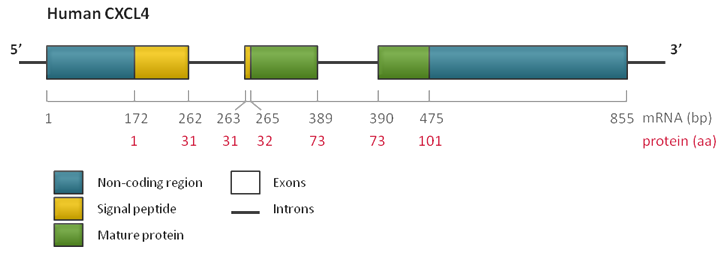
Figure 1. Structure of the human CXCL4 gene. This figure schematically depicts the structure of the human CXCL4 gene as described in the NCBI database (NM_002619). Lines represent the introns, whereas rectangular exons are coloured blue, yellow and green to represent the non-coding domains, the signal peptide and the mature protein, respectively. Grey numbers indicate the basepair numbering in the CXCL4 mRNA. Red numbers apply to the amino acids encoded.
Description
The CXCL4 mRNA is encoded by three exons as depicted in figure 1. Alternative splicing of the gene has not been reported.
Transcription
The CXCL4 mRNA is predominantly present in platelets, but has also been detected in monocytes, T cells, T cell clones, human aortic smooth muscle cells, the colorectal adenocarcinoma cell line HCT-8.
Pseudogene
None.
Proteins
Note
CXCL4 precursor: 101 amino acids (aa), 10844.9 Da; CXCL4 mature: 70 aa, 7765.2 Da; Alternatively spliced signal peptide CXCL4: 74 aa, 8141.5 Da.
Several NH2-terminally truncated forms.
Several NH2-terminally truncated forms.
Description
CXCL4 is a member of the CXC chemokine family of chemoattractant cytokines. CXCL4 is a non-ELR CXC chemokine, meaning that it lacks the sequence glutamic acid-leucine-arginine just in front of the two NH2-terminally located conserved cysteine residues.
Expression
CXCL4 is stored in secretory granules and released in response to protein kinase C activation. For example, in platelets the CXCL4 protein is stored in the alpha-granules and released upon activation by e.g. thrombin as a homotetramer bound to chrondroitin-4-sulphate on a carrier protein. Therefore, CXCL4 is present at high concentrations in thrombi and concentrations in serum reach levels of 10 µg/ml. CXCL4 protein has also been detected in mast cells by immunohistochemistry, and is released by monocytes (100 ng/ml), activated T cells, cultured microglia (1 ng/ml) and the colorectal adenocarcinoma cell line HCT-8 (0.5 ng/ml). Finally, prostate cancer cell lines DU-145 and PC-3 were shown to express CXCL4.
Localisation
Secreted or stored in intracellular granules.
Function
The first extracellular molecules binding CXCL4 were identified to be chrondroitin-sulphate-containing proteoglycans (Figure 2). These GAG mediate the effects of CXCL4 on monocytes and neutrophils and pass intracellular signals to tyrosine kinases of the Src family, members of the MAP kinase family and monomeric GTPases. CXCL4 also has high affinity for heparin and heparan sulphate. Through its ability to bind and neutralize heparin, CXCL4 influences blood coagulation. More so, the interaction of CXCL4 with heparan sulphate proteoglycans on endothelial cells is responsible for the rapid clearance of CXCL4 from the circulation and prevents degradation of the chemokine.
Besides binding to GAG, CXCL4 has also been described to bind several growth factors, such as VEGF and FGF-2, and other chemokines, including CCL2/MCP-1 and possibly CXCL12/SDF-1 (Carlson et al., 2012). This heteromultimerisation, sequestering angiogenic proteins, explains at least in part the anti-angiogenic effect of CXCL4. Heteromer formation of CXCL4 with CCL5/RANTES also affects monocyte recruitment (Koenen et al., 2009), and possibly atherogenesis.
Although proteoglycans are mostly considered to be "co- receptors", the high affinity of CXCL4 for GAG was for a long time thought to mediate most, if not all, of its biological functions since no GPCR for CXCL4 was identified. However, Lasagni et al. identified a splice variant of CXCR3, which was named CXCR3B, as a functional GPCR for CXCL4. Currently, CXCL4 is known to activate both CXCR3A and CXCR3B (Figure 2). In general, proliferative and positive migratory effects are supposed to be mediated by CXCR3A, whereas inhibition of chemotaxis, anti-proliferative and apoptotic effects are postulated to be provoked via CXCR3B.
Besides binding to GAG, CXCL4 has also been described to bind several growth factors, such as VEGF and FGF-2, and other chemokines, including CCL2/MCP-1 and possibly CXCL12/SDF-1 (Carlson et al., 2012). This heteromultimerisation, sequestering angiogenic proteins, explains at least in part the anti-angiogenic effect of CXCL4. Heteromer formation of CXCL4 with CCL5/RANTES also affects monocyte recruitment (Koenen et al., 2009), and possibly atherogenesis.
Although proteoglycans are mostly considered to be "co- receptors", the high affinity of CXCL4 for GAG was for a long time thought to mediate most, if not all, of its biological functions since no GPCR for CXCL4 was identified. However, Lasagni et al. identified a splice variant of CXCR3, which was named CXCR3B, as a functional GPCR for CXCL4. Currently, CXCL4 is known to activate both CXCR3A and CXCR3B (Figure 2). In general, proliferative and positive migratory effects are supposed to be mediated by CXCR3A, whereas inhibition of chemotaxis, anti-proliferative and apoptotic effects are postulated to be provoked via CXCR3B.
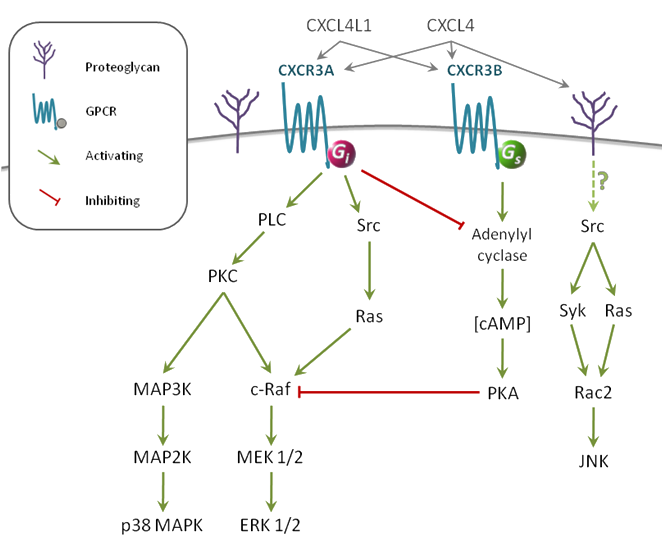
Figure 2. Signaling pathways activated by CXCL4. A complex signaling network lies at the basis of the functional diversity of CXCL4. This network integrates several cascades initiated by different cellular receptors, including the G-protein-coupled receptors (GPCR) CXCR3A (Gi) and CXCR3B (Gs). CXCL4 also displays an exceptional high affinity for the glycosaminoglycans chains on membrane-embedded proteoglycans, hypothesized to initiate signaling cascades of their own (Kasper and Petersen, 2011). The schematic network depicted here represents a selection of prominent CXCL4-activated pathways and provides insight into the complexity of CXCL4 signaling, yet does not provide an exhaustive list of all signaling molecules implicated. Target cells for CXCL4 include leukocytes (neutrophils, monocytes, activated T cells, dendritic cells, NK cells and mast cells), endothelial cells, airway epithelial cells, hepatic stellate cells, mesangial cells and vascular pericytes.
Homology
CXCL4 is most closely related to its variant CXCL4L1, a non-allelic variant found only in primates. In men, mature proteins only differ in 3 amino acids.
Mutations
Note
CXCL4 appears to behave as a tumor suppressor gene. In multiple myeloma, CXCL4 is frequently silenced as a consequence of promoter hypermethylation (Cheng et al., 2007). Furthermore, a subclass of acute lymphoblastic leukemia patients exhibits a common translocation with a breakpoint distal to the CXCL4 gene (Arthur et al., 1982; Griffin et al., 1987).
Implicated in
Entity name
Leukemia and myeloma
Prognosis
Serum proteome profiling revealed decreased serum levels of CXCL4 as a biomarker for advanced myelodysplastic syndrome (MDS), often progressing to acute myeloid leukemia (AML) (Aivado et al., 2007). Other studies have corroborated involvement of CXCL4 over the course of MDS and AML and have recognized the chemokine as a prognostic, therapy-associated marker indicative of response to therapy, blood count recovery and eventual clinical outcome (Bai et al., 2013; Chen et al., 2010; Kim et al., 2008).
Oncogenesis
Evidence in acute lymphoblastic leukemia (ALL), showing a common translocation amongst a subclass of patients, with a breakpoint in 4q21 which was later shown to be distal to the CXCL4 gene, suggested the involvement of CXCL4 in ALL tumorigenesis (Arthur et al., 1982; Griffin et al., 1987). More recently, decreased serum levels of CXCL4 have also been suggested to serve as a marker for pediatric ALL (Shi et al., 2009). In multiple myeloma CXCL4 was effectively identified as a tumor suppressor gene, frequently silenced as a consequence of promoter hypermethylation (Cheng et al., 2007).
Entity name
Disease
The platelet-associated CXCL4 expression was found to be elevated shortly after implantation of human osteosarcoma in mice (Cervi et al., 2008). It has been proposed as a biomarker of early tumor growth. Alternatively, another recent study described plasma levels of CXCL4 to be elevated in pediatric osteosarcoma patients (Li et al., 2011).
Prognosis
Not only were plasma levels of CXCL4 in pediatric osteosarcoma patients shown to be significantly higher than those in controls, survival analysis further revealed that higher circulating levels of CXCL4 were associated with a poorer outcome (Li et al., 2011). CXCL4 may prove to be a promising prognostic factor in osteosarcoma patients in the future.
Entity name
Liposarcoma
Disease
The platelet-associated CXCL4 expression, unlike its soluble plasma counterpart, was found to be elevated shortly after implantation of human liposarcoma in mice (Cervi et al., 2008). It has been proposed as a biomarker of early tumor growth.
Entity name
Mammary adenocarcinoma
Disease
The platelet-associated CXCL4 expression, unlike its soluble plasma counterpart, was found to be elevated shortly after implantation of human mammary adenocarcinoma in mice (Cervi et al., 2008). It has been proposed as a biomarker of early tumor growth.
Entity name
Pancreatic adenocarcinoma
Prognosis
Discovery of a cancer-associated reduction of CXCL4 serum concentrations lead to the identification of CXCL4 as a discriminating marker in pancreatic cancer (Fiedler et al., 2009). Potential of CXCL4 as a diagnostic marker was shortly after confirmed (Poruk et al., 2010). Moreover, serum CXCL4 was also identified as a strong independent predictor of survival in this study, where decreased survival is associated with elevated CXCL4 levels. Finally, as a prognostic marker, CXCL4 may prove to be valuable in identifying patients at risk of complications and thus may benefit from prophylactic antithrombotic therapy (Poruk et al., 2010).
Entity name
Colorectal cancer
Disease
Platelet content of CXCL4 in 35 patients with colon cancer was shown to be significantly increased when compared to 84 age-matched healthy controls (Peterson et al., 2012). Though not thought to be clinically relevant, a change in CXCL4 platelet levels was identified as a predictor of colorectal carcinoma which could potentially enable early diagnosis of disease.
Entity name
Prostate cancer
Prognosis
Recent in vitro research has evidenced that particular prostate tumor cells, namely DU-145 and PC-3 cells, exhibit a shift in CXCR3 splice variant presentation (Wu et al., 2012). In combination with the reported elevated tumor CXCL4 expression in vitro, these data suggest CXCL4 might promote in vitro migration and invasiveness of prostate cancer cells marked by a change in their CXCR3 expression pattern. However, CXCL4 levels have been described previously to be significantly decreased in the sera of all metastatic prostate carcinoma patients compared to healthy individuals, as well as compared to localized prostate carcinoma patients (Lam et al., 2005).
Entity name
Endometriosis-associated ovarian cancer (EAOC)
Oncogenesis
Both clear cell and endometrioid types of ovarian cancers occasionally develop on the bases of endometriosis. These endometriosis-associated ovarian cancers (EAOC) are characterized by infiltration of CXCL4-depleted tumor-associated macrophages, whereas in contrast, in pre-existing endometriosis CXCL4 is strongly expressed by CD68+ infiltrating macrophages (Furuya et al., 2012). Macrophage CXCL4 expression is thus associated with EAOC disease state and pre-malignant lesions.
Entity name
Metastatic carcinoma
Disease
Analysis of platelet content in a heterogeneous group of patients with newly diagnosed metastatic disease (including colorectal cancer, renal cell cancer, malignant fibrous histiocytoma, leiomyosarcoma and peripheral neuroectodermal cancer) a significant reduction in CXCL4 platelet concentrations was observed (Wiesner et al., 2010). Simultaneously, however, CXCL4 was upregulated in cancer patient plasma.
Entity name
Chemotherapy-induced thrombocytopenia (CIT)
Prognosis
CXCL4 may be a useful biomarker predicting the risk of thrombocytopenia developing with chemotherapy (CIT) (Lambert et al., 2012). Patients with low steady-state platelet CXCL4 levels would better tolerate chemotherapy, whereas high concentrations may be an indication for CIT and predict the need for a platelet transfusion.
Entity name
Hepatitis and liver fibrosis
Disease
CXCL4 expression is enhanced in the liver of patients with advanced hepatitis C virus-induced fibrosis or nonalcoholic steatohepatitis and Cxcl4 knock-out mice had significantly reduced histological and biochemical liver damage in an in vivo model for fibrotic liver disease (Zaldivar et al., 2010). In vitro, recombinant mouse CXCL4 stimulated proliferation and chemotaxis of hepatic stellate cells.
Entity name
Malaria
Disease
Acute Plasmodium falciparum infection, causing malaria characterized by especially high morbidity and mortality, leads to elevated plasma levels of platelet-specific proteins, including CXCL4 (Essien and Ebhota, 1983). On the one hand CXCL4 exerts a protective, antimalarial effect. Upon binding of platelets to infected red blood cells, locally released CXCL4 in particular instigates killing of intraerythrocytic P. falciparum parasites (Love et al., 2012; McMorran et al., 2013). The protective function of blood platelets and CXCL4 is dependent on the Duffy-antigen receptor (Fy/DARC) on the erythrocytes. On the other hand, CXCL4 mediates the pathogenesis of cerebral malaria (CM), a serious complication of P. falciparum infection (Wilson et al., 2011). CXCL4 is believed to promote a pro-inflammatory environment and to contribute to disruption of the blood-brain barrier.
Prognosis
Wilson et al. have suggested a prominent role for CXCL4 in the pathogenesis of fatal CM and identified this chemokine as a potential prognostic biomarker for CM mortality (Wilson et al., 2011).
Entity name
Acquired immunodeficiency syndrome (AIDS)
Disease
Auerback et al. have identified CXCL4 as a unique broad-spectrum inhibitor of HIV-1 (Auerbach et al., 2012). Through binding of the external viral envelope glycoprotein, gp120, CXCL4 interferes with the earliest events in the viral infectious cycle, namely attachment and entry, and consequently reduces replication of different phenotypic variants of HIV-1 in CD4+ T cells and macrophages. In parallel, another study found activated platelets to release antiviral factors which suppress HIV-1 infection of T cells and confirmed CXCL4 to be a key player in this first line of defense against HIV-1 (Tsegaye et al., 2013).
Prognosis
Preliminary results reported by Auerback and colleagues suggest a correlation between higher serum levels of CXCL4 in HIV-1-infected patients and a less advanced clinical stage (Auerbach et al., 2012).
Entity name
Heparin-induced thrombocytopenia (HIT)
Disease
Heparin is widely used as anti-coagulant during invasive vascular surgery and to treat thrombo-embolic pathology. HIT is a rare (1-5%), paradoxal complication of anticoagulant heparin therapy in which patients having developed antibodies against CXCL4/heparin complexes, are at risk for venous as well as arterial thrombosis, despite low platelet counts (Rauova et al., 2010). Heparin is thought to act as an adjuvant integral to immunogenesis, whereas the HIT antibody recognizes antigenic epitopes within CXCL4 and thus the presence of CXCL4 is essential to the clinical manifestations caused by circulating antibodies (Prechel and Walenga, 2013).
Entity name
Rheumatoid arthritis
Prognosis
Increased levels of CXCL4 have been reported in the synovial fluid of patients with rheumatoid arthritis (Erdem et al., 2007). However, especially elevated plasma levels of CXCL4 in particular subsets of patients may be associated with clinical manifestation of rheumatoid arthritis, such as the occurrence of cutaneous vasculitis, and also correlate to a non-response to anti-TNFα therapy (Trocme et al., 2009; Yamamoto et al., 2002).
Entity name
Proliferative diabetic retinopathy (PDR)
Disease
Early on an association was recognized between diabetes and PDR on the one hand and elevated plasma levels of coagulation factors, such as CXCL4, on the other hand (Ek et al., 1982; Roy et al., 1988). Recent clinical studies have not only confirmed elevated CXCL4 levels in the vitreous fluid of PDR patients but also a correlation between vitreous CXCL4 concentration and PDR clinical disease activity (Nawaz et al., 2013). Vitreous levels of CXCL4 are significantly higher both in PDR with active neovascularisation and in PDR without traction retinal detachment.
Entity name
Inflammatory bowel disease (IBD)
Disease
Already in 1987, plasma CXCL4 concentrations were shown to be increased in patients with IBD disease (Simi et al., 1987). CXCL4 was later on identified as a biomarker for IBD using proteomic serum profiling (Meuwis et al., 2007). Though originally controversial, plasma CXCL4 levels were confirmed to be positively correlated to disease activity in Crohns disease (Vrij et al., 2000).
Prognosis
Similar to their predictive role in rheumatoid arthritis, high CXCL4 plasma levels are indicative of non-responsiveness to anti-TNFα antibody (infliximab) treatment in Crohns disease (Meuwis et al., 2008).
Entity name
Atherosclerosis
Disease
The proatherogenic role of CXCL4 has been established in a variety of mostly preclinical studies (e.g. Sachais et al., 2007). CXCL4, released by activated platelets at injury sites, presumably promotes the progression of atherosclerotic lesions through different mechanisms. These include recruiting and arresting peripheral monocytes at the lesion site and consequently facilitating their differentiation into macrophages and concordant polarization as well as inhibiting degradation of LDL-R while increasing uptake and esterification of ox-LDL in macrophages (Aidoudi and Bikfalvi, 2010; Gleissner, 2012). The histological distribution of CXCL4 was also shown to be associated with the location and grade of vascular lesions (Pitsilos et al., 2003). Staining of macrophages for CXCL4 correlated with symptomatic atherosclerotic disease. Moreover, proinflammatory heteromer formation of CXCL4 with another platelet chemokine CCL5/RANTES has emerged as an additional regulatory mechanism, enhancing monocyte recruitment and thereby contributing to the disease progression (Koenen et al., 2009). Recently, a linkage study described an association between CXCL4 and platelet activation in human patients, thus linking this chemokine to the clinical manifestation of atherosclerosis (Bhatnagar et al., 2012).
Article Bibliography
| Pubmed ID | Last Year | Title | Authors |
|---|---|---|---|
| 20806113 | 2010 | Interaction of PF4 (CXCL4) with the vasculature: a role in atherosclerosis and angiogenesis. | Aidoudi S et al |
| 17220270 | 2007 | Serum proteome profiling detects myelodysplastic syndromes and identifies CXC chemokine ligands 4 and 7 as markers for advanced disease. | Aivado M et al |
| 6947832 | 1982 | Translocation 4; 11 in acute lymphoblastic leukemia: clinical characteristics and prognostic significance. | Arthur DC et al |
| 22645343 | 2012 | Identification of the platelet-derived chemokine CXCL4/PF-4 as a broad-spectrum HIV-1 inhibitor. | Auerbach DJ et al |
| 23915341 | 2013 | Potential biomarkers for adult acute myeloid leukemia minimal residual disease assessment searched by serum peptidome profiling. | Bai J et al |
| 22763266 | 2012 | Genetic variants in platelet factor 4 modulate inflammatory and platelet activation biomarkers. | Bhatnagar P et al |
| 23009808 | 2013 | The heterodimerization of platelet-derived chemokines. | Carlson J et al |
| 17914028 | 2008 | Platelet-associated PF-4 as a biomarker of early tumor growth. | Cervi D et al |
| 20739954 | 2010 | Identification of disease- and therapy-associated proteome changes in the sera of patients with myelodysplastic syndromes and del(5q). | Chen C et al |
| 17077331 | 2007 | 4q loss is potentially an important genetic event in MM tumorigenesis: identification of a tumor suppressor gene regulated by promoter methylation at 4q13.3, platelet factor 4. | Cheng SH et al |
| 6753124 | 1982 | Enhanced in vivo platelet activation in diabetes mellitus. | Ek I et al |
| 17265155 | 2007 | Synovial angiostatic non-ELR CXC chemokines in inflammatory arthritides: does CXCL4 designate chronicity of synovitis? | Erdem H et al |
| 6192658 | 1983 | Platelet secretory activities in acute malaria (Plasmodium falciparum) infection. | Essien EM et al |
| 19470732 | 2009 | Serum peptidome profiling revealed platelet factor 4 as a potential discriminating Peptide associated with pancreatic cancer. | Fiedler GM et al |
| 22555803 | 2012 | Impaired CXCL4 expression in tumor-associated macrophages (TAMs) of ovarian cancers arising in endometriosis. | Furuya M et al |
| 22275902 | 2012 | Macrophage Phenotype Modulation by CXCL4 in Atherosclerosis. | Gleissner CA et al |
| 3622011 | 1987 | Human platelet factor 4 gene is mapped to 4q12----q21. | Griffin CA et al |
| 21295372 | 2011 | Molecular pathways of platelet factor 4/CXCL4 signaling. | Kasper B et al |
| 17998245 | 2008 | Platelet factor-4 is an indicator of blood count recovery in acute myeloid leukemia patients in complete remission. | Kim JY et al |
| 19122657 | 2009 | Disrupting functional interactions between platelet chemokines inhibits atherosclerosis in hyperlipidemic mice. | Koenen RR et al |
| 15952230 | 2005 | Mass profiling-directed isolation and identification of a stage-specific serologic protein biomarker of advanced prostate cancer. | Lam YW et al |
| 22564375 | 2012 | Platelet factor 4 platelet levels are inversely correlated with steady-state platelet counts and with platelet transfusion needs in pediatric leukemia patients. | Lambert MP et al |
| 20806347 | 2011 | Elevated expression of CXC chemokines in pediatric osteosarcoma patients. | Li Y et al |
| 23245326 | 2012 | Platelet factor 4 activity against P. falciparum and its translation to nonpeptidic mimics as antimalarials. | Love MS et al |
| 23710276 | 2013 | New insights into the protective power of platelets in malaria infection. | McMorran BJ et al |
| 18489908 | 2008 | Proteomics for prediction and characterization of response to infliximab in Crohn's disease: a pilot study. | Meuwis MA et al |
| 23352833 | 2013 | Autocrine CCL2, CXCL4, CXCL9 and CXCL10 signal in retinal endothelial cells and are enhanced in diabetic retinopathy. | Nawaz MI et al |
| 22402885 | 2012 | VEGF, PF4 and PDGF are elevated in platelets of colorectal cancer patients. | Peterson JE et al |
| 14652645 | 2003 | Platelet factor 4 localization in carotid atherosclerotic plaques: correlation with clinical parameters. | Pitsilos S et al |
| 20729288 | 2010 | Serum platelet factor 4 is an independent predictor of survival and venous thromboembolism in patients with pancreatic adenocarcinoma. | Poruk KE et al |
| 23561460 | 2013 | Emphasis on the Role of PF4 in the Incidence, Pathophysiology and Treatment of Heparin Induced Thrombocytopenia. | Prechel MM et al |
| 20724543 | 2010 | Monocyte-bound PF4 in the pathogenesis of heparin-induced thrombocytopenia. | Rauova L et al |
| 2967258 | 1988 | Plasma fibrinopeptide A, beta-thromboglobulin, and platelet factor 4 in diabetic retinopathy. | Roy MS et al |
| 18000617 | 2007 | Elimination of platelet factor 4 (PF4) from platelets reduces atherosclerosis in C57Bl/6 and apoE-/- mice. | Sachais BS et al |
| 19291297 | 2009 | Discovery and identification of potential biomarkers of pediatric acute lymphoblastic leukemia. | Shi L et al |
| 3570037 | 1987 | Raised plasma concentrations of platelet factor 4 (PF4) in Crohn's disease. | Simi M et al |
| 23634812 | 2013 | Platelet activation suppresses HIV-1 infection of T cells. | Solomon Tsegaye T et al |
| 18664547 | 2009 | Apolipoprotein A-I and platelet factor 4 are biomarkers for infliximab response in rheumatoid arthritis. | Trocmé C et al |
| 21111666 | 2011 | The role of the CXC chemokines platelet factor-4 (CXCL4/PF-4) and its variant (CXCL4L1/PF-4var) in inflammation, angiogenesis and cancer. | Vandercappellen J et al |
| 10691994 | 2000 | Platelet factor 4 and beta-thromboglobulin in inflammatory bowel disease and giant cell arteritis. | Vrij AA et al |
| 20182908 | 2010 | Differential changes in platelet VEGF, Tsp, CXCL12, and CXCL4 in patients with metastatic cancer. | Wiesner T et al |
| 21508508 | 2011 | CXCL4 and CXCL10 predict risk of fatal cerebral malaria. | Wilson NO et al |
| 22236567 | 2012 | Altered CXCR3 isoform expression regulates prostate cancer cell migration and invasion. | Wu Q et al |
| 12447635 | 2002 | Elevated plasma levels of beta-thromboglobulin and platelet factor 4 in patients with rheumatic disorders and cutaneous vasculitis. | Yamamoto T et al |
| 20162727 | 2010 | CXC chemokine ligand 4 (Cxcl4) is a platelet-derived mediator of experimental liver fibrosis. | Zaldivar MM et al |
Other Information
Locus ID:
NCBI: 5196
MIM: 173460
HGNC: 8861
Ensembl: ENSG00000163737
Variants:
dbSNP: 5196
ClinVar: 5196
TCGA: ENSG00000163737
COSMIC: PF4
RNA/Proteins
| Gene ID | Transcript ID | Uniprot |
|---|---|---|
| ENSG00000163737 | ENST00000296029 | P02776 |
Expression (GTEx)
Pathways
Protein levels (Protein atlas)
References
| Pubmed ID | Year | Title | Citations |
|---|---|---|---|
| 37883794 | 2024 | PF4 activates the c-Mpl-Jak2 pathway in platelets. | 2 |
| 38008700 | 2024 | Platelet factor 4(PF4) and its multiple roles in diseases. | 4 |
| 38307410 | 2024 | Hyperactivation of β-catenin signal in hepatocellular carcinoma recruits myeloid-derived suppressor cells through PF4-CXCR3 axis. | 2 |
| 38540666 | 2024 | The Binding of the SARS-CoV-2 Spike Protein to Platelet Factor 4: A Proposed Mechanism for the Generation of Pathogenic Antibodies. | 0 |
| 38547695 | 2024 | Platelet factor 4 promotes deep venous thrombosis by regulating the formation of neutrophil extracellular traps. | 0 |
| 37883794 | 2024 | PF4 activates the c-Mpl-Jak2 pathway in platelets. | 2 |
| 38008700 | 2024 | Platelet factor 4(PF4) and its multiple roles in diseases. | 4 |
| 38307410 | 2024 | Hyperactivation of β-catenin signal in hepatocellular carcinoma recruits myeloid-derived suppressor cells through PF4-CXCR3 axis. | 2 |
| 38540666 | 2024 | The Binding of the SARS-CoV-2 Spike Protein to Platelet Factor 4: A Proposed Mechanism for the Generation of Pathogenic Antibodies. | 0 |
| 38547695 | 2024 | Platelet factor 4 promotes deep venous thrombosis by regulating the formation of neutrophil extracellular traps. | 0 |
| 36807143 | 2023 | Platelet-instructed SPP1(+) macrophages drive myofibroblast activation in fibrosis in a CXCL4-dependent manner. | 32 |
| 37115730 | 2023 | An Evaluation of Platelet Factor 4, Beta-Thromboglobulin and Mean Platelet Volume in the Assessment of Thrombotic Risks in Subjects with Diabetes Mellitus at Lagos State University Teaching Hospital, Ikeja, Lagos, Nigeria. | 0 |
| 37150909 | 2023 | Platelet factor 4 triggers thrombo-inflammation by bridging innate and adaptive immunity. | 8 |
| 37565509 | 2023 | Platelet factor 4 induces bone loss by inhibiting the integrin α5-FAK-ERK pathway. | 1 |
| 37648114 | 2023 | New insights into the binding of PF4 to long heparin oligosaccharides in ultralarge complexes using mass spectrometry. | 2 |
Citation
Katrien Van Raemdonck ; Paul Proost ; Jo Van Damme ; Sofie Struyf
PF4 (platelet factor 4)
Atlas Genet Cytogenet Oncol Haematol. 2014-01-01
Online version: http://atlasgeneticsoncology.org/gene/41693/pf4-%28platelet-factor-4%29
