CREBBP (CREB binding protein)
2009-03-01 Cristina Gervasini AffiliationDivision of Medical Genetics, San Paolo School of Medicine, University of Milan, 20142 Milan, Italy
Identity
HGNC
LOCATION
16p13.3
IMAGE

LEGEND
A: CBP (16p22) - Courtesy Mariano Rocchi, Resources for Molecular Cytogenetics.
LEGEND
B: Map showing the position of BAC clone RP11-1072J2 (UCSC Genome Browser assembly Mar 2006), centered on CREBBP gene (top) and two images of partial metaphases from normal controls showing, after FISH, CREBBP-specific signals at 16p13.3 (bottom).
LOCUSID
ALIAS
CBP,KAT3A,MKHK1,RSTS,RSTS1
FUSION GENES
DNA/RNA
Description
The gene spans about 155 kb; transcription from centromere to telomere, number of exons: 31.
Transcription
10 kb mRNA, with a 7.3 kb coding sequence, start codon in exon 1, stop codon in exon 31.
Proteins
Description
2442 amino acids; 265351 Da; predict PI=8.83; Known domains are: KIX= CREB binding , Bromo= Bromodomain, Zn=zinc-finger (corresponding to cysteine-histidine rich regions), HAT= acetyl transferasic, Q= poly Glutaminic stretch. From the carboxy to the N-terminus: Q-Zn-HAT-Zn-Bromo-KIX-Zn. Reported isoform b (2402 aa) lacking aa406-444 (exon 5). Methylation of the KIX domain by CARM1 blocks association with CREB. Phosphorylated upon DNA damage, probably by ATM or ATR.
Expression
Wide expression; expression in the whole embryo as well brain; cDNA sources: mammary gland; lung; placenta; testis; lymph node; thymus; mouth; ear; kidney; embryonic tissue; larynx; pancreas; intestine; blood; heart; amniotic fluid; trachea; liver; thyroid; skin; connective tissue; uterus; eye; prostate; stomach; ovary; salivary gland; muscle; adrenal gland; bone marrow; adipose tissue; spleen; nerve; bone; bladder.
Localisation
Nucleus.
Function
Binds specifically to phosphorylated CREB and enhances its transcriptional activity toward cAMP-responsive genes;
Acts as transcription co-activator by: i) enabling the interaction between different TF and RNAPolII complexes, ii) serving as molecular scaffold that brings enzymes to the promoter, iii) remodelling the chromatin favouring the open status, by histone and non-histone proteins acetylation.
Essential role in embryogenesis, cell differentiation, apoptosis, and proliferation;
Involved in the regulation of cell cycle during G1/S transition.
Acts as transcription co-activator by: i) enabling the interaction between different TF and RNAPolII complexes, ii) serving as molecular scaffold that brings enzymes to the promoter, iii) remodelling the chromatin favouring the open status, by histone and non-histone proteins acetylation.
Essential role in embryogenesis, cell differentiation, apoptosis, and proliferation;
Involved in the regulation of cell cycle during G1/S transition.
Homology
Implicated in
Entity name
Disease
Acute non lymphocytic leukemia (AML) and treatment related AML (t-AML).
Prognosis
Poor: remission is obtained in half cases; survival is often less than 1yr.
Cytogenetics
+8 as an additional anomalies in half cases.
Hybrid gene
5 MOZ - 3 CBP.
Fusion protein
N-term finger motifs and acetyl transferase from MOZ fused to most of CBP, with a breakpoint in 5 of the CREB binding domain of CBP.
Entity name
Disease
Acute myeloid leukaemia (AML) M4/M5a and therapy-related myelodysplastic syndromes (MDS). Only 4 cases described.
Prognosis
Poor, bad response to chemotherapy.
Hybrid gene
5 MYST4 - 3 CBP.
Fusion protein
In-frame fusion between MYST4 exon 17 and CREBBP exon 3. Variants fusing MYST4 exon 16 and CREBBP exon 5; MYST4 exon 17 and CREBBP exon 7 have been also described. CREBBP-MYST4 transcripts have been detected.
Entity name
Disease
Therapy related AML (t-AML); should be very close to the t(11;22)(q23;q13).
Prognosis
Likely to be poor.
Hybrid gene
5 MLL - 3CBP.
Fusion protein
N-term AT hook and DNA methyltransferase from MLL fused to most of CBP; variable brakpoint in CBP: either 5 to the CREB binding domain (like in the t(8;16)), or just upstream the bromodomain.
Entity name
Note
Due to CBP haploinsufficiency.
Disease
Rare autosomal dominant congenital disorder characterized by postnatal growth retardation and psychomotor developmental delay, skeletal anomalies (broad and duplicated distal phalanges of thumbs and halluces are a landmark sign) and specific facial dysmorphisms. The latter include down-slanted palpebral fissures, broad nasal bridge, beaked nose and micrognathia. In addition, patients with RSTS have an increased, although not well documented, risk of tumor formation.
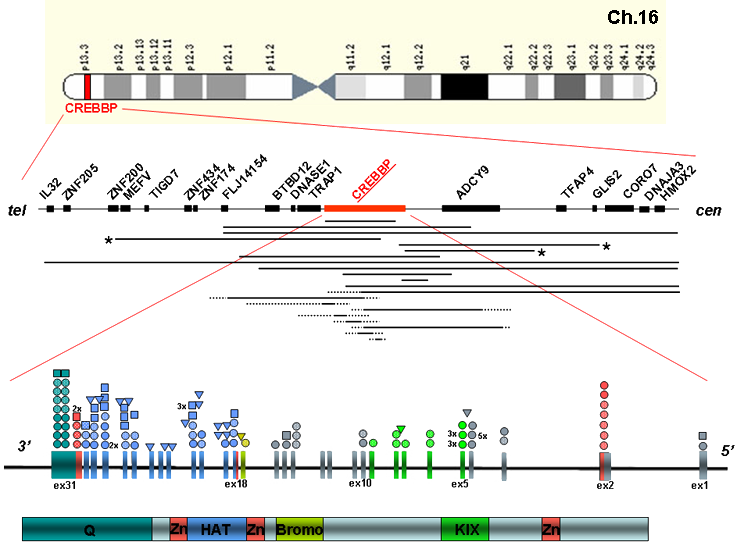
Top: Ideogram of chromosome 16 and chromosomal localisation of the CREBBP gene. Middle: the genomic region including CREBBP (red) and flanking genes is zoomed. Deletions spanning CREBBP and adjacent sequences (accounting for about 10% of CREBBP mutations) are indicated by black lines. Mosaic deletions (only 3 so far detected) are asterisked; dotted lines target low-resolution mapped breakpoints. So far 22 deletions have been reported and the differently sized ones (21) are here diagrammed.
Bottom: structure of CREBBP gene and protein. Different colours are used to link gene exons (pictured by rectangles) and corresponding protein domains. Different reported point mutations (n.108 in Leiden Open Variation Database) are shown: filled circles (nonsense) and dotted circles (frameshift), squares (missense) and triangles (splicing). Most mutations cluster to exons encoding the HAT domain.
Known domains from the carbossi-terminal are: Q= poly Glutaminic stretch, Zn=zinc-finger, HAT= acetyl transferasic, Bromo= Bromodomain, KIX= CREB binding).
Breakpoints
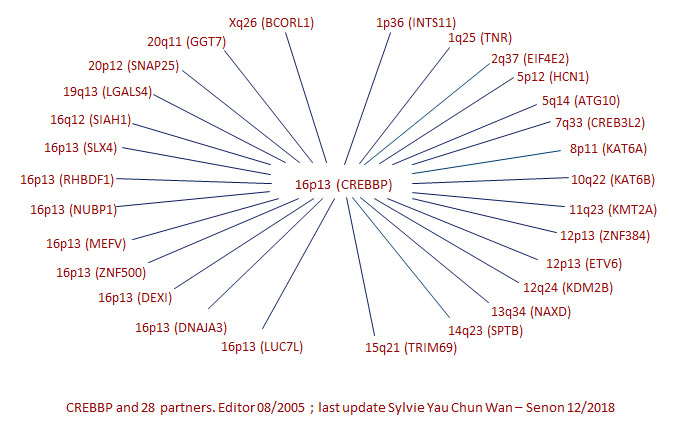
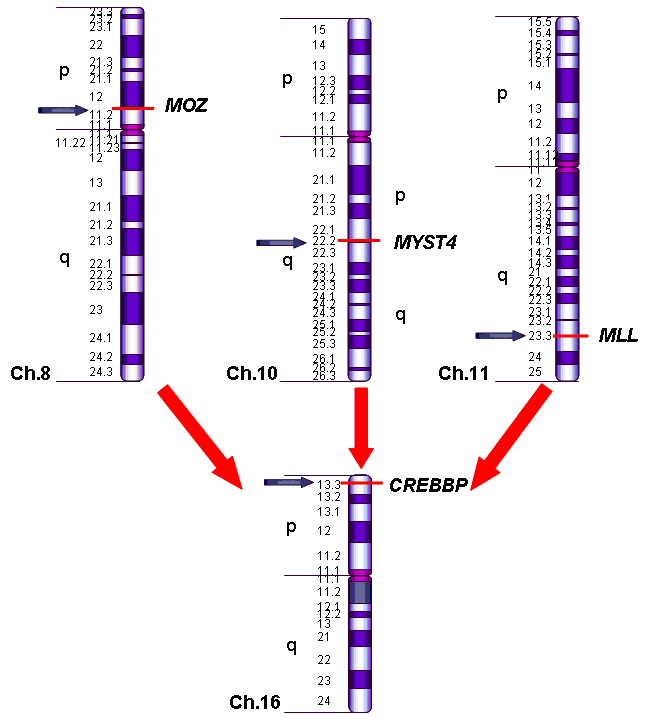
Localization of breakpoints affecting CREBBP and partner genes in leukaemia-associated balanced translocations.
Article Bibliography
| Pubmed ID | Last Year | Title | Authors |
|---|---|---|---|
| 10828885 | 2000 | CBP/p300 histone acetyl-transferase activity is important for the G1/S transition. | Ait-Si-Ali S et al |
| 15207239 | 2004 | Chromatin acetylation, memory, and LTP are impaired in CBP+/- mice: a model for the cognitive deficit in Rubinstein-Taybi syndrome and its amelioration. | Alarcón JM et al |
| 12909086 | 2003 | Ca(2+)/CREB/CBP-dependent gene regulation: a shared mechanism critical in long-term synaptic plasticity and neuronal survival. | Bito H et al |
| 11927640 | 2002 | CBP and p300: versatile coregulators with important roles in hematopoietic gene expression. | Blobel GA et al |
| 8782817 | 1996 | The translocation t(8;16)(p11;p13) of acute myeloid leukaemia fuses a putative acetyltransferase to the CREB-binding protein. | Borrow J et al |
| 12747548 | 2003 | The multifunctional role of E1A in the transcriptional regulation of CREB/CBP-dependent target genes. | Brockmann D et al |
| 8960368 | 1996 | p300 and CBP as transcriptional regulators and targets of oncogenic events. | Eckner R et al |
| 17855048 | 2007 | High frequency of mosaic CREBBP deletions in Rubinstein-Taybi syndrome patients and mapping of somatic and germ-line breakpoints. | Gervasini C et al |
| 9177780 | 1997 | Construction of a 1.2-Mb contig surrounding, and molecular analysis of, the human CREB-binding protein (CBP/CREBBP) gene on chromosome 16p13.3. | Giles RH et al |
| 10497301 | 1999 | p300 and CBP: partners for life and death. | Giordano A et al |
| 9238849 | 1997 | The multifunctional role of the co-activator CBP in transcriptional regulation. | Goldman PS et al |
| 11358491 | 2001 | p300/CBP/p53 interaction and regulation of the p53 response. | Grossman SR et al |
| 16868563 | 2006 | Rubinstein-Taybi syndrome. | Hennekam RC et al |
| 11962765 | 2002 | The versatile functions of the transcriptional coactivators p300 and CBP and their roles in disease. | Janknecht R et al |
| 15313412 | 2004 | CBP and p300: HATs for different occasions. | Kalkhoven E et al |
| 17410209 | 2007 | CBP/p300 are bimodal regulators of Wnt signaling. | Li J et al |
| 18273021 | 2008 | The structural basis of protein acetylation by the p300/CBP transcriptional coactivator. | Liu X et al |
| 12168567 | 2002 | Transcriptional control of the inflammatory response: a role for the CREB-binding protein (CBP). | Matt T et al |
| 11467739 | 2001 | CBP, a transcriptional coactivator and acetyltransferase. | McManus KJ et al |
| 10610021 | 1999 | Developmentally regulated expression of the transcriptional cofactors/histone acetyltransferases CBP and p300 during mouse embryogenesis. | Partanen A et al |
| 15313413 | 2004 | Targeting CREB-binding protein (CBP) loss of function as a therapeutic strategy in neurological disorders. | Rouaux C et al |
| 9238046 | 1997 | MLL is fused to CBP, a histone acetyltransferase, in therapy-related acute myeloid leukemia with a t(11;16)(q23;p13.3). | Sobulo OM et al |
| 9166831 | 1997 | The t(11;16)(q23;p13) translocation in myelodysplastic syndrome fuses the MLL gene to the CBP gene. | Taki T et al |
| 17484131 | 2007 | Aberrant forms of histone acetyltransferases in human disease. | Van Beekum O et al |
| 11279224 | 2001 | CREB-binding protein and p300 in transcriptional regulation. | Vo N et al |
| 18657848 | 2008 | t(8;16)(p11;p13) predisposes to a transient but potentially recurring neonatal leukemia. | Wong KF et al |
| 10523850 | 1999 | Function for p300 and not CBP in the apoptotic response to DNA damage. | Yuan ZM et al |
Other Information
Locus ID:
NCBI: 1387
MIM: 600140
HGNC: 2348
Ensembl: ENSG00000005339
Variants:
dbSNP: 1387
ClinVar: 1387
TCGA: ENSG00000005339
COSMIC: CREBBP
RNA/Proteins
Expression (GTEx)
Pathways
Protein levels (Protein atlas)
References
| Pubmed ID | Year | Title | Citations |
|---|---|---|---|
| 37721116 | 2024 | Molecular insight into CREBBP and TANGO2 variants causing intellectual disability. | 1 |
| 37864465 | 2024 | NOTCH1 and CREBBP co-mutations negatively affect the benefit of adjuvant therapy in completely resected EGFR-mutated NSCLC: translational research of phase III IMPACT study. | 2 |
| 38037460 | 2024 | CBP-mediated FOXO4 acetylation facilitates postmenopausal osteoporosis (PMO) progression through the inhibition of the Wnt/β-catenin signaling pathway. | 0 |
| 38637838 | 2024 | BCOR::CREBBP fusion in malignant neuroepithelial tumor of CNS expands the spectrum of methylation class CNS tumor with BCOR/BCOR(L1)-fusion. | 0 |
| 37721116 | 2024 | Molecular insight into CREBBP and TANGO2 variants causing intellectual disability. | 1 |
| 37864465 | 2024 | NOTCH1 and CREBBP co-mutations negatively affect the benefit of adjuvant therapy in completely resected EGFR-mutated NSCLC: translational research of phase III IMPACT study. | 2 |
| 38037460 | 2024 | CBP-mediated FOXO4 acetylation facilitates postmenopausal osteoporosis (PMO) progression through the inhibition of the Wnt/β-catenin signaling pathway. | 0 |
| 38637838 | 2024 | BCOR::CREBBP fusion in malignant neuroepithelial tumor of CNS expands the spectrum of methylation class CNS tumor with BCOR/BCOR(L1)-fusion. | 0 |
| 36477795 | 2023 | SARS-CoV-2 infection activates CREB/CBP in cellular cyclic AMP-dependent pathways. | 4 |
| 36872777 | 2023 | Hypermethylation at CREBBP Is Associated with Cognitive Impairment in a Mexican American Cohort. | 1 |
| 36893259 | 2023 | KMT2D acetylation by CREBBP reveals a cooperative functional interaction at enhancers in normal and malignant germinal center B cells. | 4 |
| 37161136 | 2023 | Identification and verification of FN1, P4HA1 and CREBBP as potential biomarkers in human atrial fibrillation. | 0 |
| 37314181 | 2023 | Emerging roles of p300/CBP in autophagy and autophagy-related human disorders. | 2 |
| 37353110 | 2023 | β-catenin/CBP activation of mTORC1 signaling promotes partial epithelial-mesenchymal states in head and neck cancer. | 2 |
| 37816914 | 2023 | The histone acetyl transferases CBP and p300 regulate stress response pathways in synovial fibroblasts at transcriptional and functional levels. | 1 |
Citation
Cristina Gervasini
CREBBP (CREB binding protein)
Atlas Genet Cytogenet Oncol Haematol. 2009-03-01
Online version: http://atlasgeneticsoncology.org/gene/42
Historical Card
2000-07-01 CREBBP (CREB binding protein) by Jean-Loup Huret Affiliation
Genetics, Dept Medical Information, University of Poitiers, CHU Poitiers Hospital, F-86021 Poitiers, France
